

Earnings Analysis: JVCKENWOOD Q1 FY2027 Results – Decoding the Revenue Growth vs. Profit Decline, Segment Performance, and Growth Strategy

Sentiment Analysis

Earnings Analysis: JVCKENWOOD Q1 FY2027 Results – Decoding the Revenue Growth vs. Profit Decline, Segment Performance, and Growth Strategy
JVCKENWOOD Corporation (TSE: 6632) announced its financial results for the first quarter of the fiscal year ending March 31, 2027 (April 1, 2026 – June 30, 2026) . The company reported "revenue growth with profit decline," as top-line revenue exceeded the same period last year, while operating and business profits fell due to surging material costs and temporary market headwinds. This report provides a comprehensive analysis of the overall performance, the specific factors behind the profit decline, segment-by-segment performance, and the company's recovery and shareholder return strategies based on the released financial materials.
1. Overview of Q1 FY2027 Financial Results (Consolidated Summary)
The company's consolidated performance for the first quarter is as follows:
- Revenue : 88.8 billion yen (up 10.7% / +8.6 billion yen YoY)
- Business Profit : 2.0 billion yen (down 34.2% / -1.0 billion yen YoY)
- Operating Profit : 1.5 billion yen (down 65.0% / -2.8 billion yen YoY)
- Profit Before Income Taxes : 1.8 billion yen (down 62.7% / -3.1 billion yen YoY)
- Quarterly Profit Attributable to Owners of the Parent : 1.0 billion yen (down 71.3% / -2.5 billion yen YoY)
Revenue growth of 10.7% was driven by increased sales of domestic OEM products in the M&T (Mobility & Telematics Services) segment , strong performance in entertainment content within the ES (Entertainment Solutions) segment , and the favorable impact of the yen's depreciation . Conversely, profitability was significantly pressured by surging prices for key components such as memory , the lingering impact of the U.S. government shutdown on the S&S (Safety & Security) segment , and an increase in fixed costs, including personnel expenses.
2. Deep Dive Analysis: Factors Affecting Business Profit
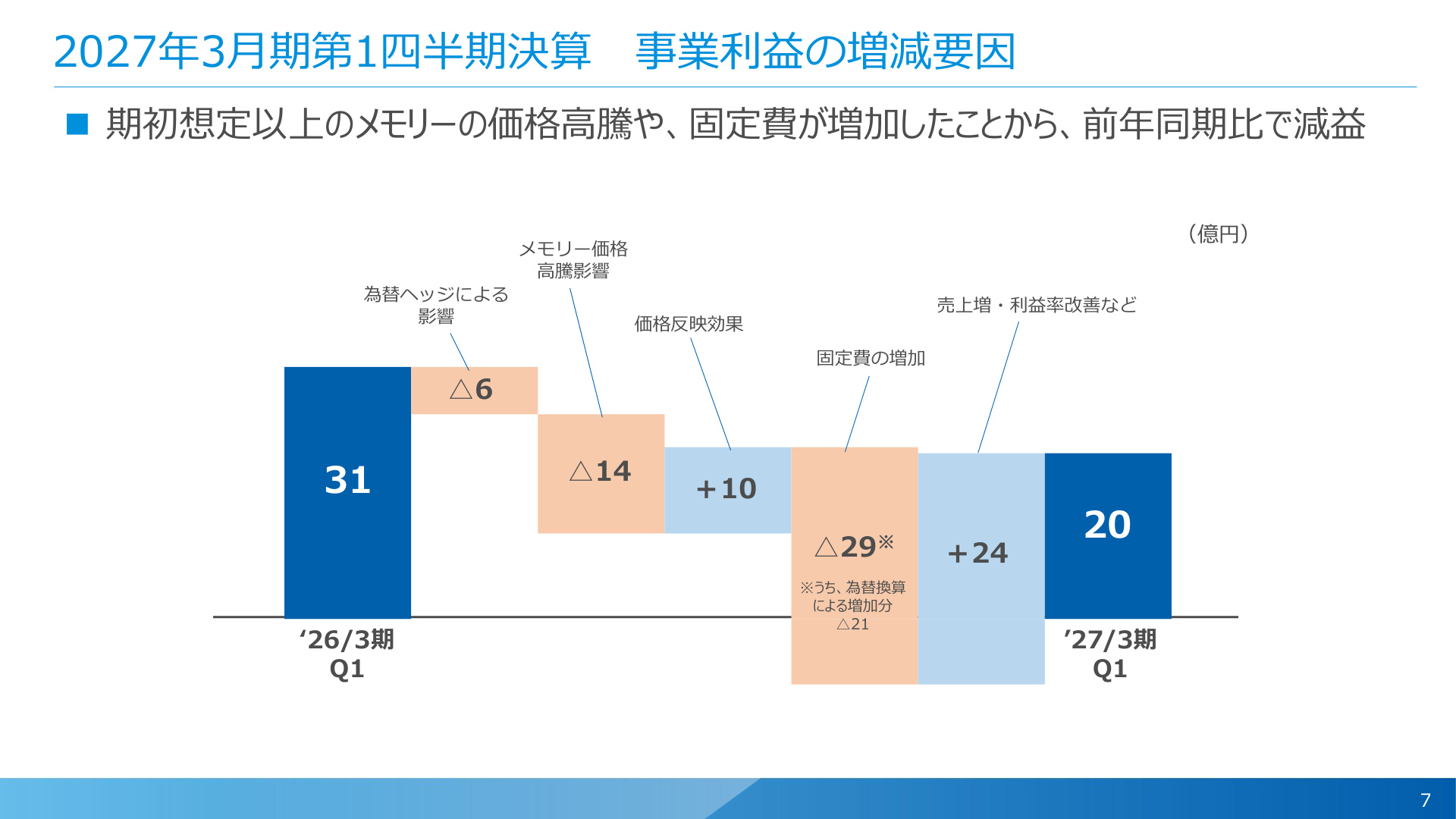
The transition from a business profit of 3.1 billion yen in the same period last year to 2.0 billion yen this quarter involved a complex interplay of positive and negative factors. The following waterfall chart visualizes this structure:
[Significance of Slide 6 and Data Context]
This slide is the most critical data for structurally and quantitatively explaining the reasons for the Q1 business profit decline . It highlights that the 1.0 billion yen year-on-year decline was caused by a combination of external cost pressures and strategic investments.
Specifically, it consists of the following elements:
- Impact of Currency Hedging : -0.6 billion yen
- Impact of Surging Memory Prices : -1.4 billion yen (semiconductor and memory prices rose faster than initially projected)
- Price Pass-through Effect : +1.0 billion yen (while price adjustments were implemented, they did not fully absorb the cost increases in Q1)
- Increase in Fixed Costs : -2.9 billion yen (including -2.1 billion yen from currency translation effects, with the remainder allocated to personnel expansion for future growth)
- Sales Growth & Profit Margin Improvement : +2.4 billion yen (driven by increased core business sales and improved product mix)
As this analysis shows, despite revenue growth and pricing efforts (totaling +3.4 billion yen), the "higher-than-expected surge in memory prices (-1.4 billion yen)" and "increased fixed costs including currency effects (-2.9 billion yen)" outweighed these gains, resulting in the Q1 profit decline.
3. Segment Performance and Regional Trends
Performance trends varied significantly across business segments.
(1) S&S (Safety & Security) Segment
- Revenue : 18.5 billion yen (up 1.1% YoY)
- Business Profit : 0.1 billion yen (down 92.3% YoY)
Revenue increased due to the normalization of component supplies, which boosted recovery in the private (commercial/industrial) market , and the weak yen. However, profit fell sharply due to delays in budget execution caused by the U.S. government shutdown in the North American public safety market, which reduced sales of high-margin radio terminals, combined with increased fixed costs for growth initiatives.
(2) M&T (Mobility & Telematics Services) Segment
- Revenue : 53.5 billion yen (up 14.8% YoY)
- Business Profit : 0.6 billion yen (down 62.3% YoY)
Strong sales of new products launched at the end of the previous fiscal year for domestic OEM applications drove significant revenue growth. However, as this segment accounts for approximately 90% of the company's total memory procurement, it was hit hardest by surging memory prices. Additionally, the sluggish Chinese market for the subsidiary ASK further impacted profitability, leading to a significant decline in business profit despite higher revenue.
(3) ES (Entertainment Solutions) Segment
- Revenue : 14.4 billion yen (up 9.2% YoY)
- Business Profit : 1.3 billion yen (up 208.5% YoY)
In the media business, headphones and earphones recovered following adjustments to tariff measures, though projector sales declined. Conversely, entertainment (music/video content) performed exceptionally well , achieving a dramatic threefold increase in business profit (+0.9 billion yen) compared to the previous year, providing a strong pillar for company-wide profitability.
(4) Regional Revenue Trends
By region, the Japanese market (32.2 billion yen, +6.4 billion yen YoY) , supported by strong domestic OEM sales, and the Americas market (22.9 billion yen, +2.2 billion yen YoY) , driven by the recovery in private radio systems, led the overall performance. The regional revenue mix is 36% Japan, 26% Americas, 21% Europe, and 14% Asia/China.
4. Key Topics: Strategic M&A and Strengthening Business Foundations
Despite short-term profit headwinds, structural measures for medium-to-long-term growth are progressing steadily.
[Significance of Slide 20 and Data Context]
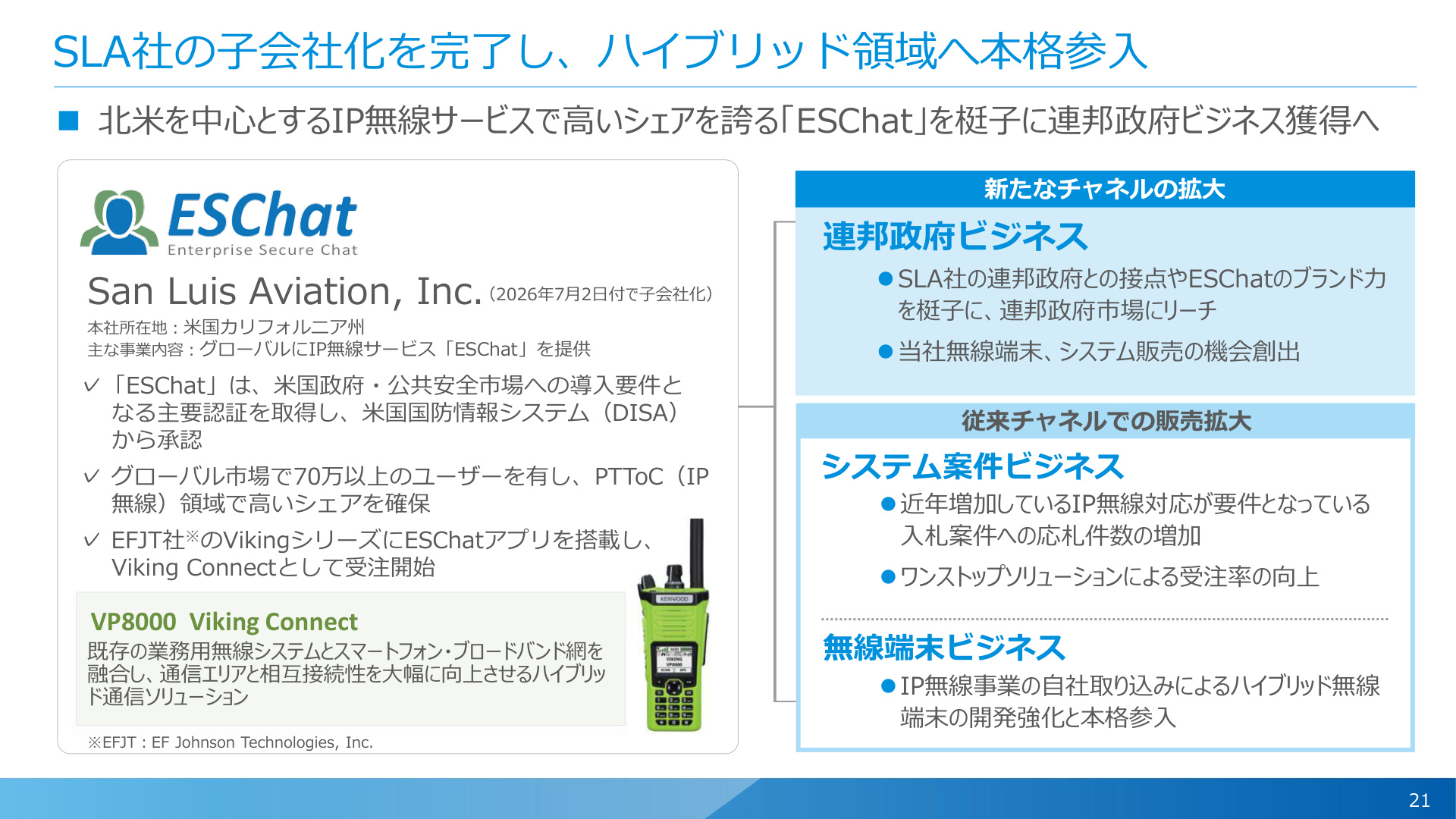
This slide outlines the M&A strategy that serves as the core of the medium-to-long-term growth story in the S&S segment . The acquisition of the U.S.-based San Luis Aviation, Inc. (SLA) , completed on July 2, 2026, marks a full-scale entry into the IP radio and hybrid domain (Push-to-Talk over Cellular: PTToc) , moving beyond traditional LMR (Land Mobile Radio).
SLA's "ESChat" platform has over 700,000 users globally and is approved by the U.S. Defense Information Systems Agency (DISA) , boasting high security and market share in the North American public safety sector. JVCKENWOOD plans to create synergies through this integration:
- Expansion of Federal Business : Leveraging SLA's strong connections with the federal government to reach markets that were previously difficult to enter.
- Development of Hybrid Radios : Launching hybrid terminals like the "VP8000 Viking Connect," which integrates the ESChat app into proprietary radio terminals (Viking series), to secure a competitive advantage in bidding projects.
This demonstrates a clear strategy to evolve the stagnant public safety business into a high-value-added, solution-based business by incorporating IP radio technology.
Furthermore, in the M&T segment's OEM business, it was reported that orders for the sales targets set in the medium-term management plan "VISION2030" have been almost entirely secured , establishing a strong position for future project acquisition.
5. Response to Rising Material Costs and Full-Year Outlook
To address supply shortages and surging memory prices, the company is not merely absorbing costs but is implementing SCM (Supply Chain Management) structural reforms and pricing strategies .
- Strengthening SCM/S&OP : Building a system for integrated management of demand, supply, and inventory, while promoting multi-sourcing and strategic inventory rules.
- Progress in Price Pass-through : Continuously reflecting costs in product prices, particularly in the M&T segment, with effects expected to become more pronounced from Q2 onwards.
Full-Year Earnings Forecast (Unchanged)
Although Q1 business profit fell short of expectations, the company has maintained its full-year earnings forecast for the fiscal year ending March 31, 2027 .
- Revenue : 364.0 billion yen (up 2.0% YoY)
- Business Profit : 23.4 billion yen (up 12.1% YoY)
- Operating Profit : 20.6 billion yen (up 0.3% YoY)
- Profit Attributable to Owners of the Parent : 15.0 billion yen (down 10.6% YoY)
From Q2 onwards, the company expects a recovery in delayed public safety radio orders, synergy effects from the SLA acquisition, steady performance in domestic OEM and entertainment businesses, and the full-scale impact of price pass-throughs, aiming to achieve the full-year profit growth target (23.4 billion yen in business profit).
6. Shareholder Return Policy and Capital Efficiency
Even during this transitional period, the company maintains a proactive stance on shareholder returns.
[Significance of Slide 23 and Data Context]
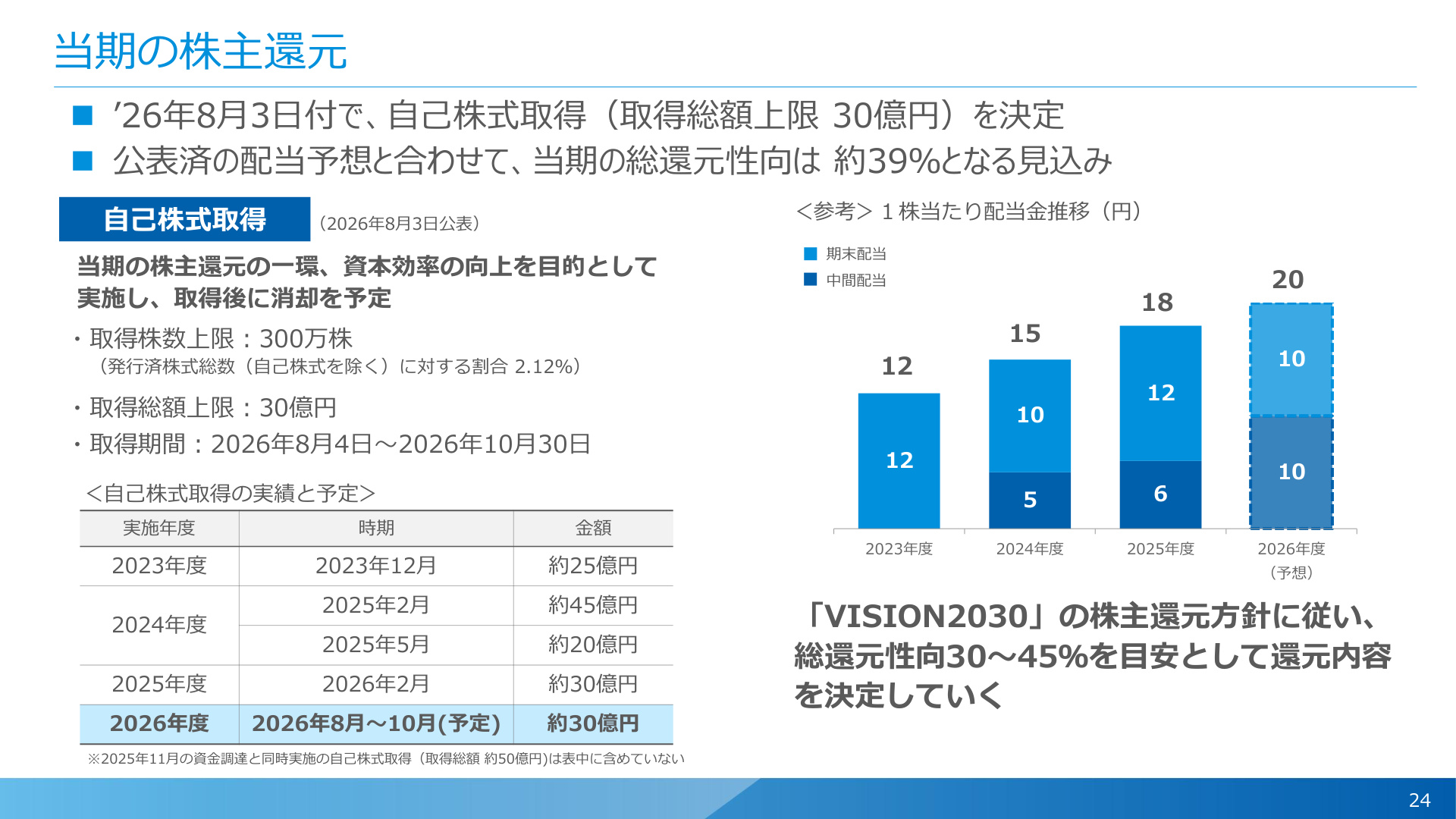
This slide summarizes the company's commitment to improving capital efficiency and specific shareholder return measures . The share buyback program announced on August 3, 2026, the same day as the earnings release, is a major point of interest for investors.
Key points of the policy:
- Share Buyback Decision : Maximum acquisition of 3.0 billion yen (representing 2.12% of total shares outstanding / up to 3 million shares). The acquisition period is from August 4 to October 30, 2026, with plans to cancel the shares after acquisition.
- Dividend Forecast : Annual dividend of 20 yen per share (10 yen interim, 10 yen year-end), representing a 2 yen increase from the previous year's 18 yen.
- Total Return Ratio : The total return ratio for the current fiscal year, combining dividends and share buybacks, is expected to be approximately 39% .
This aligns with the policy set in the "VISION2030" medium-term management plan to target a "total return ratio of 30% to 45%," demonstrating the company's commitment to agile capital policy. The company remains focused on improving capital efficiency to maintain its ROE target (10.1% forecast for the current fiscal year).
7. Conclusion and Future Focus
JVCKENWOOD's Q1 FY2027 results were impacted by short-term profit pressure from external factors (surging memory prices, U.S. government shutdown) , but the company maintained a revenue growth trend driven by strong M&T OEM performance and the success of the ES entertainment business .
Future focus areas include:
- Realization of Price Pass-through Effects : To what extent can the company pass on memory cost increases to product prices and recover profit margins from Q2 onwards?
- Recovery Speed of the S&S Segment : The pace of deploying hybrid radios using "ESChat" following the SLA integration and resolving order delays in the North American public safety market.
- Progress Toward Full-Year Targets (23.4 billion yen in business profit) : Whether the recovery scenario from Q2 onwards proceeds as planned.
Investors will continue to monitor the company's progress in business structural reform as it balances material cost management with strategic growth investments (M&A) while maintaining a strong commitment to shareholder returns.
This content is not intended as investment advice or a recommendation. Any opinions expressed are solely the personal views of each article.