


FUJI FY2027 Q1 Earnings Analysis: Record-Breaking Performance Driven by AI Demand and the 'NXTR' Mounter Strategy, Leading to Significant Full-Year Guidance Upward Revision

StockClub
Published: Aug 03, 2026, 11:38 AM
Sentiment Analysis
FUJI FY2027 Q1 Earnings Analysis: Record-Breaking Performance Driven by AI Demand and the 'NXTR' Mounter Strategy, Leading to Significant Full-Year Guidance Upward Revision
FUJI Corporation (Ticker: 6134) delivered a stellar start to the fiscal year ending March 2027. The company’s Q1 results were propelled by the rapid expansion of demand for AI servers , a recovery in the smartphone and automotive sectors, and the successful consolidation of its flagship mounter (electronic component assembly robot) lineup into the next-generation 'NXTR' model . Given this robust business environment, the company has significantly revised its full-year earnings and dividend forecasts upward.
This report provides a detailed analysis of the factors behind this rapid growth, segment-specific performance, and future growth strategies, focusing on 10 key topics derived from the earnings presentation materials.
1. Q1 Earnings Summary: All Key Financial Metrics Reach Record Highs
For the first quarter of the fiscal year ending March 2027, FUJI reported orders received of 85,784 million yen (+96.6% YoY) , net sales of 60,597 million yen (+45.9% YoY) , operating profit of 15,212 million yen (+192.6% YoY) , ordinary profit of 15,883 million yen (+182.0% YoY) , and net income attributable to owners of the parent of 12,622 million yen (+122.1% YoY) .
Every financial metric set a new quarterly record, with the operating profit margin improving dramatically from 12.5% in the same period last year to 25.1% .
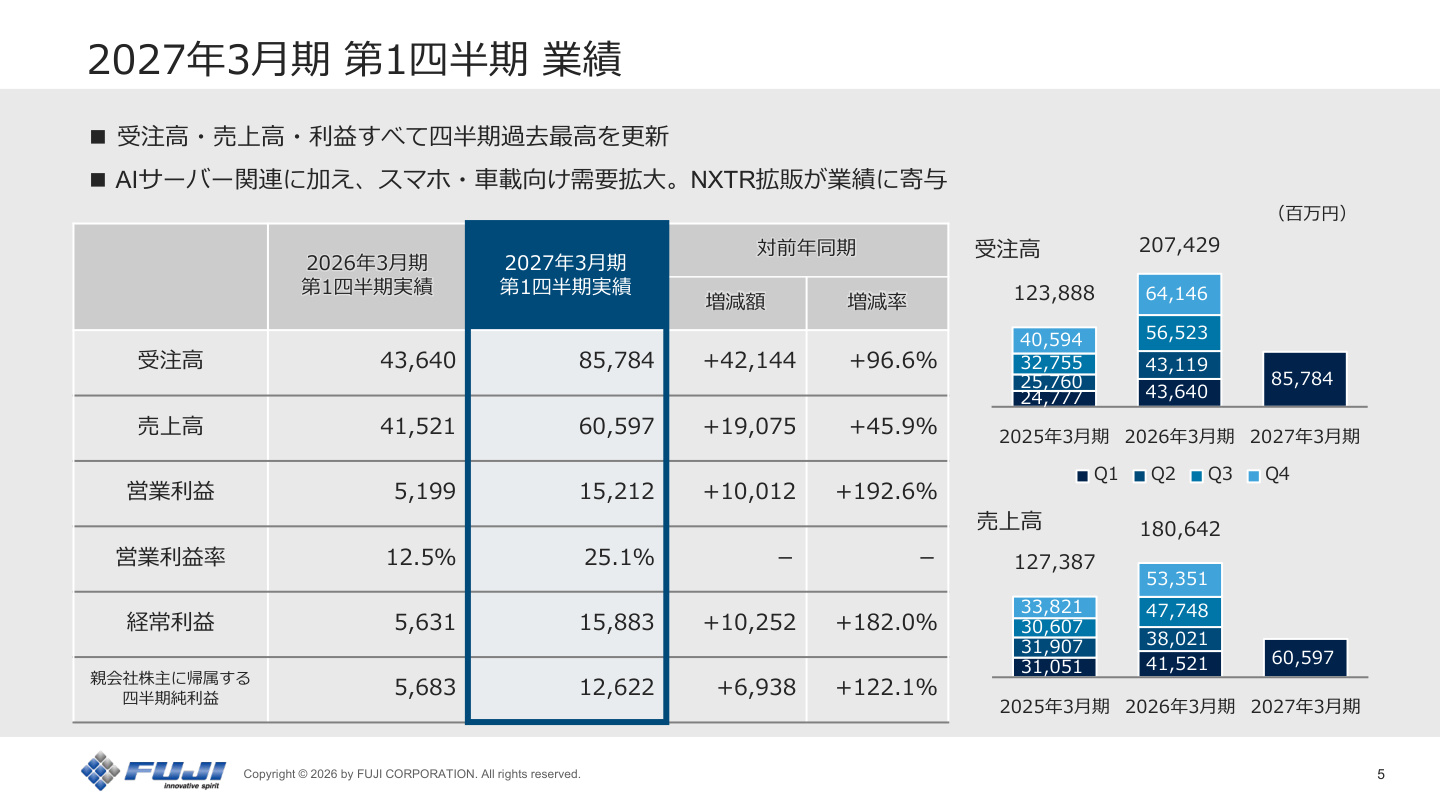
As shown in the slide above, orders received exceeded 85 billion yen and net sales surpassed 60 billion yen in the first quarter alone. This performance was driven by capital expenditure demand for high-performance AI servers—fueled by the proliferation of generative AI—which expanded faster than anticipated. This was complemented by a recovery in demand for automotive applications, driven by electrification and electronic integration, as well as the smartphone sector. Furthermore, the company’s ability to capture this strong demand through an all-encompassing strategy centered on its flagship 'NXTR' platform was the decisive factor in the significant increase in both revenue and profit.
2. Operating Profit Variance Analysis: Structure and Drivers of the Threefold Increase (+10 billion yen)
We analyze the factors behind the surge in operating profit from 5,199 million yen in the same period last year to 15,212 million yen.
Key takeaways from this profit variance waterfall chart include:
- Sales Volume Effect (+7,000 million yen) : The accumulation of marginal profit resulting from the substantial increase in net sales was the primary driver of profit growth.
- Selling Price Effect (+5,562 million yen) : A higher sales ratio of high-value-added models and effective price pass-throughs led to a significant improvement in profit margins.
- Model Consolidation Effect (+398 million yen) : Transitioning from the legacy 'NXT III' to the next-generation 'NXTR' improved production efficiency and reduced manufacturing costs (Gross profit impact: +11,433 million yen).
- Negative Factors : While rising material costs (-1,352 million yen) and increased SG&A expenses such as shipping and sales commissions (-1,421 million yen) occurred, these were far outweighed by the volume growth, price revisions, and structural reform effects.
3. Segment Performance ①: Robotic Solutions (The Growth Engine Accounting for Over 90% of Total Revenue)
The core Robotic Solutions segment was the primary driver of the company's overall growth.
- Orders Received : 82,841 million yen (+104.0% YoY)
- Net Sales : 58,624 million yen (+52.5% YoY)
- Operating Profit : 16,508 million yen (+167.2% YoY)
- Order Backlog : 85,877 million yen (+142.5% YoY)
Quarterly orders exceeded 80 billion yen, marking a record high. The order backlog has also climbed to 85.8 billion yen, providing a solid foundation for operations and shipments from Q2 onwards.
[Regional Sales Trends]
- Other Asia (43% of total) : Demand for AI servers and smartphones surged, particularly in Thailand and Vietnam.
- China (30% of total) : Recovery and expansion were observed across a wide range of sectors, including smartphones, automotive, semiconductors, and AI servers.
- North America (17% of total) : Demand remained steady, led by communication infrastructure, automotive, and AI server-related projects.
[Sales Trends by Industry]
Server-related sales maintained a high level (21%), while communications (smartphones, etc.) accounted for 21%, automotive for 11%, and semiconductors (including FUJI and its subsidiary Fasford Technology) for 17%. This demonstrates a diversified and powerful demand portfolio that is not dependent on any single market.
[Model Trends: Full Shift to NXTR]
In high-speed mounters, the ratio of legacy 'NXT' models dropped from 30% in the same period last year to 0%, marking the completion of the transition to 'NXTR' (NXTR now accounts for 54% of sales). NXTR’s strengths in high-density mounting and automation are directly contributing to improved productivity and higher gross margins.
4. Segment Performance ②: Machine Tools (Struggling in the Machine Tool Market)
Conversely, the Machine Tools segment continues to face a challenging business environment.
- Orders Received : 2,305 million yen (-6.4% YoY)
- Net Sales : 1,351 million yen (-48.6% YoY)
- Operating Profit : -184 million yen (compared to a profit of 122 million yen in the same period last year)
Due to a low opening order backlog (3,143 million yen), net sales were halved. Despite implementing cost-cutting measures such as reducing fixed costs, the segment fell into an operating loss . The primary cause is the overall sluggish demand for capital investment in the automotive sector across all regions.
5. Significant Upward Revision of FY2027 Full-Year Earnings Forecast
Based on the exceptionally strong Q1 progress and the outlook for continued high demand (particularly in AI servers), the company has significantly raised its initial full-year forecast.
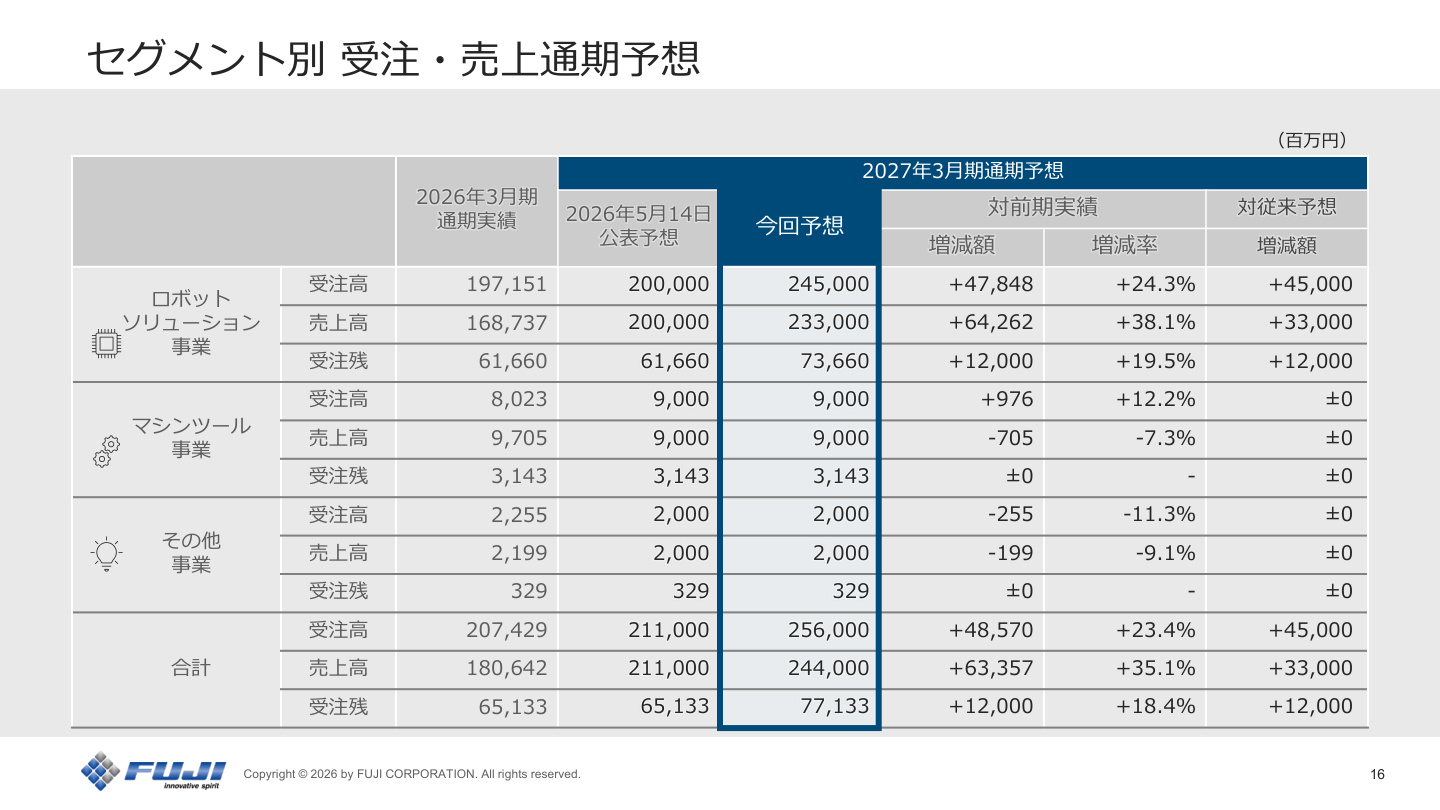
Key points of the revised full-year plan:
- Orders Received : 256,000 million yen (+45,000 million yen vs. previous forecast / +23.4% YoY)
- Net Sales : 244,000 million yen (+33,000 million yen vs. previous forecast / +35.1% YoY)
- Operating Profit : 60,000 million yen (+16,400 million yen vs. previous forecast / +104.9% YoY)
- Operating Profit Margin : 24.6% (+3.9 percentage points from the previous 20.7% forecast)
- Net Income : 44,000 million yen (+11,000 million yen vs. previous forecast / +179.7% YoY)
Full-year operating profit is projected to more than double (+104.9%) to 60 billion yen, setting a new record by a significant margin. To meet this surge in demand, the company is strengthening its supply chain and production capacity.
6. Strengthening Shareholder Returns (Dividend Policy)
In line with the significant upward revision of earnings, shareholder returns will also be increased.
- Annual Dividend Forecast : 190 yen per share (95 yen interim, 95 yen year-end)
- Previous Year Results : 90 yen annually (40 yen interim, 50 yen year-end) — a substantial increase of 100 yen
- Dividend Payout Ratio : 38.0%
Backed by a solid financial foundation (high equity ratio and accumulated retained earnings), the company clearly demonstrates its commitment to balancing growth investment with proactive shareholder returns.
7. Comprehensive Analysis and Future Outlook
FUJI’s Q1 FY2027 results represent a masterful capture of the AI-driven demand opportunity , leading to impressive earnings growth.
Key points to watch moving forward include:
- Sustainability of AI Server Demand and Next-Gen Packaging : Maintaining the technical superiority of 'NXTR' in meeting cutting-edge mounting needs, such as optoelectronic fusion and handling large, heavy components (up to 200mm x 200mm, 2.0kg).
- Supply Chain Capacity Adjustment : Whether the company can maintain high shipment levels through the end of the fiscal year without bottlenecks in material procurement or assembly lines amidst surging orders.
- Bottoming Out of the Machine Tools Segment : The timing of the recovery in capital investment as the automotive industry transitions toward electrification.
As a leader in the electronic component assembly robot industry, all eyes are on how the company will chart its future growth trajectory through its all-encompassing strategy centered on 'NXTR'.
This content is not intended as investment advice or a recommendation. Any opinions expressed are solely the personal views of each article.