

Eisai Q1 FY2026 Earnings Deep Dive: Double-Digit Growth Driven by the '3L' Powerhouse and Innovations in Alzheimer’s Disease Treatment

StockClub
Published: Aug 03, 2026, 11:33 AM
Sentiment Analysis
Eisai Q1 FY2026 Earnings Deep Dive: Double-Digit Growth Driven by the '3L' Powerhouse and Innovations in Alzheimer’s Disease Treatment
Eisai Co., Ltd. delivered a strong start to fiscal year 2026, with the first quarter (April–June) results showing double-digit growth in both revenue and operating profit year-on-year , underpinned by the robust expansion of its core pharmaceutical business. This report provides a comprehensive and detailed analysis based on the earnings materials, covering performance highlights, drivers of revenue and profit fluctuations, the progress of the "3L" product portfolio, and innovations in the next-generation pipeline and diagnostic landscape that will drive future growth.
1. Earnings Highlights and Progress Against Full-Year Forecasts
In Q1 FY2026, consolidated results (IFRS) showed revenue of ¥234.3 billion (+15.6% YoY) and operating profit of ¥24.7 billion (+19.2% YoY) . Core performance metrics were equally strong, with Core Operating Profit at ¥24.7 billion (+13.9% YoY) , Profit Attributable to Owners of the Parent at ¥18.2 billion (+26.0% YoY) , and Earnings Per Share (EPS) at ¥64.71 .
Progress against the full-year consolidated earnings forecast at the end of the first quarter is tracking very favorably:
- Revenue : ¥234.3 billion against a full-year forecast of ¥883.5 billion ( 26.5% progress ; target 27%)
- Operating Profit : ¥24.7 billion against a full-year forecast of ¥70.0 billion ( 35.3% progress ; target 35%)
- Profit for the Period : ¥18.2 billion against a full-year forecast of ¥52.3 billion ( 34.9% progress )
- EPS : ¥64.71 against a full-year forecast of ¥185.00 ( 35.0% progress )
Revenue from the pharmaceutical business alone reached ¥230.9 billion (+16.4% YoY) , more than offsetting the decline in other businesses (¥3.4 billion, -18.4% YoY). The company maintained high profit margins while keeping the R&D expense ratio under disciplined control at 18.7% (compared to 19.1% in the same period last year).
2. Analysis of Revenue and Operating Profit Drivers
To understand the structure behind the Q1 growth, it is essential to examine the contribution of individual products and changes in the cost structure.
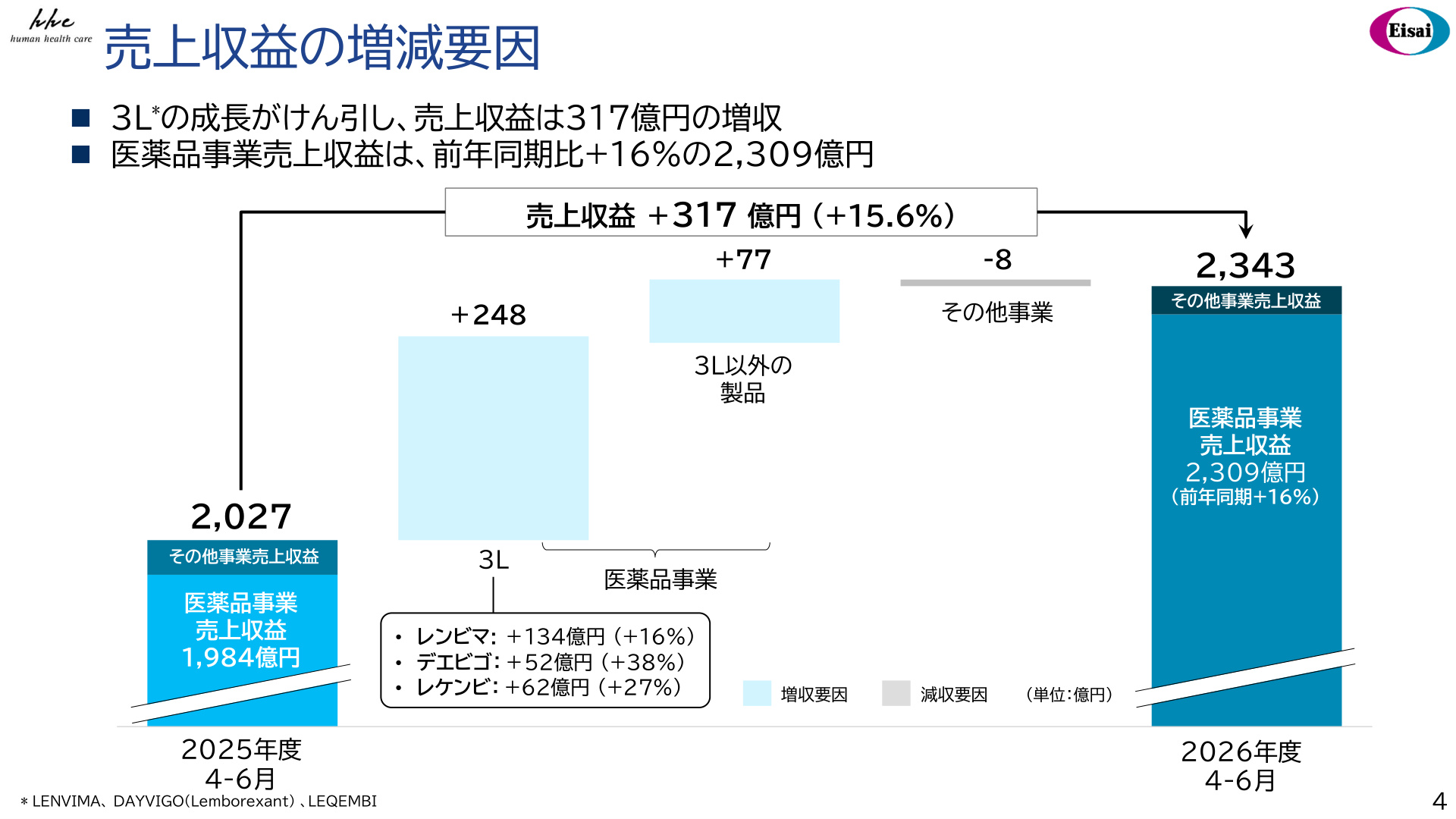
The following slide illustrates the factors contributing to the change in revenue compared to the same period last year.
[Analysis of Revenue Drivers]
The most significant takeaway from this slide is that the "3L" flagship products (Lenvima, Dayvigo, and Leqembi) are the overwhelming primary drivers of revenue growth . Of the ¥31.7 billion revenue increase from ¥202.7 billion in the previous year to ¥234.3 billion this period, the 3L portfolio contributed a ¥24.8 billion increase (+20.5% YoY). Specifically, the anticancer agent "Lenvima" contributed +¥13.4 billion (+16%) , the insomnia treatment "Dayvigo" added +¥5.2 billion (+38%) , and the Alzheimer’s disease treatment "Leqembi" contributed +¥6.2 billion (+27%) . Furthermore, other pharmaceutical products also showed a revenue increase of +¥7.7 billion , confirming the healthy expansion of the entire core business.
[Analysis of Operating Profit Drivers]
Operating profit also achieved a +¥4.0 billion (+19.2%) increase , rising from ¥20.7 billion to ¥24.7 billion. The breakdown is as follows:
- Increase in Gross Profit (+¥23.2 billion) : Gross profit grew significantly in line with the expansion of the pharmaceutical business.
- Increase in R&D Expenses (-¥4.9 billion) : The company continues to actively allocate resources to key next-generation projects such as Leqembi and the anti-MTBR tau antibody "Etalanetug."
- Increase in SG&A Expenses (-¥14.7 billion) : Major factors include an ¥8.2 billion increase in profit-sharing expenses paid to the partner (Merck & Co., Inc., Rahway, NJ, USA) due to Lenvima's sales growth (totaling ¥44.3 billion), and active investment (¥2.6 billion increase) associated with the global launch of Leqembi.
Notably, the expansion in revenue fully absorbed the aggressive R&D investments and commercialization costs, resulting in an improvement of the operating profit margin by 0.3 percentage points, from 10.2% to 10.6% .
3. Global Business Update: The "3L" Flagship Products
① Anticancer Agent "LENVIMA"
Eleven years after its launch, Lenvima, a multi-kinase inhibitor that has helped approximately 620,000 patients in 83 countries, remains a powerful growth engine.
- Q1 Revenue : ¥97.3 billion (+16% YoY) (28.2% progress against the ¥345.0 billion full-year forecast)
- US Market : Revenue of ¥66.5 billion (+14.5% YoY). It continues to maintain the top market share among TKIs (tyrosine kinase inhibitors) for renal cell carcinoma, endometrial carcinoma, hepatocellular carcinoma, and thyroid cancer indications.
- Future Outlook : An application for a new indication for advanced renal cell carcinoma based on the "LITESPARK-011" study (Lenvima + Welireg combination therapy) is underway, with a US PDUFA action date set for October 4, 2026 .
② Insomnia Treatment "DAYVIGO"
Dayvigo, an internally discovered orexin receptor antagonist, has been approved in 29 countries and regions, with its global rollout accelerating.
- Q1 Revenue : ¥18.9 billion (+38% YoY) (25.8% progress against the ¥73.5 billion full-year forecast)
- Regional Trends : In the core Japanese market, it recorded sales of ¥12.4 billion (+13.4% YoY), retaining the #1 market position in both sales and patient share. It is showing remarkable growth in all regions, including the US (¥3.3 billion, +74.5% YoY) and China (¥1.4 billion, +1779.1% YoY).
- New Applications : In July 2026, the company completed regulatory filings for chronic insomnia in the UK (MHRA) and Europe (EMA).
③ Alzheimer’s Disease (AD) Treatment "LEQEMBI"
Leqembi, an anti-Aβ protofibril antibody approved in 53 countries and regions, is solidifying its foundation as a disease-modifying therapy for dementia.
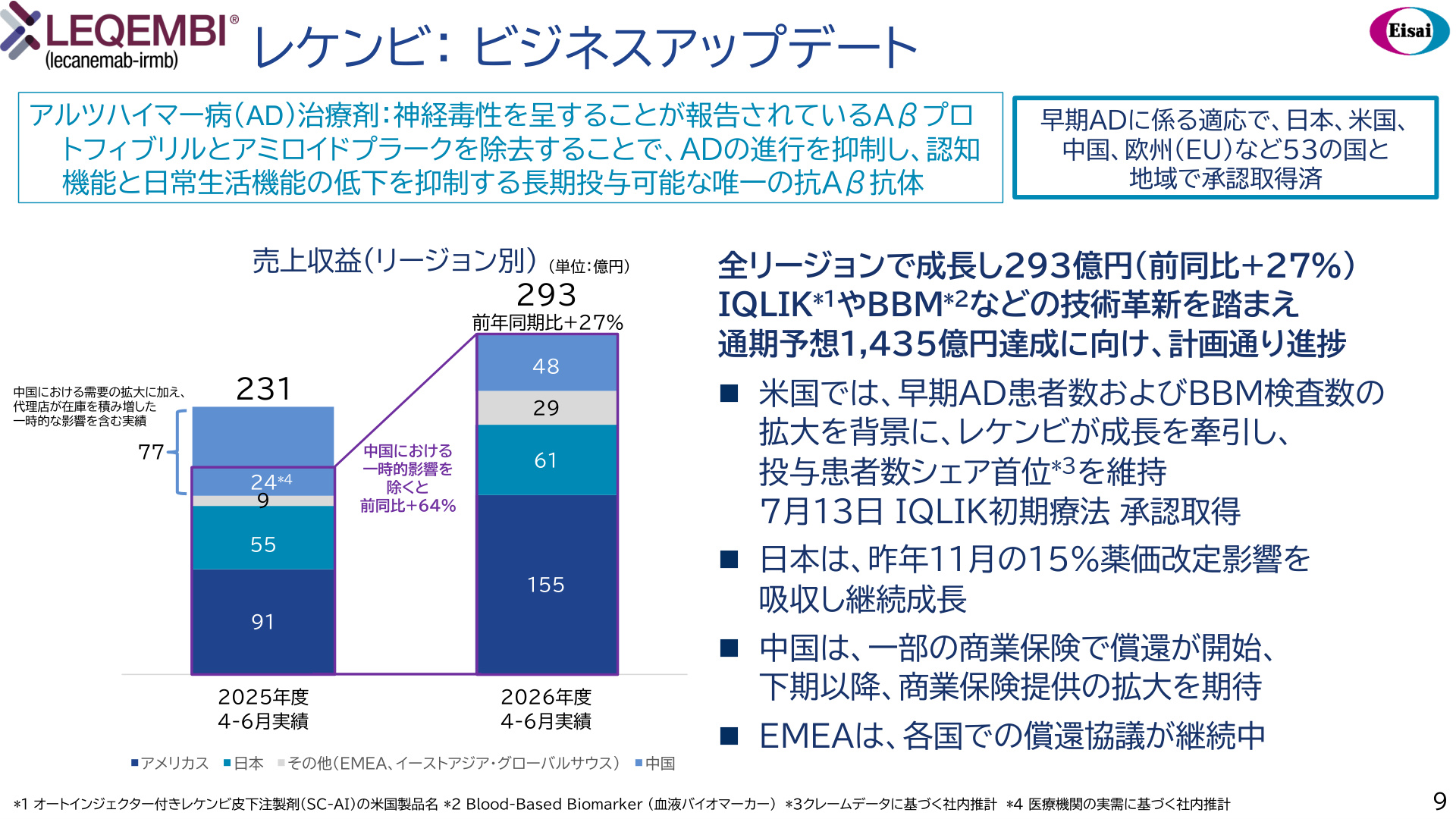
- Q1 Revenue : ¥29.3 billion (+27% YoY) (20.4% progress against the ¥143.5 billion full-year forecast)
Detailed regional status is shown in the product update slide below.
[Leqembi Regional Status and Context]
This slide visually conveys the growth trajectory of Leqembi in major global regions. The regional composition and key points for the ¥29.3 billion revenue are as follows:
- United States : ¥15.5 billion (+70.5% YoY) . Growth was driven by an increase in early AD patients and blood biomarker (BBM) testing, maintaining the leading share in treated patients.
- Japan : ¥6.1 billion (+10.9% YoY) . Achieved continued growth by absorbing the impact of the 15% drug price revision implemented last November.
- China : ¥4.8 billion (-37.3% YoY) . While it appears as a decline compared to the same period last year (¥7.7 billion) due to temporary inventory stocking by distributors, excluding this one-time factor, it shows strong underlying growth of +64% . Reimbursement has begun under some commercial insurance plans, with acceleration expected from the second half onward.
- EMEA : ¥0.5 billion (compared to ¥0.1 billion in the same period last year). Reimbursement negotiations are ongoing in various countries.
Furthermore, a significant strategic advancement is the approval of "IQLIK (subcutaneous injection)" for initial therapy in the US on July 13, 2026 .
4. Maximizing Leqembi Value and Transforming the Healthcare Ecosystem
To support the widespread adoption of Leqembi, the company is driving structural reforms along three axes: "improving convenience of administration," "accumulating evidence on long-term efficacy and safety," and "simplifying diagnostic pathways."
Innovation in Administration (Deployment of IQLIK)
Previously, bi-weekly intravenous (IV) infusions were required. With the US-approved subcutaneous autoinjector "IQLIK," weekly home administration is now possible . This significantly reduces the burden on patients and caregivers, alleviates constraints on infusion beds and resources at medical institutions, and contributes to a dramatic expansion in prescription capacity.
Insights from Real-World Evidence (RWE)
The "LEADER study," presented at AAIC2026 and covering 432 patients across 13 US facilities, showed that 82.5% of patients treated with Leqembi maintained or improved their disease stage (75.9% stable, 6.6% improved). Additionally, 78.9% of patients who continued treatment for over 18 months transitioned smoothly to maintenance therapy (IV every 4 weeks or weekly IQLIK), confirming the consistency of safety and efficacy in long-term administration.
Social Implementation of Blood Biomarkers (BBM)
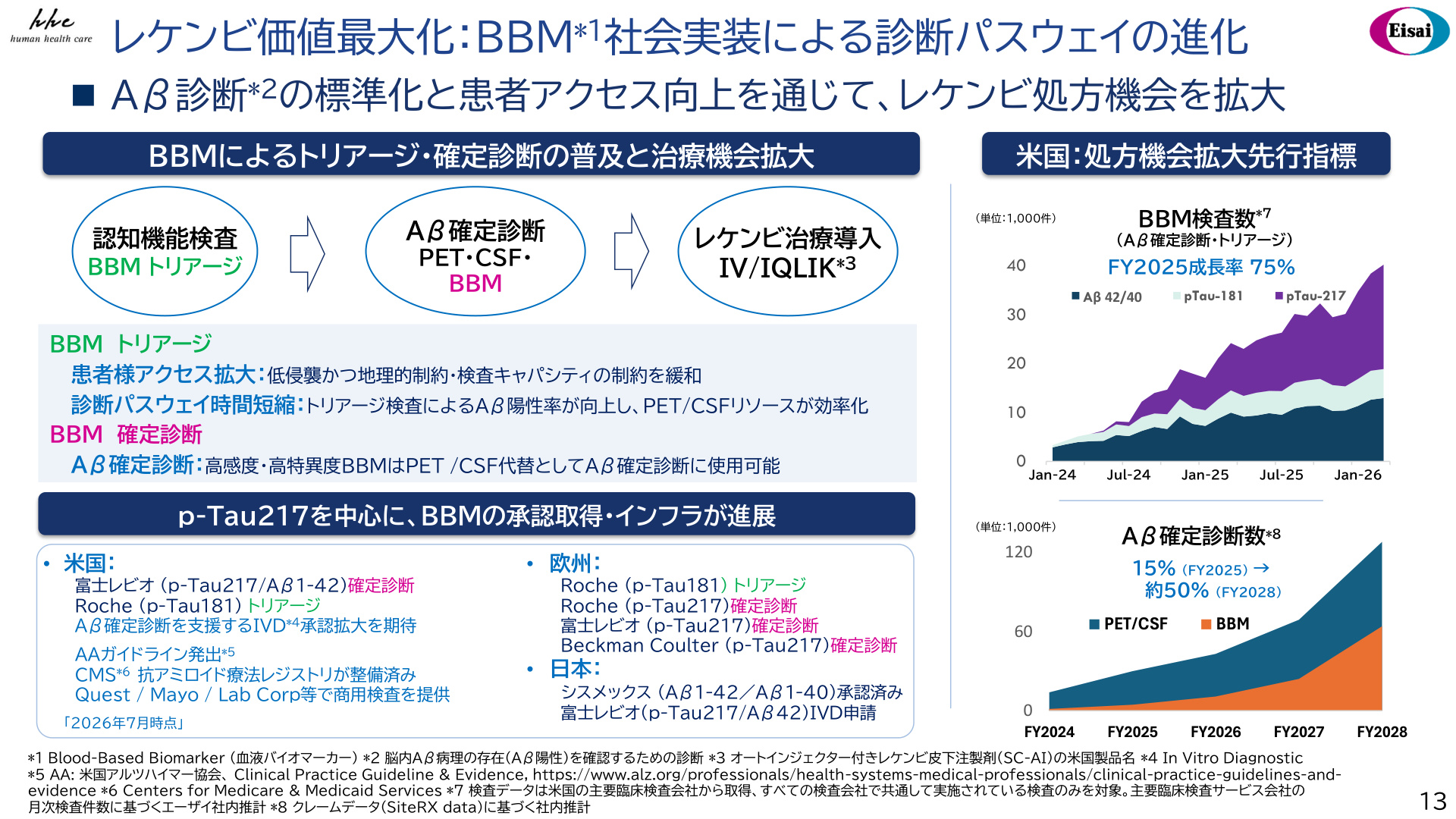
The biggest bottleneck in Alzheimer’s diagnosis has been the limited access and high cost associated with PET scans and cerebrospinal fluid (CSF) testing. The key to solving this is blood biomarkers (BBM) .
[BBM Social Implementation Context]
This slide is a critical chart illustrating the "evolution of the diagnostic pathway" that will explosively expand prescription opportunities for Leqembi. By introducing highly sensitive and specific blood tests (such as p-Tau217) into the Aβ confirmation diagnostic process—which previously relied on expensive PET scans or invasive CSF collection—the hurdles for triage and definitive diagnosis in clinical settings are dramatically lowered.
As shown in the graph on the right side of the slide, the number of BBM tests in the US increased at an astonishing pace of +75% YoY in FY2025 . Furthermore, the proportion of BBM in Aβ definitive diagnoses is expected to expand from 15% in FY2025 to approximately 50% by FY2028 . Approval for in vitro diagnostics (IVD) from companies like Roche, Fujirebio, and Beckman Coulter is progressing in the US, and applications and guideline development are accelerating in Japan and Europe. The widespread adoption of BBM will serve as the ultimate infrastructure to guide potential early AD patients to diagnosis and treatment rapidly.
5. Segment Trends and Next-Generation Pipeline Outlook
Regional Segment Performance
Each regional pharmaceutical segment maintains high profit margins.
- Japan : Revenue ¥57.9 billion (+3.4%), Segment Profit ¥21.0 billion (+8.1%, margin 36.3%). Growth driven by Dayvigo, Leqembi, and Jyseleca (¥5.4 billion, +25.2%).
- Americas : Revenue ¥86.6 billion (+22.3%), Segment Profit ¥51.9 billion (+25.0%, margin 60.0%). Lenvima and Leqembi are strong revenue drivers.
- China : Revenue ¥42.5 billion (+16.6%), Segment Profit ¥21.2 billion (+18.2%, margin 49.8%). Merislon (¥5.1 billion, +67.1%) and Methycobal remain solid.
- EMEA : Revenue ¥23.6 billion (+24.4%), Segment Profit ¥12.5 billion (+51.8%, margin 52.7%).
- EAGS (East Asia & Global South) : Revenue ¥20.2 billion (+25.3%), Segment Profit ¥9.5 billion (+15.0%, margin 46.9%).
Next-Generation AD Drug Discovery (ATN Continuum)
Eisai is not stopping at the success of Leqembi (targeting Aβ) but is developing a comprehensive drug discovery approach targeting tau pathology and neurodegeneration.
- Etalanetug (E2814) : An anti-MTBR tau antibody. It has a novel mechanism of action that inhibits tau propagation and aggregation, with combination trials with Leqembi (Tau NexGen study, sAD Study 202) underway. In a study targeting DIAD patients, it confirmed Proof of Mechanism (POM) by reducing eMTBR-tau243 concentrations in CSF and plasma by over 90% in 9 months .
- AHEAD3-45 Study : A Phase III study administering lecanemab to patients in the preclinical AD stage to prevent the onset of AD itself . Data readout is scheduled for FY2028.
Expansion of the Orexin Platform
Leveraging the knowledge in the orexin field gained from Dayvigo, the development of the orexin 2 receptor agonist "Ledasorexton (E2086)" is progressing. In a single-dose study (Study 101) targeting patients with type 1 narcolepsy (NT1), it significantly suppressed excessive daytime sleepiness and confirmed good safety and tolerability. The company aims to obtain top-line data from the 202 study within FY2026, expanding the potential of drug discovery from sleep disorders to the regulation of the entire brain function network.
6. Conclusion
In the Q1 FY2026 earnings, Eisai demonstrated solid performance expansion through the strong growth of existing flagship products centered on the "3L." Simultaneously, the company is advancing the establishment of a foundation for Leqembi's market expansion, such as the IQLIK approval and BBM social implementation , as well as the steady progress of next-generation pipelines like the tau-targeting drug Etalanetug and the orexin agonist Ledasorexton . These results indicate that the "dual engines" of achieving short-term performance targets and enhancing medium- to long-term corporate value are functioning effectively.
This content is not intended as investment advice or a recommendation. Any opinions expressed are solely the personal views of each article.