


Nippon Ham FY2027/3 Q1 Earnings Deep Dive: Behind the Record-High Profits and Strategic Business Overview

StockClub
Published: Aug 03, 2026, 11:27 AM
Sentiment Analysis
Based on the Q1 earnings report for the fiscal year ending March 2027 (FY2027/3) released by NH Foods Ltd. (Securities Code: 2282), this report provides a detailed analysis of the company's performance, segment-specific results, and the structure and strategic initiatives of its full-year plan.
1. FY2027/3 Q1 Overview: Record-High Business Profit for a First Quarter
In Q1 of FY2027/3, the NH Foods Group achieved net sales of 384.9 billion yen (+8.7% YoY) and business profit of 19.4 billion yen (+19.5% YoY) , marking the highest business profit ever recorded for a first quarter. Amidst an inflationary environment, the results demonstrate the success of the group's vertically integrated model and its aggressive push for procurement optimization.
Conversely, profit attributable to owners of the parent was 10.8 billion yen (-5.6% YoY) , representing a decline despite the growth in business profit. This was primarily due to an increase in corporate income tax expenses.
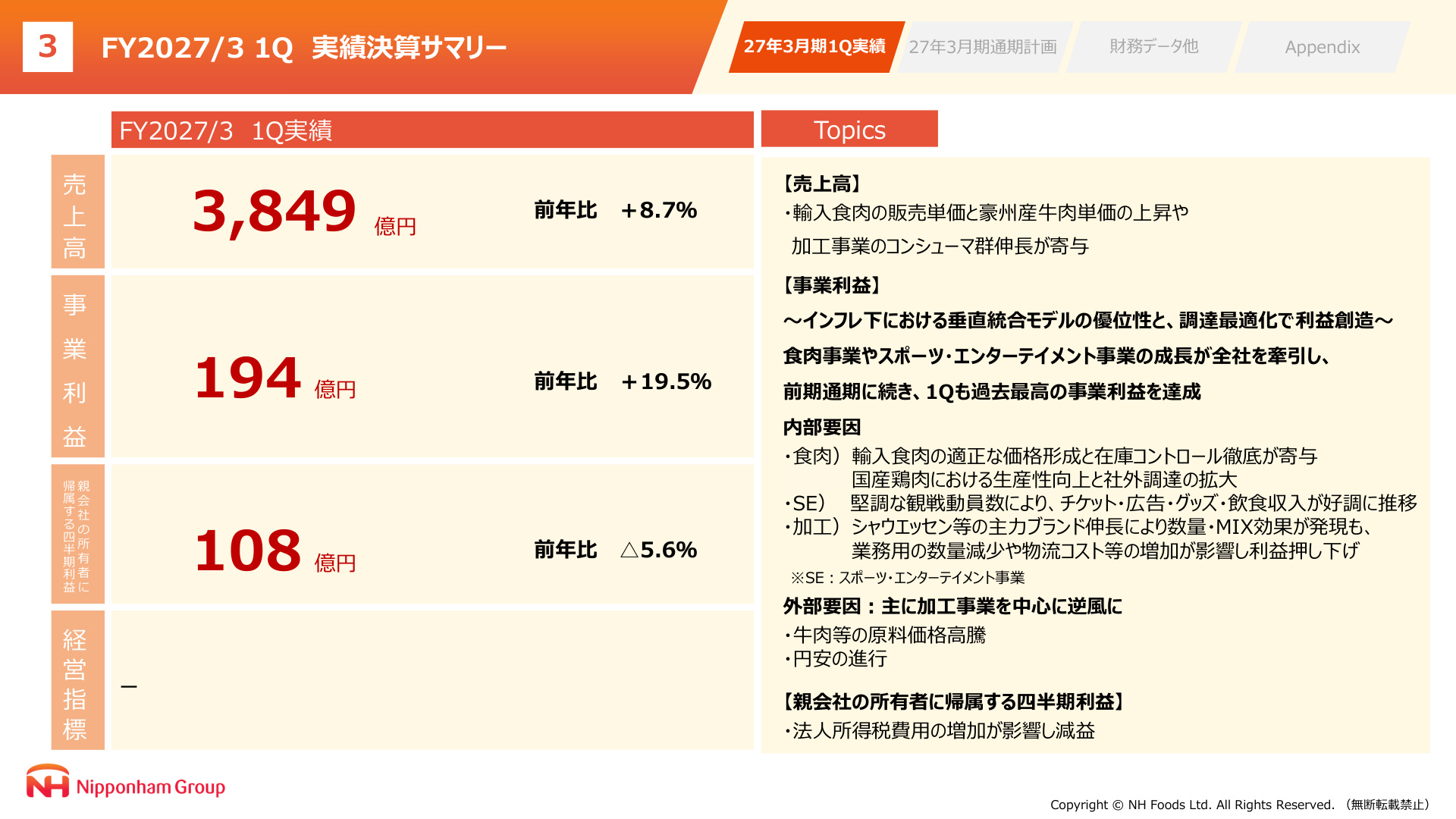
Significance and Analysis of the "FY2027/3 Q1 Earnings Summary" Slide
This slide is critical for understanding the consolidated performance for the quarter and the primary drivers behind it.
- Structure of Earnings Highlights : The strong growth in both sales and profit was driven by the Processed Foods Business and the Sports & Entertainment Business . In the Fresh Meats Business, the formation of appropriate pricing for imported meat, rigorous inventory control, and improved productivity in domestic chicken production were major contributors.
- Overcoming External Headwinds : External challenges, such as soaring raw material costs (e.g., beef), the weakening yen, and rising packaging and energy costs due to the Middle East situation, impacted the processed foods segment. However, the company’s story of achieving record-high profits is rooted in its ability to absorb these negative external factors through strengthened company-wide procurement, appropriate price pass-throughs, and cumulative internal improvements.
2. Segment Analysis: Fresh Meats and Sports Businesses Lead the Group
A detailed look at the performance of each segment clarifies the market environment and the effectiveness of the strategies implemented by each business unit.
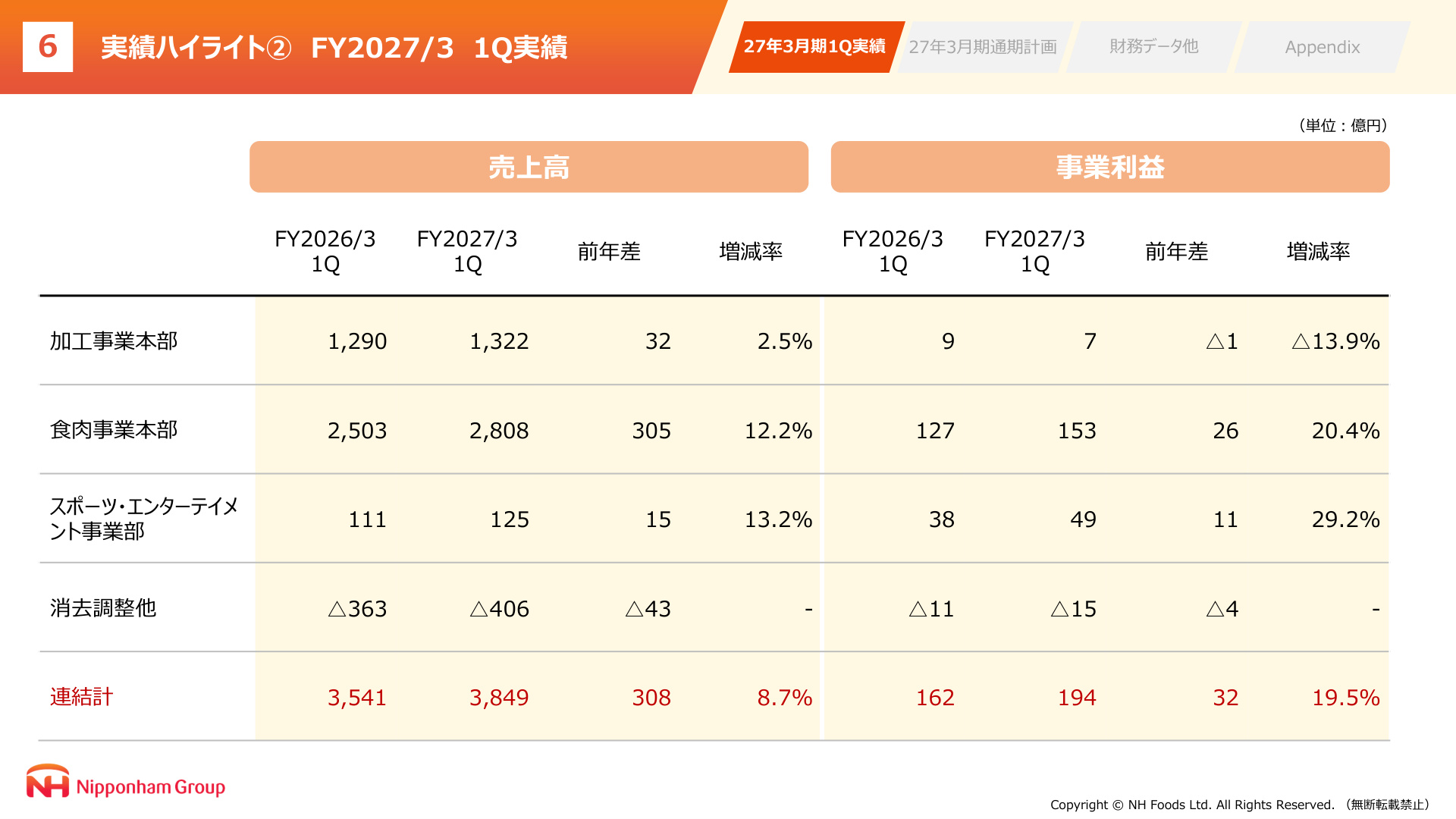
Significance and Analysis of the "Performance Highlights ② FY2027/3 Q1 Results" Slide
This slide is essential for understanding the dynamics of the company's business structure, as it provides a snapshot of net sales and business profit for each segment (Processed Foods, Fresh Meats, and Sports & Entertainment) along with their year-on-year growth rates.
Below is a deep dive into the trends for each segment.
① Fresh Meats Business: Margin Improvement and Pricing Success
- Net Sales : 280.8 billion yen (+12.2% YoY)
- Business Profit : 15.3 billion yen (+20.4% YoY)
- Overview : The Fresh Meats Business was the primary driver, accounting for nearly 80% of total company profit. Domestic operations benefited from appropriate price pass-throughs for imported meat, strict inventory management, improved productivity in domestic chicken, and expanded external procurement. In contrast, the Australian business struggled, with business profit of 1.7 billion yen (-41.1% YoY) due to soaring livestock market prices and a decline in exports to China. Despite the impact of the fire at the Shiretoko food plant (a loss of 1.2 billion yen due to reduced domestic chicken production and opportunity costs), these were offset by productivity improvements at other plants and favorable market conditions.
② Processed Foods Business: Growth in Core Brands vs. Challenges in Food Service
- Net Sales : 132.2 billion yen (+2.5% YoY)
- Business Profit : 0.7 billion yen (-13.9% YoY)
- Overview : While the processed foods segment saw an increase in sales, it experienced a decline in profit. Consumer products, led by core brands like "Schau Essen," performed well (wiener sales at 108% YoY), benefiting from volume and product mix effects. However, profit was weighed down by lower manufacturing volumes due to sluggish adoption of food service products, increased sales commissions and logistics costs associated with sales growth, and rising costs for raw materials (e.g., beef) and auxiliary materials/energy due to the Middle East situation.
③ Sports & Entertainment Business: Ballpark Effect and Profitability
- Net Sales : 12.5 billion yen (+13.2% YoY)
- Business Profit : 4.9 billion yen (+29.2% YoY) (Business Profit Margin: 39.2% )
- Overview : Initiatives to enhance the appeal of the Hokkaido Ballpark F Village led to significant growth in both sales and profit. Attendance for professional baseball games during Q1 reached 1.11 million (average of 30,729 per game), exceeding the 1.08 million recorded in the same period last year. Revenue from tickets, advertising, merchandise, and food and beverage all performed well, supported by non-game day events like the "Bread Festival" and "Pet Festival," as well as enhanced stadium production, such as the introduction of LED ribbon boards.
3. FY2027/3 Full-Year Plan and Growth Scenario
For the full fiscal year ending March 2027, NH Foods targets net sales of 1.5 trillion yen (+2.9% YoY) , business profit of 61 billion yen (-10.7% YoY) , and profit attributable to owners of the parent of 38 billion yen (+8.4% YoY) . While the plan anticipates a decline in operating profit, profit attributable to owners of the parent is expected to rise as the impact of extraordinary losses recorded in the previous fiscal year dissipates.
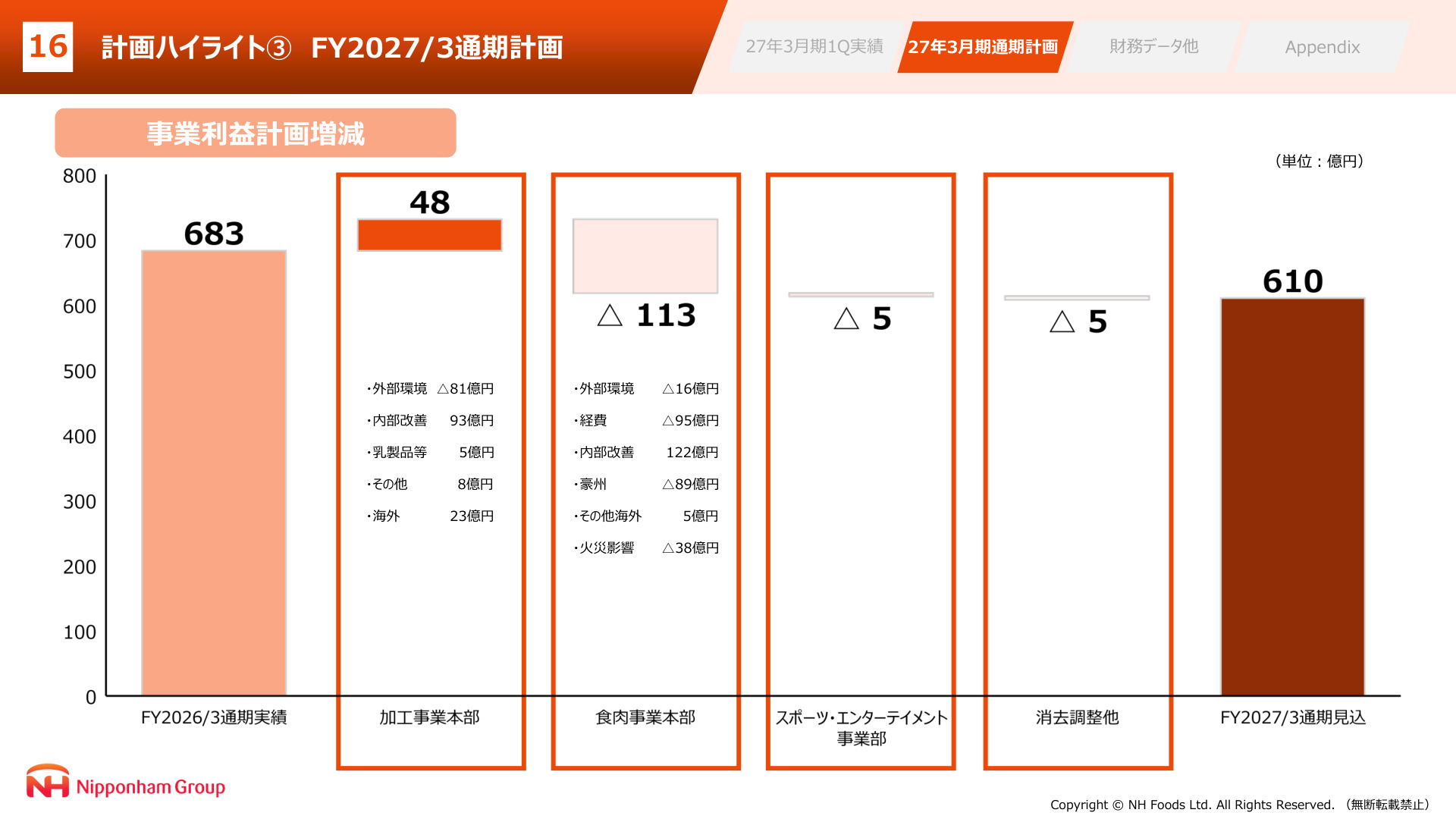
Significance and Analysis of the "Plan Highlights ③ FY2027/3 Full-Year Plan: Business Profit Variance" Slide
This slide visualizes the factors behind the 7.3 billion yen year-on-year decrease in business profit from the previous year's 68.3 billion yen to the current plan of 61 billion yen. It is fundamental data for decoding the challenges the company faces and the recovery scenarios for each business.
- Processed Foods Recovery Scenario (+4.8 billion yen boost) : The company plans a significant recovery from 7.2 billion yen in the previous year to 12.0 billion yen (+66.7% YoY). Despite the backdrop of a deteriorating external environment (-8.1 billion yen), the structure relies on top-line growth, "volume expansion" following price revisions, and internal improvements (+9.3 billion yen), including fixed cost reduction and AI-driven operational efficiency.
- Fresh Meats Profit Decline Outlook (-11.3 billion yen drag) : The plan incorporates a decline from 61.3 billion yen in the previous year to 50.0 billion yen (-18.4% YoY). Key factors include soaring livestock prices and weak sales prices in the Australian beef business (-8.9 billion yen), the impact of the Shiretoko plant fire (-3.8 billion yen), and increased personnel and logistics expenses (-9.5 billion yen). However, the company aims to mitigate volatility through internal improvements (+12.2 billion yen), such as leveraging its strong sales capabilities for appropriate price pass-throughs and strengthening branded meat products.
4. Financial Structure, Capital Investment, and Management KPIs
Capital Efficiency and Management KPIs
NH Foods continues to push for improved profitability and optimized capital efficiency.
- ROE (Return on Equity) : Expected to rise to 7.2% , up 0.6 percentage points YoY.
- ROIC (Return on Invested Capital) : Planned at 5.3% , down 0.8 percentage points YoY.
- EPS (Earnings Per Share) : Expected to increase by 42.55 yen to 403.68 yen .
Capital Investment and Cash Flow Strategy
Capital investment for the current fiscal year is planned at 60 billion yen (+42.3% YoY) .
- Processed Foods (17.2 billion yen) : Maintenance and renewal of domestic and overseas production facilities and optimization of production lines.
- Fresh Meats (30.0 billion yen) : Strengthening domestic upstream operations and investment in expanding feedlots in Australia.
- Sports & Entertainment (7.4 billion yen) : Growth investments, including facility enhancements to improve the visitor experience and peripheral development ahead of the 2028 new station opening.
- Cash Flow and Financial Health : The D/E ratio at the end of Q1 remained at a healthy level of 0.47. Operating cash flow for Q1 was 1.9 billion yen, primarily due to an increase in inventories (up 20.6 billion yen) resulting from higher unit prices and increased volumes of meat stock.
5. Summary and Future Outlook
NH Foods' Q1 FY2027/3 results represent a strong start, achieving record-high business profit for a first quarter by leveraging its strengthened procurement, appropriate price pass-throughs, and the advantages of its vertically integrated model , even amidst a harsh external environment of high raw material costs and a weak yen.
Key points for future business development include:
- Volume Recovery and Structural Reform in Processed Foods : Whether promotional efforts to re-expand volume after price revisions and the effects of fixed cost reduction and operational efficiency materialize as planned toward the second half of the year.
- Risk Management and Market Response in Fresh Meats : Deployment of flexible sales and feeding strategies to counter volatility in the Australian beef market, and the early stabilization of alternative production systems following the Shiretoko plant fire.
- Sustainable Growth in Sports & Entertainment : Increasing the drawing power of the ballpark centered on ES CON FIELD and long-term value creation, such as the relocation of farm facilities (to Eniwa, Hokkaido) looking toward 2030–2031.
As the group continues to strengthen its business foundation and focus on capital efficiency, the execution of strategic initiatives across each segment will be closely monitored.
This content is not intended as investment advice or a recommendation. Any opinions expressed are solely the personal views of each article.