

Revenium Launches ‘Guardrails’ for Real-Time AI Spend and Model Use Enforcement
Globe News Wire
Published: Aug 03, 2026, 05:00 PM GMT+9
Sentiment Analysis
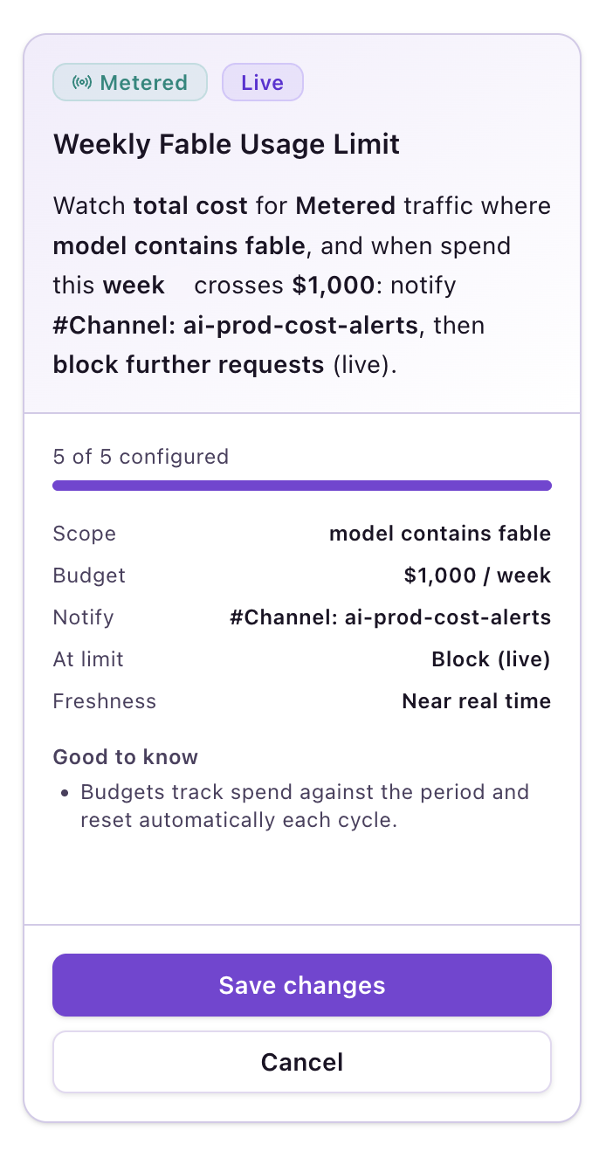
Revenium, the AI Economic Control System, today launched Guardrails, a set of runtime controls that let enterprises enforce spend limits and model access rules at the point an AI call is placed. Where Revenium’s existing Tool Registry gives enterprises full-stack visibility into what AI agents spend, and AI Outcomes measures whether that spend paid off, Guardrails takes on a different job. Rather than tracking what AI costs or whether it was worth it, Guardrails decides in real time whether a call happens at all. Visibility and outcome tracking tell a team what already happened. Neither one reaches into the moment a developer’s script calls an unapproved model, or a support workflow quietly drifts into a pricier tier. By the time a dashboard shows the spike, the money is already spent. Revenium’s Guardrails moves that decision earlier by checking a rule against a call before it reaches the provider, instead of after it lands on a bill. “Teams don’t want to wait for a budget review to decide whether a brand-new AI model belongs in their stack,” said Jason Cumberland, CPO and co-founder, Revenium. “With Guardrails, that decision is a rule instead of a policy nobody reads. Point it at a model like Claude Fable 5, set it to enforce, and the answer is already built into the workflow.” With Guardrails, users can: Scope a rule to a specific organization, product, agent, model, or task type Alert a team through the channel it already watches, or block the call outright before it reaches the provider Start a rule from a filtered view of spend by employee, carrying that same scope over automatically Keep a history on every rule, and give teammates who only need to check it read-only access without the ability to change anything Attach a message to a blocked call, written by whoever set the rule, so a developer sees an explanation instead of a dead end The model-level scope gives teams a clean way to handle a new release. When Anthropic shipped Claude Fable 5 this summer as the newest model in its top-tier Mythos class, many engineering leads wanted their teams to stay on the existing lineup until the new tier had a reviewed price tag and an approved use case. A Guardrail scoped to a single model closes that gap without a code change. Point one at Claude Fable 5, set it to enforce instead of notify, and every call that agent or application makes through Revenium’s SDK stops before it reaches the provider until someone decides otherwise. “Every dashboard we’ve built has been about knowing what already happened,” said John Rowell, CEO and co-founder, Revenium. “Guardrails is the first one that decides what happens next. A rule can stop a call before the provider ever sees it, which is a different kind of control than a chart that updates the next morning.” Guardrails launches alongside a wider set of Revenium platform updates aimed at the same goal of deepening the economic intelligence teams rely on to run AI spend responsibly. Also in this release: Smarter cost-risk alerts. Revenium now watches for spend risk before the bill arrives, flagging when cost per call climbs faster than usage (often a sign a model swap or prompt change quietly makes every call pricier) and when a single agent, product, or API key breaks from its own normal spending pattern. Automatic spike explanations. When a day’s AI spend jumps, Revenium now explains why on its own, tying the spike to the specific people and usage behind it and weighing that against what the team actually produced that day, ins...
Source: Globe News Wire
This content is not intended as investment advice or a recommendation. Any opinions expressed are solely the personal views of each article.