


Earnings Deep Dive: INES Corp. (9742) Q1 FY2027 Analysis: Dramatic Reduction in Losses Driven by Municipal Standardization and Financial Sector Projects, On Track for Full-Year Profitability

StockClub
Published: Jul 31, 2026, 10:44 AM
Sentiment Analysis
Earnings Deep Dive: INES Corp. (9742) Q1 FY2027 Analysis
INES Corp. (Ticker: 9742) reported strong revenue growth for the first quarter of the fiscal year ending March 2027, with sales reaching 8,692 million yen (+12.7% YoY) . Regarding profitability, while the company continues to incur upfront costs such as depreciation related to investments in municipal system standardization, the expansion in revenue and a significant improvement in gross profit margins led to an operating loss of -78 million yen , marking an 800 million yen improvement from the -878 million yen loss recorded in the same period last year. This report provides a multi-faceted analysis of the company's performance structure, segment trends, financial foundation, full-year outlook, and shareholder return policy, based on the published earnings supplementary materials.
1. Q1 FY2027 Performance Highlights and Profit Structure Analysis
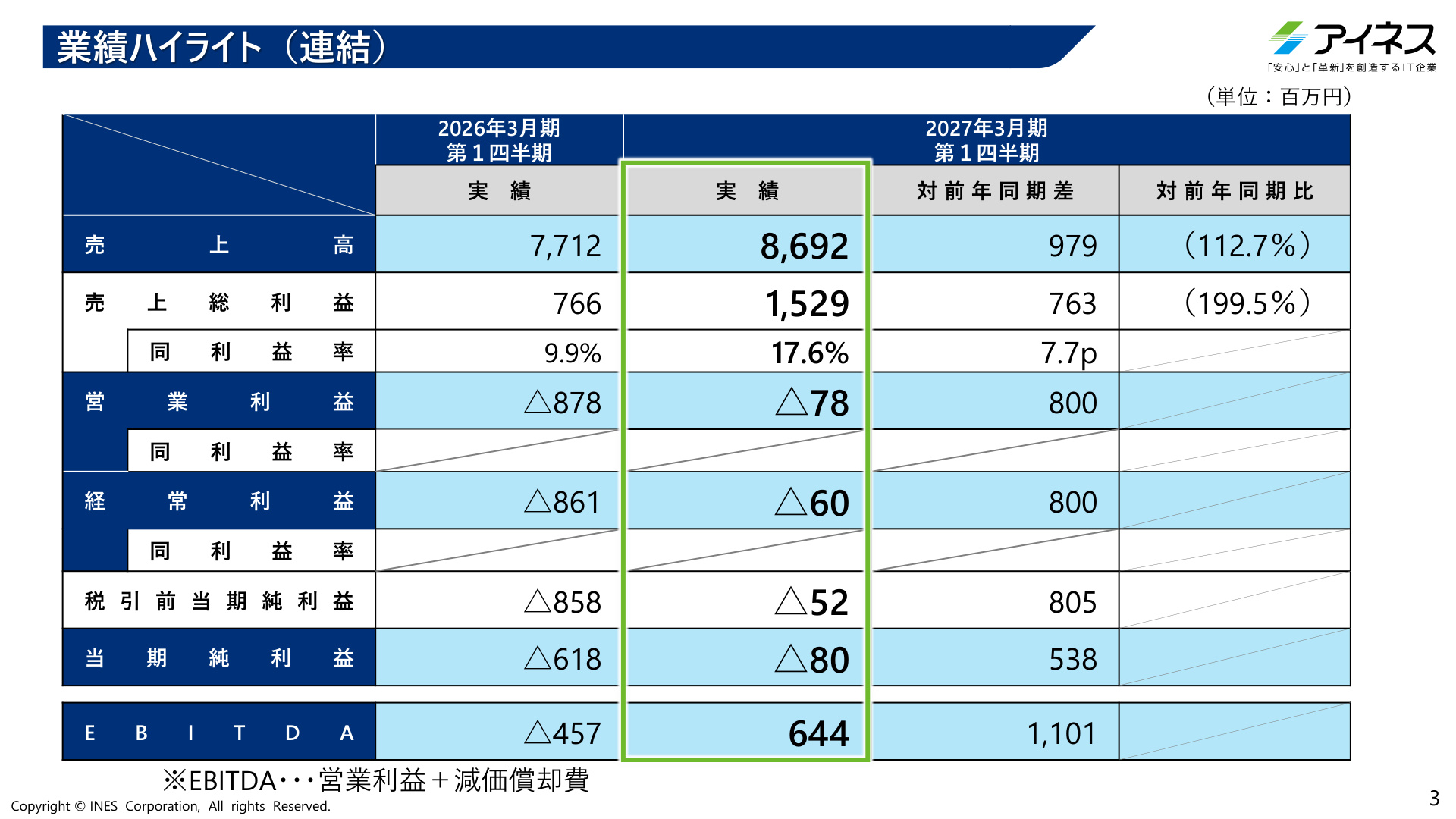
The key items from the income statement for the first quarter and their year-on-year improvements are as follows:
- Net Sales : 8,692 million yen ( +12.7% YoY / +979 million yen)
- Gross Profit : 1,529 million yen ( +99.5% YoY / +763 million yen)
- Gross Profit Margin : 17.6% ( +7.7 percentage points YoY )
- Operating Profit : -78 million yen (vs. -878 million yen in Q1 FY2026 / +800 million yen improvement )
- Ordinary Profit : -60 million yen (vs. -861 million yen in Q1 FY2026 / +800 million yen improvement )
- Net Profit : -80 million yen (vs. -618 million yen in Q1 FY2026 / +538 million yen improvement )
- EBITDA : 644 million yen (vs. -457 million yen in Q1 FY2026 / +1,101 million yen improvement )
The following slide provides a detailed overview of the Q1 profit and loss structure and year-on-year comparisons.
[Slide Commentary: Importance and Background of Performance Highlights]
The most critical takeaways from the slide above are the "dramatic improvement in gross profit margin" and the "return to positive EBITDA." The gross profit margin improved by 7.7 percentage points from 9.9% in the same period last year to 17.6% , with gross profit expanding (+99.5%) at a pace significantly outpacing revenue growth (+12.7%). This is likely attributable to the progress of high-margin projects, the mitigation of loss-making factors, and improved utilization rates.
Furthermore, EBITDA—a measure of cash-based generation capacity that adds back depreciation—turned clearly positive at 644 million yen (+1,101 million yen YoY) . While depreciation of intangible assets related to upfront investments in municipal system standardization continues to weigh on the bottom line, it is evident that the company's underlying cash-generating capability has improved significantly.
2. Revenue Trends by Sector and Growth Drivers
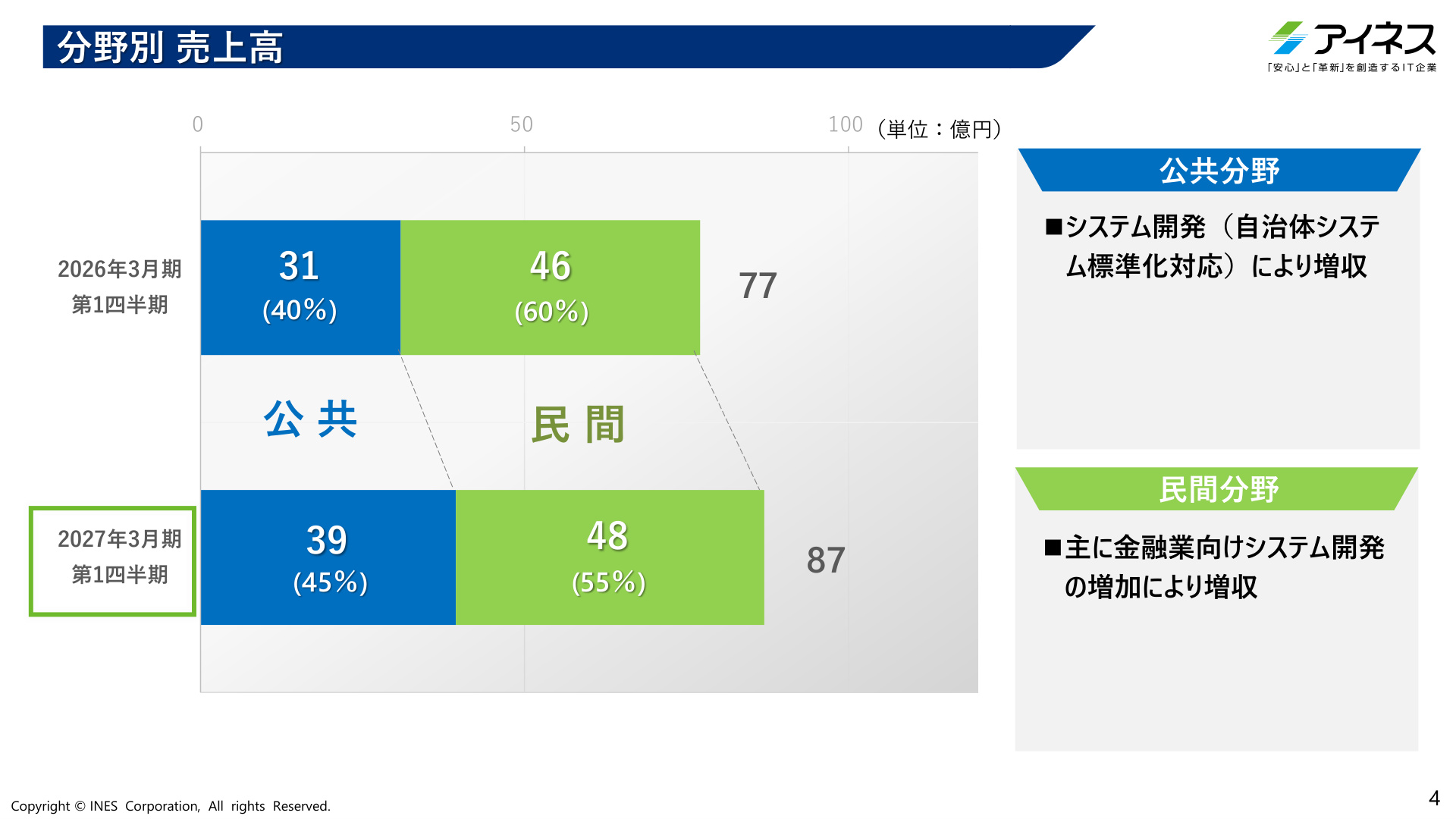
The company's revenue is broadly categorized into the "Public Sector," targeting government agencies such as national and local municipalities, and the "Private Sector," targeting financial institutions and private enterprises. Q1 performance by sector is as follows:
- Public Sector : 3.9 billion yen (45% of total / vs. 3.1 billion yen, 40% of total in Q1 FY2026)
- Private Sector : 4.8 billion yen (55% of total / vs. 4.6 billion yen, 60% of total in Q1 FY2026)
- Total Sales : 8.7 billion yen (vs. 7.7 billion yen in Q1 FY2026)
Details regarding the sector composition and factors behind the revenue growth are shown in the slide below.
[Slide Commentary: Importance of Sector Trends and Structural Changes]
The slide above illustrates that while the company achieved revenue growth in both sectors, the Public Sector is acting as the primary driver .
- Public Sector (+25.8% YoY / +0.8 billion yen) : The significant revenue increase is primarily due to the steady progress of system development projects related to the government-led "Municipal System Standardization." As local governments nationwide move toward standardizing and centralizing core systems, demand for INES's specialized municipal solutions remains robust.
- Private Sector (+4.3% YoY / +0.2 billion yen) : Steady growth was maintained, supported by the expansion of system development projects for the financial industry . The company is successfully capturing demand for DX investments and system renewals among financial institutions.
As a result, the Public Sector's share of total company sales has risen by 5 percentage points from 40% to 45% , demonstrating that municipal DX projects aligned with national policy are strongly supporting the company's performance momentum.
3. Evaluation of Financial Position and Cash Position
The balance sheet as of the end of the first quarter (June 30, 2026) is as follows:
- Total Assets : 48,743 million yen (-618 million yen from end of previous FY)
- Current Assets: 22,721 million yen ( +504 million yen )
- Fixed Assets: 26,021 million yen (-1,122 million yen)
- Liabilities : 12,203 million yen (-192 million yen)
- Current Liabilities: 6,914 million yen (-16 million yen)
- Fixed Liabilities: 5,288 million yen (-176 million yen)
- Net Assets : 36,540 million yen (-426 million yen)
Factors Affecting Assets/Liabilities and Cash Flow
- Assets : Current assets increased due to an rise in cash and deposits following the collection of accounts receivable. Conversely, fixed assets decreased due to the redemption of corporate bonds and the progress of depreciation.
- Liabilities : Liabilities decreased, primarily in fixed liabilities, due to the repayment and reduction of long-term borrowings.
- Cash and Deposits : Looking at historical quarterly trends, there is a seasonal tendency for cash and deposit balances to spike in the first quarter due to the collection cycle of accounts receivable. In the current period, cash and deposits have accumulated to approximately 16 billion yen, maintaining a highly abundant and safe financial structure .
- Equity Ratio : With net assets reaching approximately 36.5 billion yen, the company maintains an extremely sound equity ratio exceeding 70%.
4. Full-Year Earnings Forecast and Shareholder Return Policy
INES has maintained its initial full-year earnings forecast for the fiscal year ending March 2027 (Sales: 40 billion yen, Operating Profit: 2.5 billion yen). Although the first quarter resulted in a small operating loss (-78 million yen) due to the upfront occurrence of various investment costs, this is a significant improvement from the same period last year (-878 million yen), and progress toward full-year profitability remains on track.
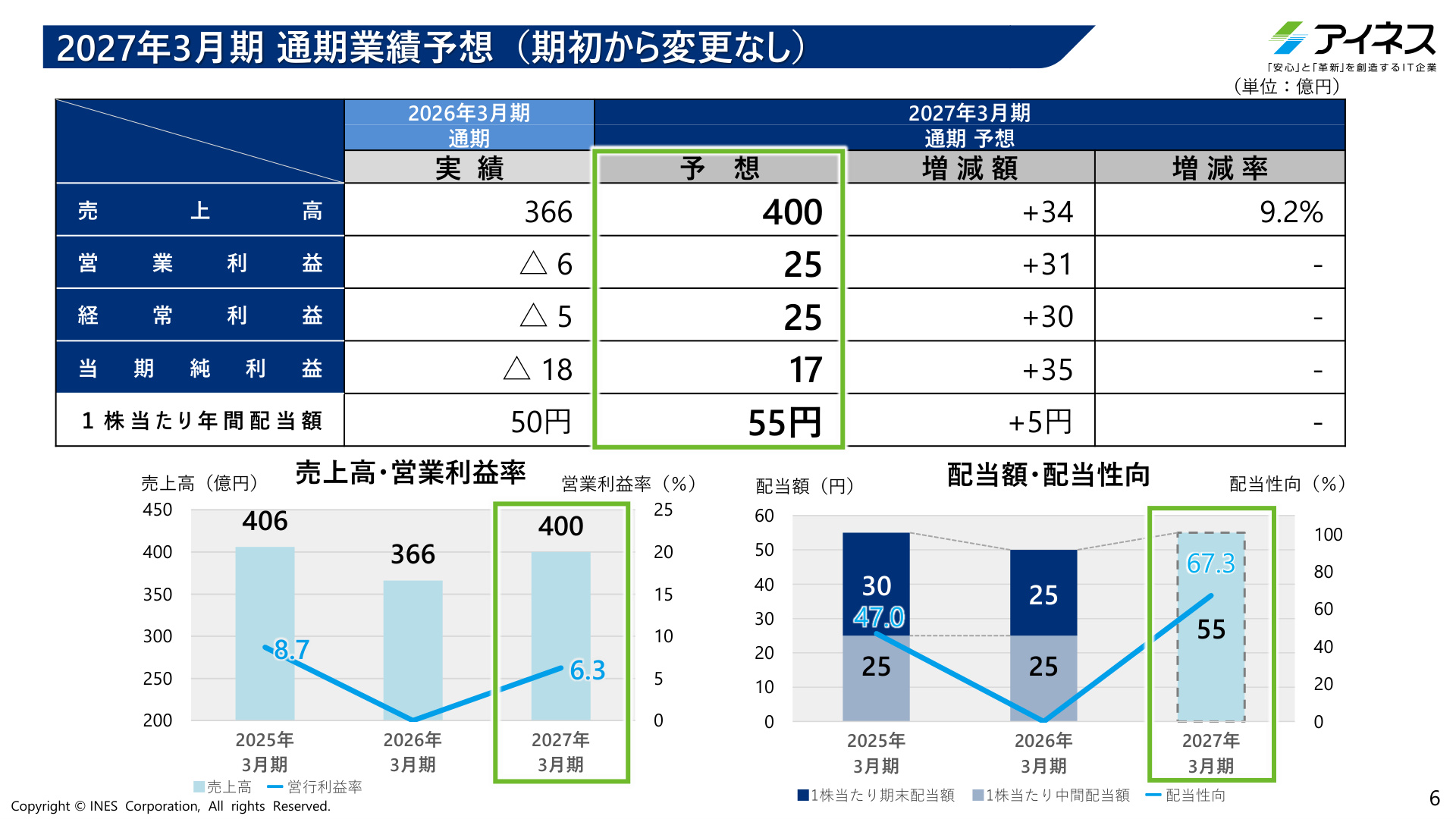
Details of the full-year earnings forecast and dividend plan are shown in the slide below.
[Slide Commentary: Full-Year Forecast and Return Stance]
This slide clearly outlines the company's mid-term V-shaped recovery scenario and its proactive stance toward shareholder returns .
-
Full-Year Earnings Forecast (Unchanged from initial plan) :
- Net Sales : 40 billion yen ( +9.2% YoY / +3.4 billion yen)
- Operating Profit : 2.5 billion yen (vs. -0.6 billion yen in previous FY / +3.1 billion yen turnaround )
- Operating Profit Margin : 6.3% (vs. -1.6% in previous FY)
- Net Profit : 1.7 billion yen (vs. -1.8 billion yen in previous FY / +3.5 billion yen turnaround )
While the previous fiscal year (FY2026) saw a temporary operating loss due to the concentration of municipal system standardization investments, the current fiscal year (FY2027) is planned as a significant V-shaped recovery to 2.5 billion yen in operating profit, as investments cycle through and development results contribute to sales while depreciation burdens normalize.
-
Shareholder Returns (Dividend Policy) :
- Annual Dividend per Share : 55 yen (Interim 25 yen, Year-end 30 yen / +5 yen increase from 50 yen in previous FY)
- Forecasted Dividend Payout Ratio : 67.3%
The company has demonstrated a policy of reliably increasing dividends during the earnings recovery phase. By maintaining a high payout ratio (67.3%), it confirms a strong commitment to both the efficient use of shareholder capital and profit distribution.
5. Summary and Future Focus Points
INES's Q1 FY2027 results demonstrate that the company is successfully capturing the tailwinds of the large-scale national policy theme of municipal system standardization, achieving steady revenue growth and a significant reduction in losses .
Key points for investors to watch moving forward include:
- Completion Timing and Profitability of Municipal Standardization Projects : Whether projects peaking between FY2025 and FY2026 can be delivered on schedule and within budget, maintaining high gross profit margins.
- Pace of Profit Generation in the Second Half : Due to the industry characteristics of system integrators, there is a tendency for acceptance and revenue recognition to concentrate in the second half (particularly Q4). The progress toward the full-year operating profit target of 2.5 billion yen will be closely monitored from Q2 onwards.
- Sustainability of Private Sector DX Demand : Whether project acquisition in the private sector continues to progress steadily, maintaining a balanced portfolio.
- Capital Efficiency and Shareholder Returns : Whether there will be next-generation IT investments or additional return measures utilizing the abundant cash on hand, while maintaining the high return level of a 55 yen annual dividend (67.3% payout ratio).
Having emerged from the upfront investment phase, the company is transitioning into an investment recovery and earnings recovery phase, making quarterly performance progress a key focus for the future.
This content is not intended as investment advice or a recommendation. Any opinions expressed are solely the personal views of each article.