


【Earnings Deep Dive】 Fuji Housing (8860) Q1 FY2027: Achieving a Record-High Order Backlog of ¥69.9 Billion and the Full Picture of a Balanced Management Model with 70% Stock Revenue

StockClub
Published: Jul 31, 2026, 10:41 AM
Sentiment Analysis

Fuji Housing (8860) Q1 FY2027 Earnings Deep Dive Report
Fuji Housing Co., Ltd. has released its financial results for the first quarter of the fiscal year ending March 2027 (April 2026 – June 2026). While the company experienced a temporary year-on-year decline in revenue and profit due to the reactionary effect of large-scale condominium deliveries in the same period last year, as well as rising personnel costs and interest payments, progress toward the full-year consolidated sales target of ¥145 billion (a record high) remains extremely steady. Already, 81.2% of the full-year target is secured or projected (via order backlog and stock revenue).
This report extracts 10 key topics from the released earnings presentation materials, providing a comprehensive analysis of segment performance, financial structure, and future growth strategies.
1. Earnings Highlights: Q1 Results and Record-Breaking Order Backlog
Consolidated results for the first quarter were as follows: Net Sales of ¥35.278 billion (down 4.9% YoY) , Operating Profit of ¥2.035 billion (down 19.2% YoY) , Ordinary Profit of ¥1.715 billion (down 27.9% YoY) , and Quarterly Net Profit of ¥1.116 billion (down 30.4% YoY) .
While the results appear to show a decline in revenue and profit, this is primarily due to the reactionary drop from the concentration of large-scale condominium deliveries in the previous year's first quarter, and the figures are largely in line with the company's initial business plan.
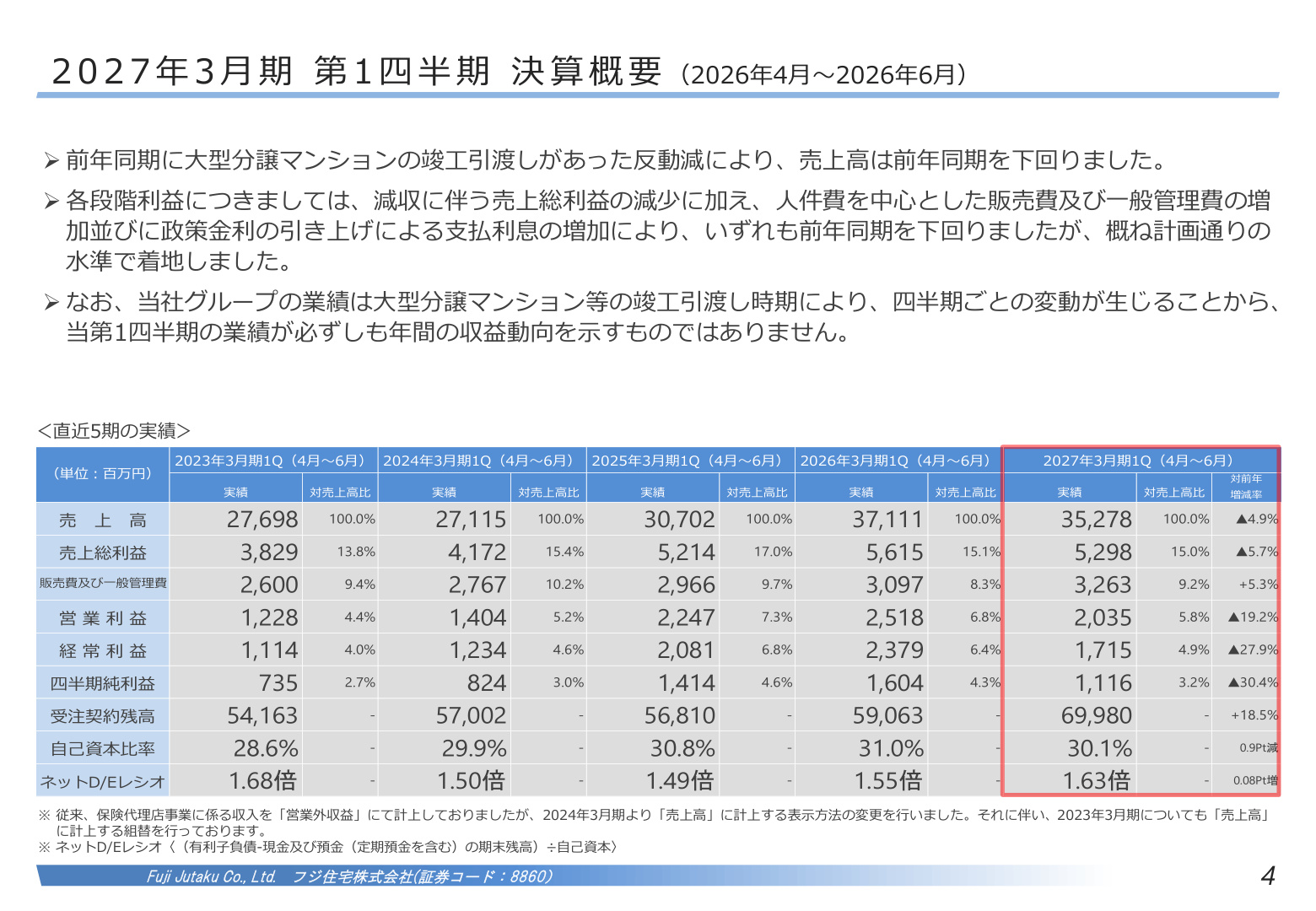
The slide above summarizes the Q1 performance trends and key financial indicators over the past five fiscal years. The reason this slide is critical is that it clearly illustrates the contrast between the "decline in revenue and profit on the P&L" and the "sharp increase in the order backlog, a leading indicator."
Although sales and profit levels fell short of the previous year, the order backlog, which serves as the source for future revenue, reached ¥69.98 billion (up 18.5% YoY) , marking a record high for a first-quarter closing. Since the real estate sales business uses the delivery-based revenue recognition method, quarterly earnings tend to fluctuate; however, the significant accumulation of the order backlog provides a solid foundation for future performance.
Furthermore, the equity ratio remains at a healthy 30.1% , maintaining the 30% threshold and confirming that the company is continuing aggressive business expansion while ensuring financial soundness.
2. Full-Year Earnings Forecast and Probability of Achievement
At the beginning of the fiscal year, the company left its full-year forecast undecided to assess the impact of supply chain uncertainties for construction materials and delivery timing due to escalating tensions in the Middle East. With the supply environment largely normalized, the company has now released its full-year earnings forecast .
- Net Sales : ¥145.00 billion (up 4.8% YoY, record-high forecast )
- Operating Profit : ¥9.10 billion (up 9.7% YoY)
- Ordinary Profit : ¥7.00 billion (up 0.1% YoY)
- Net Income : ¥4.60 billion (down 3.3% YoY)
The plan to achieve ¥145 billion in sales is built with a very high degree of certainty:
- Q1 Consolidated Sales : ¥35.2 billion (Progress rate: 24.3% )
- Portion of Order Backlog Scheduled for Current FY Sales : ¥55.3 billion (Contribution: 38.1% )
- Projected Rental and Management Revenue from July onwards : ¥27.3 billion (Contribution: 18.8% )
Combined, ¥117.8 billion (81.2% of the full-year target) is already within the range of high certainty. The remaining ¥27.2 billion is expected to be achieved through additional orders for built-to-sell houses, completed condominiums, short-turnover sales of pre-owned homes, and land utilization projects.
3. Segment Analysis: Contrasting Results and Strong Support from Stock Revenue
The trends in each segment clearly demonstrate the strengths of the company's "balanced management" approach.
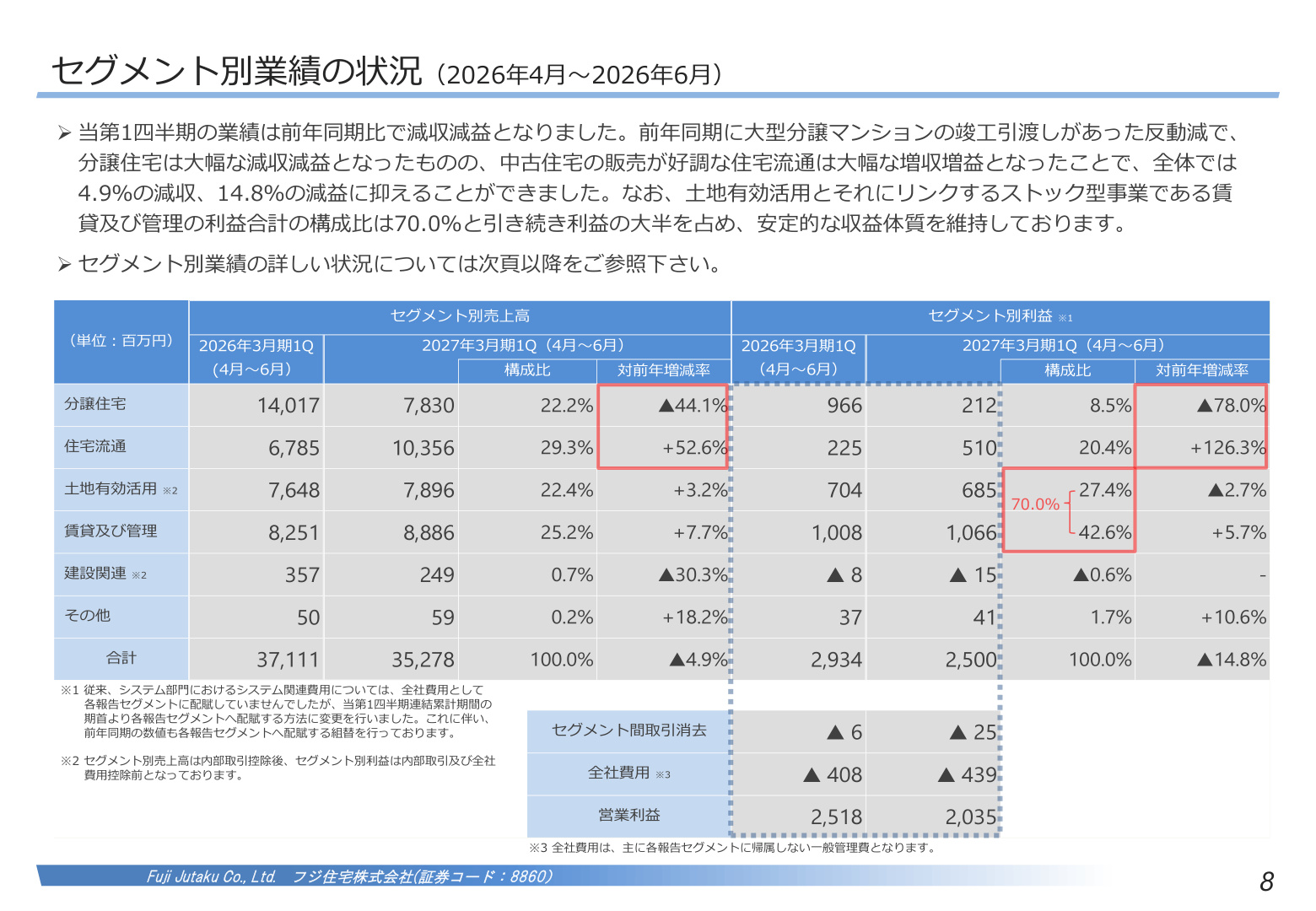
The slide above shows the year-on-year changes and composition ratios for sales and segment profit. The key takeaway from this data is that the business structure functions as a mutually complementary system where the reactionary decline in one segment is covered by growth in others.
Specifically, while the Housing Sales segment saw a significant decline—with sales down 44.1% YoY to ¥7.83 billion and profit down 78.0% to ¥0.212 billion—the Housing Distribution segment expanded rapidly, with sales of ¥10.356 billion (up 52.6% YoY) and segment profit of ¥0.51 billion (up 126.3% YoY).
Even more noteworthy is that the combined segment profit ratio of "Land Utilization" and "Rental and Management" reached 70.0% (¥1.751 billion). Because these stock-based, stable businesses—which are less susceptible to economic fluctuations—generate the majority of total profit, the company has built a stable earnings structure capable of absorbing quarterly volatility caused by condominium delivery timing.
Detailed Segment Status
- Housing Sales Segment
- Custom-built homes performed well with 154 units delivered (up 13.5% YoY). Conversely, condominium deliveries dropped significantly to 31 units (compared to 190 units in the same period last year). However, this is because condominium completions and deliveries for this fiscal year are concentrated in the second half (3 buildings/253 units) , and order intake remains extremely robust.
- Housing Distribution Segment
- Strategic inventory accumulation in response to rising demand for pre-owned homes has paid off. Sales of pre-owned condominiums reached 306 units (up 24.4% YoY), and pre-owned detached houses reached 41 units (up 78.3% YoY). Exceptional expertise in purchasing and reselling is driving performance.
- Land Utilization Segment
- The company develops construction contracts for rental apartment buildings for individual investors (the "Fuji Palace" series) and housing for the elderly with services. Sales were steady at ¥7.896 billion (up 3.2% YoY), and high occupancy rates ( 97.8% ) are maintained through strong leasing capabilities, including management systems.
- Rental and Management Segment
- Number of rental units under management reached 40,932 (up 2,330 units YoY), and the number of elderly housing facilities operated reached 289 (up 15 facilities YoY, No. 1 in Japan ). With sales of ¥8.886 billion (up 7.7% YoY) and segment profit of ¥1.066 billion (up 5.7% YoY), this segment functions as a reliable source of stock revenue that accumulates steadily each term.
4. Analysis of Order Backlog: Record Levels Promising Future Performance
The most important indicator for gauging Fuji Housing's growth potential is the "Order Backlog."
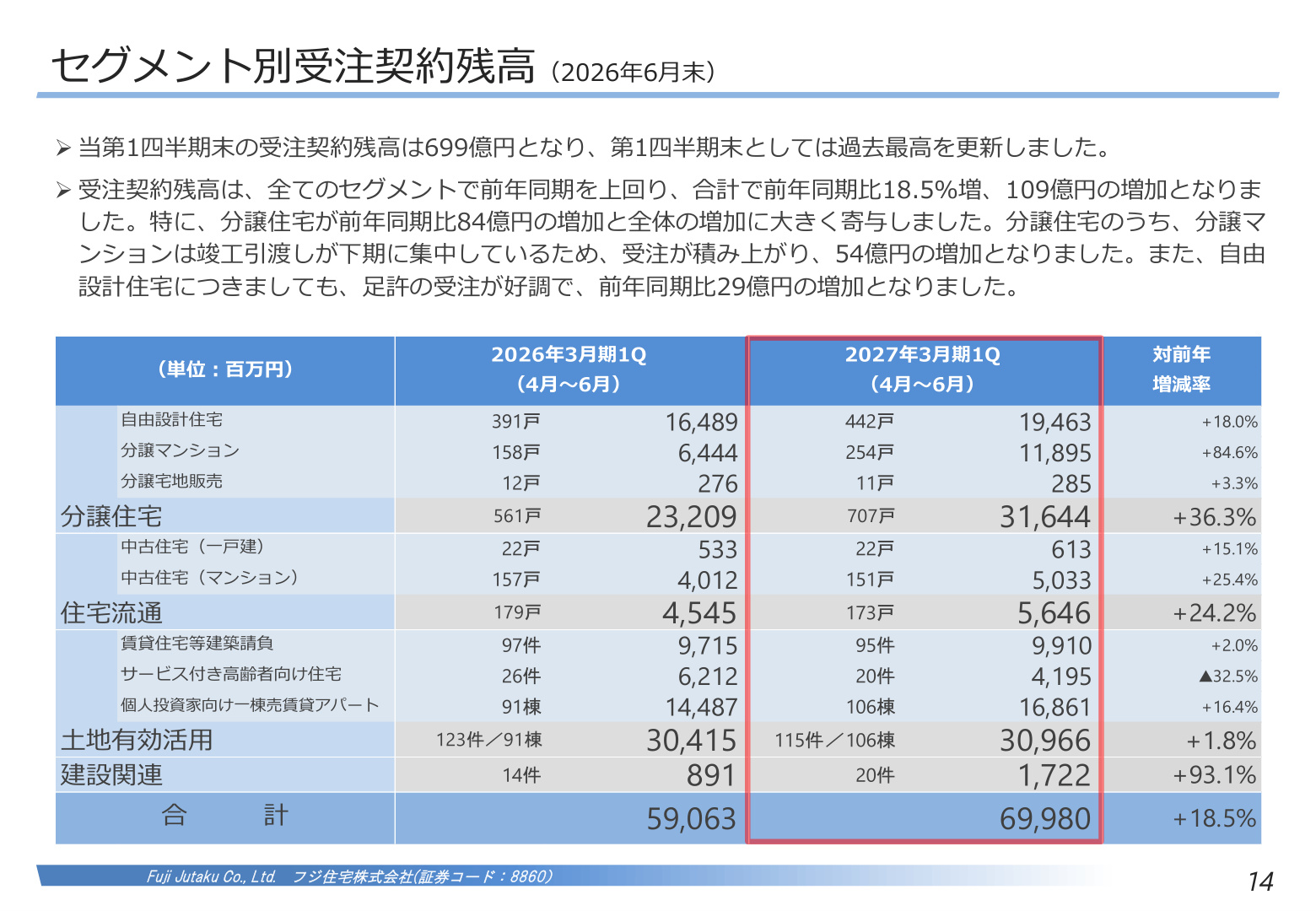
This slide provides detailed data on the trends in order backlog for each segment and their year-on-year growth. The importance of this slide lies in the fact that it shows order backlogs have increased year-on-year in every single segment.
The total company order backlog reached ¥69.98 billion (up 18.5% YoY, an increase of ¥10.9 billion) , achieving a record high for a first-quarter closing.
- Housing Sales : ¥31.644 billion (up 36.3% YoY)
- In addition to the accumulation of condominium orders shifting to the second half (¥11.895 billion, up 84.6% YoY), custom-built homes also showed strong underlying demand at ¥19.463 billion (up 18.0% YoY).
- Housing Distribution : ¥5.646 billion (up 24.2% YoY)
- Land Utilization : ¥30.966 billion (up 1.8% YoY)
- The order backlog for rental apartment buildings is progressing steadily at 106 buildings (up 15 buildings YoY), and sales are expected to exceed the previous fiscal year's total.
As shown, the steady accumulation of projects across all departments provides significant confidence in performance for this and the next fiscal year.
5. Management Indicators, Financial Strategy, and Shareholder Returns
The company's firm and ambitious stance is also evident in its financial and shareholder return policies.
- Maintaining Financial Soundness : Due to strengthened land acquisition and inventory securing, interest-bearing debt increased, causing the net D/E ratio to rise slightly to 1.63x (up 0.08 points from 1.58x at the end of the previous fiscal year). However, the equity ratio remains at 30.1% , maintaining high safety standards while leveraging capital.
- Approach to ROE and PBR : While ROE for the fiscal year ended March 2026 was 8.4% , exceeding the assumed cost of capital, the PBR remains at 0.51x , below the 1.0x level. The company aims to improve market valuation by concentrating investments in high-efficiency, high-stability businesses like land utilization and rental management, while strengthening IR activities.
- Dividend Policy (Progressive Dividend Policy) : Based on a policy of stable dividends, the company continues its progressive dividend policy introduced in the fiscal year ended March 2024. The annual dividend per share for the fiscal year ending March 2027 is planned at ¥32 (¥16 interim, ¥16 year-end) , with a projected payout ratio of 24.9% . The company also promotes comprehensive shareholder returns through shareholder benefit programs and share buybacks.
6. Summary and Future Focus Points
Fuji Housing's Q1 FY2027 earnings, beyond the surface-level decline in revenue and profit due to the reactionary effect of large-scale deliveries in the previous year, demonstrated the robustness of its business model and the strength of its future growth foundation.
Future Focus Points :
- Earnings recovery driven by the concentration of condominium deliveries in the second half.
- Expansion pace of the pre-owned home purchase and resale (Housing Distribution) business, which continues to see high yields and high demand.
- Accumulation of stock revenue (Rental and Management) based on a portfolio of over 40,000 managed units.
- Conversion of the record-high order backlog (¥69.98 billion) into actual sales.
With its unique strategy of community-based "balanced management" and "strengthening of stock businesses," the company's progress toward its record-high sales target of ¥145 billion will continue to be closely monitored.
This content is not intended as investment advice or a recommendation. Any opinions expressed are solely the personal views of each article.