


Nichiha (7943) Q1 FY2027 Earnings Analysis: Profit Doubling Driven by U.S. Operational Turnaround and Robust Capital Policy

StockClub
Published: Jul 31, 2026, 10:35 AM
Sentiment Analysis
Nichiha Corporation (Securities Code: 7943) reported its Q1 results for the fiscal year ending March 2027 , showing a slight decline in net sales year-on-year, yet achieving significant growth in profit at all levels . This performance was driven by the successful pass-through of price revisions in the domestic market, the expansion of high-value-added products and dramatic profitability improvements in the U.S. business, and a reversal of foreign exchange losses.
This report provides a detailed analysis of the company's current performance, structural drivers, market trends, and capital policy—with a focus on shareholder returns—based on 10 key topics derived from the earnings materials.
1. Consolidated Earnings Highlights: Overcoming Lower Sales with Overwhelming Profit Growth
In Q1 FY2027, consolidated net sales were 33,985 million yen (down 2.5% YoY) . Conversely, operating profit reached 1,893 million yen (up 62.6% YoY) , ordinary profit hit 1,907 million yen (up 100.4% YoY) , and net profit attributable to owners of the parent surged to 2,401 million yen (up 245.2% YoY) .
While sales saw a marginal decline, operating profit grew 1.6x, ordinary profit doubled, and net profit increased 3.45x, highlighting a qualitative shift in the company's profit structure.
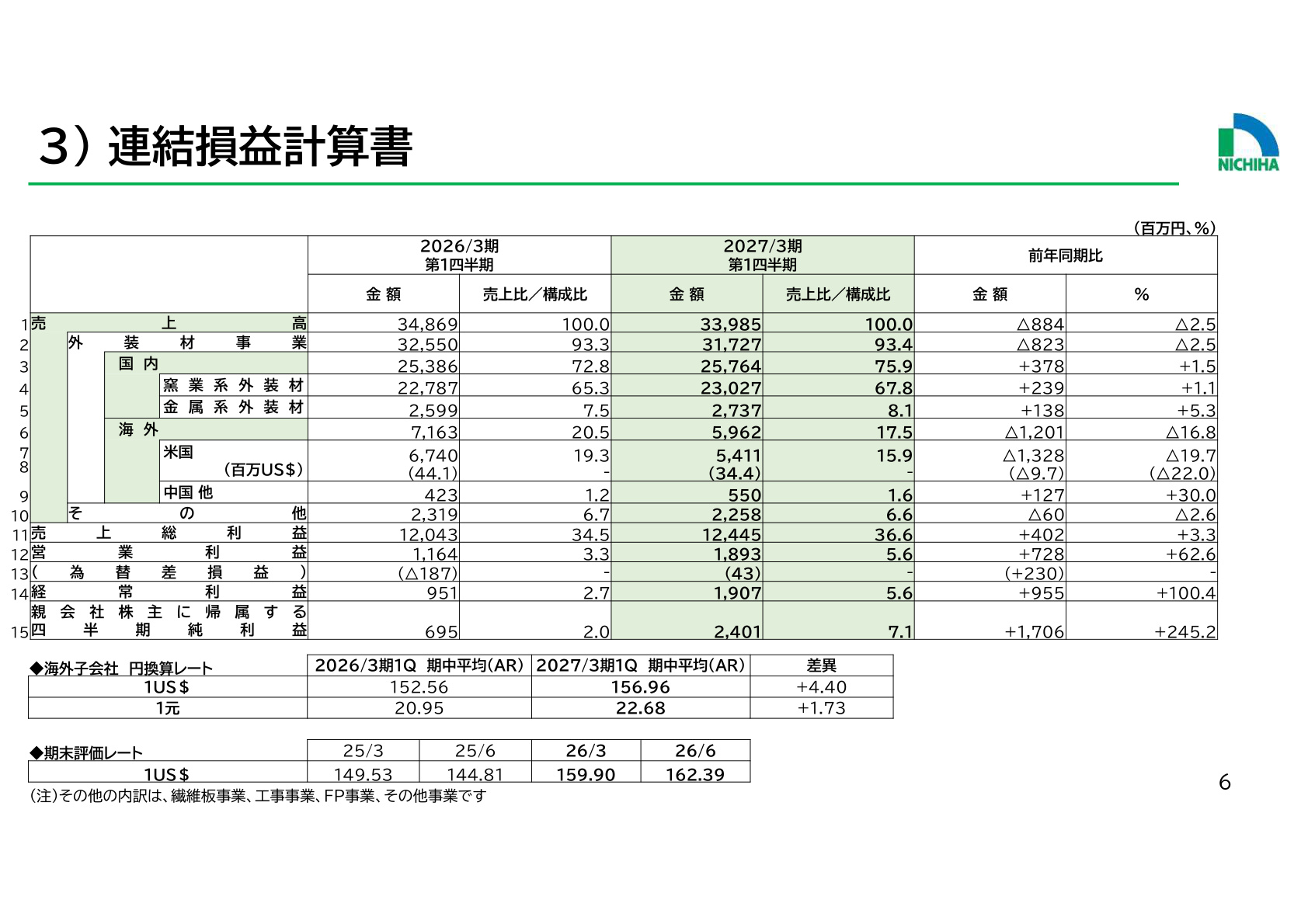
The consolidated statement of income slide above clearly illustrates the business-by-business breakdown and the impact of exchange rates behind this substantial profit growth. In the core exterior materials business, domestic ceramic siding sales remained solid at 23,027 million yen (up 1.1% YoY) , while metal siding sales reached 2,737 million yen (up 5.3% YoY) . Although overseas sales declined to 5,962 million yen (down 16.8% YoY) (34.4 million USD), profitability improved significantly due to enhanced local margins. Furthermore, the shift from a 187 million yen foreign exchange loss in the same period last year to a 43 million yen gain this period contributed significantly to the 100.4% YoY increase in ordinary profit.
2. Domestic Housing Market Trends and Market Share
The domestic housing starts market is showing signs of recovery, particularly in the detached housing segment. New detached housing starts in Q1 reached 82,000 units (up 23.6% YoY) , a strong increase. However, total industry sales volume for ceramic exterior materials was 6,001 thousand tsubo (down 2.6% YoY) , indicating a slight time lag compared to the growth in housing starts.
Nichiha’s ceramic siding sales volume was 3,498 thousand tsubo (down 3.0% YoY) , resulting in a market share of 58.3% (down 0.2 percentage points YoY) . Nevertheless, the company is pursuing a strategy to maintain and improve unit selling prices despite the overall market downturn, successfully offsetting volume declines with revenue growth.
3. U.S. Housing and Construction Market Sentiment
In the U.S. market, housing starts as of June 2026 remained flat at 1.427 million units (seasonally adjusted annual rate) . Furthermore, the Architecture Billings Index (ABI) , an indicator of design sentiment for commercial and industrial buildings, stood at 46.7 , remaining below the 50-point threshold that separates growth from contraction.
Despite this challenging external environment, the company is shifting its focus from commodity-grade residential products to commercial-use (high-end) products known for superior design and durability, thereby transitioning toward a high-profit structure less susceptible to market fluctuations.
4. Domestic Business Operating Profit Factors: Results of Price Revisions and Cost Management
Operating profit in the domestic business expanded from 830 million yen in the same period last year to 1,130 million yen (up 290 million yen, +35.4% YoY) .
Analysis of the factors behind this change is as follows:
- Sales Factors (Price revisions, domestic subsidiaries, etc.) : +480 million yen contribution. Despite lower sales volume, the impact of previous price revisions boosted profits.
- Material and Energy Costs : -100 million yen negative impact. Raw material and energy costs remain at high levels.
- Inventory Changes (Manufacturing fixed costs) : -40 million yen negative impact.
- Fixed Cost Increases : -30 million yen negative impact.
The domestic business achieved profit growth by fully absorbing cost increases through price revisions and improved product mix , thereby enhancing profit margins.
5. U.S. Business V-Shaped Recovery: Shift to High-End Products and Production Efficiency
The most notable point in this quarter's earnings is the dramatic improvement in U.S. business profitability . Sales in local currency were 34.4 million USD (compared to 44.1 million USD in the same period last year, which consisted of 12.5 million USD in commodity residential and 31.6 million USD in high-end products). By decisively withdrawing from and reducing commodity products to focus exclusively on commercial (high-end) products (34.4 million USD), the company saw a decline in total sales scale, but operating profit made a dramatic turnaround from a 0.1 million USD loss in the same period last year to a 3.9 million USD (approx. 616 million yen) profit .
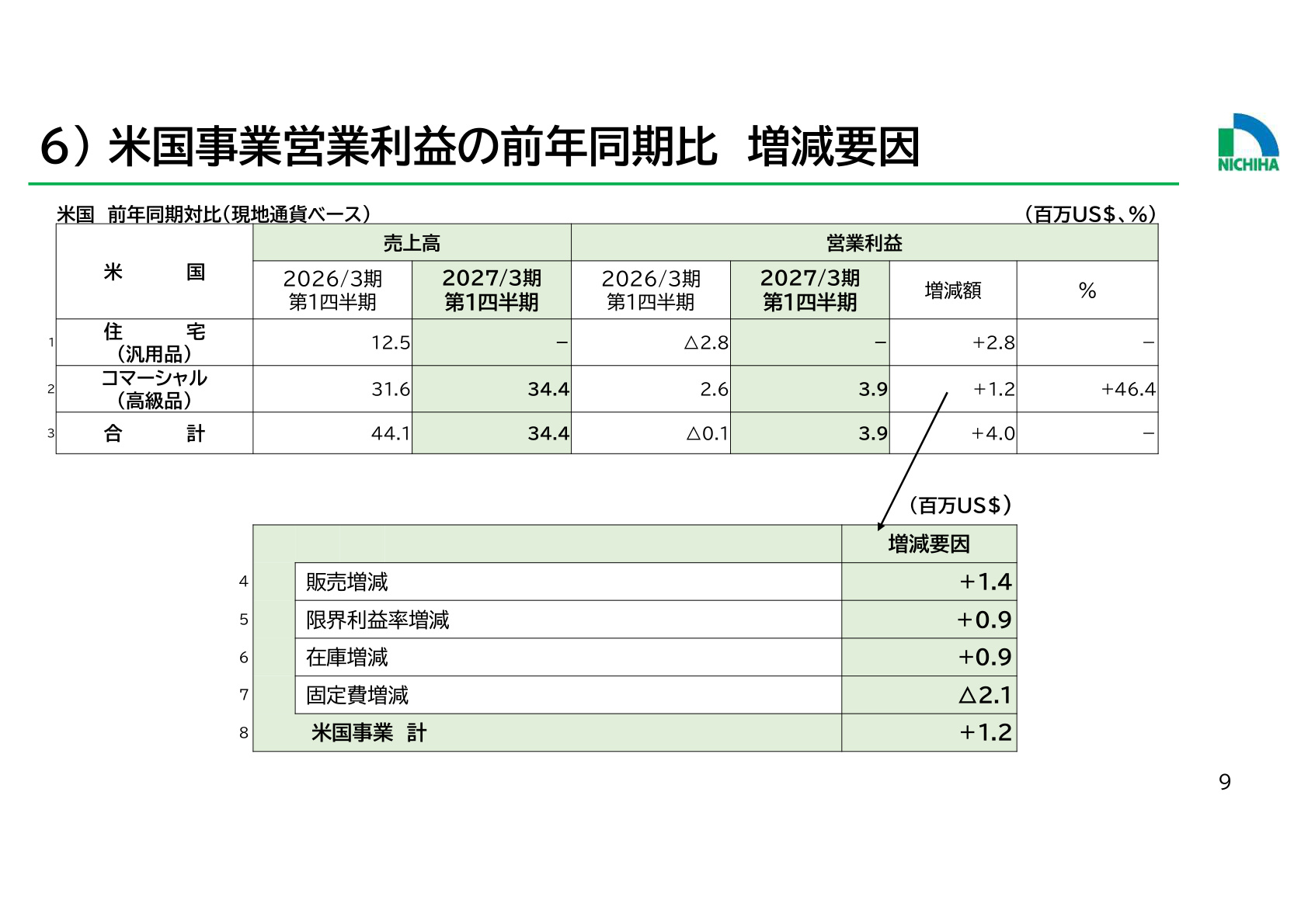
The slide above details why U.S. operating profit improved by +4.0 million USD (local currency basis) year-on-year. The breakdown of profit growth shows that sales volume/mix (+1.4 million USD) , marginal profit ratio (+0.9 million USD) , and inventory changes (+0.9 million USD) were major contributors. By completing the shift from low-margin commodity residential products to high-value-added commercial products, the marginal profit ratio improved dramatically. Combined with optimized operational rates and fixed cost control, the U.S. business has emerged as a major driver of consolidated profit.
6. Sustainable Growth in the Domestic Non-Residential Market
The domestic non-residential market (stores, offices, welfare facilities, etc.) , which the company is focusing on as a medium-to-long-term growth pillar, is showing very steady growth. Non-residential sales in Q1 reached 2,760 million yen (up 8.4% YoY) , maintaining a record-high pace.
Compared to the housing market, the non-residential market features larger adoption areas per project and a preference for high-end, design-oriented exterior materials. The company is steadily expanding its market share in the non-residential sector in anticipation of the long-term decline in detached housing starts.
7. China Business and Other Trends
Sales in the China business reached 933 million yen (up 16.3% YoY / 41.1 million yuan) , but operating profit was 26 million yen (down 14.6% from 30 million yen in the same period last year) , showing a slight stagnation. Amid the ongoing downturn in China's real estate market, the company continues to exercise cautious credit management and efficient sales activities.
8. Aggressive Capital Policy: Decision on Share Buybacks and Dividend Increases
Concurrently with the earnings announcement, the company unveiled a highly impactful capital policy aimed at enhancing shareholder returns and capital efficiency.
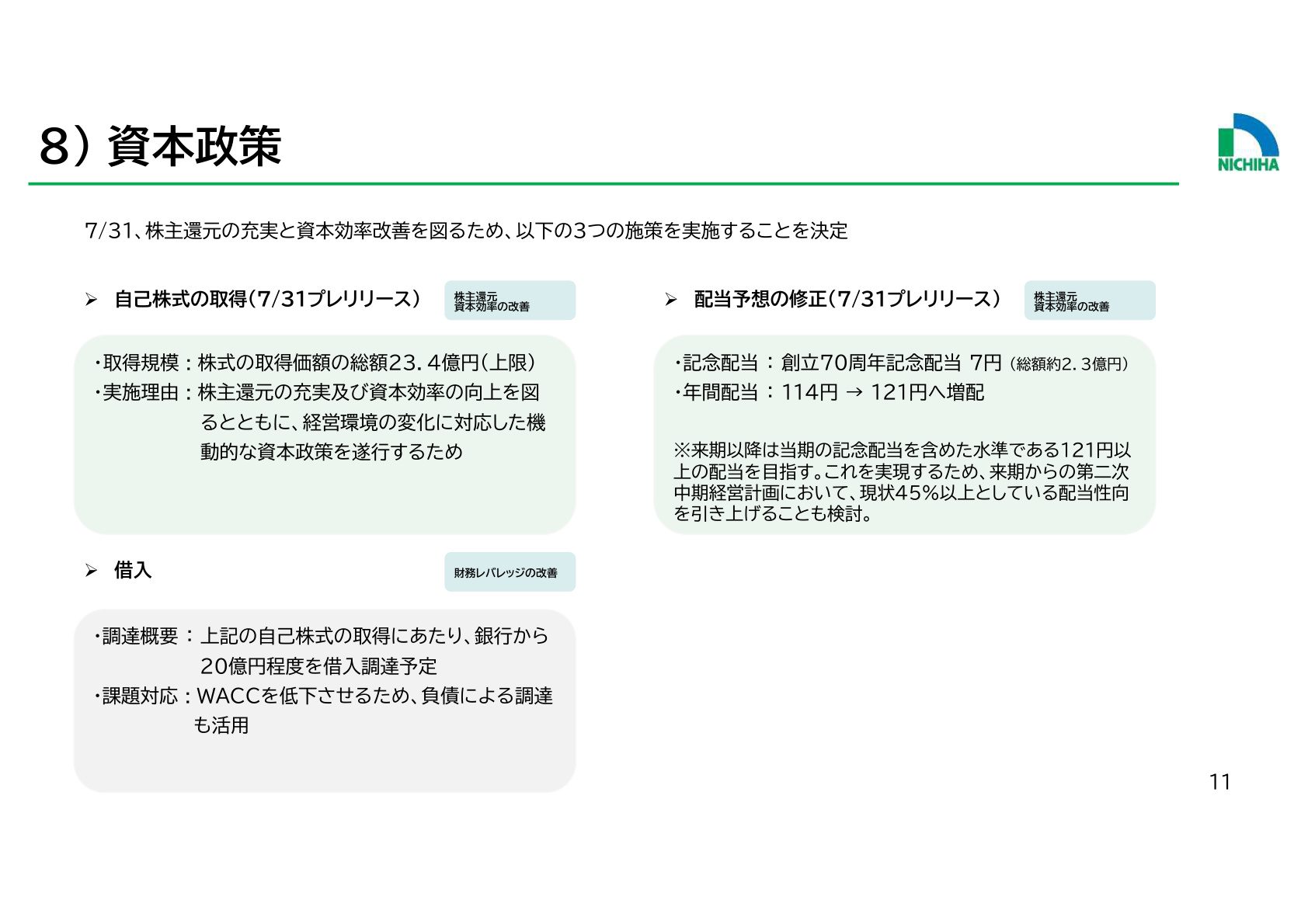
As shown in this slide, the initiatives are summarized in three points:
- Share Buybacks : Implementation of a share repurchase program with a cap of 2.34 billion yen to pursue flexible capital policy and improve ROE.
- Significant Dividend Increase : An additional 7 yen commemorative dividend for the 70th anniversary, raising the annual dividend forecast from 114 yen to 121 yen (a substantial increase over the previous fiscal year). Furthermore, the company aims to maintain a dividend level of at least 121 yen in future periods and is considering raising the dividend payout ratio to 45% or higher in the Second Medium-Term Management Plan.
- Utilization of Financial Leverage (Borrowing) : The company plans to borrow approximately 2 billion yen from banks to fund the share buybacks. By utilizing debt and being mindful of an optimal capital structure, the company aims to reduce its WACC (Weighted Average Cost of Capital) .
These are ambitious initiatives that embody the "management conscious of cost of capital and stock price" requested by the Tokyo Stock Exchange.
9. Progress Toward Full-Year Earnings Forecasts
The full-year consolidated earnings forecast for the fiscal year ending March 2027 remains unchanged:
- Net Sales : 141,000 million yen (down 1.9% YoY)
- Operating Profit : 9,600 million yen (up 2.6% YoY)
- Ordinary Profit : 9,800 million yen (down 4.4% YoY)
- Net Profit Attributable to Owners of the Parent : 8,000 million yen (up 221.7% YoY)
The progress rate for operating profit at the end of Q1 is 19.7% ; however, the company's performance typically tends to be weighted toward the second half (the H1 operating profit forecast is 3,600 million yen, making the Q1 progress rate 52.6% , which is extremely steady). Considering the stabilization of U.S. profitability and growth in domestic non-residential, the company has made a solid start toward achieving its H1 targets.
10. Conclusion: Overall Earnings Picture and Medium-to-Long-Term Story
What is clear from these results is that Nichiha is transforming from a mere "domestic detached housing exterior manufacturer" into a "highly profitable company earning from the U.S. high-value-added market and the domestic non-residential market."
Three growth engines are beginning to function: appropriate price pass-through in the domestic market, structural reform in the U.S. business (significant improvement in marginal profit ratio through concentration on commercial products), and expansion in the non-residential sector. Combined with a robust capital policy —including share buybacks, dividend increases, and WACC reduction through debt utilization—this earnings report clearly demonstrates management's commitment to enhancing corporate value.
This content is not intended as investment advice or a recommendation. Any opinions expressed are solely the personal views of each article.