

Mitsubishi Kakoki Kaisha Q1 FY2027 Earnings Analysis: Structural Reform for GX Business Profitability and Accelerated Mid-to-Long-Term Growth

StockClub
Published: Jul 31, 2026, 10:21 AM
Sentiment Analysis
Mitsubishi Kakoki Kaisha Q1 FY2027 Earnings Deep-Dive Report
Mitsubishi Kakoki Kaisha, Ltd. (Securities Code: 6331) achieved significant year-on-year growth in both revenue and profit for the first quarter of the fiscal year ending March 31, 2027 (April 1, 2026 – June 30, 2026), driven by its core Engineering business and the high-profile GX (Green Transformation) business . This report provides a detailed analysis of the company's recent performance highlights, segment trends, key topics, and updates to its mid-to-long-term management plan based on the released financial materials.
1. Q1 FY2027 Earnings Summary and Revision of Full-Year Forecast
Overview of Q1 Results
Mitsubishi Kakoki's consolidated Q1 results were as follows: Net Sales of 18,805 million yen (+18.9% YoY) , Operating Profit of 2,022 million yen (+40.3% YoY) , Ordinary Profit of 2,090 million yen (+19.2% YoY) , and Quarterly Net Profit Attributable to Owners of the Parent of 1,942 million yen (+66.5% YoY) . Orders received also showed remarkable growth, reaching 16,171 million yen (+56.0% YoY) .
Driven by an increase in gross profit resulting from higher sales, the operating profit margin improved by 1.7 percentage points to 10.8% , up from 9.1% in the same period last year. Furthermore, quarterly earnings per share (EPS) rose significantly from 51.20 yen to 85.25 yen .
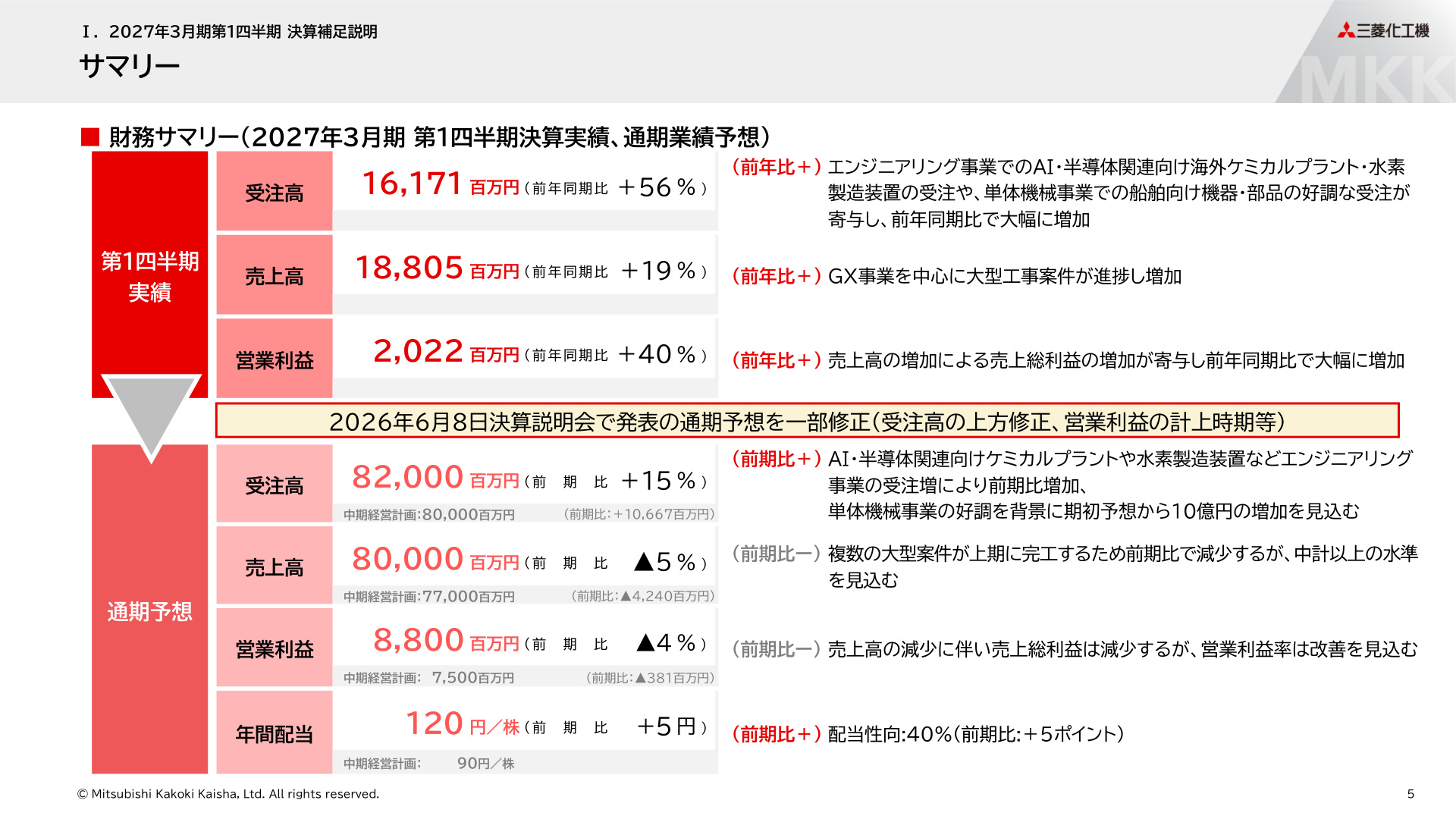
Slide Commentary: The Importance of the Financial Summary
The slide above (P.5) is the most critical data for grasping the extremely strong earnings momentum in Q1 and the policy for revising the full-year forecast. The rapid growth in Q1—with orders received up 56% YoY and operating profit up 40% YoY —is underpinned by the acquisition of orders for overseas chemical plants related to AI and semiconductors, hydrogen production equipment, and strong sales of marine equipment. More importantly, reflecting the strength in AI/semiconductor-related plants and standalone machinery, the company has upwardly revised its full-year order forecast by 1 billion yen, from 81 billion yen to 82 billion yen (+15% YoY) . While the full-year forecasts for net sales and operating profit remain unchanged from the initial plan, this accounts for the scheduling impact of multiple large-scale projects slated for completion in the first half, indicating that the business fundamentals remain extremely robust.
Structural Changes in SG&A Expenses and Growth Investment
Selling, General and Administrative (SG&A) expenses for Q1 were 2,181 million yen (+10.7% YoY). However, the ratio to net sales decreased from 12.5% to 11.6% (a 0.9 percentage point improvement) , contributing to higher profitability. An analysis of the breakdown shows that R&D expenses for new product creation rose to 186 million yen (+71.8% YoY) , and estimate design costs increased to 248 million yen (+32.6% YoY) due to a surge in inquiries. This should be viewed not merely as a cost increase, but as a proactive growth investment aimed at securing future orders and revenue.
2. Detailed Segment Analysis
The company's business is classified into three segments: "Engineering Business," "Standalone Machinery Business," and "GX Business." The status of each segment is as follows:
① Engineering Business: Driven by Strong Demand in Semiconductor and Hydrogen Sectors
- Orders Received : 9,948 million yen (+115.7% YoY) , doubling year-on-year.
- Net Sales : 7,895 million yen (-10.2% YoY).
- Segment Profit : 286 million yen (+109.4% YoY) .
Orders grew significantly against the backdrop of robust demand for AI/semiconductor-related chemical plants and hydrogen production equipment overseas. Although net sales saw a slight decline due to the timing of project progress for large-scale items, segment profit more than doubled year-on-year due to improved profitability in individual projects, cost-of-sales control, and SG&A efficiency.
② Standalone Machinery Business: Maintaining High Levels Amid Favorable Shipbuilding and Shipping Markets
- Orders Received : 6,008 million yen (+9.7% YoY) .
- Net Sales : 5,040 million yen (-1.8% YoY).
- Segment Profit : 1,380 million yen (-3.0% YoY).
Supported by the strong global shipbuilding and shipping market, orders for domestic marine equipment and parts remained at a high level, and orders for oil purifiers for China increased. The full-year order forecast has been upwardly revised from the initial 21 billion yen to 22 billion yen . The segment maintains a high profit margin (27.4%), demonstrating the company's solid value chain and earning power.
③ GX Business: Long-Awaited Profitability Achieved Through Significant Revenue Growth
- Orders Received : 784 million yen (-26.9% YoY).
- Net Sales : 5,868 million yen (+211.5% YoY) .
- Segment Profit : 355 million yen (Turned profitable from a 119 million yen loss in the same period last year) .
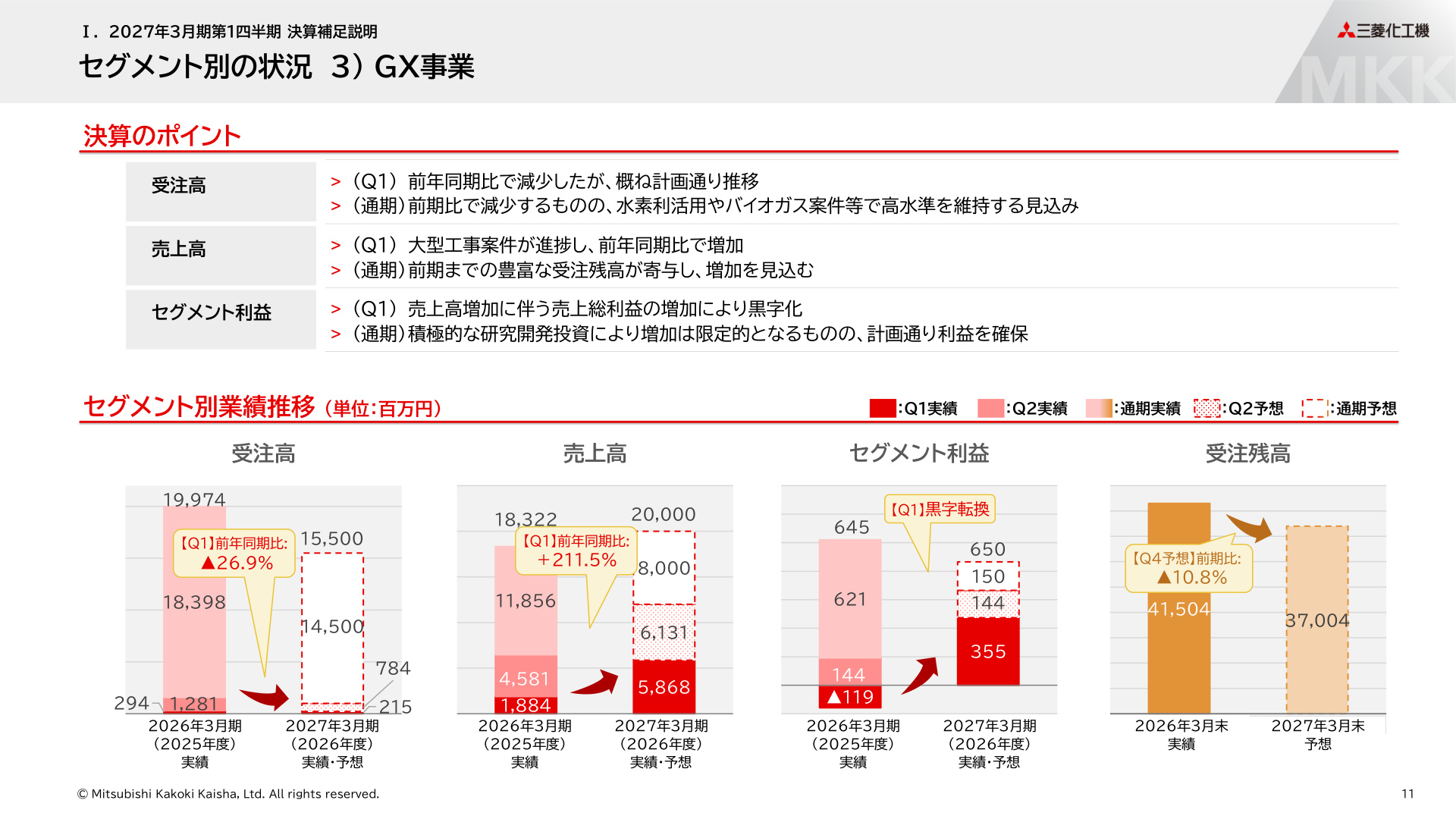
Slide Commentary: GX Business Segment Trends and the Significance of Profitability
The slide above (P.11) clearly shows that the "GX Business," which the company has been cultivating as a pillar of growth, has reached a major turning point. The abundant order backlog from the previous fiscal year was steadily executed, and with the progress of large-scale construction projects, net sales surged approximately 3.1 times year-on-year (5,868 million yen) . As a result of the sharp increase in gross profit accompanying the massive expansion in sales, the segment successfully turned to a profit of 355 million yen from a 119 million yen loss in the same period last year. While orders received appear to be in a temporary trough, this is in line with the planned order schedule centered on the second half, and a high level of performance is expected for the full year, particularly in hydrogen utilization and biogas projects. This is critical data proving that the company's solutions for a decarbonized society have begun to contribute to earnings in earnest.
3. Response to Macro Environment and Technical Topics
Risk Management for Middle East Tensions and Rising Material Costs
Regarding the external environment, there have been price hikes and supply constraints for certain materials (rubber products, paints, lubricants, PVC, etc.) due to crude oil and naphtha shortages. However, the company has promptly implemented diversification of suppliers , thorough inventory management , and consideration of alternative materials . As these materials currently account for a small percentage of total costs, the impact on earnings has been limited . Furthermore, there have been no delays or cancellations of customer capital investment plans, and stable business operations continue.
Development of Next-Generation Technologies and Progress in Demonstration Tests
The company is accelerating technology development for the decarbonization market:
- On-site Hydrogen Production Equipment (HyGeia Series) : Adoption is expanding for hydrogen reduction steelmaking demonstration equipment (e.g., for Nippon Steel) to reduce CO2 in steelmaking processes, and for environmental plants that produce hydrogen from biogas derived from sewage sludge, chicken manure, and food waste.
- Methanation Equipment Demonstration : The company is conducting methanation demonstration tests (started in March 2026) at its Kawasaki Works, combined with CO2 capture equipment, aiming for the early commercialization of circular technology that reuses CO2 as a raw material for city gas.
- Expansion of Oil Purifier (SJ Series) Applications : Applications are expanding beyond traditional marine use into new fields, such as impurity removal in the manufacturing process of SAF (Sustainable Aviation Fuel) made from waste cooking oil, and the concentration and recovery of microalgae that grow by absorbing CO2.
Synergy Creation Through M&A and Capital Alliances
In June 2026, the company acquired a 52.5% stake in Saito Centrifugal Separator Co., Ltd. , which specializes in large-scale industrial centrifuges, and entered into a capital and business alliance. By adding Saito's large-scale lineup for food and beverages to Mitsubishi Kakoki's strengths in marine oil purifiers (small-to-medium) and the chemical/pharmaceutical fields, the company has complemented its product lineup and strengthened its competitive foundation against rivals .
4. Mid-to-Long-Term Management Plan and "2050 Management Vision" Update
In May 2026, the company announced a partial update to the "Mitsubishi Kakoki Group 2050 Management Vision," raising its long-term targets in line with the acceleration of its growth pace.
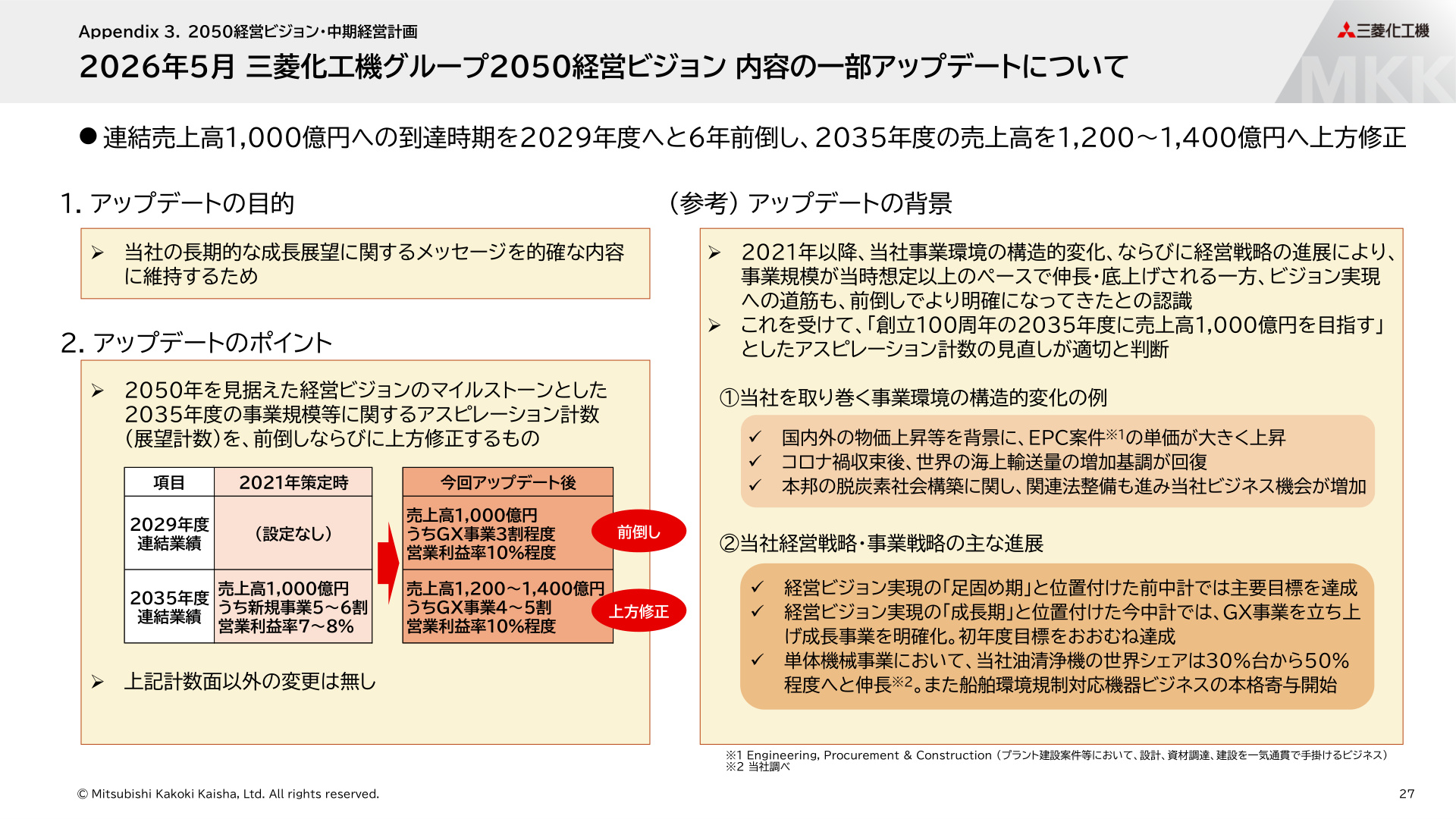
Slide Commentary: Updating the 2050 Management Vision and Growth Story
The slide above (P.27) is extremely important as it shows the roadmap for long-term corporate value enhancement . Since the vision was formulated in 2021, the business environment has undergone significant structural changes, including rising EPC project unit prices due to domestic and international inflation, the recovery of global maritime transport volumes, and the progress of legislation for building a decarbonized society in Japan. In response, the company has significantly accelerated and upwardly revised its quantitative targets as follows:
- FY2029 Consolidated Performance Target : Net sales of 100 billion yen (with the GX business accounting for approximately 30%) and an operating profit margin of approximately 10% ( achieved ahead of the original target ).
- FY2035 Target (100th Anniversary) : The previous target of "100 billion yen in net sales (with 50-60% from new businesses)" has been significantly revised upward to 120-140 billion yen in net sales (with 40-50% from the GX business) and an operating profit margin of approximately 10% .
This update symbolizes that the company has successfully completed its "foundation-building phase" and has fully transitioned into a "growth and leap phase" with the GX business as its growth driver. The story is clearly mapped out: generating solid cash flow from existing engineering and standalone machinery businesses while aiming for non-linear growth by combining the GX business with M&A.
5. Conclusion
Mitsubishi Kakoki's Q1 FY2027 earnings report demonstrated both strong company-wide performance and the quantitative and qualitative achievement of profitability in the GX business . By capturing structural tailwinds such as the expansion of the semiconductor, hydrogen, and decarbonization markets, and by upwardly revising its full-year order forecast, the company has underscored the strength of current demand.
Moving forward, key points to watch will be the realization of synergies from M&A, the commercialization of technologies related to hydrogen, methanation, SAF, and microalgae, and the growth speed of the GX business toward the FY2029 net sales target of 100 billion yen.
This content is not intended as investment advice or a recommendation. Any opinions expressed are solely the personal views of each article.