


Sanwa Holdings Q1 FY2026 Earnings Analysis: Domestic Strength Offsets Temporary Americas Disruption; Evaluating the Recovery Scenario and Shareholder Returns from Q2 Onward

StockClub
Published: Jul 31, 2026, 10:18 AM
Sentiment Analysis
Sanwa Holdings' Q1 FY2026 earnings (for the period ending March 2027) marked a challenging start, with significant operating profit declines driven by a sluggish macroeconomic environment and operational disruptions at manufacturing facilities in its core Americas segment. However, given the steady performance of the domestic Japanese business, the successful penetration of price pass-throughs (price revisions), and clear recovery measures expected in the Americas from Q2 onwards, the company has maintained its full-year consolidated operating profit forecast (81 billion yen) and annual dividend forecast (146 yen).
This report provides a comprehensive analysis of the current performance, regional challenges and drivers, the outlook for earnings recovery, and shareholder return policies, focusing on key topics extracted from the earnings materials.
1. Revenue Trends and Factor Analysis: Price Pass-throughs and FX Offset Volume Declines
Consolidated revenue for the first quarter was 140.4 billion yen (down 0.3% YoY; down 4.4% on a real basis excluding FX impacts) , remaining largely flat compared to the same period last year.
Observing revenue trends by region, the Japanese market remained solid at 55.4 billion yen (up 1.3% YoY) , while the European market reached 30.3 billion yen (up 9.5% YoY; down 4.9% in local currency) . Conversely, the Americas (ODC) market , the largest profit contributor, struggled at 52.7 billion yen (down 5.5% YoY; down 8.7% in local currency) , and the Asian market recorded 2.1 billion yen (down 20.8% YoY) .
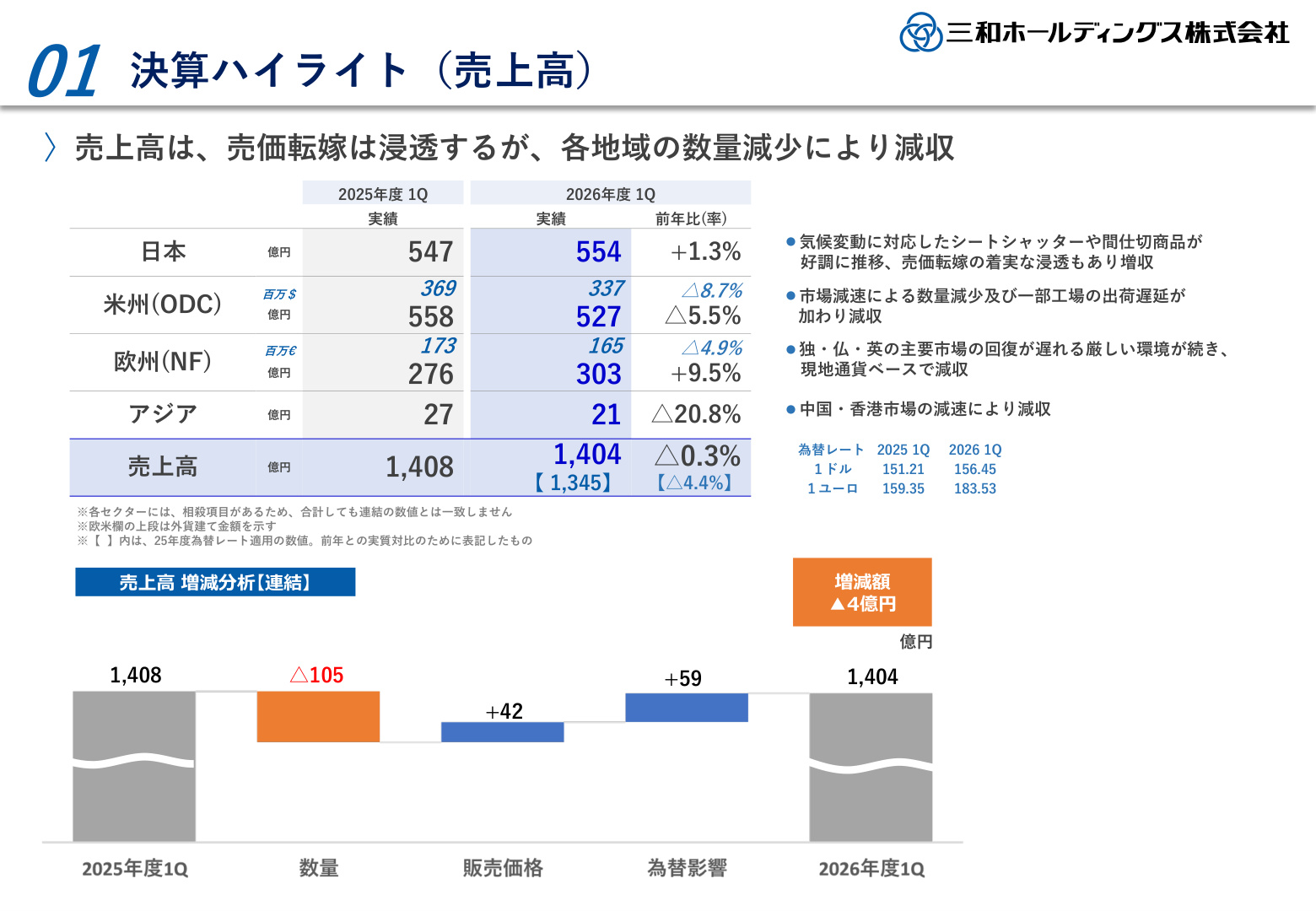
The slide above (01 Earnings Highlights: Revenue) visually presents the factors behind revenue fluctuations. This slide is critical as it clearly illustrates whether revenue changes stem from "volume," "selling price," or "foreign exchange."
According to the revenue variance analysis, while volume declines due to softening demand in various regions acted as a 10.5 billion yen drag, the effects of selling price pass-throughs (+4.2 billion yen) and FX translation gains from a weaker yen (+5.9 billion yen) helped limit the final revenue decline to just 0.4 billion yen (0.3%). In Japan, demand for sheet shutters and partition products tailored to climate change remained strong, and price pass-throughs have been steadily implemented.
2. Factors Behind the Sharp Profit Decline and Structural Challenges
Consolidated operating profit for Q1 fell sharply to 5.88 billion yen (down 40.8% YoY; operating margin dropped from 7.1% in the same period last year to 4.2%) . Additionally, ordinary profit was 6.65 billion yen (down 36.1% YoY) , and net profit attributable to owners of the parent was 4.84 billion yen (down 32.9% YoY) .
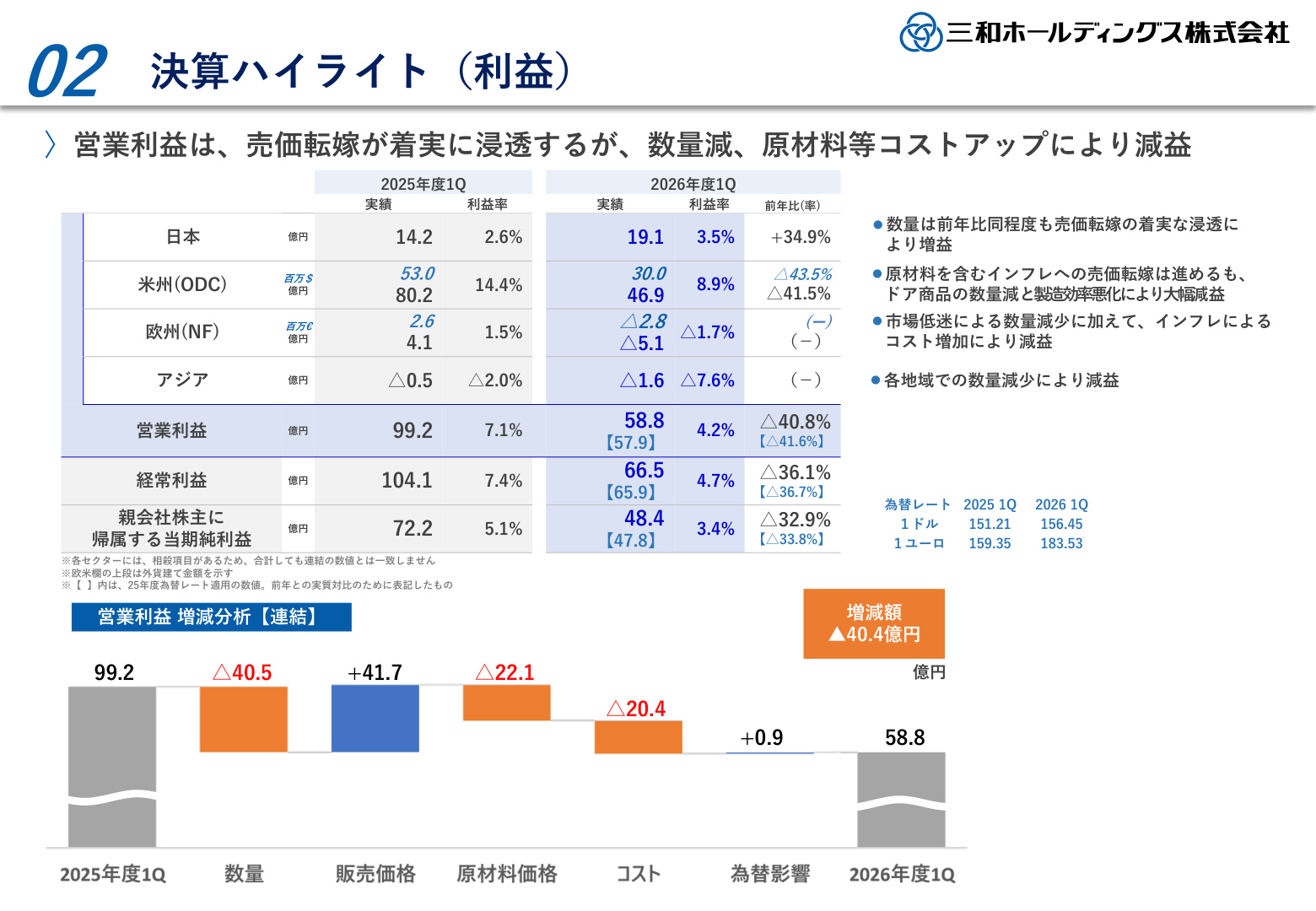
The slide above (02 Earnings Highlights: Profit) is one of the most important pieces of data, showing the breakdown of factors that led to the significant operating profit decline.
Tracing the profit variance analysis, while higher selling prices provided a positive impact of +4.17 billion yen, the following major pressures occurred:
- Profit erosion due to volume decline: -4.05 billion yen
- Rising raw material prices (inflationary impact): -2.21 billion yen
- Increased manufacturing and labor costs: -2.04 billion yen
Despite progress in price pass-throughs, the company could not fully absorb the volume decline and rising costs, resulting in an operating profit decline of 4.04 billion yen . By segment, while Japan increased profit to 1.91 billion yen (up 34.9% YoY) , the Americas (ODC) recorded a significant profit decline to 4.69 billion yen (down 41.5% YoY; down 43.5% in local currency) , and Europe (NF) fell into an operating loss of 0.51 billion yen (compared to a 0.41 billion yen profit in the same period last year) .
3. Segment Details: Diverging Performance Between Japan and Overseas Markets
-
Japan Segment While volume remained on par with the previous year, price pass-throughs against rising material costs were steadily implemented, leading to year-on-year growth in both revenue and profit. Orders for sheet shutters and partition-related products for both new construction and renovation contributed to this result.
-
Americas (ODC) Segment Demand, particularly in the housing market, remained sluggish due to high interest rates and inflationary pressures in the U.S. In addition, operational issues at specific plants (discussed below) caused shipping delays and worsened manufacturing efficiency.
-
Europe (NF) Segment The delay in economic recovery in major markets such as Germany, France, and the UK led to a continued decline in volume on a local currency basis. Compounded by cost inflation, the segment fell into a loss.
-
Asia Segment Impacted by the real estate recession and market slowdown in China and Hong Kong, the segment continued to see revenue declines and operating losses (-0.16 billion yen).
4. Issues in the Americas Door Business and Recovery Initiatives
Regarding the Americas door business, which was the primary factor behind the company-wide performance slump in Q1, the materials provide a detailed analysis of challenges and specific countermeasures.
Main Factors for Performance Deterioration:
- Macro Environment : Continued high interest rates due to tariff impacts, Middle East tensions, and inflationary pressures led to a decline in housing demand.
- Plant Operational Issues :
- Pensacola Plant (Florida) : The resolution of productivity declines associated with plant consolidation was slower than anticipated.
- Mount Hope Plant (Ohio) : Temporary system confusion following the introduction of a new ERP (Enterprise Resource Planning) system.
- Delayed Fixed Cost Reduction : The speed of reducing fixed costs, such as labor, in response to volume declines was insufficient.
Company Response and Outlook: To address operational issues, the company is improving equipment utilization rates, optimizing inventory, and reviewing quality inspection processes to improve on-time delivery rates, while also resolving ERP system errors. In addition to enforcing emergency cost-cutting measures, the company engaged external consultants in April to launch a full-scale profit structure reform.
As a result of these measures, operating profit for the Americas (ODC) is expected to recover sharply to 10 billion yen in Q2 (April-June) (up significantly from 4.7 billion yen in Q1) , with a plan to catch up to a level close to the initial forecast (14.7 billion yen in operating profit) for the first half (January-June).
5. Full-Year Forecast, Progress, and Maintenance of Shareholder Return Policy
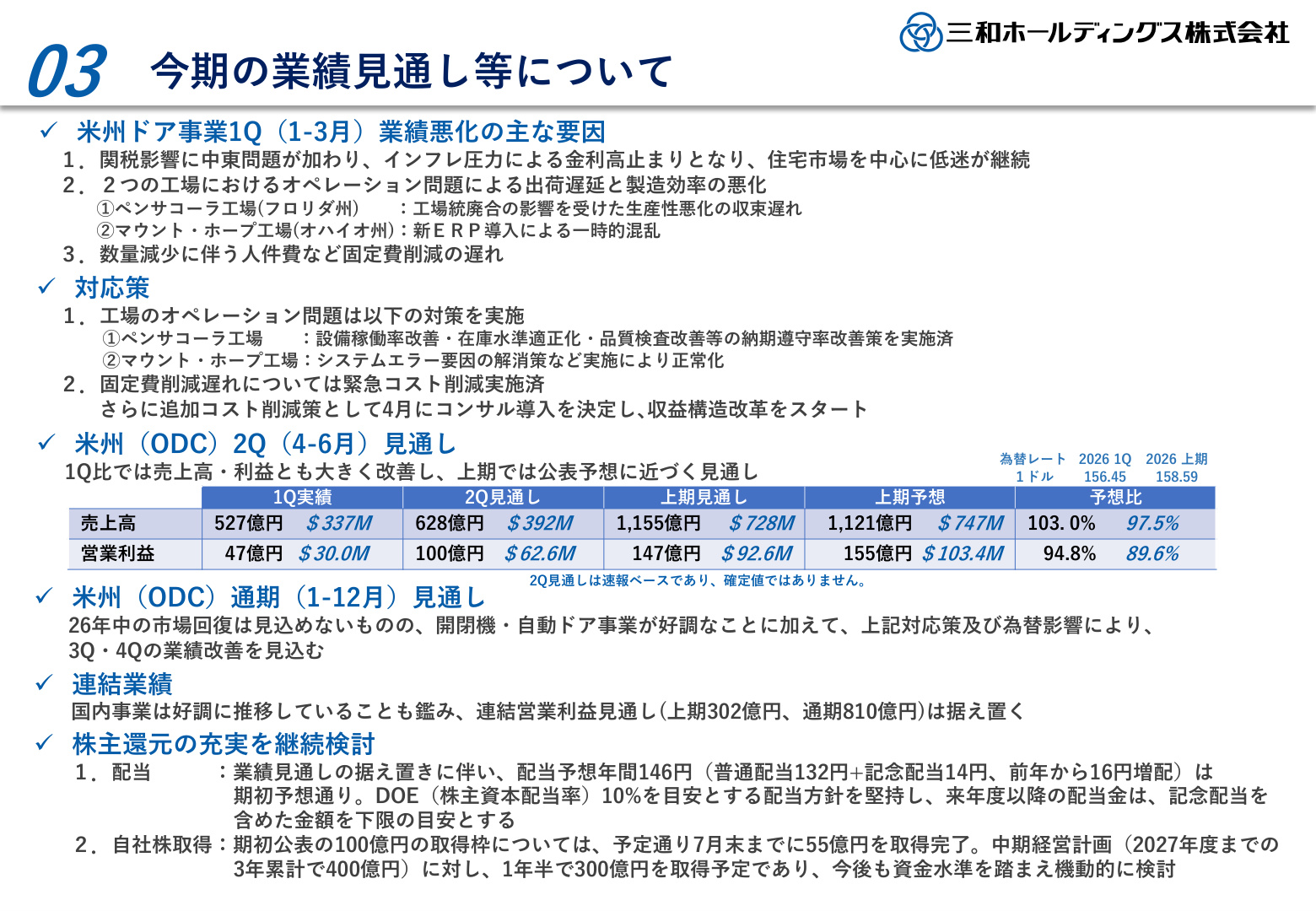
The slide above (03 Earnings Outlook for the Current Fiscal Year) is a crucial summary of the "future earnings recovery story" and "execution plan for shareholder returns," which are of the highest interest to investors.
Although the first quarter was a difficult start with a significant profit decline, Sanwa Holdings has maintained its full-year consolidated operating profit forecast (81 billion yen, with 30.2 billion yen for the first half) . This is supported by the strong domestic business, the recovery plan for the Americas from Q2 onwards, and the steady performance of the door operator and automatic door businesses.
Furthermore, the company’s proactive stance on shareholder returns is confirmed:
- Maintenance of Dividend Policy : In line with the maintained earnings outlook, the annual dividend forecast of 146 yen (132 yen ordinary dividend + 14 yen 70th-anniversary commemorative dividend, an increase of 16 yen YoY) remains unchanged. The company adheres to its return policy targeting a DOE (Dividend on Equity) of 10%.
- Progress on Flexible Share Buybacks : Of the 10 billion yen share buyback program announced at the beginning of the fiscal year, 5.5 billion yen was completed by the end of July . Against the medium-term management plan (a total of 40 billion yen over three years through FY2027), the company is on track to complete 30 billion yen in one and a half years, demonstrating steady capital policy aimed at enhancing shareholder value.
Summary: Key Points to Watch
Sanwa Holdings' Q1 FY2026 earnings revealed the impact of temporary operational disruptions at Americas plants and a high-interest-rate environment . However, the pricing power and high profitability of the domestic business are supporting the entire group. If the normalization of plants in the Americas and the progress of cost reductions through consultant involvement can be confirmed, the scenario for a recovery in performance from Q2 onwards becomes increasingly realistic.
This content is not intended as investment advice or a recommendation. Any opinions expressed are solely the personal views of each article.