


Air Water FY2025 Full-Year Earnings Deep Dive: Clearing Past Accounting Irregularities and Impairment Charges to Pave the Way for Resurgent Growth

StockClub
Published: Jul 31, 2026, 10:05 AM
Sentiment Analysis

Air Water (Ticker: 4088) FY2025 Full-Year Earnings Deep Dive: Clearing Past Accounting Irregularities and Impairment Charges to Pave the Way for Resurgent Growth
Air Water Inc. (Ticker: 4088) has released its FY2025 full-year financial results (supplementary materials for voluntary inspection). This reporting period marks a significant turning point for the company, characterized by a thorough investigation into past accounting irregularities, the completion of restatements for prior fiscal years, and the concentrated processing of large-scale impairment losses as part of a group-wide structural reform.
This report extracts 10 key topics from the disclosed financial materials to provide a comprehensive analysis of the company's overall performance, its response to accounting irregularities, the details of its profit structure, cash flow health, segment-specific trends, and the outlook for a V-shaped earnings recovery in FY2026.
1. FY2025 Full-Year Earnings Overview and Highlights
While FY2025 consolidated results saw revenue and Business Profit —the indicator of core earning power—reach or maintain record highs, the bottom line resulted in a significant loss due to the concentrated booking of non-recurring factors , including losses related to past accounting irregularities and impairment charges stemming from a review of future business plans.
- Revenue : ¥1,066.8 billion (+5.3% YoY, +¥53.7 billion)
- Business Profit : ¥74.5 billion (+6.1% YoY, +¥4.3 billion)
- Non-recurring factors : -¥111.7 billion (-¥104.0 billion YoY)
- Operating Profit : -¥37.2 billion (vs. ¥62.5 billion profit in the previous year)
- Profit attributable to owners of parent : -¥63.9 billion (vs. ¥39.9 billion profit in the previous year)
- Dividend per share : ¥75 (maintained at the same level as the previous year)
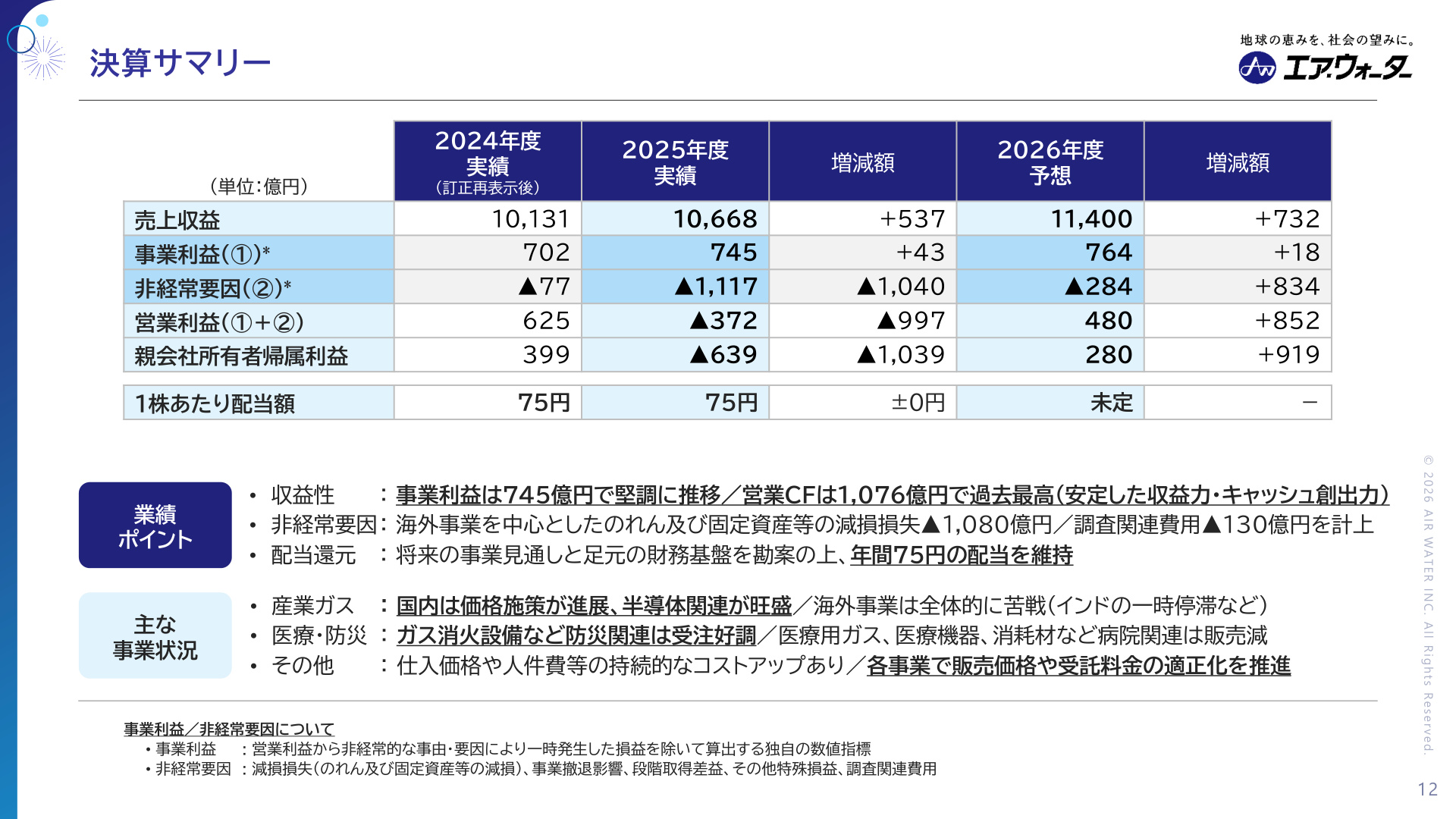
[Significance and Background of Slide 11 (Earnings Summary)]
The slide above is a critical list of management indicators covering FY2025 results, FY2026 forecasts, and key metrics. The most important takeaway is the two-tiered structure: "Business Profit, representing core earning power, grew to ¥74.5 billion (+6.1% YoY)," while "Operating Profit fell into a temporary deficit due to the one-time booking of ¥111.7 billion in impairment and other non-recurring factors." Backed by the company's stable cash-generating ability, management has maintained an annual dividend of ¥75 , signaling confidence in the company's financial foundation and the robustness of its business base.
2. Summary of Accounting Irregularities and Completion of Voluntary Inspection
Following the discovery of accounting irregularities related to inventory at a consolidated subsidiary in July 2025, the company established a Special Investigation Committee composed of external experts and conducted a comprehensive voluntary accounting inspection covering all 211 consolidated companies.
This investigation revealed that revenue and operating profit had been overstated over the past several years, leading to the restatement of past securities reports and financial results from FY2020 to FY2024. For instance, FY2024 operating profit was revised downward by ¥12.7 billion, from ¥75.2 billion to ¥62.5 billion, effectively clearing and correcting all accumulated accounting distortions.
3. Governance Reform and New Management Structure
The root causes of the accounting irregularities were identified as a "corporate culture prioritizing performance targets above all else," "insufficient checks and balances in the finance and accounting departments," and "weaknesses in management infrastructure and internal controls." In response, the company announced a fundamental overhaul of its management structure.
- Board of Directors Composition : Reduced internal directors from 4 to 3 and increased outside directors from 4 to 5 (forming a majority) . Three of the five outside directors are new appointees, significantly strengthening oversight and check-and-balance functions.
- New Organizational Units : Established a Board of Directors Secretariat (Corporate Secretary function) and a Management Reform Office to drive the implementation of recurrence prevention measures and the reconstruction of internal management systems.
- Planned Governance Transition : Considering and promoting a transition to a Company with Audit and Supervisory Committee .
4. Improvement Roadmap for Removal of "Securities on Alert"
Following the designation of the company's stock as Securities on Alert by the Tokyo Stock Exchange effective May 1, 2026, the company has formulated an improvement plan to enhance the effectiveness of its recurrence prevention measures.
The improvement plan consists of five pillars: "Corporate Culture Reform," "Governance Reform," "Reconstruction of Management Infrastructure and Internal Controls," "Strengthening Internal Audits," and "Strengthening Audit & Supervisory Board Audits." The company has presented a clear roadmap to develop and build these systems in FY2026, foster their adoption and effectiveness through FY2026–2027, and aim for the removal of the Securities on Alert designation within 2027 .
5. Analysis of Factors Affecting Business Profit and Operating Profit (Deep Dive into Profit Structure)
The most notable feature of the FY2025 income statement is the contrast between positive growth in core operations and the negative impact of non-recurring factors associated with structural reform.
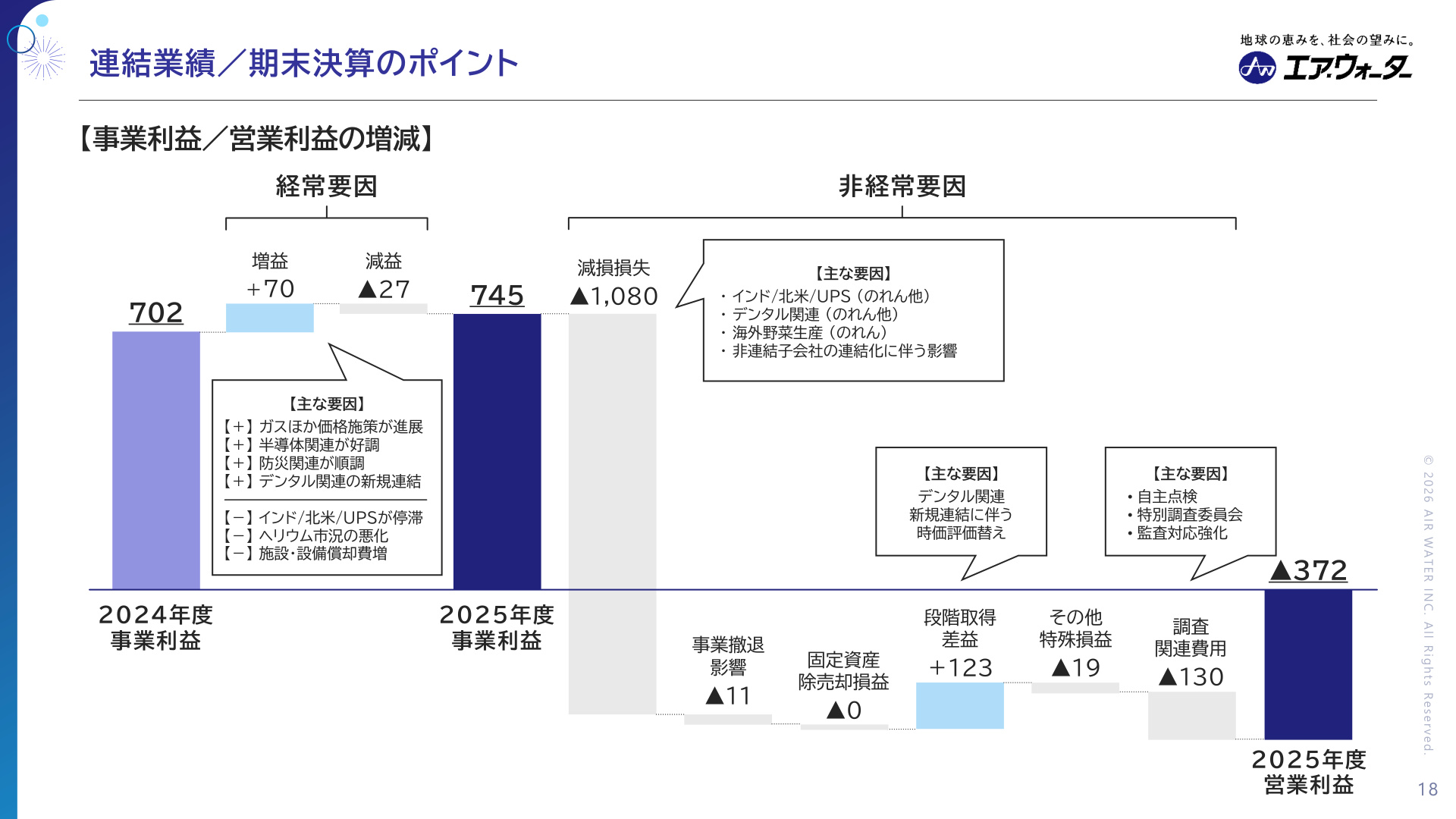
[Significance and Background of Slide 17 (Changes in Business Profit/Operating Profit)]
This waterfall chart clearly illustrates the bridge from FY2024 Business Profit of ¥70.2 billion to the FY2025 Operating Loss of ¥37.2 billion. Regarding recurring factors , progress in pricing strategies for industrial gases (+¥7.0 billion) and increased demand in semiconductor and disaster prevention sectors contributed to an increase in Business Profit to ¥74.5 billion. However, non-recurring factors such as impairment losses of -¥108.0 billion , investigation-related expenses of -¥13.0 billion, and business withdrawal impacts of -¥1.1 billion weighed heavily on the results. This chart visually demonstrates that the current deficit is not due to "business decline," but rather to "portfolio rationalization and the clearing of past negative legacies" for the future.
6. Details of Impairment Losses and Business Portfolio Review
The main components of the impairment losses (-¥108.0 billion) are as follows:
- Impairment based on review of future plans : Indian industrial gas/goodwill and fixed assets (-¥46.4 billion), dental-related/goodwill (-¥16.4 billion), high-output UPS/goodwill (-¥10.4 billion), North American industrial gas/goodwill (-¥6.6 billion), and biomass power generation/fixed assets (Onahama -¥4.7 billion, Kanda -¥3.8 billion).
- Impairment based on declining business profitability : North American refrigeration equipment, overseas vegetable production, biogas facilities, etc.
These impairment charges are a necessary process to rigorously review business plans from past M&A and capital investments against the current market environment, accelerating business portfolio restructuring from a "best owner" perspective that prioritizes capital efficiency (ROIC/ROE).
7. Cash Flow Robustness and Financial Soundness
While the income statement shows a large deficit, the cash flow statement confirms the company's exceptionally strong business foundation.
- Operating Cash Flow : ¥107.6 billion (record high) (+¥14.8 billion YoY)
- Investing Cash Flow : -¥88.6 billion (-¥28.3 billion YoY)
- Free Cash Flow : ¥19.0 billion surplus
Since impairment losses (-¥108.0 billion) are accounting expenses that do not involve cash outflows, the stable cash-generating power of core businesses, centered on industrial gases, remains intact. Furthermore, the balance of cash and cash equivalents at the end of the period increased to ¥87.1 billion (+¥13.9 billion YoY), ensuring sufficient liquidity for immediate business operations and capital investment.
8. Segment Performance and Market Environment
Behind the company-wide Business Profit of ¥74.5 billion, there are varying performances across segments:
- Digital & Industry : Revenue ¥329.9 billion (-4.2%), Business Profit ¥32.6 billion (-3.6%). While domestic industrial gas remained solid due to demand for advanced semiconductors driven by generative AI and successful price pass-throughs, temporary stagnation in overseas markets like India and North America and a worsening helium market environment had an impact.
- Energy Solutions : Revenue ¥98.5 billion (+6.3%), Business Profit ¥10.1 billion (+23.2%). Significant profit growth was achieved through fuel switching in LP gas, acquisition of sales rights, and timely price pass-throughs.
- Health & Safety : Revenue ¥268.5 billion (+21.8%), Business Profit ¥16.2 billion (+20.0%). The segment captured demand for disaster prevention equipment in power and data center sectors, and benefited from new consolidation effects.
- Agri & Foods : Revenue ¥153.0 billion (+2.2%), Business Profit ¥7.1 billion (+9.2%). Despite uncertainty in harvest volumes due to extreme heat, the company promoted variety switching and cost optimization.
- Other Businesses : Revenue ¥216.9 billion (+5.4%), Business Profit ¥13.4 billion (+13.6%). Logistics benefited from freight rate optimization, and specialized trading companies benefited from the expansion of semiconductor factories.
9. FY2026 Full-Year Earnings Forecast and V-Shaped Recovery Scenario
In FY2026, the company expects a rapid return to operating profit, driven by the completion of the impairment process and steady growth in core businesses.
- Revenue : ¥1,140.0 billion (+6.9% YoY, +¥73.2 billion)
- Business Profit : ¥76.4 billion (+2.6% YoY, +¥1.8 billion)
- Non-recurring factors : -¥28.4 billion (+¥83.3 billion improvement YoY)
- Operating Profit : ¥48.0 billion (return to profit, +¥85.2 billion YoY)
- Profit attributable to owners of parent : ¥28.0 billion (return to profit, +¥91.9 billion YoY)
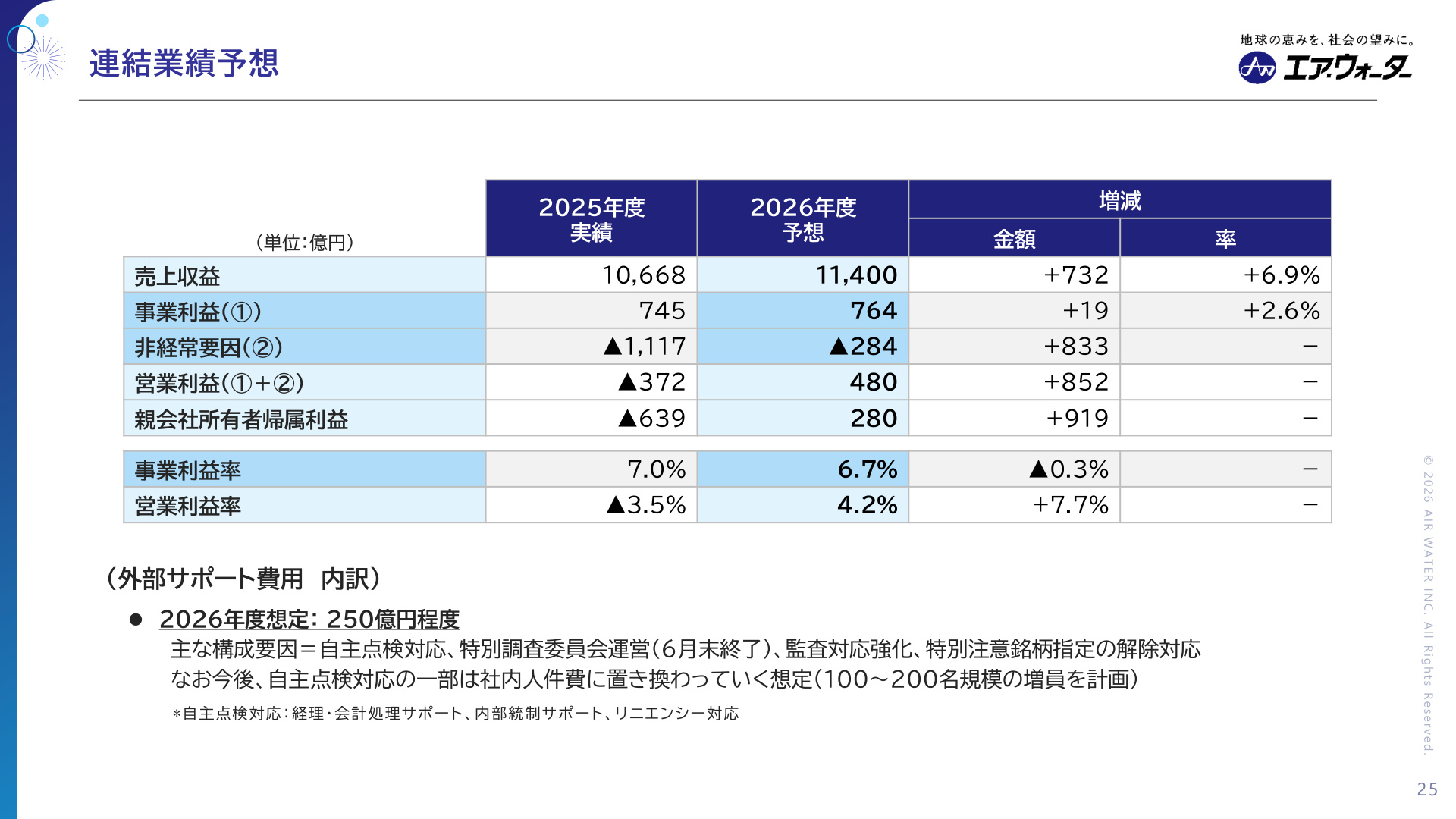
[Significance and Background of Slide 24 (Consolidated Earnings Forecast)]
This slide shows the roadmap for the V-shaped recovery the company aims to achieve in FY2026. The sharp recovery to ¥48.0 billion in Operating Profit and ¥28.0 billion in Net Profit is a direct result of completing impairment charges in FY2025. Of the -¥28.4 billion in projected non-recurring factors, approximately ¥25.0 billion consists of external support costs for voluntary inspection responses and governance system construction (accounting support, compliance, personnel increases, etc.). The company expects to achieve a significant profit even after absorbing these structural reform costs, clearly outlining a path back to a growth trajectory.
10. Capital Investment Plan and Dividend Policy (Shareholder Returns)
Capital Investment Plan
The capital investment plan for FY2026 is ¥74.8 billion (+¥9.6 billion from the ¥65.1 billion result in FY2025). The company will prioritize allocating ¥38.0 billion to the "Digital & Industry" sector, continuing investments in domestic semiconductor gas plants and industrial gas plants in North America and India, with the goal of further strengthening its competitive edge in the industrial gas field.
Dividend Policy
Regarding the FY2025 dividend, despite a significant net loss, the company maintained an annual dividend of ¥75 (dividend payout ratio -%) , taking into account its operating cash flow generation and financial soundness. The dividend forecast for FY2026 remains "undecided" as the company carefully monitors future earnings progress, financial conditions, and improvements toward the removal of the Securities on Alert designation.
This content is not intended as investment advice or a recommendation. Any opinions expressed are solely the personal views of each article.