


CAVE (3760) FY2026 Earnings Q&A Analysis: Completion of Unprofitable Business Restructuring and AI-Driven Profit Growth Story

StockClub
Published: Jul 31, 2026, 10:03 AM
Sentiment Analysis
1. Executive Summary
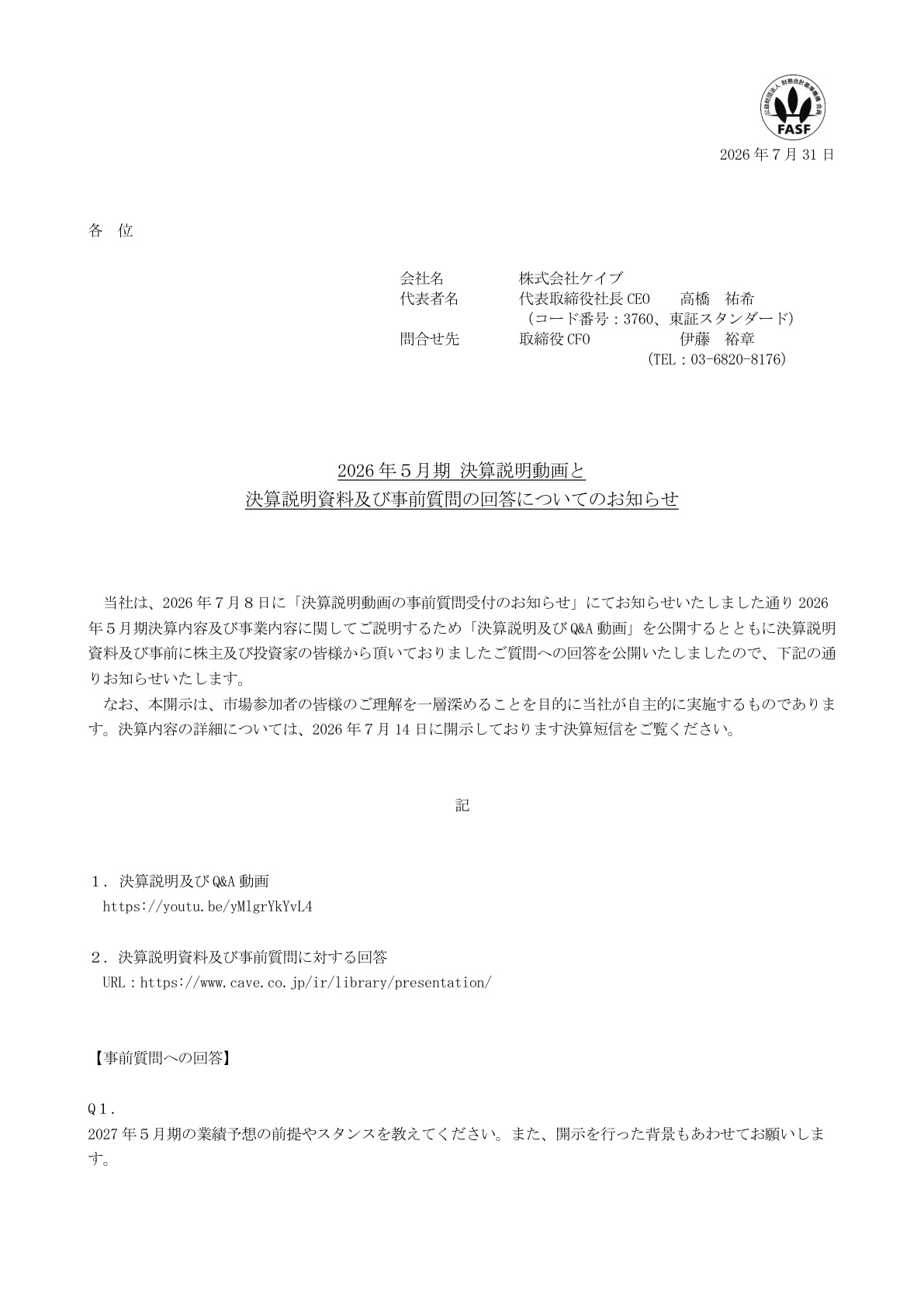
CAVE Interactive Co., Ltd. (Securities Code: 3760) has released its earnings presentation video and responses to pre-submitted questions from shareholders and investors for the fiscal year ended May 2026. The most significant takeaway from this disclosure is the completion of the restructuring of unprofitable businesses and the impairment of software-related assets , which had been persistent challenges from previous years.
Under the new management team, the company has strengthened its information disclosure policy and announced earnings forecasts for the fiscal year ending May 2027, along with a clear medium-term target of "exceeding 2 billion yen in operating profit within two years." The company has revealed a concrete approach toward fundamentally normalizing its profit structure, including establishing a stable revenue base centered on its consolidated subsidiary, DeraGame Inc., curbing development costs and accelerating development speed through company-wide AI integration, and introducing a " Core Operating Profit " metric that accounts for R&D investments.
2. Thorough Elimination of Financial Risks and Progress in Asset Compression
Regarding impairment losses, which had been a major factor in earnings volatility in previous years, the company disclosed that it has proactively executed large-scale risk mitigation. Software-related assets in the gaming business, which stood at approximately 2.2 billion yen at the beginning of the fiscal year, were significantly compressed to approximately 30 million yen by the end of the fiscal year ended May 2026.
As a result, the company has determined that the risk of additional impairment in the future has been reduced to a very limited level. With the restructuring of unprofitable businesses now largely complete, the foundation is set to clearly visualize the company's "underlying earning power" without being swayed by excessive impairment charges.
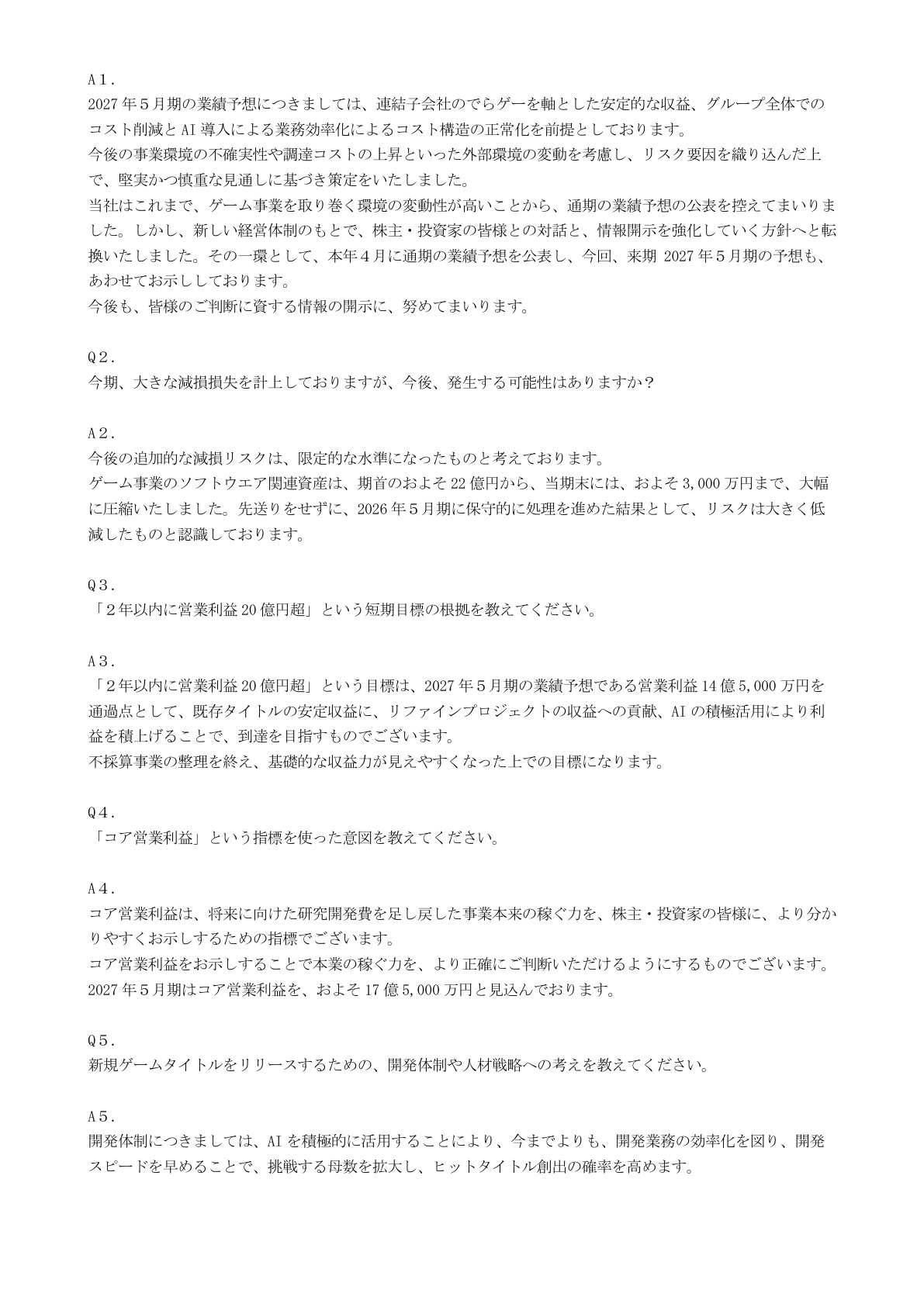
The slide above (page 2 of the Q&A document) is a critical section that provides detailed answers to issues of greatest concern to investors, such as the presence of additional impairment risks , the basis for profit targets under the new management , and the definition of the new "Core Operating Profit" metric . By disclosing specific figures regarding asset compression, the company has demonstrated, with objective data, that its financial safety has been enhanced.
3. Earnings Outlook and the Scenario for Achieving "Operating Profit Over 2 Billion Yen Within Two Years"
In its newly disclosed earnings forecast for the fiscal year ending May 2027, the company plans for an operating profit of 1.45 billion yen . Furthermore, it has set a short-to-medium-term profit goal of "exceeding 2 billion yen in operating profit within two years" using this as a milestone.
Assumptions and Growth Drivers for Earnings Forecasts
- Stabilization of Base Revenue : Built on the stable earnings contribution from the consolidated subsidiary "DeraGame."
- Contribution from Refinement Projects : Promoting profitability improvements for existing titles and effective utilization of existing IP.
- Normalization of Cost Structure : Accelerating operational efficiency through AI integration in addition to reducing unnecessary costs across the group.
- Introduction of Core Operating Profit : The company expects a " Core Operating Profit "—which represents the business's inherent earning power by adding back R&D expenses for future growth—of approximately 1.75 billion yen for the fiscal year ending May 2027.
The company emphasizes that its earnings forecasts are based on a prudent outlook that carefully incorporates external factors and risks, such as business environment uncertainty and rising procurement costs.
4. Full-Scale AI Integration and Revamping of Development Systems and Talent Strategy
Positioned as the most important key factor in the company's future growth strategy is the active utilization of AI (Artificial Intelligence) . The contribution of AI to earnings is organized into the following two phases:
- Phase 1: Short-term Cost Reduction and Efficiency : By introducing AI into development and peripheral tasks, the company will immediately achieve cost containment and operational efficiency. This has already begun to contribute to the improvement of the current cost structure.
- Phase 2: Medium-to-Long-term Development Capability Enhancement and Hit Rate Improvement : By reducing development costs and investment amounts per title, the company will achieve an " expansion of the challenge base ," allowing it to attempt the development of more new titles within the same resource constraints. By increasing development speed and release frequency, the company aims to raise the probability (success rate) of creating hit titles.
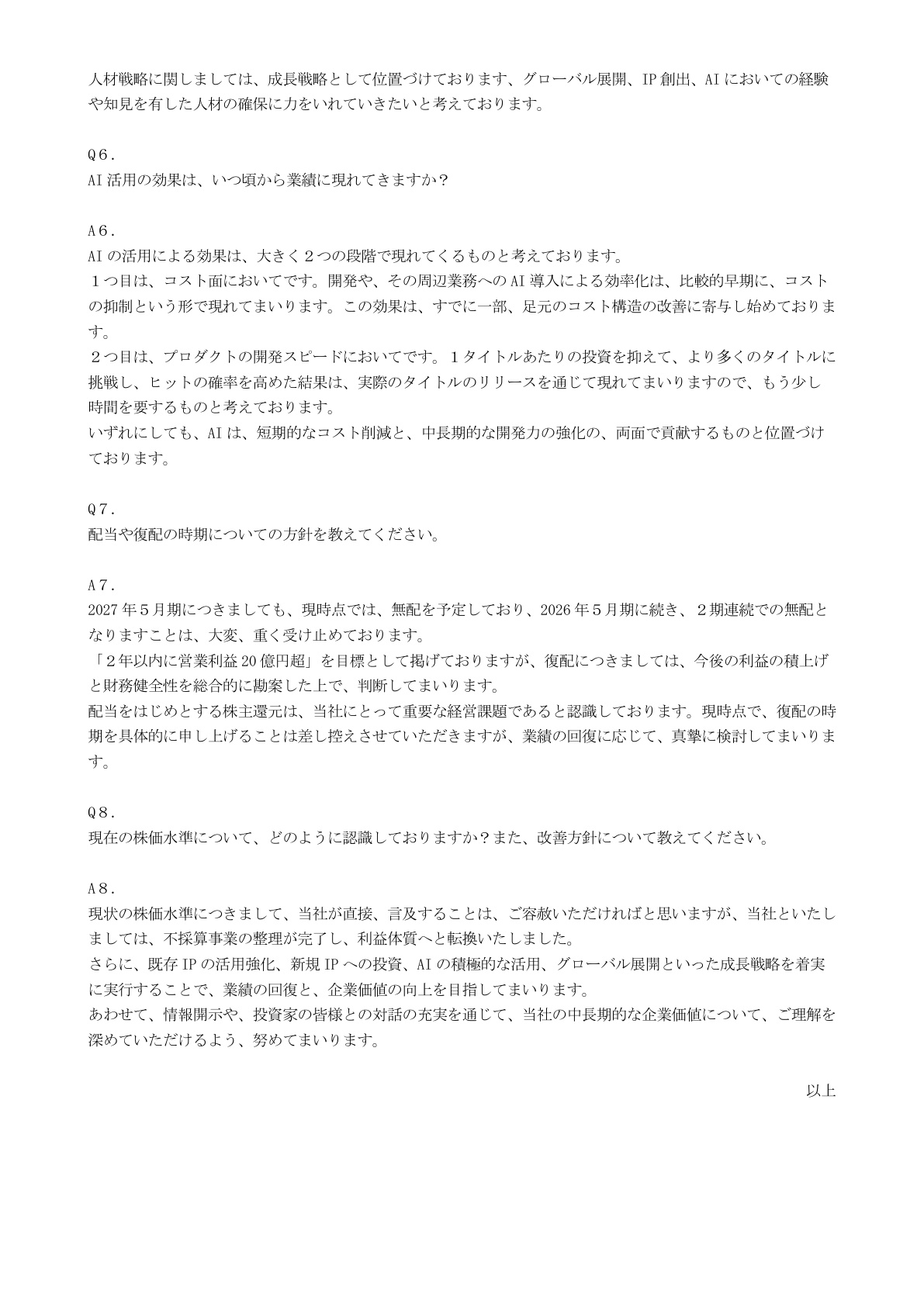
The slide above (page 3) specifies the timeline for the effects of AI utilization and the dividend policy and conditions for resuming dividends , which are of high interest to investors. It illustrates the overall picture of an AI strategy that leads not only to cost-cutting but also to top-line growth through improved product release speed.
Regarding talent strategy, the company has set the acquisition of high-level personnel proficient in global expansion, new IP creation, and AI utilization as its top priority, aiming to bolster the organization's overall capabilities.
5. Shareholder Return Policy and Approach to Improving Stock Price and Corporate Value
Regarding dividend policy, the company indicated that it plans to pay no dividends for the fiscal year ending May 2027 (the second consecutive year of no dividends), following the fiscal year ended May 2026. The management team has stated that they take this situation very seriously.
The path to resuming dividends involves steadily accumulating profits toward the goal of "exceeding 2 billion yen in operating profit within two years" and carefully determining the timing of dividend resumption while comprehensively considering financial health . The company has expressed its sincere intention to consider returning to shareholder distributions as business performance recovers in earnest.
To improve stock price levels and corporate value, the company has specified that it will steadily execute the following measures:
- Transitioning to a profit-oriented structure through the completion of unprofitable business restructuring
- Strengthening the utilization of existing IP and active investment in new IP
- Transforming costs and development speed through AI utilization
- Expanding the market through global development
- Enhancing dialogue with investors through strengthened IR activities and information disclosure
6. Conclusion
What can be read from CAVE's earnings Q&A materials is the fact that the structural reform to shift into a "full-scale profit growth phase" has been completed , following the conclusion of impairment processing for past issues such as unprofitable businesses and bloated software assets.
Moving forward, the company will work toward achieving an operating profit of 1.45 billion yen for the fiscal year ending May 2027, and the subsequent medium-term goal of over 2 billion yen, driven by the dual engines of stable revenue from DeraGame and thorough development efficiency and cost reduction through AI. While the issue of two consecutive years of no dividends remains, this earnings disclosure clearly presented a strategic roadmap for recovering the core earning power of the business—as evidenced by the 1.75 billion yen forecast for core operating profit—and realizing sustainable corporate value enhancement.
This content is not intended as investment advice or a recommendation. Any opinions expressed are solely the personal views of each article.