

In-Depth Earnings Analysis: Kanro (2216) H1 FY2026 Results – Revenue Growth Amid Profit Decline, Full-Year Guidance Revision, and the Strategic Shift Toward Gummies

StockClub
Published: Jul 31, 2026, 09:52 AM
Sentiment Analysis
Kanro Co., Ltd.'s consolidated financial results for the first half of the fiscal year ending December 2026 showed a revenue increase of 4.4% year-on-year to 17.454 billion yen . However, operating profit declined by 19.4% year-on-year to 2.146 billion yen , resulting in a performance characterized by higher revenue but lower profit .
This report provides an in-depth analysis of the earnings highlights, the structural factors behind the profit decline, the downward revision of full-year forecasts, the status of core products, and the long-term growth strategy, broken down into 10 key topics.
1. Earnings Highlights and Progress Against Targets
The key performance indicators for the first half of FY2026 and the achievement rates against initial forecasts are as follows:
- Net Sales : 17.454 billion yen (+4.4% YoY, 97.0% of initial forecast)
- Operating Profit : 2.146 billion yen (-19.4% YoY, 93.3% of initial forecast)
- Ordinary Profit : 2.159 billion yen (-19.4% YoY, 93.9% of initial forecast)
- Net Profit for the Half-Year : 1.554 billion yen (-17.1% YoY, 97.1% of initial forecast)
While revenue maintained growth, both top-line and profit figures fell slightly short of initial expectations due to a sharper-than-anticipated decline in demand for the throat lozenge category and a deterioration in the cost-of-sales ratio.
2. Structural Analysis of Operating Profit Decline and Cost Factors
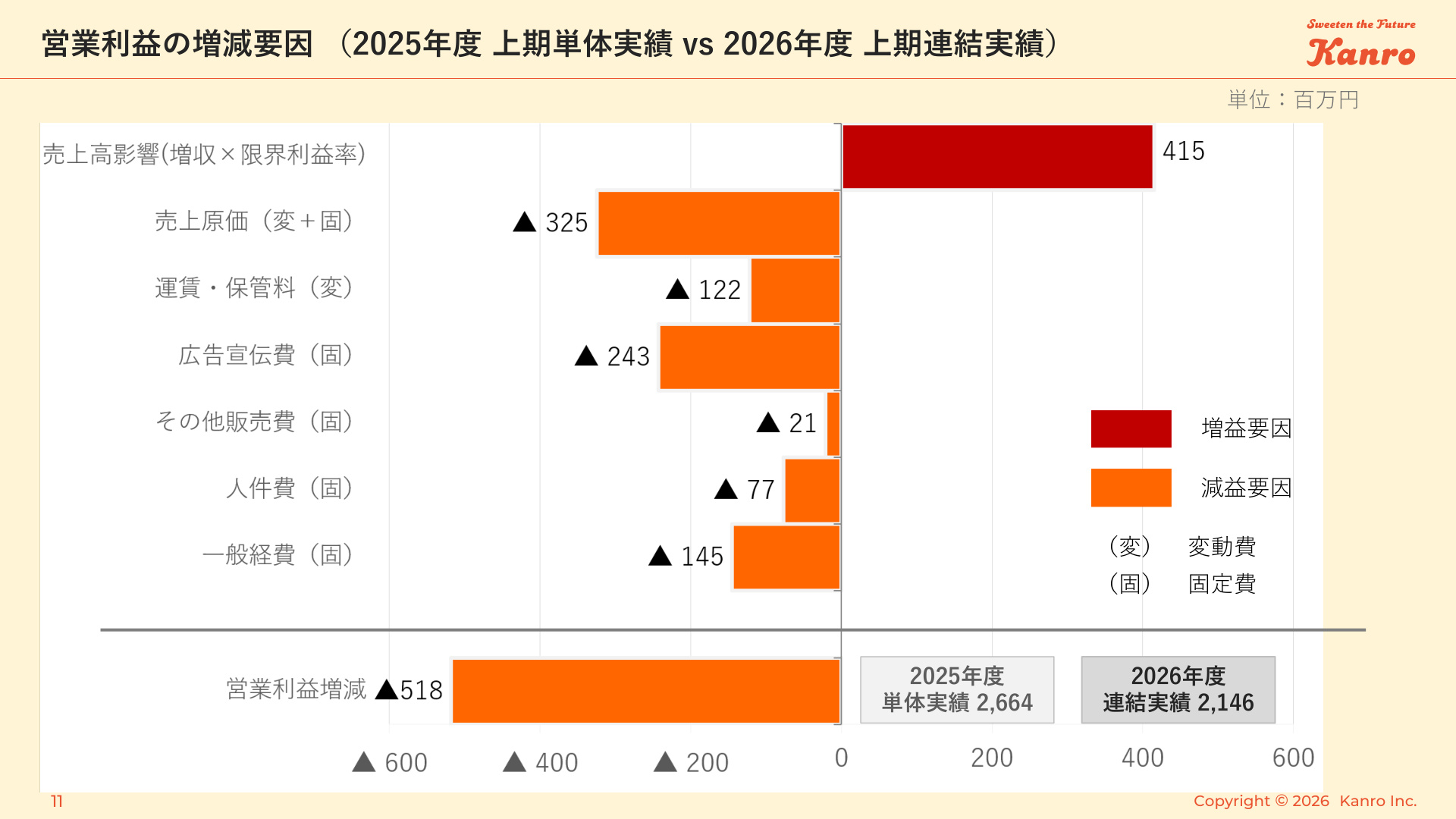
The following slide (Page 11) details the factors behind the 518 million yen decline in operating profit, which fell from 2.664 billion yen in the same period last year to 2.146 billion yen.
[Slide Commentary: Background of H1 Operating Profit Variance]
This waterfall chart clearly illustrates why operating profit declined significantly despite an increase in net sales.
- Positive Factors (+415 million yen) : Increased marginal profit resulting from higher sales.
- Major Negative Factors (Total -933 million yen) :
- Increase in Cost of Sales (-325 million yen) : Deterioration in the cost-of-sales ratio due to soaring raw material and energy costs, exacerbated by geopolitical tensions in the Middle East.
- Increase in Advertising Expenses (-243 million yen) : Proactive upfront investment to enhance brand value and strengthen promotions (+83.4% YoY to 535 million yen).
- Increase in General Expenses (-145 million yen) : Higher depreciation and system-related costs associated with the implementation of a new core system.
- Increase in Logistics and Storage Costs (-122 million yen) : Deterioration in storage and delivery cost ratios due to rising logistics expenses.
In summary, the direct cause of the H1 profit decline was that the profit-generating effect of increased sales was outweighed by rising raw material and energy prices, as well as higher logistics, system, and advertising expenses.
3. Category Trends: Status and Initiatives for Hard Candies
Sales in the candy category remained resilient, growing 5.1% year-on-year .
- Throat Lozenge Brands : Brands such as "Non-Sugar Throat Lozenge" and "Health Throat Lozenge" saw year-on-year revenue declines as demand for throat lozenges across the market peaked and subsequently softened.
- "Kin no Milk" Brand : Seasonal products like "Kin no Milk Premium Chocolat" and "Kin no Milk Salt Milk" performed well, achieving year-on-year revenue growth and maintaining the number one share in the milk candy market.
- "Kanro Ame" : Celebrating its 70th anniversary since its 1955 launch, this long-selling brand recorded year-on-year revenue growth through initiatives such as the "Kanro Ame 70th Anniversary Project," which successfully reignited awareness and purchasing.
4. Category Trends: Competitive Environment and Growth Opportunities in Gummies
While total sales in the gummy category grew by 5.1% year-on-year , performance varied significantly by product line.
- Struggling Core Brands : "Pure Gummy" saw year-on-year revenue declines despite TV commercial campaigns, as the impact was limited. "Candemina Gummy" also faced year-on-year revenue declines due to intensifying competition. "Marosh" experienced a temporary revenue decline as the impact of its rebranding faded.
- Strong/Expanding Brands : The hard gummy "Kanro The Strong" series and limited-time/channel-exclusive products performed well. Additionally, "Gummi-tsu"—sold at the direct-managed store "Hitotubu Kanro" and the official e-commerce site "Kanro POCKeT"—saw significant sales growth, driven by a permanent store opening at Isetan Shinjuku and pop-up stores at Haneda Airport.
5. Downward Revision of Full-Year Consolidated Forecasts and H2 Outlook
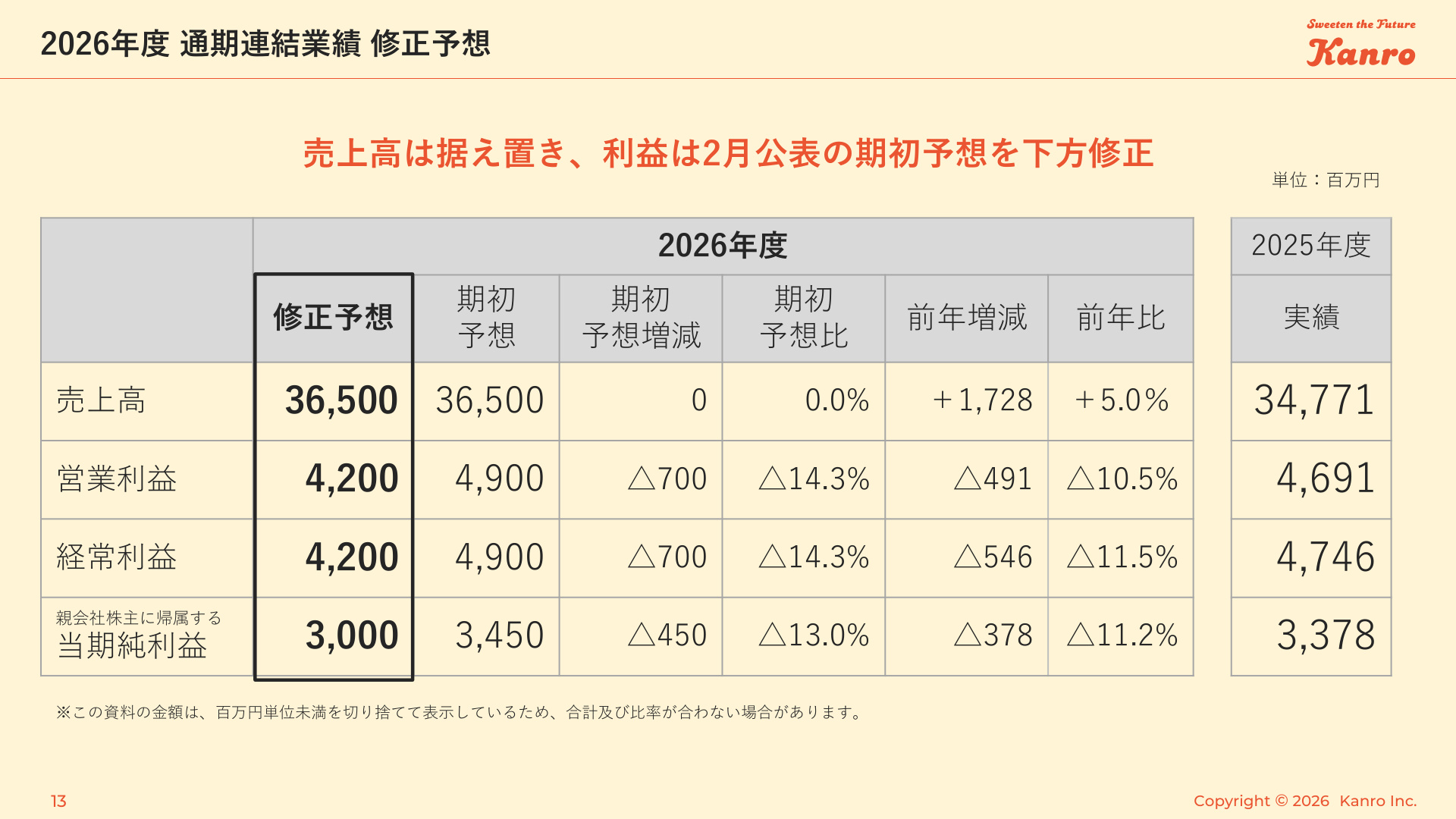
Reflecting H1 cost increases and demand trends, Kanro has revised its full-year consolidated earnings forecast for the fiscal year ending December 2026, as shown in the slide below (Page 13).
[Slide Commentary: Importance and Background of Full-Year Revision]
This table shows the difference between the initial full-year forecast and the revised figures.
- Net Sales : Maintained at 36.5 billion yen (+5.0% YoY) . The company plans to recover the H1 revenue shortfall through H2 promotional measures and price revisions.
- Operating Profit : Revised downward to 4.2 billion yen (-700 million yen vs. initial forecast, -10.5% YoY) .
- Net Profit : Revised downward to 3.0 billion yen (-450 million yen vs. initial forecast, -11.2% YoY) .
While the top-line revenue target remains unchanged, profit forecasts were reduced due to rising raw material costs (such as packaging), increased manufacturing fixed costs (repairs, energy), and higher storage and delivery costs due to logistics inflation. Cost pressures are expected to continue to squeeze marginal profit growth in the second half.
6. Performance Trends (2022–2026) and the Structure of the "Gummy Shift"
To understand Kanro's long-term growth trajectory and business structure transformation, the following slide (Page 17) is critical.
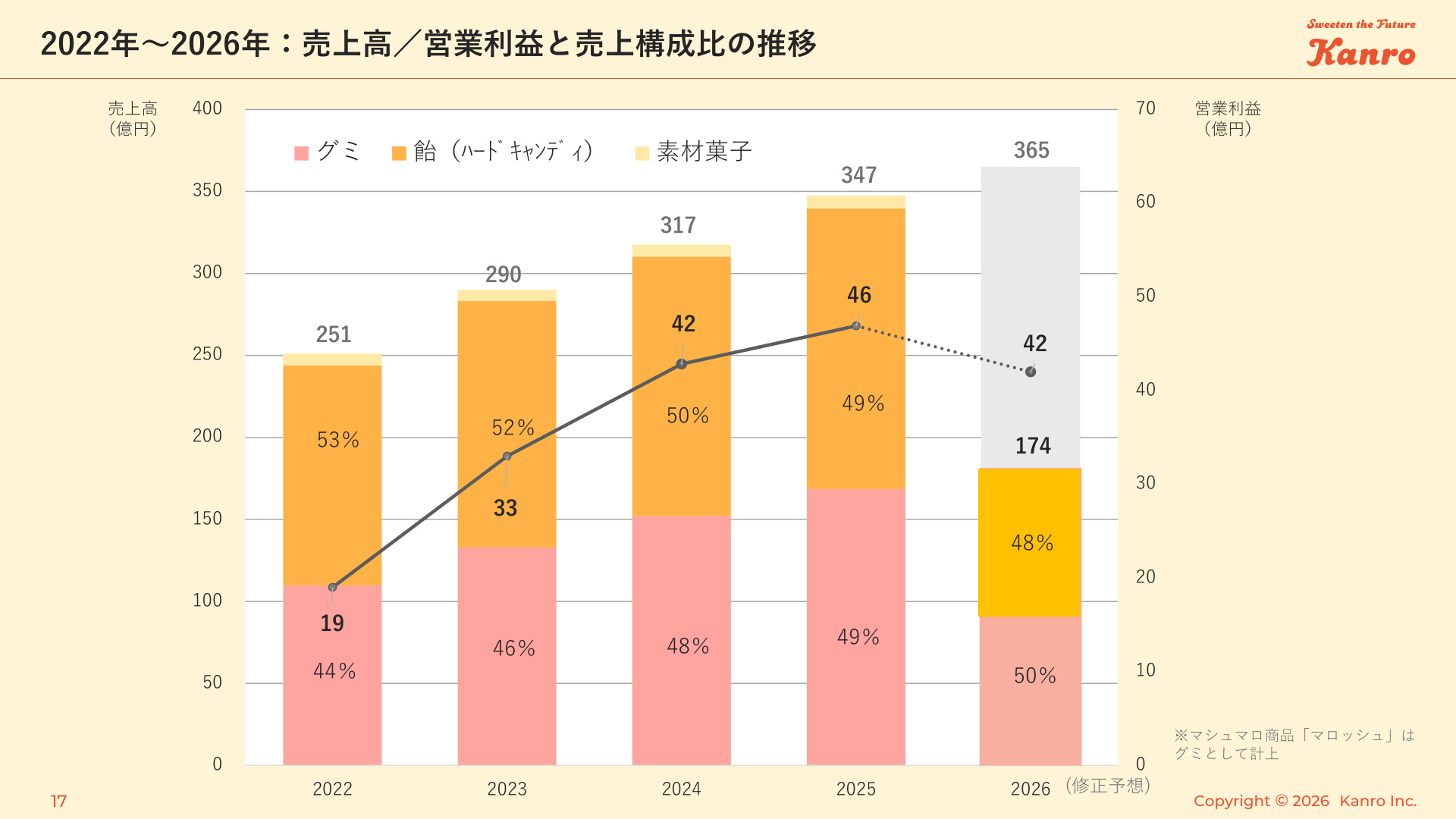
[Slide Commentary: Changes in Category Composition and Long-Term Growth Trajectory]
This graph illustrates the trends in net sales, operating profit, and sales composition by product category from 2022 to 2026 (revised forecast).
- Expansion of Sales Scale : Sales are expected to grow by over 45% , from 25.1 billion yen in 2022 to 36.5 billion yen in 2026, indicating a robust top-line growth trend.
- Shift to Gummies (Portfolio Transformation) : The gummy category, which accounted for 44% of sales in 2022, is expected to reach 50% in 2026. With hard candies at 48%, the business structure is steadily transitioning to one where gummies represent the largest share of sales .
- Profitability Trends : Operating profit surged from 1.9 billion yen in 2022 to 4.6 billion yen in 2025, though it is expected to temporarily dip to 4.2 billion yen in 2026 due to cost inflation. However, the long-term profit base remains significantly higher than it was in 2022.
7. Market Environment Analysis: Candy and Gummy Market Trends
The overall candy market grew by 2.4% year-on-year to 197.8 billion yen from January to June 2026.
- Candy Market : Sales of 64.9 billion yen ( -1.8% YoY ), impacted by the stabilization of throat lozenge demand.
- Gummy Market : Sales of 68.3 billion yen ( +2.8% YoY ). While the rapid growth pace of the past has moderated, the market continues to expand steadily.
- Kanro's Market Share : Kanro has increased its share across the board: 12.2% in the total candy market (up from 11.8%), 21.2% in the candy market (up from 19.5%), and 15.1% in the gummy market (up from 14.7%), solidifying its position as an industry leader.
8. Balance Sheet Management and Improvement of Capital Efficiency
Kanro is promoting balance sheet management to improve capital efficiency and sustainable corporate value.
- Asset Compression : Promoting the effective use of cash and deposits and the reduction of cross-shareholdings to enhance asset efficiency.
- Utilization of Interest-Bearing Debt : Maintaining financial soundness while leveraging appropriate debt (Net assets of 19.73 billion yen and liabilities of 12.153 billion yen as of the end of H1 2026).
- ROIC Management : Thorough KPI management using an ROIC (Return on Invested Capital) tree to monitor the earning power of each business segment.
9. Shareholder Return Policy: Maintaining Dividends and Large-Scale Share Buybacks/Cancellations
Despite the downward revision in earnings, Kanro maintains a proactive stance on shareholder returns .
- Annual Dividend : Maintained at 33 yen per share (year-end dividend of 18 yen) as initially forecast (target payout ratio of 46.4%).
- Share Buybacks : Implementation of a share buyback program with a maximum of 1.1 million shares and a total acquisition cost of up to 1.4 billion yen (starting August 3, 2026).
- Cancellation of Treasury Shares : Cancellation of 3 million shares of treasury stock (scheduled for August 31, 2026).
Even in a period of downward earnings pressure, the company is demonstrating a strong commitment to improving per-share value and capital efficiency through share buybacks and cancellations.
10. Future Outlook for the Gummy Market and "Mid-Term Management Plan 2030" Financial Targets
According to Kanro's estimates, the domestic gummy market is projected to expand to a 150 billion yen scale by 2030 , driven by the establishment of consumption habits across a wide range of generations and expansion in overseas markets.
Against this backdrop, the comparison between the company's "Mid-Term Management Plan 2030" financial targets and the 2026 revised forecast is as follows:
- Net Sales : 2025 Actual 34.7 billion yen → 2026 Forecast 36.5 billion yen → 2030 Target 50 billion yen+ (CAGR 7.8%+)
- Operating Profit Margin : 2025 Actual 13.5% → 2026 Forecast 11.5% → 2030 Target 13%+
- EBITDA : 2025 Actual 6.29 billion yen → 2026 Forecast 5.85 billion yen → 2030 Target 10 billion yen
- ROIC : 2025 Actual 18.3% → 2026 Forecast 13.2% → 2030 Target 11%+
- ROE : 2025 Actual 18.9% → 2026 Forecast 15.2% → 2030 Target 15%+
Although FY2026 represents a temporary plateau due to rising costs and upfront investments, the company remains committed to its growth trajectory toward 2030 and its high financial efficiency targets (ROE 15%+ and ROIC 11%+) , aiming to enhance long-term corporate value through brand reconstruction, overseas expansion, and the strengthening of direct-managed businesses.
This content is not intended as investment advice or a recommendation. Any opinions expressed are solely the personal views of each article.