


CUC Inc. (9158) Q1 FY2027 Earnings Analysis: Strategic Progress Amid Concentrated Upfront Investments for Mid-to-Long Term Growth

StockClub
Published: Jul 30, 2026, 10:12 AM
Sentiment Analysis

CUC Inc. (Securities Code: 9158) Q1 FY2027 Earnings Analysis
CUC Inc.'s financial results for the first quarter of the fiscal year ending March 2027 (April–June 2026) showed robust growth, with revenue increasing by 9.0% year-on-year to 14,159 million yen , driven by business expansion across all segments. Conversely, due to aggressive upfront investments for sustainable future growth and the impact of medical fee revisions, EBITDA fell 29.4% to 1,225 million yen , operating profit declined 95.7% to 32 million yen , and the company recorded a net loss attributable to owners of the parent of 281 million yen (compared to a profit of 208 million yen in the same period last year).
While the significant decline in profit may appear alarming at first glance, management explains that "occupancy rates for new hospice facilities and home nursing services are expected to improve steadily, and both revenue and profit are generally tracking in line with the full-year plan ." This report provides a detailed breakdown of the upfront investments behind this profit decline, the KPI trends in the core hospice and home nursing businesses, and the company's response to the medical fee revisions.
1. Consolidated Financial Highlights and Quarterly Trends
In the first quarter, while top-line growth continued, the bottom line temporarily bottomed out due to upfront investments. Progress against the full-year plan stands at 21.9% for revenue , 12.6% for EBITDA , and 0.8% for operating profit .
The following graph illustrates the quarterly trends in revenue and EBITDA margin.
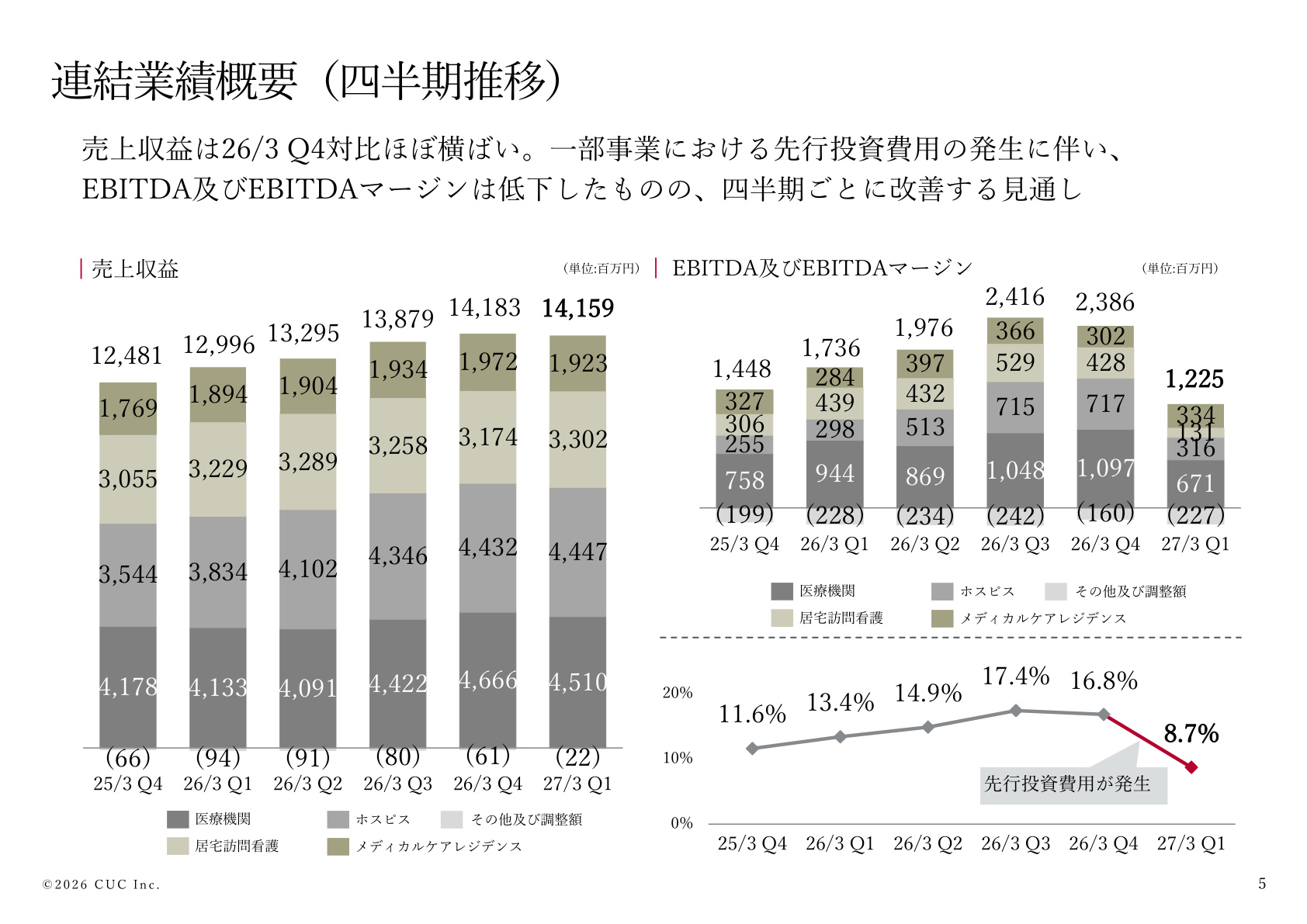
[Slide Commentary: Quarterly Performance Trends]
This slide is crucial for accurately understanding CUC's growth trajectory and profit margin fluctuations. The bar chart on the left (Revenue) shows that while revenue remained largely flat compared to the previous quarter (FY26/3 Q4: 14,183 million yen), it achieved a 9.0% year-on-year increase (FY26/3 Q1: 12,996 million yen) , confirming the continued expansion of the top line.
Meanwhile, focusing on the line graph on the right (EBITDA margin), the margin, which was at high levels of 17.4% in Q3 and 16.8% in Q4 of FY26/3, has dropped to 8.7% in this first quarter (FY27/3 Q1). However, this decline is not due to a sudden deterioration in business performance, but rather to strategic investments, including rapid expansion of home nursing bases and personnel reinforcement, preparation costs for opening US OBL (Office-Based Lab) facilities, and concentrated costs for new hospice openings . The company's outlook anticipates that occupancy rates will rise quarter by quarter, leading to a gradual recovery in profit margins.
2. Deep Dive into Profit Decline (EBITDA Variance Analysis)
Despite the increase in revenue, EBITDA declined by 511 million yen year-on-year. The detailed breakdown is as follows:
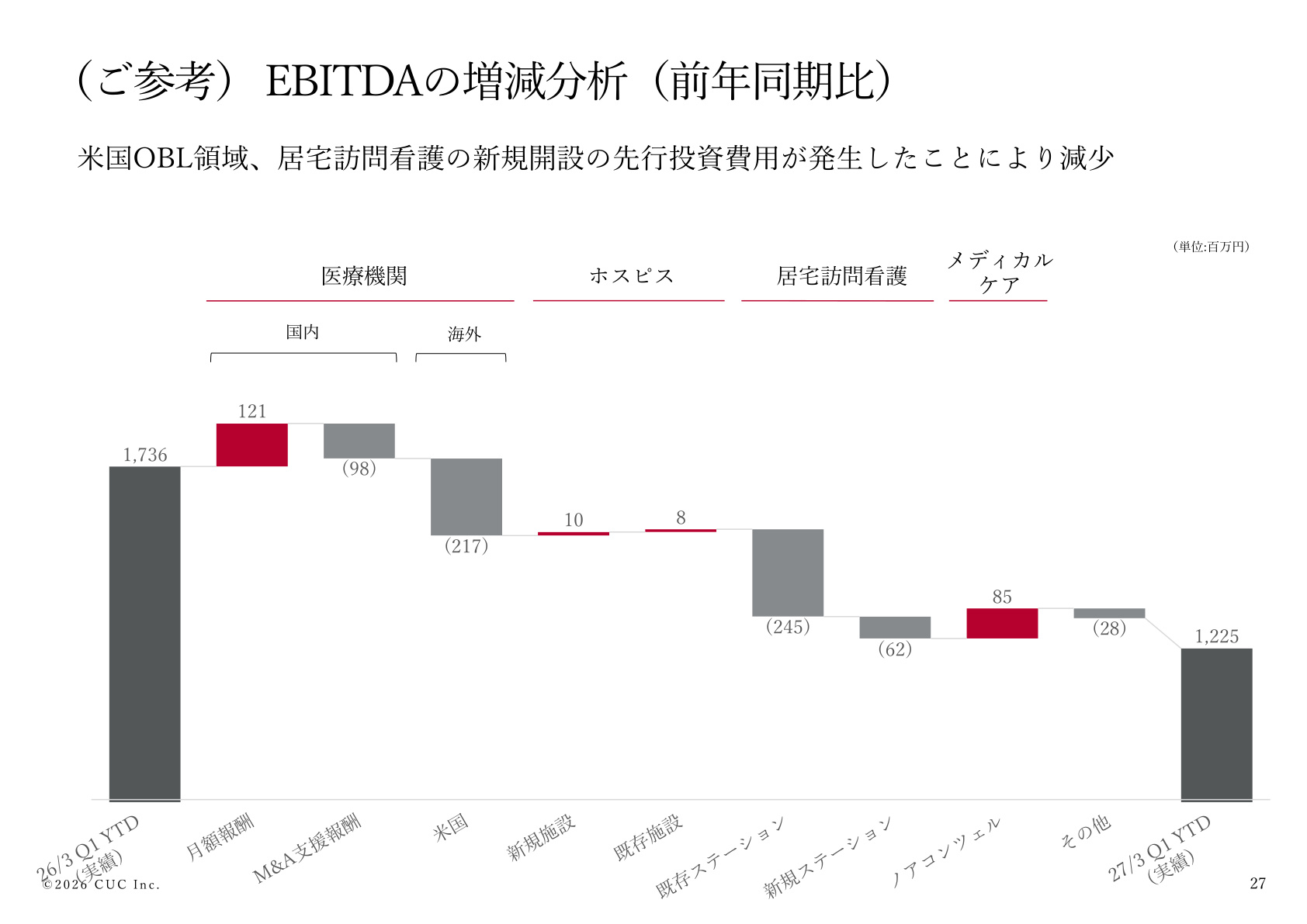
[Slide Commentary: EBITDA Variance Analysis]
This waterfall chart is a core document that allows for an immediate grasp of the positive and negative impacts of each business segment on profit.
- Domestic Medical Institution Support : Despite an improvement in monthly fees (+121 million yen), there was a reactionary decline (-98 million yen) from M&A support fees that were concentrated in Q1 of the previous year.
- Overseas Medical Institution Support (US) : The upfront costs for opening and launching the new US OBL (Office-Based Lab) business resulted in a negative impact of 217 million yen.
- Hospice : While there was a positive contribution from increased occupancy in existing and new facilities, the decline in unit prices due to medical fee revisions acted as a drag.
- Home Nursing : Profit was significantly pressured by personnel recruitment at existing stations (-245 million yen) and the initial losses from opening seven new bases (-62 million yen).
- Medical Care Residence : The segment achieved a profit increase of 85 million yen due to improved occupancy rates and price optimization at the Amulife Nijigaoka Field facility.
As shown, the primary factors for the profit decline are "investments in human capital and network expansion to enhance the future value of the business," clearly indicating that this is not due to a decline in demand for the core business.
3. Segment Performance and Key KPI Analysis
Progress and key KPI trends for each segment are as follows:
① Medical Institution Support Segment
- Revenue : 4,510 million yen ( +9.1% YoY)
- EBITDA : 671 million yen ( -28.9% YoY) In Japan, the number of major supported facilities expanded to 167 (+5.7% YoY) , and monthly fees increased steadily. Overseas, the revenue (1,835 million yen, +14.0% YoY) from "Vascular Specialists," the US OBL operator consolidated in February 2026, contributed to the results. However, segment EBITDA decreased due to rising preparation costs for new US OBL openings and feasibility study costs for new domestic businesses.
② Hospice Segment
- Revenue : 4,447 million yen ( +16.0% YoY)
- EBITDA : 316 million yen ( +6.0% YoY)
- Number of Facilities / Capacity : 67 facilities ( +26.4% YoY ) / 2,318 beds ( +31.3% YoY ) Revenue reached a record high due to the opening of new facilities (15 facilities contributed). While the occupancy rate for existing facilities remains high at 83.7% , the EBITDA margin fell to 7.1% due to the impact of the medical fee revision implemented in June 2026 (annual revenue per resident was 8.1 million yen, down 5.4% YoY) and initial opening costs.
③ Home Nursing Segment
- Revenue : 3,302 million yen ( +2.3% YoY)
- EBITDA : 131 million yen ( -70.0% YoY)
- Number of Users : 15,445 ( +3.8% YoY ), Total Care Hours: 330,000 hours ( +4.0% YoY ) Demand for home nursing remains extremely strong, and the number of users is increasing. In anticipation of future station expansion, the number of full-time equivalent nurses and therapists was significantly increased to 1,313 (+10.1% YoY) . EBITDA decreased significantly due to the costs of opening seven new bases, but profitability is expected to recover gradually from Q2 onwards as personnel utilization improves.
④ Medical Care Residence Segment
- Revenue : 1,923 million yen ( +5.5% YoY)
- EBITDA : 334 million yen ( +34.2% YoY) With the "Amulife Nijigaoka Field" facility, opened in October 2024, transitioning to a profit-generating phase, and successful price optimization for rent and food costs, the segment achieved both revenue and profit growth. The EBITDA margin improved significantly to 17.4% (compared to 13.6% in the same period last year).
4. Growth Strategy and Response to Medical Fee Revisions
Management's specific measures regarding the "medical fee revision (hospice business)," which is the biggest concern for investors, are shown in the following slide.
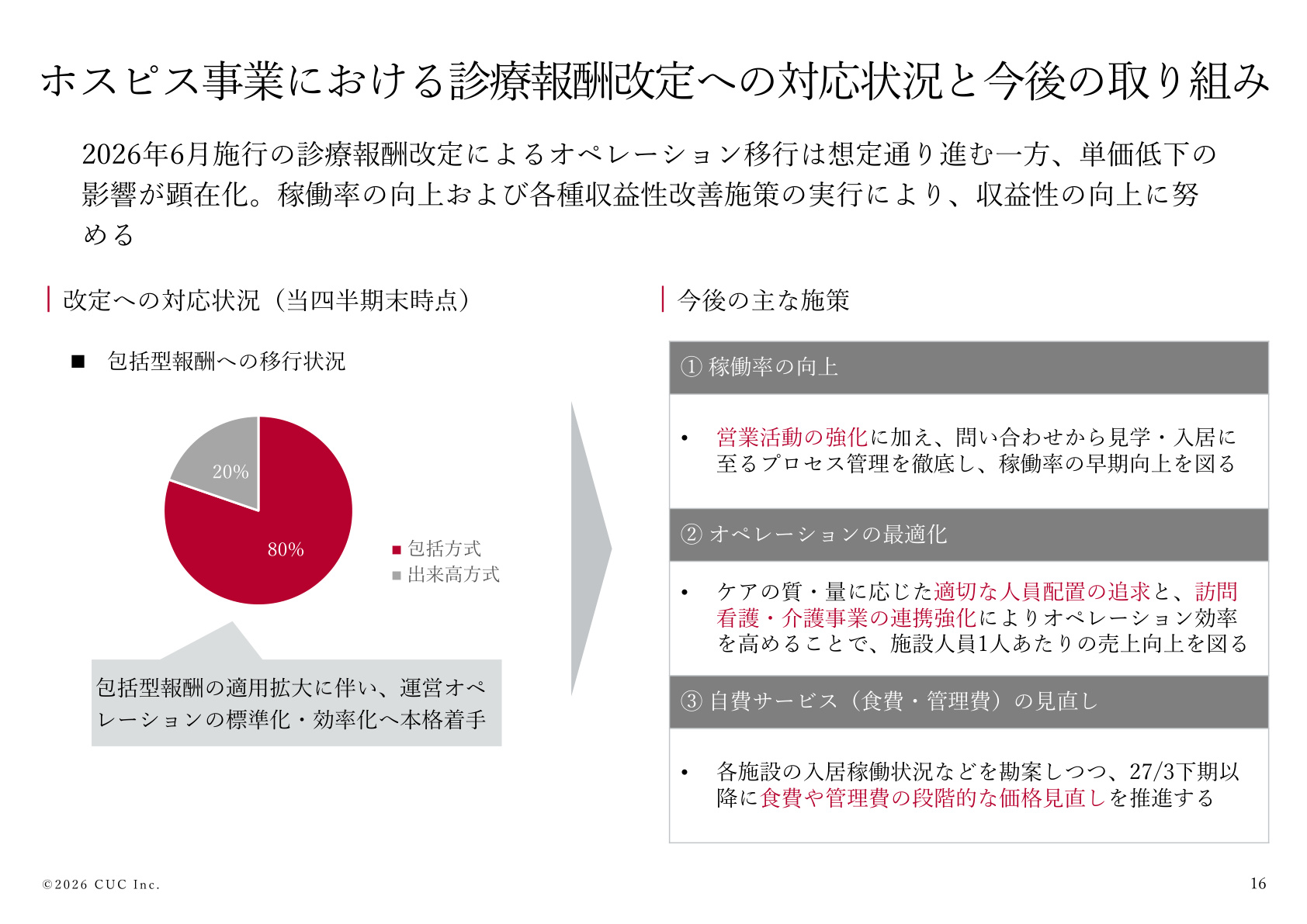
[Slide Commentary: Response to Revisions and Future Initiatives in the Hospice Business]
Following the medical fee revision implemented in June 2026, responding to the transition of the evaluation system and the decline in unit prices has become an urgent priority for the hospice business. This slide is significant as it presents a roadmap for restoring the business's profitability .
As shown in the pie chart on the left, the transition rate to comprehensive remuneration has reached 80% as of the end of the quarter, and the standardization of operations under the new system is progressing. The "Key Future Initiatives" listed on the right represent a concrete action plan to compensate for the unit price decline:
- Early Improvement of Occupancy Rates : Strengthening sales activities and thoroughly managing the process from inquiries to facility tours and move-ins.
- Operational Optimization : Improving productivity per staff member through appropriate staffing based on the quality and volume of care, and strengthening collaboration between home nursing and nursing care businesses.
- Review of Out-of-Pocket Services : Promoting a phased review of prices for food and administrative expenses from the second half of FY2027/3 onwards.
Furthermore, as a mid-to-long-term growth engine, the company is aggressively promoting the "in-house opening of large-scale hospice facilities with a capacity of 50 or more beds." With plans to open a total of 8 facilities in FY2027/3 (4 have already been opened in Nishitokyo, Chigasaki, Kitakyushu, and Maebashi), the company is aiming for efficiency through economies of scale.
5. Financial Position and Summary of Full-Year Outlook
Financial Position (BS Movements)
Total assets increased by 3,195 million yen from the end of the previous fiscal year to 101,144 million yen , crossing the 100 billion yen threshold. This is due to the execution of 5 billion yen in borrowings for overseas business and M&A funding (cash and deposits increased to 18,327 million yen) and an increase in goodwill and intangible assets (15,660 million yen) following the acquisition of Libra Co., Ltd. The equity ratio is maintained at approximately 33%, ensuring a financial foundation that supports aggressive growth investments.
Comprehensive Analysis and Conclusion
While the Q1 FY2027 earnings may give a negative impression based on the superficial decline in profit, a breakdown of the content reveals that it is the "result of executing infrastructure investment, base expansion, and talent acquisition for mid-to-long-term growth as planned."
With the rise in occupancy rates in hospice and home nursing, as well as the gradual penetration of measures to address medical fee revisions (transition to comprehensive remuneration and review of out-of-pocket prices) through the second half of the year, a scenario for a V-shaped recovery in profit margins is being drawn. It can be said that the company is on the expected trajectory to achieve its full-year plan (Revenue: 64,600 million yen, Operating Profit: 3,800 million yen).
This content is not intended as investment advice or a recommendation. Any opinions expressed are solely the personal views of each article.