

Nippon Gas (NICIGAS) Q1 FY2027 Earnings Deep Dive: Solid Core Performance and Accelerated Growth in the New 'Platform Business'

StockClub
Published: Jul 30, 2026, 10:10 AM
Sentiment Analysis

Nippon Gas (NICIGAS) delivered a strong start to the fiscal year ending March 2027 , with both gross profit and operating profit for the first quarter (April–June) exceeding initial projections. Beyond margin expansion and sales volume growth in its core LP gas business, the newly disclosed 'Platform (PF) Business' segment has emerged as a significant growth driver, strongly propelling overall performance.
This report provides a comprehensive analysis based on key data from the company's earnings presentation materials, covering current performance highlights, segment-specific details, the rationale behind full-year forecasts, and mid-to-long-term capital policy and shareholder return strategies.
1. Q1 Performance Highlights and Variance Analysis vs. Initial Plan
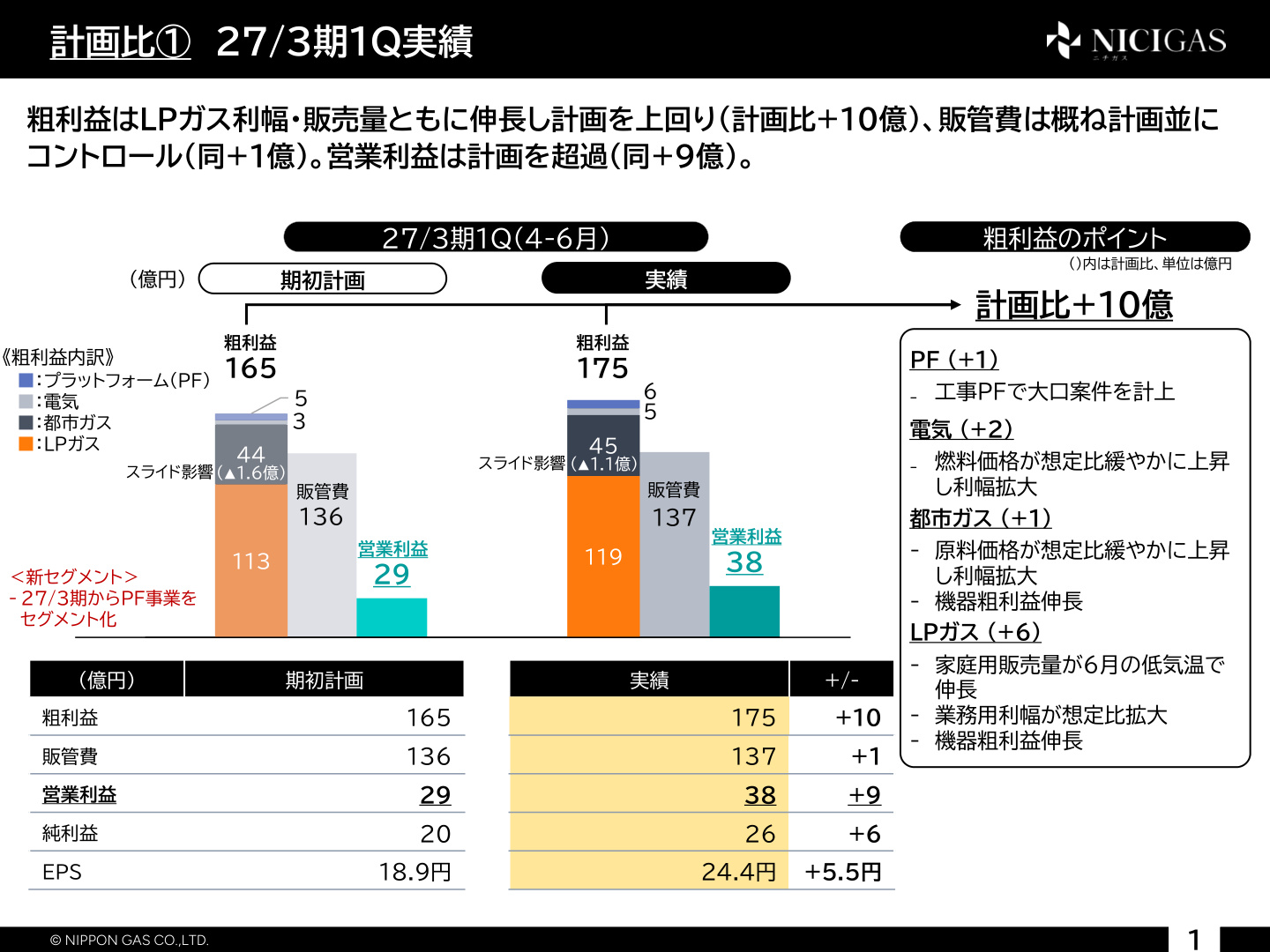
In the first quarter of FY2027, the company achieved gross profit of 17.5 billion yen (+1.0 billion yen vs. plan) and operating profit of 3.8 billion yen (+0.9 billion yen vs. plan), significantly outperforming initial targets. Net profit reached 2.6 billion yen (+0.6 billion yen vs. plan), with EPS at 24.4 yen .
The following slide is a critical document illustrating the breakdown of actual results against the Q1 plan.
[Significance and Background of the Slide Above]
This slide clearly demonstrates that the Q1 earnings beat was not driven by a single factor, but rather by all segments exceeding their respective plans . Specifically, the 1.0 billion yen surplus in gross profit was led by LP Gas (+0.6 billion yen) , followed by Electricity (+0.2 billion yen) , City Gas (+0.1 billion yen) , and Platform (+0.1 billion yen) , with every business line surpassing targets.
Furthermore, while 'Gas-related equipment' costs increased by 0.3 billion yen above plan due to proactive procurement in anticipation of inflation and supply chain conditions, this was absorbed by operational efficiencies in the field. Total SG&A expenses were controlled at 13.7 billion yen (only 0.1 billion yen above plan) , which also contributed to the 0.9 billion yen upside in operating profit.
2. Full-Year Earnings Forecast and Updated Assumptions
Although Q1 operating profit exceeded the plan by 0.9 billion yen, the full-year operating profit target of 20.0 billion yen (gross profit of 75.5 billion yen, net profit of 14.0 billion yen) remains unchanged from the initial plan.
This reflects a cautious update to the plan based on current raw material prices and weather conditions:
- LP Gas : Due to revisions in crude oil and CP price assumptions (lowering the full-year average from 720 US$/ton to 650 US$/ton) and anticipation of warmer temperatures in the second half (mild winter risk), the full-year gross profit forecast was revised from 49.5 billion yen to 49.1 billion yen (-0.4 billion yen) .
- Electricity/City Gas : Reflecting the Q1 margin upside and growth in equipment gross profit, the full-year gross profit for Electricity was revised upward from 5.2 billion yen to 5.4 billion yen (+0.2 billion yen) , and City Gas from 19.1 billion yen to 19.2 billion yen (+0.1 billion yen) .
- Platform : Incorporating the Q1 upside, the full-year gross profit forecast was raised from 1.7 billion yen to 1.8 billion yen (+0.1 billion yen) .
The operating profit plan for Q2 and beyond has been revised downward to 16.2 billion yen (-0.9 billion yen vs. initial plan), which is offset by the 0.9 billion yen beat in Q1. This indicates that the company is managing its operations with increased confidence in achieving the full-year operating profit target of 20.0 billion yen .
3. Segment-Specific Analysis
(1) LP Gas Business: Margin Expansion and Strong Equipment Sales
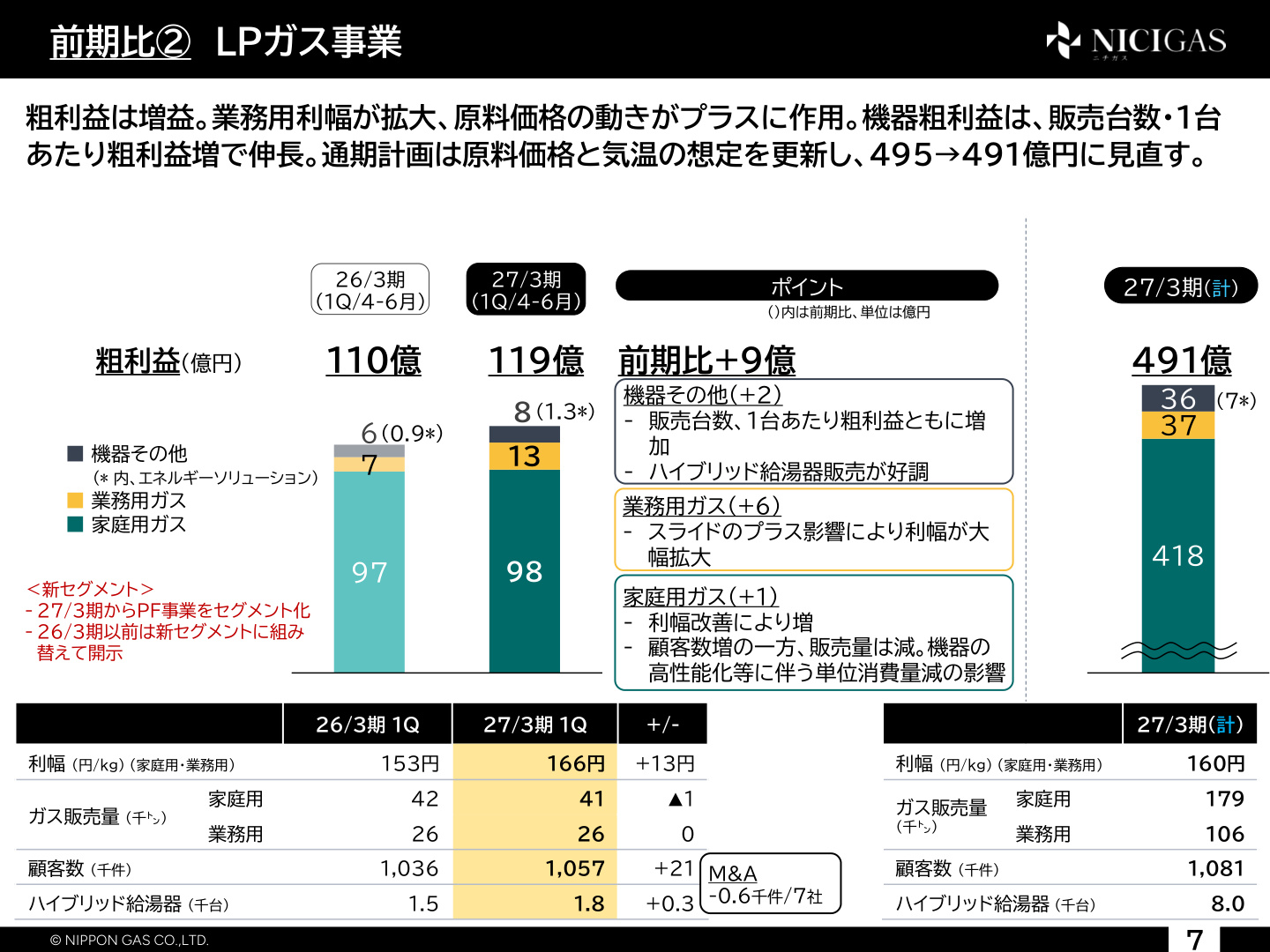
Q1 gross profit for the LP Gas business grew significantly to 11.9 billion yen (+0.9 billion yen YoY) .
[Significance and Background of the Slide Above]
This slide visualizes the profit structure and growth drivers of the company's core LP Gas business. The increase in gross profit (from 11.0 billion yen to 11.9 billion yen) is attributed to margin expansion in commercial gas (+0.6 billion yen) due to sliding scale effects and strong equipment sales, particularly hybrid water heaters (+0.2 billion yen) . Notably, the customer base continues to expand steadily , reaching 1.057 million customers, an increase of 21,000 YoY . The company has established a structure that offsets the decline in per-unit consumption due to higher-efficiency equipment by accumulating customers and securing appropriate margins (the average household/commercial margin in Q1 was 166 yen/kg, up 13 yen YoY).
(2) Electricity and City Gas Businesses: Customer Growth and Profitability Adjustments
- Electricity Business : Q1 gross profit was 0.5 billion yen (-0.5 billion yen YoY) . This was primarily due to the negative impact of the time lag in the fuel cost adjustment system. However, given the increase in contracts (+20,000 YoY to 409,000, with an electricity bundling rate of 24.5%) and Q1 margins exceeding expectations, the full-year plan has been revised upward.
- City Gas Business : Q1 gross profit was 4.5 billion yen (-0.1 billion yen YoY) . Despite a slight decline, performance remains solid when excluding the -0.11 billion yen impact from raw material price adjustments. The customer base grew steadily by 19,000 YoY to 613,000 , and with contributions from equipment sales, the full-year gross profit target was raised to 19.2 billion yen.
(3) Platform (PF) Business: A Rapidly Emerging Growth Axis
Disclosed as a new independent segment starting in FY2027, the 'Platform Business' demonstrates the results of the company's digital transformation (DX) initiatives within the energy industry.
[Significance and Background of the Slide Above]
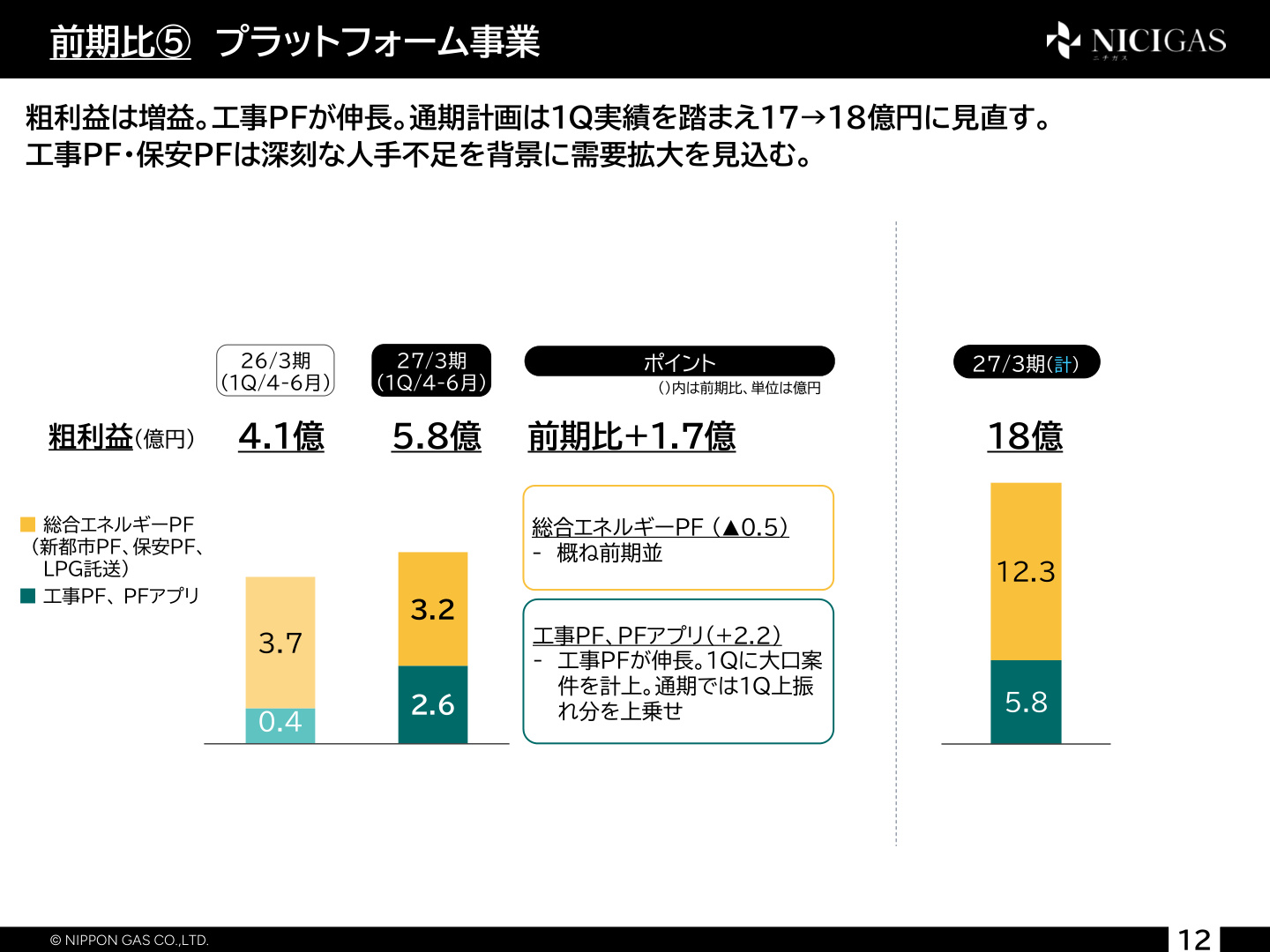
Against the backdrop of a severe labor shortage facing the entire energy industry, demand for the company's 'Construction PF,' 'Safety/Maintenance PF,' and 'PF Apps' is surging. Q1 gross profit reached 0.58 billion yen (+0.17 billion yen YoY) , with the booking of large-scale construction PF projects contributing significantly. Growth as a B2B business, which provides platforms for third-party infrastructure rather than just optimizing its own, is becoming increasingly clear, and its presence in the gross profit composition is rising. The full-year plan has been raised from 1.7 billion yen to 1.8 billion yen.
4. Capital Policy, Mid-to-Long-Term Growth Strategy, and Shareholder Returns
NICIGAS is pursuing a capital policy that achieves steady profit growth while maintaining high capital efficiency.
(1) Mid-Term Management Plan (3-year plan: FY27/3–FY29/3)
Focusing on organic growth, the company aims for 25.0 billion yen in operating profit and 82.0 billion yen in gross profit by the fiscal year ending March 2029 . As a commitment to capital efficiency, it targets an ROE of approximately 22% and an ROIC of approximately 13% , maintaining investment profitability that significantly exceeds the cost of equity (CAPM-based).
(2) B/S Control and Cash Flow
With a policy of not holding unnecessary equity, the company has set an equity ratio of approximately 40% as the optimal level . Q1 operating cash flow was 2.3 billion yen (compared to 2.1 billion yen in the same period last year), which is being allocated to growth capital such as M&A of LP gas business areas and ICT investments.
(3) Expansion of Shareholder Returns
Backed by stable cash flow generation, the company is further expanding shareholder returns. The annual dividend for FY2027 is planned at 110.0 yen per share (compared to 103.0 yen in the previous year), with a goal of returning over 36 billion yen in total dividends over three years. The company also plans to conduct flexible share buybacks depending on the maintenance of its 40% equity ratio.
Summary
Nippon Gas's Q1 FY2027 earnings were characterized by the steady expansion of its customer base in core energy businesses and the accelerated monetization of its new Platform business segment. While continued monitoring of second-half temperature fluctuations and raw material price trends is necessary, the company's rigorous SG&A management and efficient operations indicate that it is making steady progress toward achieving its full-year targets and improving mid-to-long-term capital efficiency.
This content is not intended as investment advice or a recommendation. Any opinions expressed are solely the personal views of each article.