


FPG Q3 FY2026 Earnings Analysis: Core Lease Fund Business Drives Performance as Company Navigates Tax Reforms for Mid-to-Long-Term Growth

StockClub
Published: Jul 30, 2026, 10:07 AM
Sentiment Analysis

The Q3 FY2026 earnings (October 2025 – June 2026) for FPG Inc. (Securities Code: 7148) demonstrate a powerful performance driven by its core Lease Fund business, which achieved record-breaking sales, while the Domestic Real Estate Fund business shows clear signs of recovery following the impact of recent tax reforms.
This report provides a multifaceted analysis of the company’s current performance, segment-specific details, and future growth strategies, focusing on 10 key topics derived from the earnings presentation materials.
1. Q3 FY2026 Earnings Highlights and Progress
For the first nine months of FY2026, the company reported consolidated net sales of 51.41 billion yen (down 43.3% YoY), operating profit of 17.61 billion yen (down 8.6% YoY), ordinary profit of 17.64 billion yen (down 12.6% YoY), and net profit attributable to owners of the parent of 12.10 billion yen (down 12.0% YoY).
While these figures appear to show a decline in revenue and profit, this is primarily due to accounting characteristics. In the Domestic Real Estate Fund business, the total real estate sale price is recorded as revenue, whereas in the Lease Fund business, only the arrangement and sales commissions are recorded. The shift toward a higher proportion of Lease Fund business has caused a superficial decline in revenue, but profit progress remains exceptionally steady.
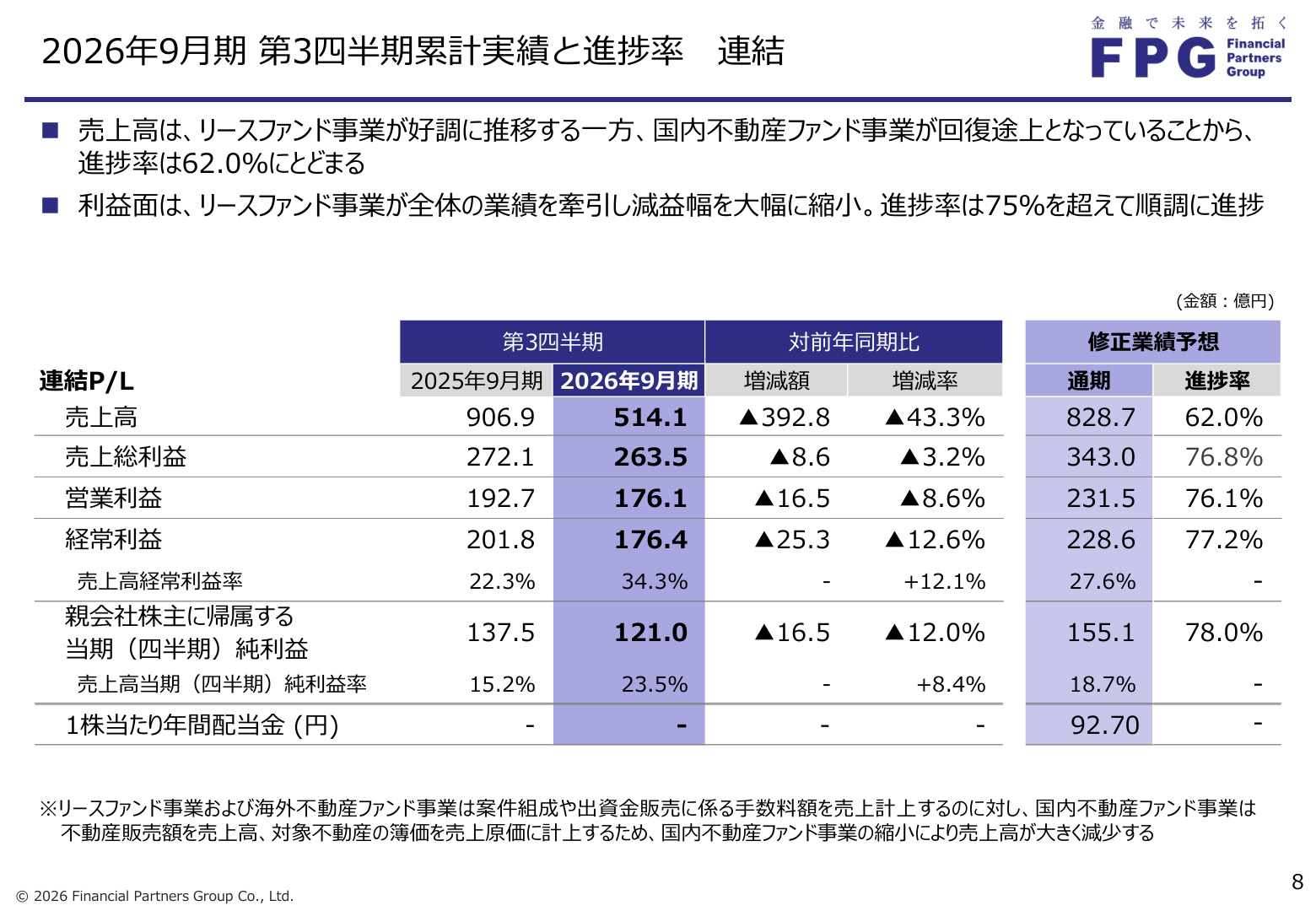
As shown in the consolidated performance slide above, the progress rates against the revised full-year forecasts are 76.1% for operating profit , 77.2% for ordinary profit , and 78.0% for net profit attributable to owners of the parent , all exceeding the 75% target line by the end of the third quarter. The ordinary profit margin has risen significantly to 34.3% (compared to 22.3% in the same period last year), indicating that a highly profitable business structure is being maintained.
2. Lease Fund Business: Record Sales Drive Performance
The primary pillar of the company, the Lease Fund business , served as the main engine for overall performance. For the first nine months, net sales reached 25.37 billion yen (up 23.6% YoY) and gross profit reached 22.30 billion yen (up 29.3% YoY), marking significant growth. Progress against full-year forecasts is exceptionally high, at 89.0% for sales and 90.6% for gross profit.
Of particular note is the growth in investment sales , fueled by overwhelming demand from investors.
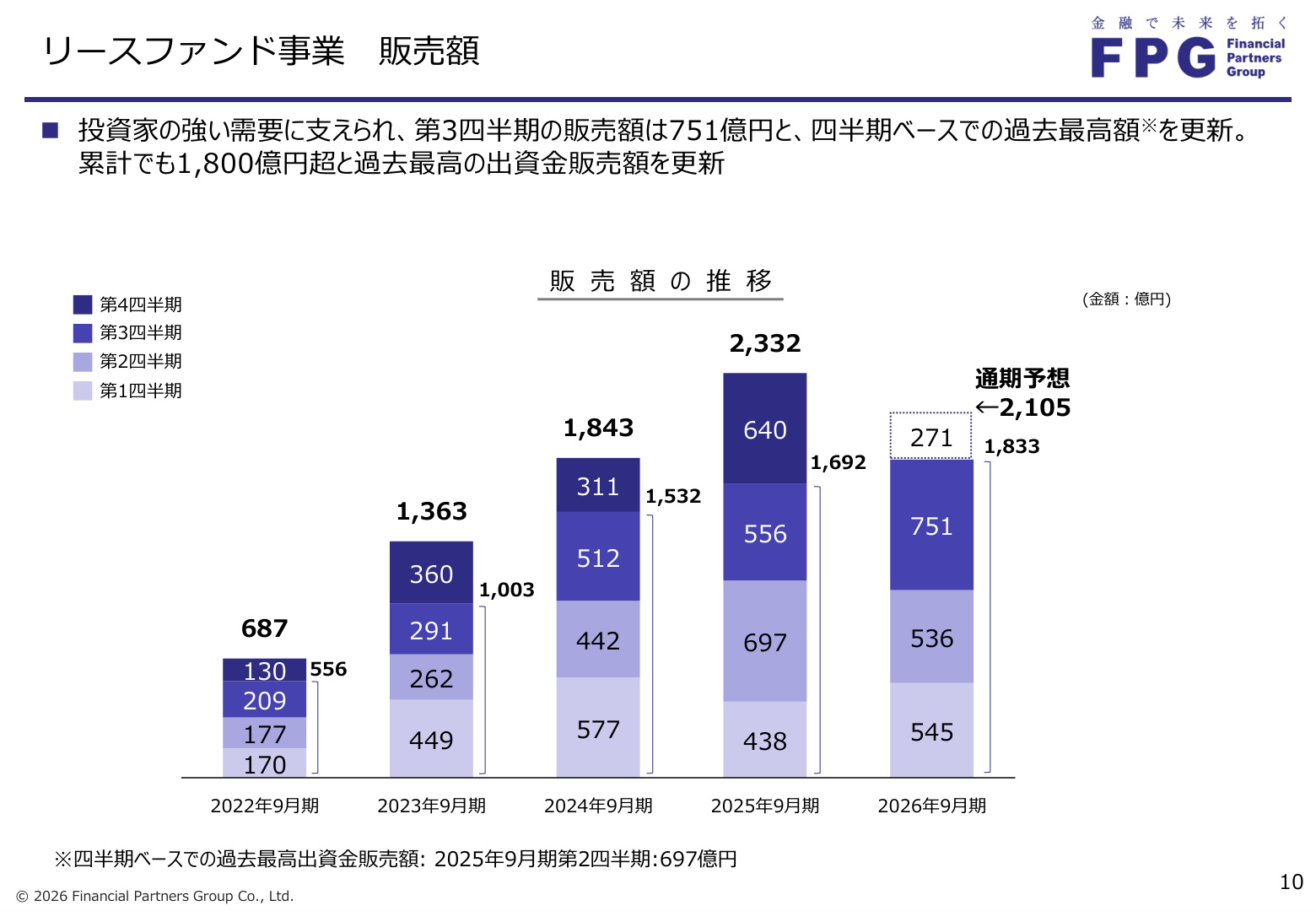
As indicated in this slide, investment sales for the third quarter (April–June) alone reached 75.1 billion yen , marking a record high on a quarterly basis . Cumulative investment sales for the first nine months reached 183.3 billion yen (up 8.3% YoY), achieving an 87.1% progress rate against the full-year forecast of 210.51 billion yen. This proves that corporate investor demand for tax deferral and asset management through operating leases—covering aircraft, ships, and containers—remains extremely robust.
3. Large-Scale JOLCO Deals and Pipeline Expansion
A major factor supporting the success of the Lease Fund business is the company’s ability to structure large-scale JOLCO (Japanese Operating Lease with Call Option) deals , built on strong relationships with global shipping giants.
In June 2026, the company secured a major deal involving four new 13,700 TEU container ships built at domestic shipyards, with Ocean Network Express (ONE) as the lessee. The company plans to begin selling two of these vessels in the fourth quarter, with the remaining two to be sold in the following period. This brings the total number of JOLCO deals for ONE to 10, establishing a stable supply line for large-scale series projects. Furthermore, these vessels feature advanced designs that reduce environmental impact (supporting methanol/ammonia fuel conversion and CO2 capture systems), balancing environmental contribution with economic rationality for investors.
Additionally, the company plans to structure over 200 billion yen in new deals in the fourth quarter, primarily focusing on large-scale shipping projects, with a record-high full-year structuring target of 578.5 billion yen .
4. Strong Launch of New Individual Product "F.bit"
In addition to its traditional corporate-focused lease funds, the company has launched "F.bit," a fractional aircraft investment product for individual investors .
"F.bit No. 1" received applications far exceeding the number of available units, resulting in an immediate sell-out via lottery. Following this success, the company began accepting applications for "F.bit No. 2" on August 3, 2026 (a deal featuring Vueling Airlines, one of the largest LCCs in Spain under the IAG Group, as the lessee). This product is gaining traction as a new asset management scheme for high-net-worth individuals, promising further expansion of the customer base.
5. Domestic Real Estate Fund Business: Recovery and Flagship Projects
The second pillar, the Domestic Real Estate Fund business , was impacted by market wait-and-see sentiment following the announcement of tax reform guidelines. Consequently, net sales for the first nine months were 25.57 billion yen (down 61.5% YoY) and gross profit was 4.22 billion yen (down 40.2% YoY). Progress rates stand at 48.6% for sales and 47.8% for gross profit.
However, monthly trends show a clear recovery from the bottom. Monthly sales (based on applications) have trended upward: 1.69 billion yen in April, 2.40 billion yen in May, and 2.87 billion yen in June .
Regarding project structuring, the company successfully structured "FPG Links Omotesando V" for 43.9 billion yen at the end of June 2026, located in a prime spot on the main street of Omotesando. This is a high-quality flagship property housing LVMH group's "Loro Piana" and Swiss luxury watchmaker "TAG Heuer," helping the company achieve its full-year structuring target of 73.4 billion yen (reaching 75.1 billion yen). Furthermore, a bulk sale of a Shirokanedai property is scheduled for the fourth quarter (with a sales contract expected to be signed by the end of July), supporting the push to meet full-year targets.
6. Restarting the Overseas Real Estate Fund Business
Regarding the third pillar, the Overseas Real Estate Fund business , the company has been selective with projects due to changing market conditions, resulting in net sales and gross profit of only 0.04 billion yen for the first nine months. However, the company has resumed full-scale consideration of new projects for the first time in about two years , and is building a pipeline to meet the full-year forecast of 5.7 billion yen.
7. Tax Reform Response and Mid-to-Long-Term Growth Strategy
One of the topics of greatest interest to investors is the policy response to the FY2026 Tax Reform Guidelines .
Under the new tax reform, the inheritance tax valuation method for fractional real estate products has been revised, shifting from the traditional "fixed asset tax valuation/roadside land value" to "an amount equivalent to the normal transaction price."
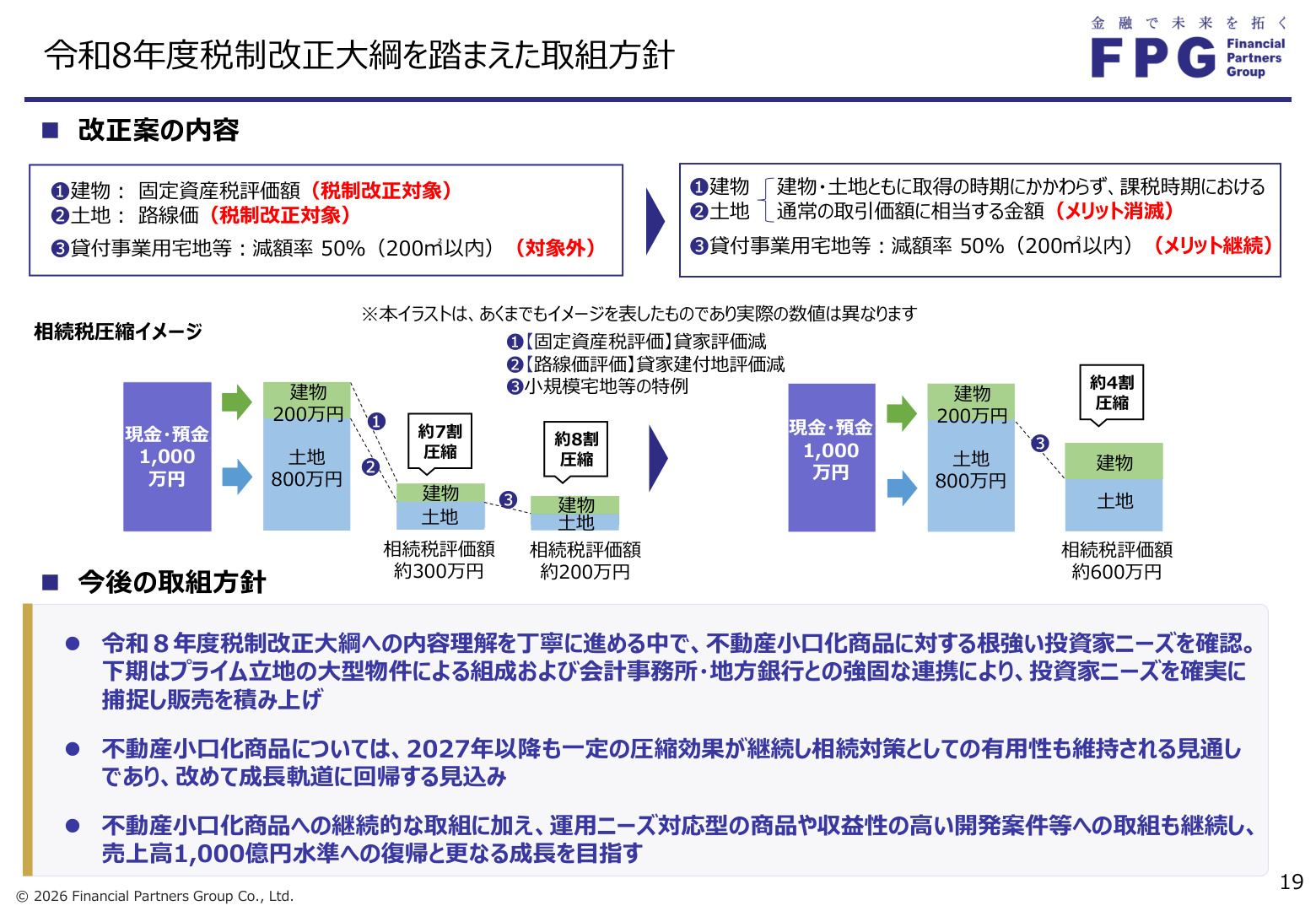
As explained in the slide above, while the revision limits the traditional 70-80% compression effect, the "Special Provisions for Small-Scale Residential Land for Loan Business Use (50% reduction)" remains applicable , maintaining the product's utility for inheritance planning.
FPG is working to promote a thorough understanding among clients and partners (accounting firms, regional banks, etc.) while simultaneously promoting large-scale prime location projects, investment-oriented products, and development projects. This forms a clear roadmap to return to a growth trajectory from 2027 onwards, aiming to restore sales to the 100 billion yen level .
8. Historical Track Record of Crisis Resilience
Since its founding, the company has a proven track record of evolving its business structure to overcome numerous tax reforms and global economic crises:
- 2005 Lease-related Tax Reform → Became a leader in lease funds by developing new products and gaining market trust.
- 2008 Lehman Shock / 2011 Great East Japan Earthquake → Diversified target assets, including the start of aircraft project structuring.
- 2020 COVID-19 Crisis → Shifted from declining aircraft demand to large-scale shipping (vessels/containers) projects and rapidly grew the Domestic Real Estate Fund business as a second pillar.
- 2020 Overseas Real Estate Tax Reform → Shifted from individual-focused to corporate-focused schemes.
- FY2026 Tax Reform → Re-growth strategy through diversification into investment/development products and strict selection of prime locations.
This history of flexibly adapting its business model and building new growth pillars whenever environmental changes occur has become an organizational strength.
9. Financial Foundation and Corporate Governance
Financially, total net assets reached 60.15 billion yen at the end of the third quarter, an increase of 2.97 billion yen from the end of the previous fiscal year. The company maintains a high turnover rate for inventory assets (product investments, real estate for structuring, etc.) and has established a flexible financing structure that combines appropriate cash on hand with borrowings.
Regarding governance, five out of seven directors are independent outside directors , and three out of seven are female directors (including one non-Japanese) . All three corporate auditors are also independent outside auditors, establishing a decision-making and oversight structure with high independence and diversity.
10. Conclusion and Future Outlook
The Q3 FY2026 earnings clearly demonstrate that FPG’s performance is firmly supported by the strong growth of the Lease Fund business .
Key points to watch moving forward include:
- Lease Fund structuring and sales pace in Q4 : The progress of the 200 billion yen+ large-scale structuring plan and the achievement of sales targets.
- Accumulation of Domestic Real Estate Fund sales : The progress of the bulk sale of the Shirokanedai property and the acceleration of sales for fractional products like Omotesando V.
- Introduction of new schemes and products in response to tax reform : Progress on specific initiatives to return to 100 billion yen in sales from 2027 onwards.
Armed with a solid revenue base and high crisis resilience, the company is steadily pursuing growth amidst a changing environment.
This content is not intended as investment advice or a recommendation. Any opinions expressed are solely the personal views of each article.