


Kyocera Q1 FY2027 Earnings Deep Dive: Record-High Profits Driven by AI/Semiconductor Demand and Yen Depreciation; Full-Year Guidance Revised Upward

StockClub
Published: Jul 30, 2026, 10:06 AM
Sentiment Analysis
Kyocera’s Q1 FY2027 earnings marked an exceptionally strong start, with both revenue and profit reaching record highs for a first quarter . The company successfully captured robust demand for advanced semiconductors and electronic components—particularly for AI data centers—while the ongoing depreciation of the yen provided a significant tailwind to earnings. Consequently, the company has significantly revised its full-year earnings forecast and ROE targets upward .
This report provides a multi-faceted analysis of the key topics detailed in the earnings materials, ranging from the background of the Q1 results and segment-specific profit trends to the revised full-year outlook and the investment strategy for the components business, which serves as the engine for mid-to-long-term growth.
1. Q1 Earnings Highlights and Overview
Kyocera’s Q1 FY2027 results showed revenue of ¥525.383 billion (up 9.9% YoY) , operating profit of ¥49.101 billion (up 164.7% YoY) , profit before income taxes of ¥74.891 billion (up 68.1% YoY) , and profit attributable to owners of the parent of ¥60.576 billion (up 63.1% YoY) . All top-line and bottom-line figures set new records for a first quarter.
The slide below summarizes the key financial indicators, variances, and the impact of exchange rates for Q1.
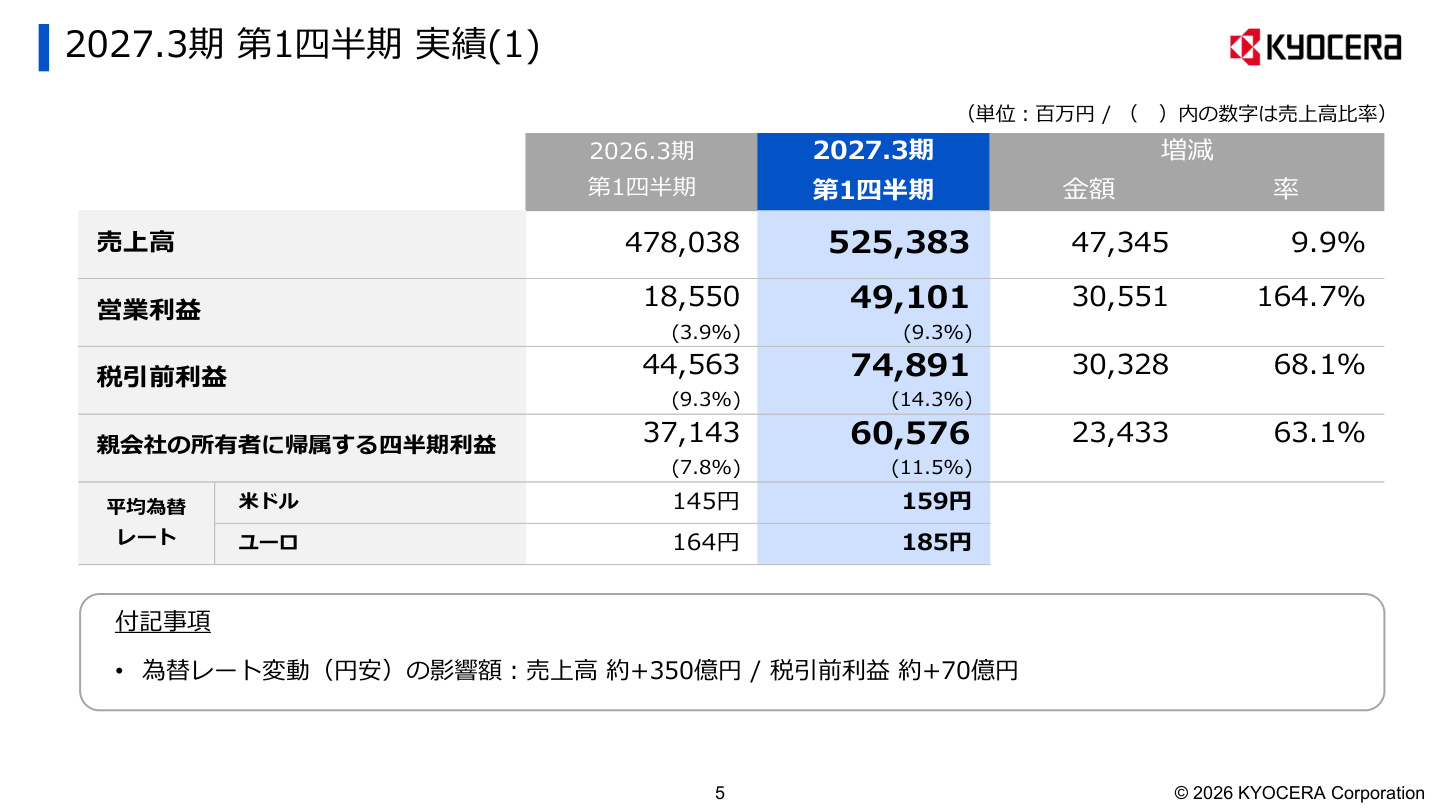
Notably, beyond achieving revenue growth, the operating profit margin improved sharply from 3.9% in the same period last year to 9.3% . The primary driver of this substantial profit growth was an improved product mix, fueled by a surge in sales of high-value-added products (such as semiconductor packages and small, high-capacity capacitors) centered on the AI data center market. Furthermore, exchange rate fluctuations contributed an estimated ¥35 billion boost to revenue and approximately ¥7 billion to profit before income taxes (based on an average rate of ¥159 to the USD and ¥185 to the EUR), indicating that both organic business growth and currency tailwinds significantly bolstered earnings.
2. Analysis of Segment Performance
Performance trends for each business segment in Q1 are as follows:
(1) Core Components Segment
- Revenue : ¥178.081 billion (up 22.1% YoY)
- Business Profit : ¥23.826 billion (up 67.9% YoY)
- Trends : Sales of fine ceramic components for semiconductor manufacturing equipment and semiconductor packages for AI data centers increased significantly. The business profit margin expanded from 9.7% in the same period last year to 13.4% , acting as the primary driver for the entire segment. Business profit also saw a sharp recovery, up 87.0% compared to the previous quarter (QoQ).
(2) Electronic Components Segment
- Revenue : ¥103.645 billion (up 23.6% YoY)
- Business Profit : ¥8.782 billion (a dramatic turnaround from a loss of ¥3.008 billion in the same period last year)
- Trends : Sales of small, high-capacity MLCCs (multi-layer ceramic capacitors) and tantalum capacitors for AI servers and data centers grew substantially. In addition to the elimination of one-time losses related to business transfers from the previous year (approx. ¥2.1 billion), the increase in high-value-added product sales and the recording of gains from real estate sales (approx. ¥3.0 billion) contributed to the profit growth.
(3) Solutions Segment
- Revenue : ¥247.627 billion (down 2.1% YoY)
- Business Profit : ¥30.333 billion (up 60.7% YoY)
- Trends : While total revenue declined due to the divestiture of a U.S. cutting tool subsidiary in Q4 of the previous fiscal year (an impact of approx. ¥36 billion), business profit increased significantly. This was driven by rising demand in core existing businesses such as information equipment (document solutions) and cutting tools, alongside ongoing profitability improvement initiatives.
3. Upward Revision of FY2027 Full-Year Forecast and Its Background
Based on the strong Q1 progress and changes in the external environment, the company has revised its full-year consolidated earnings forecast for FY2027 across the board:
- Revenue : ¥2.08 trillion (up ¥140 billion from previous forecast; up ¥9.797 billion YoY)
- Operating Profit : ¥160 billion (up ¥30 billion from previous forecast; up ¥41.862 billion YoY)
- Profit Before Income Taxes : ¥200 billion (up ¥30 billion from previous forecast; up ¥31.006 billion YoY)
- Profit Attributable to Owners of the Parent : ¥160 billion (up ¥19 billion from previous forecast; up ¥19.031 billion YoY)
- Earnings Per Share (EPS) : ¥122.04 (previous forecast: ¥102.73)
The slide below summarizes the changes in the business environment and the underlying factors that led to this upward revision from the initial forecast (announced in April) to the current one (announced in July).
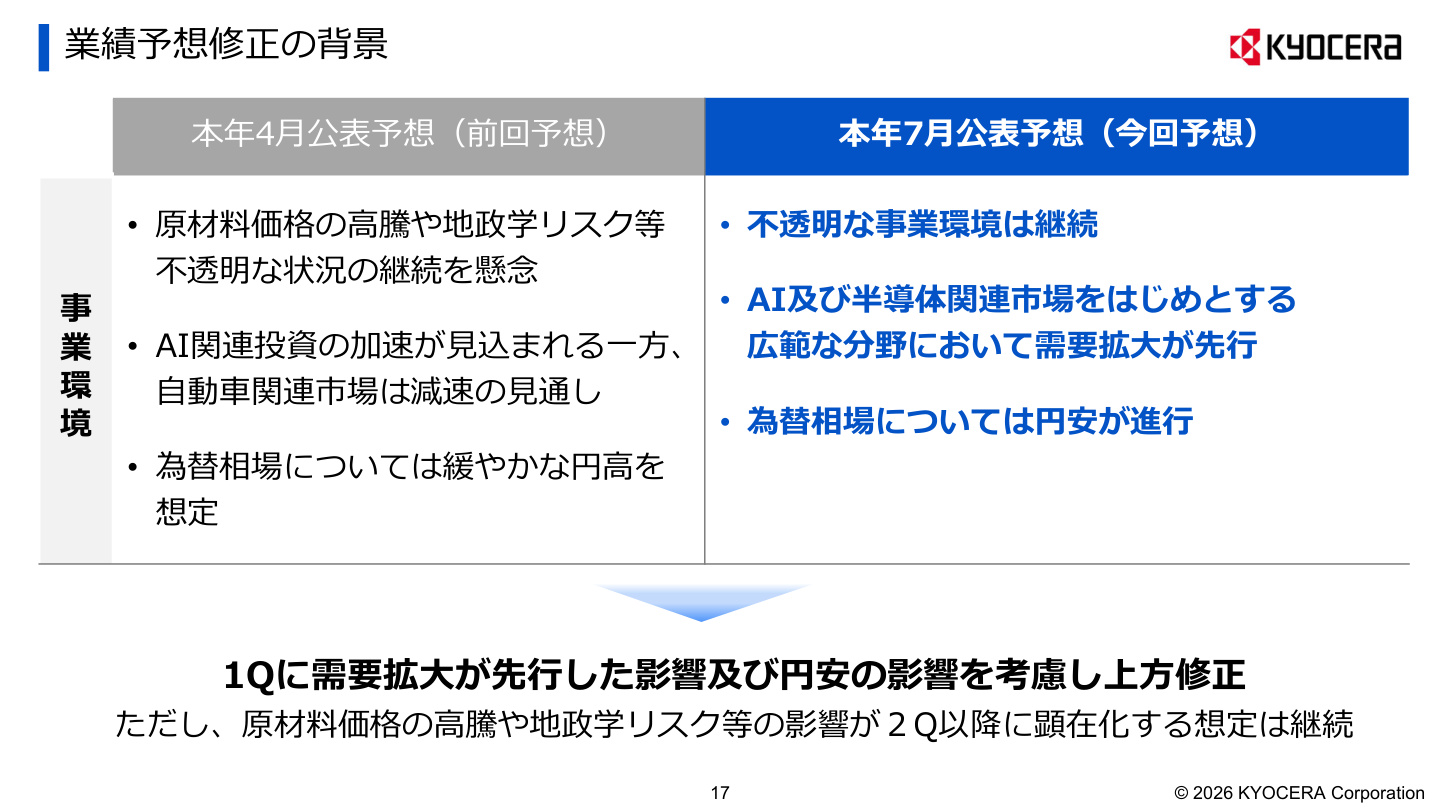
The upward revision is driven by "earlier-than-expected demand expansion in a wide range of fields, led by the AI and semiconductor-related markets" and "the depreciation of the yen (the assumed rate against the USD was changed from ¥150 to ¥155)." While concerns regarding rising raw material costs, geopolitical risks, and a slowdown in the automotive market existed at the start of the fiscal year, the robust demand for AI infrastructure has manifested at a speed that far exceeds these concerns. However, the company maintains a somewhat cautious stance, anticipating that uncertainties such as high raw material costs may emerge from Q2 onward.
4. Mid-to-Long-Term Growth Strategy: Roadmap for Concentrated Investment in the Components Business
Essential to Kyocera’s growth story is its strategic investment plan in the "advanced semiconductor and AI-related peripheral fields," which the company positions as its growth pillar.
The slide below outlines the investment plan for the components business over the six-year period from FY2026 to FY2031, as well as market outlooks in focus areas.
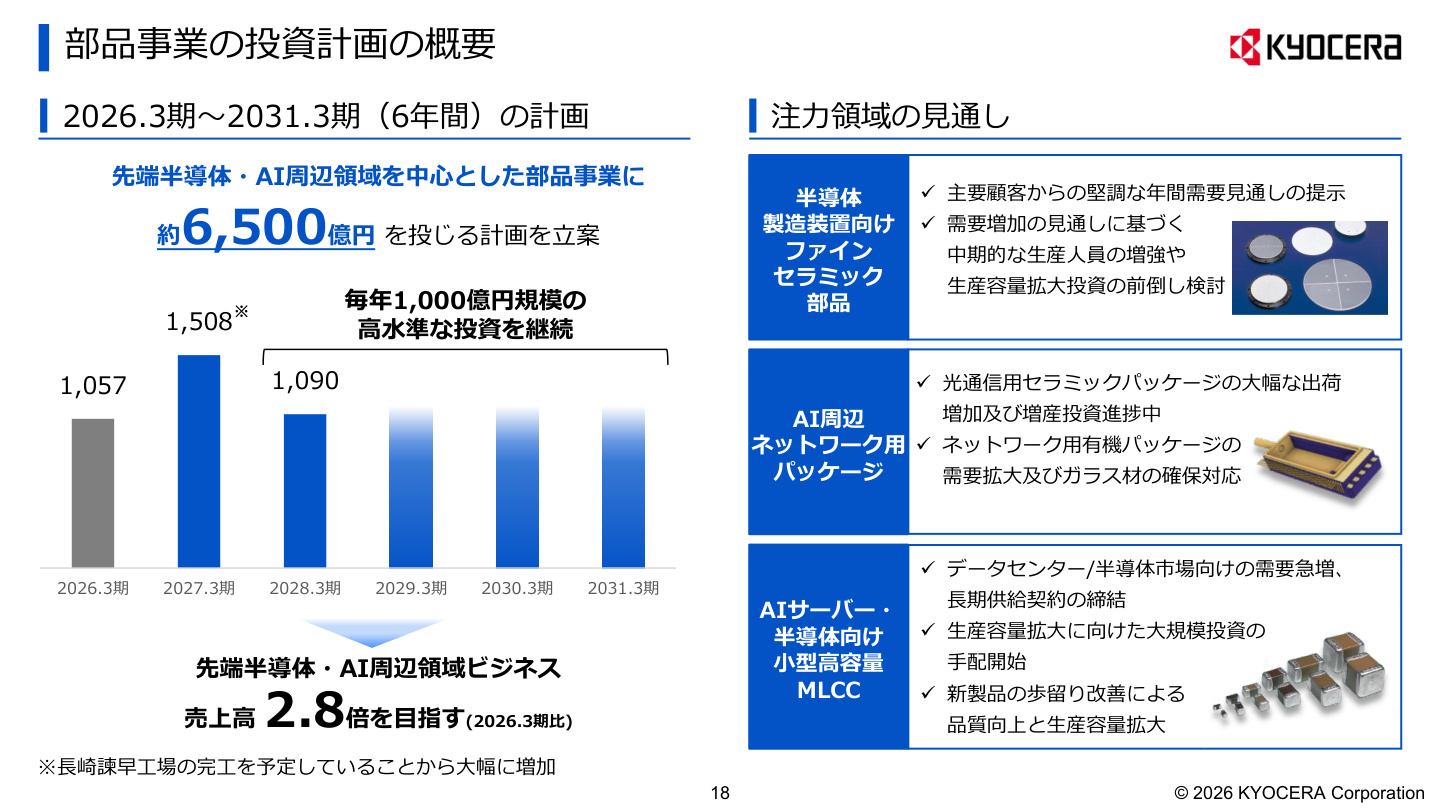
The company has announced a large-scale capital investment plan of approximately ¥650 billion over six years for its components business. This signifies a commitment to maintaining a high level of investment at a scale of ¥100 billion annually . With the completion and operation of the Nagasaki Isahaya Plant, the company aims to expand sales in the advanced semiconductor and AI-related peripheral business by 2.8 times compared to FY2026 .
Specific developments by focus area are as follows:
- Fine Ceramic Components for Semiconductor Manufacturing Equipment : Following the receipt of solid annual demand forecasts from major customers, the company is considering increasing production personnel and accelerating investments to expand production capacity.
- Packages for AI Peripheral Networks : The company is promoting the procurement of glass materials and increasing production investment to meet the surge in shipments of ceramic packages for optical communications and the growing demand for organic packages for networks.
- Small, High-Capacity MLCCs for AI Servers and Semiconductors : The company is advancing long-term supply agreements while aiming to improve profitability through large-scale capacity expansion investments and yield improvements for new products.
5. Improving Capital Efficiency and Stance Toward Achieving ROE Targets Ahead of Schedule
In line with the upward revision of earnings forecasts, the ROE forecast for FY2027 has been raised from 4.3% to 4.9% . This clarifies a scenario in which the company aims to achieve its mid-term goal of "ROE of 5.0% or higher" one year ahead of the original schedule (previously FY2028) .
As for capital efficiency improvement measures, in addition to "organic growth" driven by AI-related products and solutions, the company is proceeding as planned with "continuous optimization of capital structure," such as reducing cross-shareholdings and strengthening shareholder returns. By balancing the strengthening of business profitability with management that is conscious of the cost of capital, the company is building a structure aimed at enhancing corporate value over the mid-to-long term.
Summary
Kyocera’s Q1 FY2027 earnings were exceptionally strong, recording record-high revenue and profit due to the rapid growth of its Core Components and Electronic Components segments, which captured the powerful tailwinds of the AI and semiconductor markets . Beyond short-term upward revisions, the results confirm that the company is steadily executing its roadmap for structural growth and capital efficiency, including ¥650 billion in growth investments over six years and an early target to exceed 5.0% ROE .
This content is not intended as investment advice or a recommendation. Any opinions expressed are solely the personal views of each article.