


Kagome FY2026 H1 Earnings & Full-Year Forecast Revision Deep Dive: Overcoming Post-Price Hike Challenges and Global Growth Strategy

StockClub
Published: Jul 30, 2026, 09:53 AM
Sentiment Analysis

This is a detailed deep-dive report on Kagome Co., Ltd.'s financial results for the first half (H1) of the fiscal year ending December 2026 and the subsequent revision of its full-year earnings forecast. We provide a neutral, in-depth analysis of current performance trends, segment-specific conditions, the impact of changing external environments, and growth strategies aimed at future earnings recovery.
1. H1 FY2026 Consolidated Financial Highlights
In the first half of FY2026, Kagome achieved a 3.7% year-on-year increase in revenue to 143.7 billion yen . However, the company recorded "higher revenue, lower profit" as business profit fell 18.6% to 8.4 billion yen , operating profit declined 14.5% to 9.0 billion yen , and net profit attributable to owners of the parent dropped 24.2% to 4.6 billion yen .
- Revenue : 143.7 billion yen (+5.1 billion yen / +3.7% YoY) *Excluding the +4.8 billion yen currency impact, revenue was flat YoY.
- Business Profit : 8.4 billion yen (-1.9 billion yen / -18.6% YoY)
- Operating Profit : 9.0 billion yen (-1.5 billion yen / -14.5% YoY)
- Net Profit : 4.6 billion yen (-1.4 billion yen / -24.2% YoY)
The primary drivers for revenue growth were the depreciation of the yen (+4.8 billion yen impact) and the consolidation of the UK-based Silbury (+3.6 billion yen). Conversely, the decline in profit was attributed to increased advertising and sales promotion expenses aimed at stimulating demand following domestic price revisions, as well as a reduction in the unit selling price of tomato paste (primary processing) in the international business.
2. Segment Analysis and Brand Performance
[Domestic Processed Food Business] Sluggish Beverage Sales vs. Strong Food Performance
Revenue in the Domestic Processed Food business was 73.0 billion yen (-0.2% YoY) , with business profit at 5.0 billion yen (-8.8% YoY) .
- Beverages : Revenue 38.9 billion yen (-1.5% YoY), Business Profit 2.7 billion yen (-10.7% YoY)
- Mail Order : Revenue 6.0 billion yen (-0.6% YoY), Business Profit 0.2 billion yen (-12.7% YoY)
- Food & Others : Revenue 28.1 billion yen (+1.8% YoY), Business Profit 2.0 billion yen (-5.7% YoY)
In the Food & Others segment, household products like "Kagome Tomato Ketchup" and commercial-use sauces performed well, supported by collaborations such as the Doraemon campaign. However, in the core beverage segment, a clear contrast in demand recovery has emerged between brands following the price revisions implemented in February due to rising agricultural raw material costs.
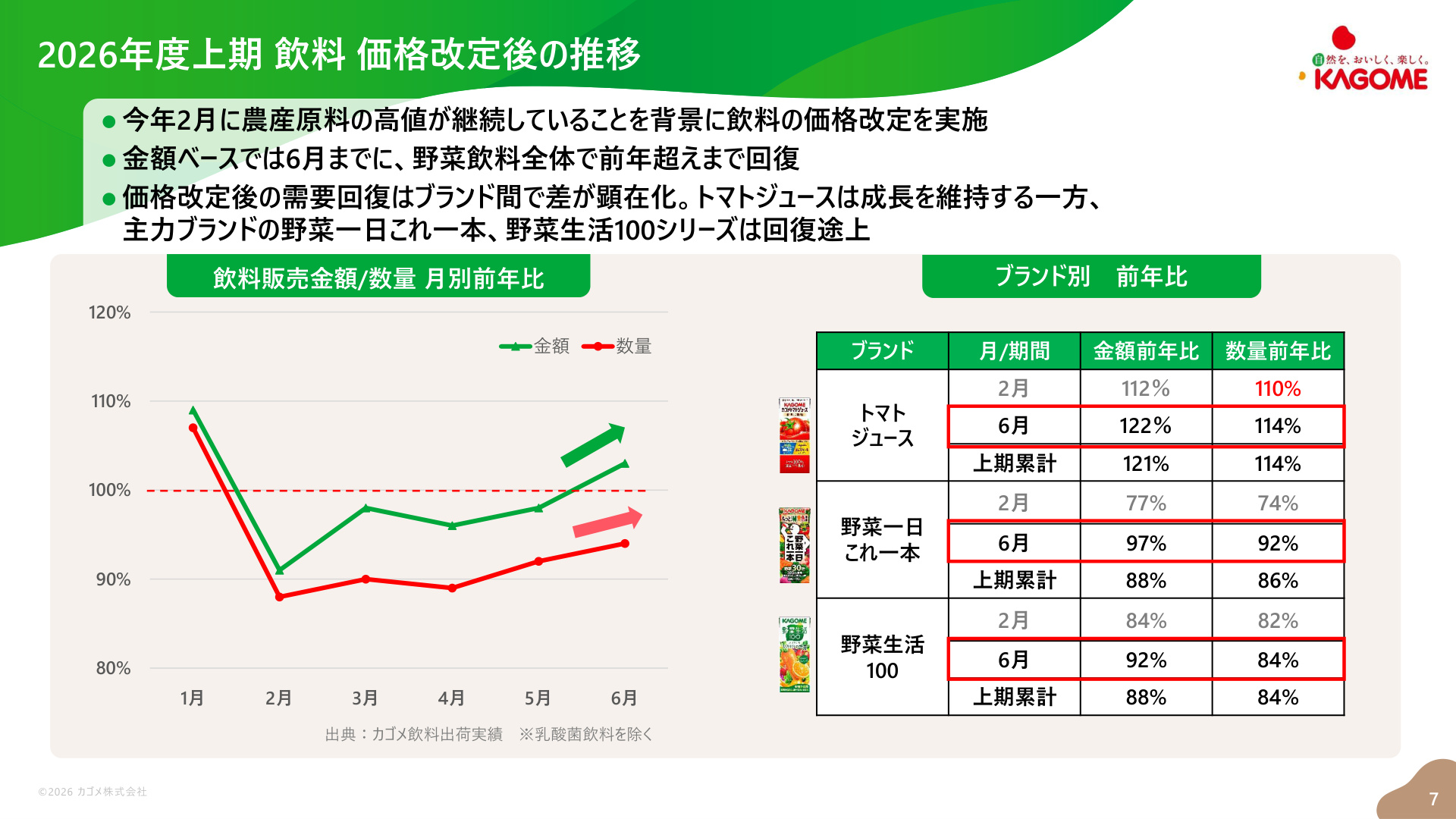
The slide above (page 7) shows the monthly sales value and volume trends for beverages and year-on-year comparisons by brand since the price revisions. Key takeaways include:
- Resilience of Tomato Juice : Due to the penetration of functional benefits (blood pressure/cholesterol management) and an increase in heavy users, growth has been maintained even after price hikes (H1 cumulative: 121% in value, 114% in volume YoY).
- Delayed Recovery of Core Vegetable Beverages : "Yasai Ichinichi Kore Ippon" (H1 cumulative: 88% in value, 86% in volume) and "Yasai Seikatsu 100" (H1 cumulative: 88% in value, 84% in volume) saw demand recovery speeds fall below company expectations.
- Background of Outflow : Customer migration to other health beverage categories such as lactic acid bacteria drinks, soy milk, and mineral water has been observed, making the reconstruction of health-value messaging for vegetable/fruit juice mixes an urgent priority.
[International Business] Scale Expansion via Silbury Acquisition and Market Impact on Primary Processing
International business revenue was 68.5 billion yen (+11.9% YoY) , with business profit at 5.1 billion yen (-10.2% YoY) .
- Tomato/Other Primary Processing : Revenue 30.6 billion yen (+5.5% YoY), Business Profit 2.3 billion yen (-23.7% YoY)
- Tomato/Other Secondary Processing : Revenue 38.2 billion yen (+18.4% YoY), Business Profit 2.7 billion yen (+10.4% YoY)
The secondary processing field (sauces for food service) achieved revenue and profit growth (+10.4% in business profit) driven by US limited-time menu adoptions, strong performance in Asian sauces, and the consolidation of Silbury. Conversely, the primary processing field faced a 23.7% decline in business profit due to market factors, including lower paste selling prices and fluctuations in procurement costs for processing tomatoes.
3. External Environment (Middle East Situation) and Forecast Revision
Considering H1 progress and changes in the external environment, Kagome has revised its full-year consolidated earnings forecast for FY2026 .
- Revenue : 310.0 billion yen (No change from initial forecast / +5.3% YoY)
- Business Profit : 190.0 billion yen (-4.0 billion yen from initial forecast / -15.1% YoY) *Downward revision
- Operating Profit : 195.0 billion yen (-3.5 billion yen from initial forecast / -12.6% YoY)
- Net Profit : 105.0 billion yen (-4.3 billion yen from initial forecast / -29.1% YoY)
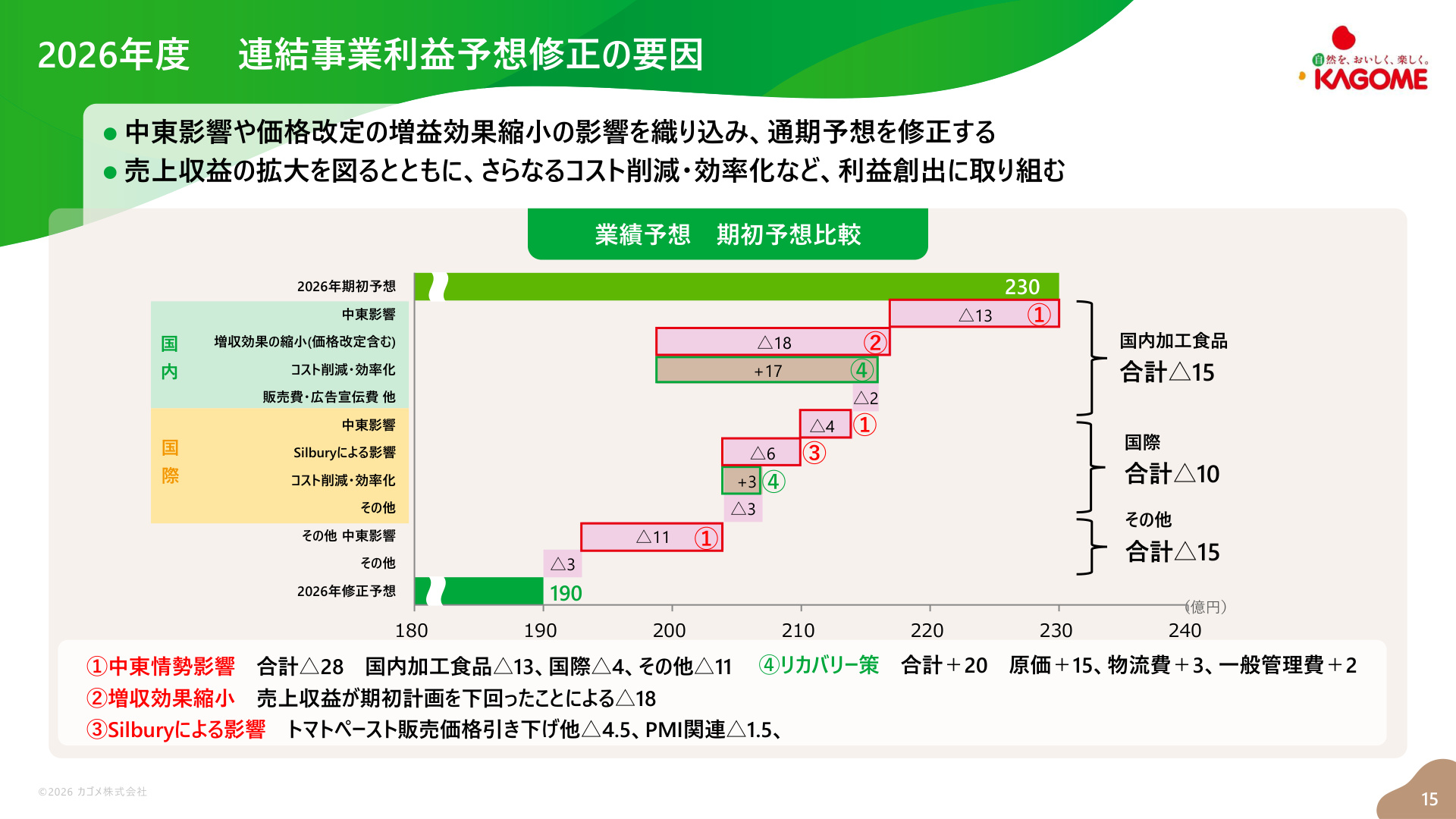
The slide above (page 15) provides a detailed breakdown of the factors leading to the revision of the business profit forecast from 23.0 billion yen to 19.0 billion yen.
- Impact of Middle East Situation (Total -2.8 billion yen)
- Domestic Processed Food (-1.3 billion yen) : Increased costs for packaging materials (film, bottles) and raw materials due to rising crude oil prices.
- International Business (-0.4 billion yen) : Higher energy, logistics, and packaging costs.
- Other (-1.1 billion yen) : Decline in seed sales to the Middle East (UG Co.), etc.
- Shrinking Revenue Growth Effect (-1.8 billion yen)
- Slower-than-expected demand recovery in domestic beverages, resulting in lower-than-planned profit gains from price revisions.
- Silbury-related Impact (-0.6 billion yen)
- Lower tomato paste prices and PMI (Post-Merger Integration) costs.
- Recovery Measures (Total +2.0 billion yen)
- Thorough cost reductions and efficiency improvements, including cost-of-goods reductions (+1.5 billion yen), logistics savings (+0.3 billion yen), and SG&A expense control (+0.2 billion yen).
4. Three Key Initiatives for Earnings Recovery in H2
To achieve the "Kagome Group Plan 2028" mid-term management plan, Kagome is accelerating the following three priority activities :
① Creating Demand through Enhanced Vegetable Beverage Value
Focusing on "Yasai Ichinichi Kore Ippon" and "Yasai Seikatsu 100," the company will boldly implement an additional 500 million yen investment (advertising and sales promotion) in H2 .
- Strengthening Functional Value : Expanding the functional labeling success (e.g., Triple Care) from tomato juice to other brands.
- Convenience & New Value : Emphasizing 88% vegetable content, addressing meal-replacement needs with smoothies, and developing easy-to-consume packaging.
- Fostering Empathy : Branding through collaboration with farmers nationwide (Megumi Meguru Action) and promoting the value of domestic fruit juices.
② Strengthening Profit Base through Productivity Improvements
- Domestic Bases : Continuing to promote 1.2 billion yen in cost reductions for 2026 (yield improvement, manufacturing loss reduction).
- Global 7 Bases : Horizontal deployment of best practices, such as the introduction of centrifuges, with a 500 million yen cost reduction target .
- Smart Agriculture : Data-driven selection of optimal varieties per field and promotion of high-sugar tomato production/processing (target: 200 million yen).
③ Driving Growth in International Secondary Processing
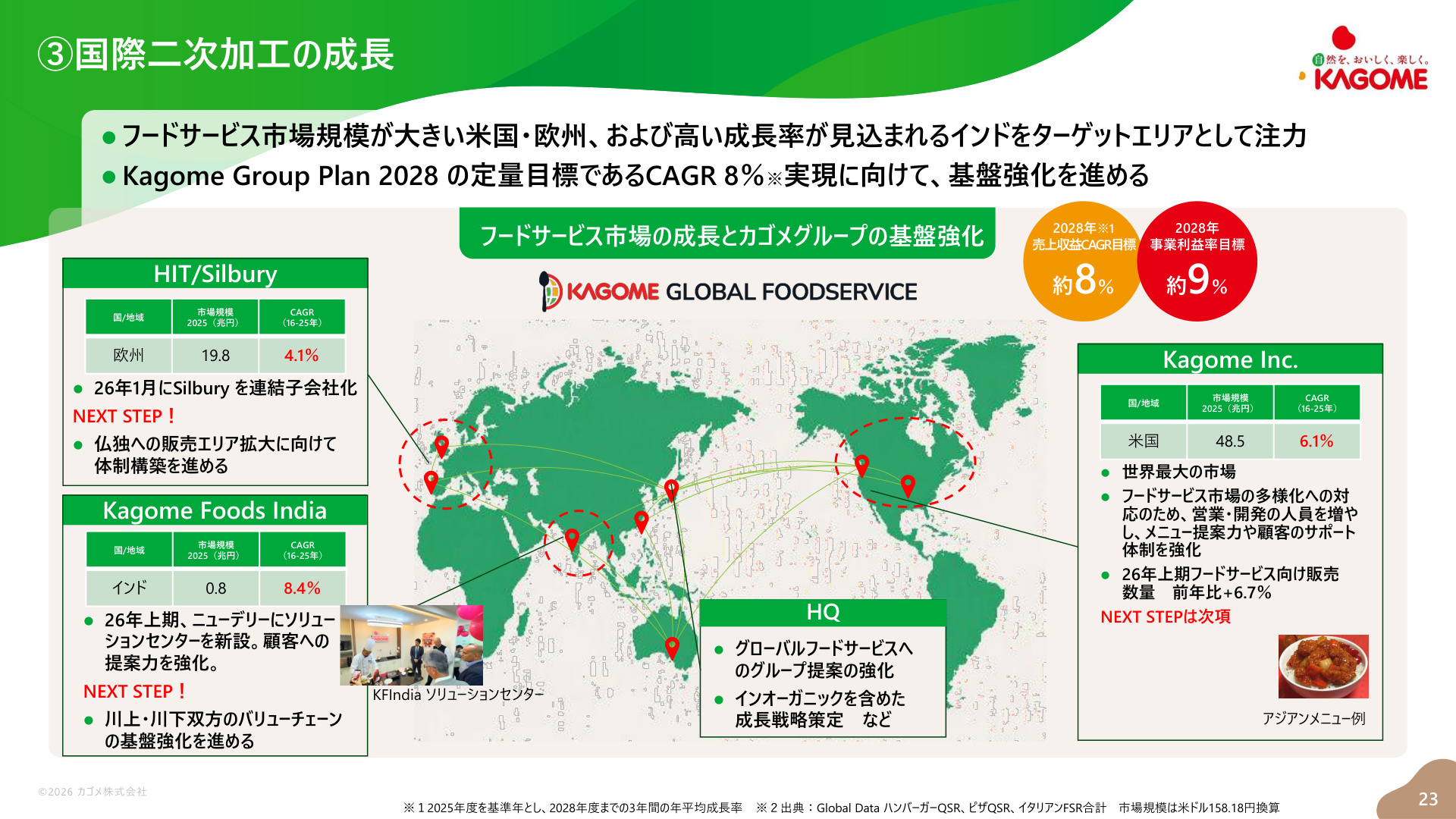
The slide above (page 23) illustrates the overall strategy for international secondary processing. North America and Europe (large food service markets) and India (high growth potential) are designated as top-priority areas.
- USA (Kagome Inc.) : Strengthening new business development in high-growth Asian, chicken, and Mexican segments within the world's largest food service market (approx. 48.5 trillion yen). Expanding sauce manufacturing capacity by approximately 1.5x through capital investment in California and other facilities.
- Europe (HIT/Silbury) : Building a structure to expand sales areas into continental Europe (France, Germany, etc.) with the newly consolidated Silbury as the cornerstone.
- India (Kagome Foods India) : Establishing a new solution center in New Delhi to enhance proposal capabilities for food service companies. H1 sales volume for food service grew 6.7% YoY.
- Mid-term Targets : Aiming for a global revenue CAGR of approximately 8% and a business profit margin of approximately 9% .
5. Comprehensive Analysis and Future Outlook
Kagome's H1 FY2026 results reflect a challenging period, with the delayed recovery of domestic beverage demand following price hikes and surging external costs due to the Middle East situation necessitating a downward revision of the full-year business profit forecast.
However, positive growth foundations are being firmly established:
- Structural Growth of Tomato Juice : Functional value messaging has taken hold, maintaining high purchase rates post-price hike.
- Expansion of International Secondary Processing : The ratio of high-value-added business for food service is increasing through US facility expansion and the acquisition of UK-based Silbury.
- Company-wide Cost Recovery Capability : The drive to execute 2 billion yen in cost reductions and efficiency improvements throughout H2.
Moving forward, the key to earnings recovery will be the extent to which the 500 million yen in additional H2 promotions translates into sales volume recovery for core brands like "Yasai Seikatsu 100," and how effectively the international secondary processing business, centered on the US and Europe, can drive profit growth.
This content is not intended as investment advice or a recommendation. Any opinions expressed are solely the personal views of each article.