


Tohoku Electric Power Q1 FY2026 Earnings Analysis: Profit Decline Driven by Fuel Adjustment Time Lags and Periodic Inspections, Alongside Growth Strategies for Demand Creation

StockClub
Published: Jul 29, 2026, 10:04 AM
Sentiment Analysis
Tohoku Electric Power Q1 FY2026 Earnings Analysis: Profit Decline Driven by Fuel Adjustment Time Lags and Periodic Inspections, Alongside Growth Strategies for Demand Creation
Tohoku Electric Power’s financial results for the first quarter of fiscal year 2026 (April 1, 2026, to June 30, 2026) showed a significant year-on-year increase in revenue, yet recorded a decline in both ordinary profit and quarterly net profit. This report delves beyond the surface-level figures to analyze substantive factors such as the impact of the fuel cost adjustment system's time lag and facility operational status, while also exploring future electricity demand trends and medium-to-long-term growth strategies, including the restart of nuclear power plants.
1. Earnings Highlights: An Overview of Revenue Growth Amid Profit Decline
In the first quarter, consolidated revenue reached 785.3 billion yen (up 249.9 billion yen, or +46.7% YoY) . Conversely, ordinary profit was 54.4 billion yen (down 3.1 billion yen, or -5.4% YoY) , and net profit attributable to owners of the parent was 36.1 billion yen (down 1.5 billion yen, or -4.2% YoY) , marking the first instance of revenue growth alongside a profit decline in four years since FY2022.
The substantial increase in revenue was primarily driven by expanded off-area trading, including an increase in self-committed volumes associated with indirect auctions in the wholesale electricity market. On the profit side, despite improvements in market and sales conditions and a reduction in supply-demand adjustment costs in the transmission and distribution business, temporary accounting factors and the suspension of nuclear power plant operations acted as downward pressures.
Regarding the full-year earnings forecast for FY2026, the company has maintained its "undecided" status due to uncertainties surrounding fuel price trends stemming from heightened geopolitical risks and potential variables associated with revisions to wheeling service charges.
2. Analysis of Consolidated Ordinary Profit and "Substantive Earnings"
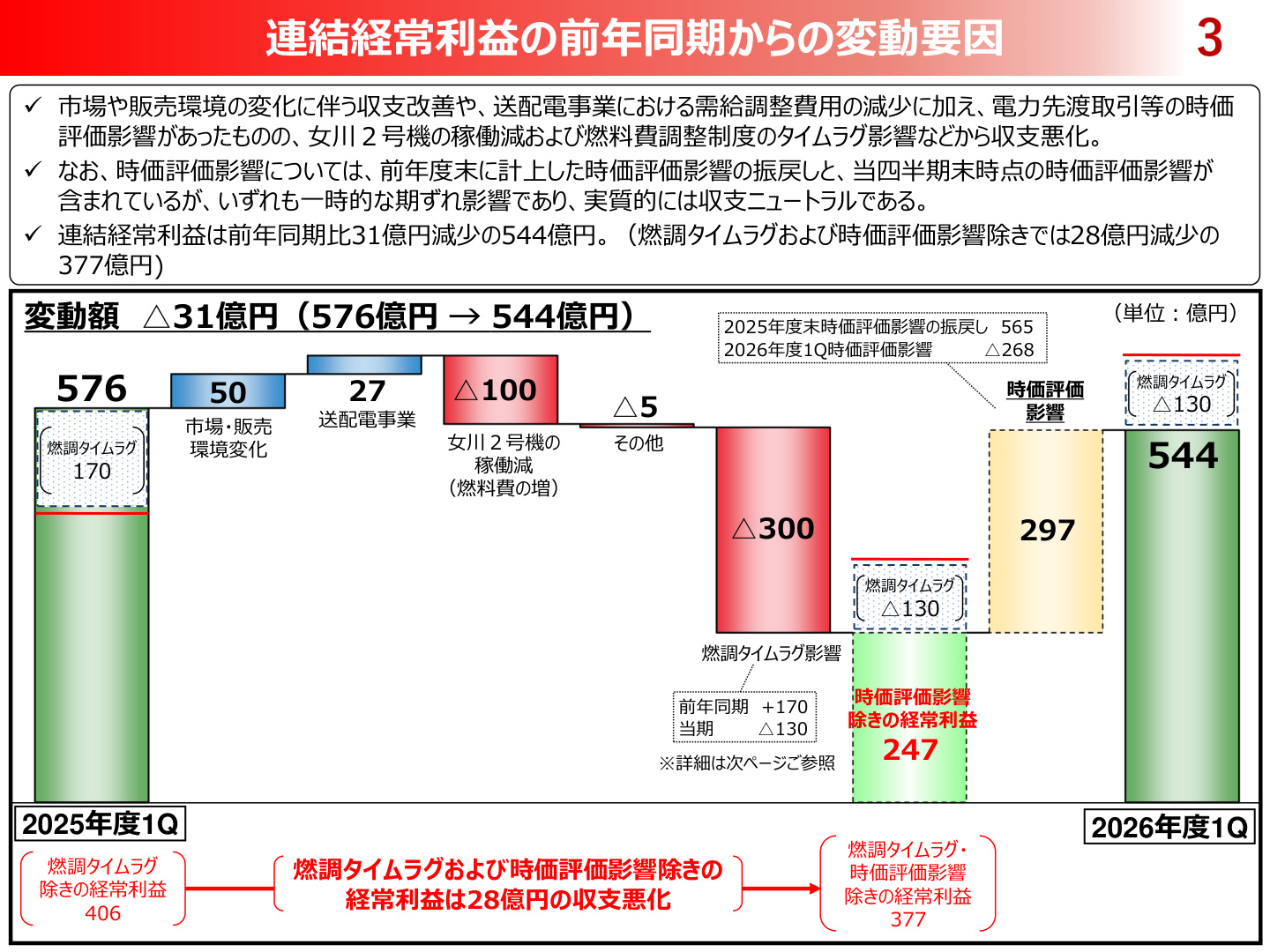
While the headline ordinary profit decreased by 3.1 billion yen YoY, a detailed breakdown reveals that special factors had a significant impact. The primary drivers of profit fluctuation are as follows:
- Fuel Cost Adjustment Time Lag : The shift from a profit of 17 billion yen in the same period last year to a loss of 13 billion yen this period resulted in a 30 billion yen negative impact on earnings.
- Reduced Operation of Onagawa Unit 2 : Increased fuel cost burdens due to periodic inspections resulted in a 10 billion yen negative impact .
- Changes in Market and Sales Environment : Improvements in wholesale market trading and other areas contributed a 5 billion yen positive impact .
- Improvement in Transmission and Distribution Business : Reductions in supply-demand adjustment costs contributed a 2.7 billion yen positive impact .
- Mark-to-Market Valuation Effects : Valuation of electricity forward contracts and the reversal of previous fiscal year-end effects resulted in a 29.7 billion yen positive impact .
The following slide illustrates these fluctuation factors in a waterfall chart.
[Slide Commentary: Factors Affecting Consolidated Ordinary Profit]
This slide shows the bridge from the previous year's first-quarter ordinary profit of 57.6 billion yen to the current 54.4 billion yen, providing the most critical data for accurately assessing Tohoku Electric Power's actual financial performance.
Notably, the large accounting and structural differences—specifically the mark-to-market valuation effects (+29.7 billion yen) and the fuel adjustment time lag (-30 billion yen) —are not directly related to the company's core operational performance. The mark-to-market effect is a period-end timing difference and is substantively neutral to earnings. Excluding these temporary timing factors, the "substantive ordinary profit" was 37.7 billion yen (down 2.8 billion yen YoY) , compared to 40.6 billion yen in the same period last year, clearly indicating a slight deterioration in underlying earnings.
3. Segment Performance and Electricity Supply-Demand Metrics
① Power Generation and Sales Segment
- Revenue : 665.3 billion yen (up 211.8 billion yen YoY)
- Ordinary Profit : 62.3 billion yen (down 17.4 billion yen YoY) While revenue grew due to increased off-area trading, profit declined due to the fuel adjustment time lag and increased costs for thermal power replacement fuel during the periodic inspection of Onagawa Unit 2.
② Transmission and Distribution Segment
- Revenue : 227.1 billion yen (up 30.8 billion yen YoY)
- Ordinary Profit : -8.5 billion yen (an improvement of 2.7 billion yen YoY) Although area demand decreased slightly due to weather factors (16.7 billion kWh, 98.9% YoY), the deficit narrowed thanks to efforts to reduce supply-demand adjustment costs.
③ Key Metrics
In terms of sales, retail electricity sales volume reached 14.4 billion kWh (up 1.2 billion kWh YoY) , showing steady growth through new customer acquisition. On the supply side, due to a lower water flow rate (82.6%) and the inspection of Onagawa Unit 2, the company's own power generation decreased to 9,929 million kWh (down 3,082 million kWh YoY), which was offset by increasing power purchases from other companies to 10,382 million kWh (up 3,441 million kWh YoY). Furthermore, the period saw significant fuel price hikes and yen depreciation, with the crude oil CIF price at 112.7 USD/bbl (vs. 75.1 USD last year) and the exchange rate at 160 JPY/USD (vs. 145 JPY last year) .
4. Financial Health and Dividend Policy
The restoration of the financial structure, which had been impaired by past surges in fuel prices, is progressing steadily.
- Total Assets : 5.6817 trillion yen (down 50.1 billion yen from the previous fiscal year-end)
- Equity Ratio : 20.0% (up 0.6 percentage points from the previous fiscal year-end)
- The substantive ratio, considering the equity credit of hybrid bonds, improved to 22.5% (from 21.8% at the end of the previous fiscal year).
Regarding dividends, the company maintains its policy of targeting a DOE (Dividend on Equity) of 2% , while simultaneously working toward the early recovery of the "equity ratio of around 20%" set after the Ukraine crisis. The annual dividend forecast for FY2026 is 40 yen per share (20 yen interim, 20 yen year-end) , remaining at the same level as the previous fiscal year.
5. Supply-Demand Topics: Data Center Attraction and Sales Enhancement
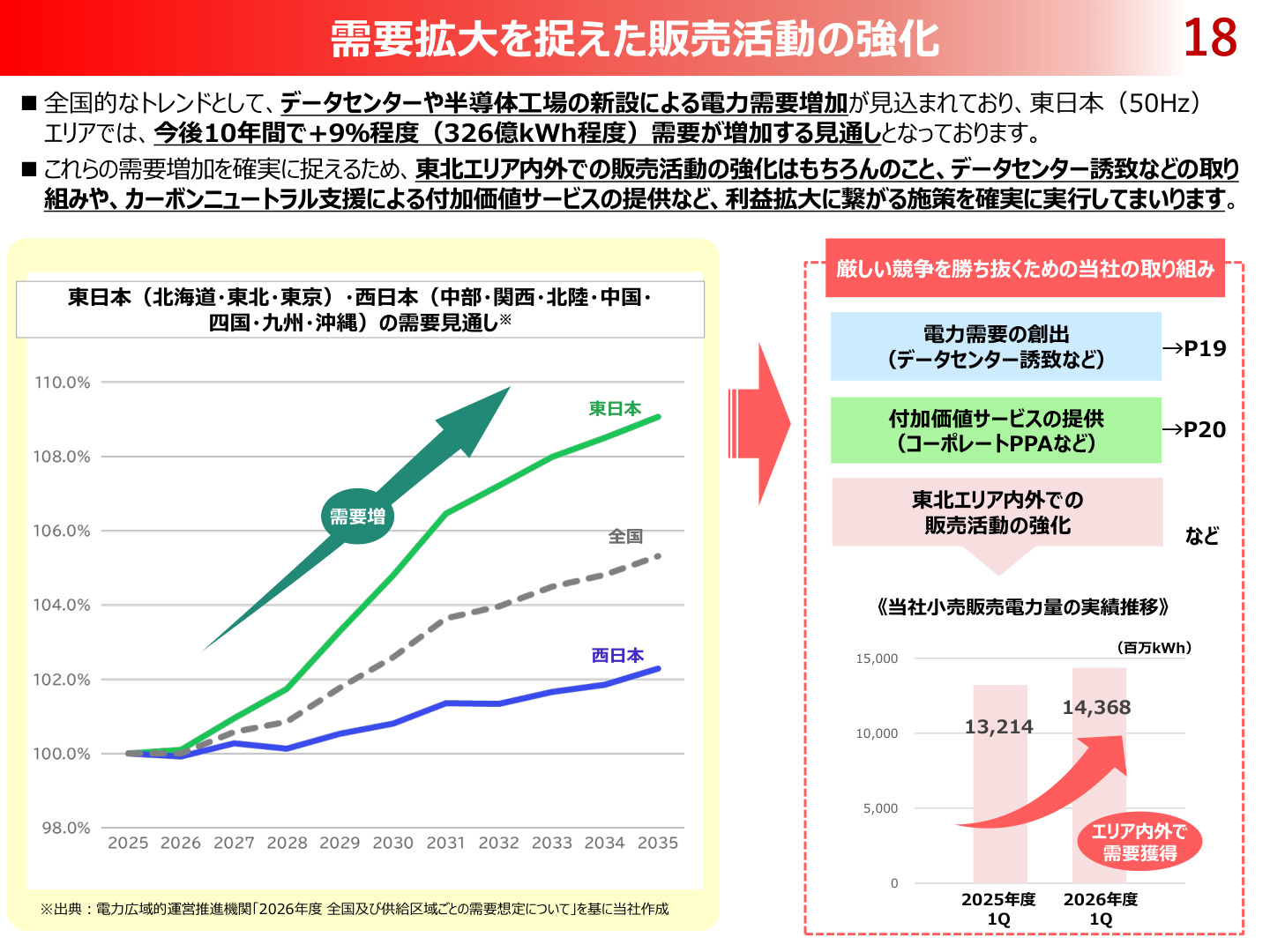
In Tohoku Electric Power's service area and the broader Eastern Japan region, long-term growth in electricity demand is expected due to the development of data centers and the expansion of semiconductor manufacturing plants, driven by advancements in DX and AI.
[Slide Commentary: Strengthening Sales Activities to Capture Demand Growth]
The slide above illustrates the projected growth in electricity demand and Tohoku Electric Power's sales strategy. Based on projections by the Organization for Cross-regional Coordination of Transmission Operators (OCCTO), electricity demand in the Eastern Japan area (50Hz) is expected to increase by approximately 9% (an increase of about 32.6 billion kWh) over the next 10 years , a pace significantly higher than the national average or the Western Japan area.
The Tohoku region possesses high advantages for attracting data centers, including abundant renewable energy potential , a cool climate , and vast land availability. Tohoku Electric Power has established a specialized team and is collaborating with partners such as Cisco, Rutilea, Hitachi, and the Development Bank of Japan (DBJ) to design networks for distributed AI data centers and build next-generation infrastructure. The company is shifting from a simple "electricity sales" business to a value-added service model that incorporates decarbonization solutions, promoting a strategy to reliably convert demand growth into profit.
6. Decarbonization, Green Business, and Progress in Nuclear Restarts
To improve medium-to-long-term profitability and achieve carbon neutrality, the company is promoting the stable operation of nuclear power and the development of renewable energy as two pillars of its strategy.
[Slide Commentary: Status and Schedule of Onagawa Unit 2]
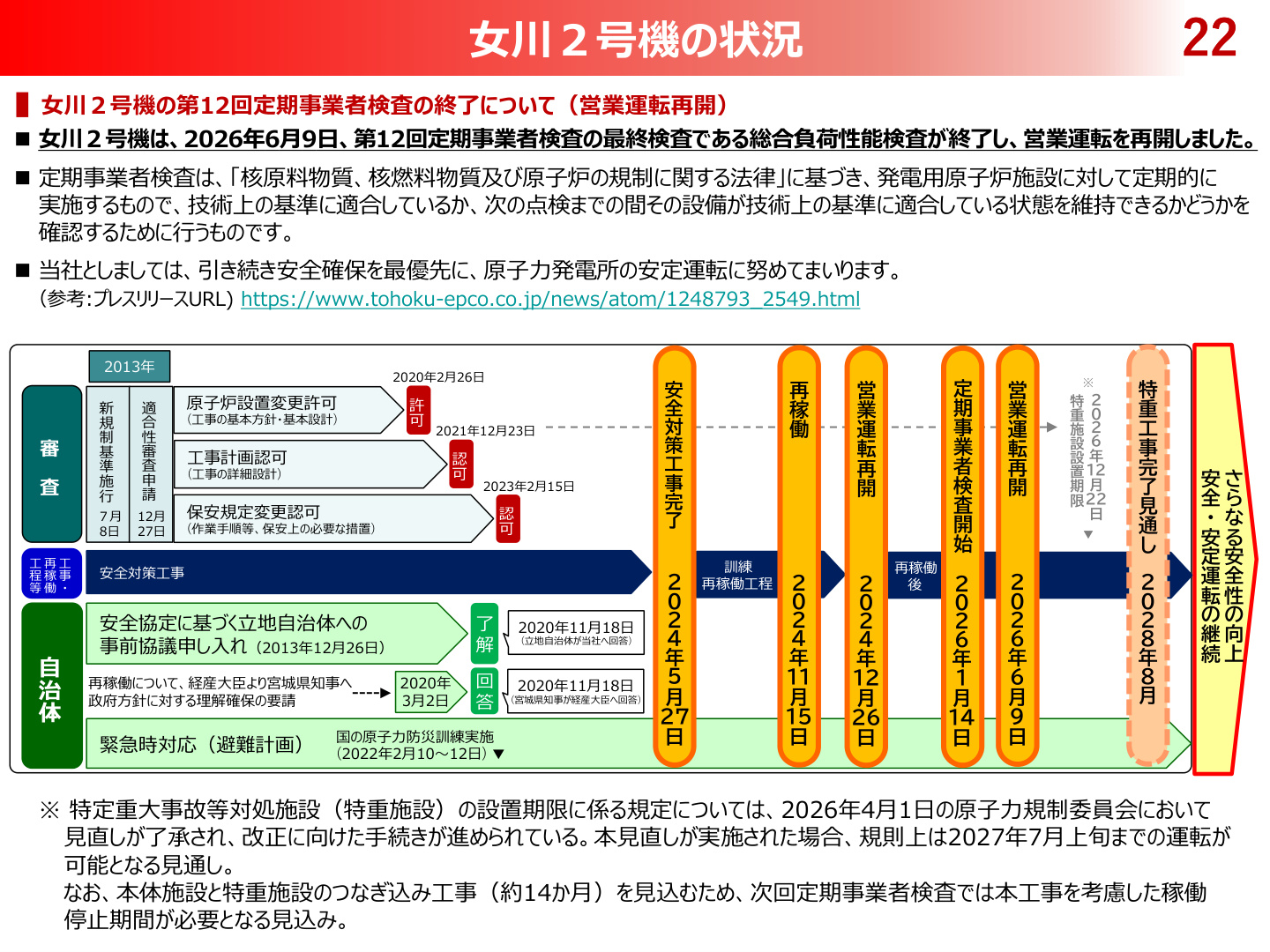
This slide details the process and schedule for the restart of Onagawa Nuclear Power Station Unit 2 , a core power source for Tohoku Electric Power.
Onagawa Unit 2 completed its final inspection (comprehensive performance test) for the 12th periodic operator inspection on June 9, 2026, and has officially resumed commercial operation . Prioritizing safety while restarting the unit as a baseload power source is of immense significance for both future fuel cost reduction and CO2 emission reduction. Moving forward, the operational plan accounts for construction work (approximately 14 months) related to facilities for dealing with specific severe accidents, and maintaining stable operation while ensuring safety remains the key to reducing earnings volatility.
Additionally, the company is steadily advancing the conformity review for Higashidori Unit 1 (aiming to announce the completion date for safety measure construction around March 2027) and geological surveys for Onagawa Unit 3 . In the renewable energy sector (green business), the company currently has approximately 900,000 kW of development and participation based on equity output, with a goal to expand this to over 2 million kW by the early 2030s . Furthermore, cumulative orders for corporate PPAs to meet corporate decarbonization needs have reached approximately 158 billion yen (total output of approx. 232,000 kW) , with large-scale contracts with companies like Skylark Holdings and Yonex accelerating the expansion of achievements both within and outside the service area.
7. Medium-to-Long-Term Financial Targets and Outlook
Tohoku Electric Power Group aims to achieve the following financial targets through structural reforms and investment in growth areas:
- Consolidated Ordinary Profit (excluding fuel adjustment time lag): 190 billion yen for FY2026 / Over 200 billion yen for FY2030
- Consolidated Equity Ratio : Around 20% for FY2026 (achieved ahead of schedule in Q1) / 25% or more for FY2030
- Consolidated ROIC (Return on Invested Capital) : Around 3.5% for FY2026 / 3.5% or more for FY2030
Although the Q1 results showed a profit decline due to fuel adjustment time lags and periodic inspections, the equity ratio reached the 20.0% target. With the resumption of commercial operation of Onagawa Unit 2, initiatives to capture data center demand, and the steady accumulation of corporate PPAs, the company has confirmed that it is steadily laying the groundwork for long-term corporate value enhancement .
This content is not intended as investment advice or a recommendation. Any opinions expressed are solely the personal views of each article.