


Advantest FY2026 Q1 Earnings Analysis: Comprehensive Overview of Upward Revisions Driven by Surging AI Demand and Expanded TAM

StockClub
Published: Jul 29, 2026, 09:59 AM
Sentiment Analysis
1. Executive Summary (Earnings Highlights and Overview)
Advantest’s fiscal year 2026 first-quarter (Q1) results marked an exceptionally strong start, with both revenue and various profit metrics reaching all-time highs for a single quarter .
Driven by the widespread adoption of generative AI and the rapid emergence of the inference AI market , demand for high-end semiconductor testing—particularly in computing and communications—has surged. Consequently, the company has significantly raised its outlook for the total addressable market ( TAM ) for semiconductor testers in calendar year 2026 (CY26). Advantest is simultaneously accelerating its production capacity expansion, R&D investments, and strategic partnerships.
This report extracts 10 key topics from the latest earnings disclosure, providing a comprehensive and detailed analysis of financial performance, market conditions, segment trends, and full-year guidance.
2. Q1 Financial Performance Analysis: Record Quarterly Revenue and High Profitability
First, let us examine the consolidated financial results for Q1 of FY2026. Compared to both the same period last year (FY25 Q1) and the previous quarter (FY25 Q4), the company achieved significant growth in both revenue and profit across all metrics.
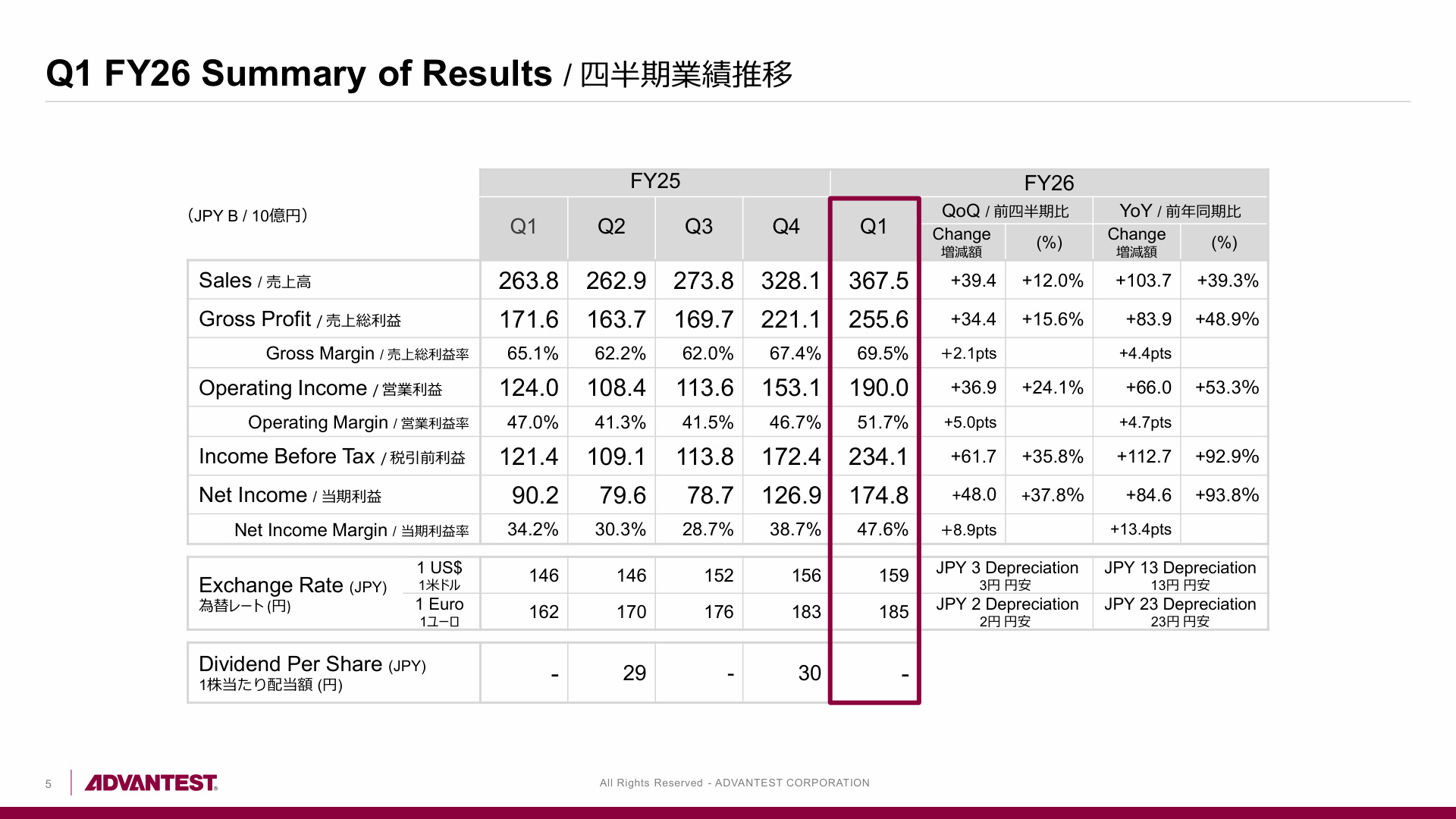
The table and chart below summarize the quarterly performance trends for Q1.
[Significance and Data Background of Slide (Page 4)]
This slide is critical as it provides direct evidence of the historically high-profit structure the company has achieved. Q1 revenue reached ¥367.5 billion (+39.3% YoY, +12.0% QoQ), and operating profit hit ¥190.0 billion (+53.3% YoY, +24.1% QoQ), both setting new records.
Particularly noteworthy is the high level of profitability. The Gross Margin reached 69.5% , and the Operating Margin hit 51.7% . Factors driving this profitability include increased shipments of sophisticated test systems due to the growing complexity of test structures, improved product mix, and the impact of a weaker yen (¥159 against the USD, ¥185 against the EUR). Pre-tax profit reached ¥234.1 billion (+92.9% YoY), and net income rose to ¥174.8 billion (+93.8% YoY), demonstrating phenomenal growth in bottom-line performance.
3. Semiconductor Tester Market (TAM) Expansion: The Rise of Inference AI
A major tailwind for the business is the expansion of the global tester market (TAM). The company has significantly revised upward its forecast for the CY26 semiconductor tester market as of July 2026.
[Significance and Data Background of Slide (Page 11)]
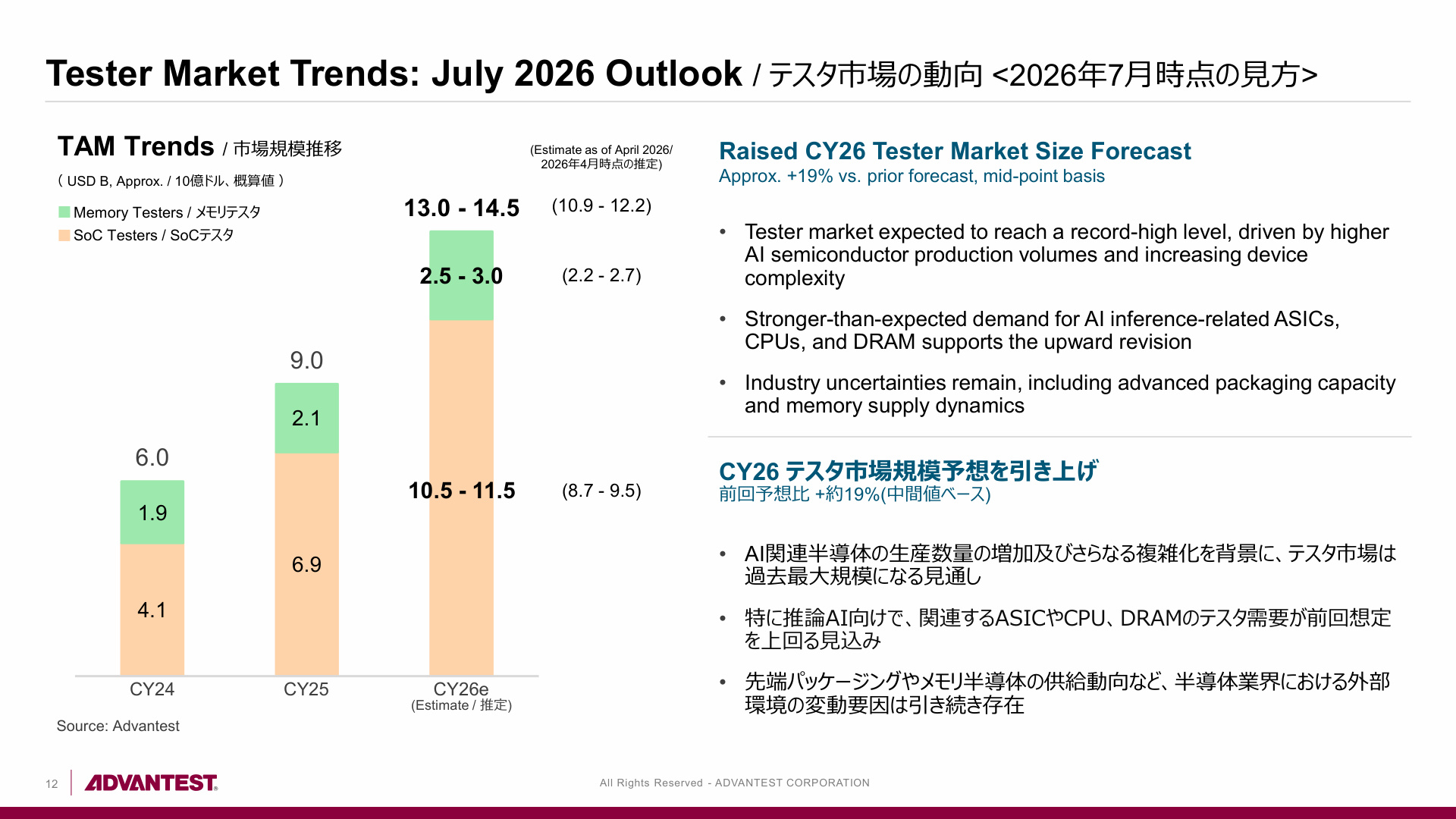
This slide demonstrates that the company's growth momentum is not temporary but is supported by structural changes in the overall semiconductor market and an expansion of the TAM . In the previous forecast (as of April 2026), the CY26 tester TAM was estimated at $10.9–$12.2 billion. Following this revision, it has been raised significantly to $13.0–$14.5 billion (an increase of approximately +19% at the midpoint compared to the previous forecast) .
Breaking this down, the SoC tester market has been raised to $10.5–$11.5 billion (previously $8.7–$9.5 billion), and the memory tester market to $2.5–$3.0 billion (previously $2.2–$2.7 billion). This is driven by demand for inference AI-related ASICs, CPUs, and DRAM (such as HBM) growing at a pace exceeding expectations, in addition to traditional training AI demand. The adoption of advanced packaging technologies and the resulting increase in device complexity, which lengthens test times and increases the difficulty of test processes, are also fueling tester demand.
4. Significant Upward Revision of FY26 Full-Year Earnings Forecast
In response to the expansion of the TAM, the company has significantly raised its full-year earnings forecast for FY2026.
[Significance and Data Background of Slide (Page 12)]
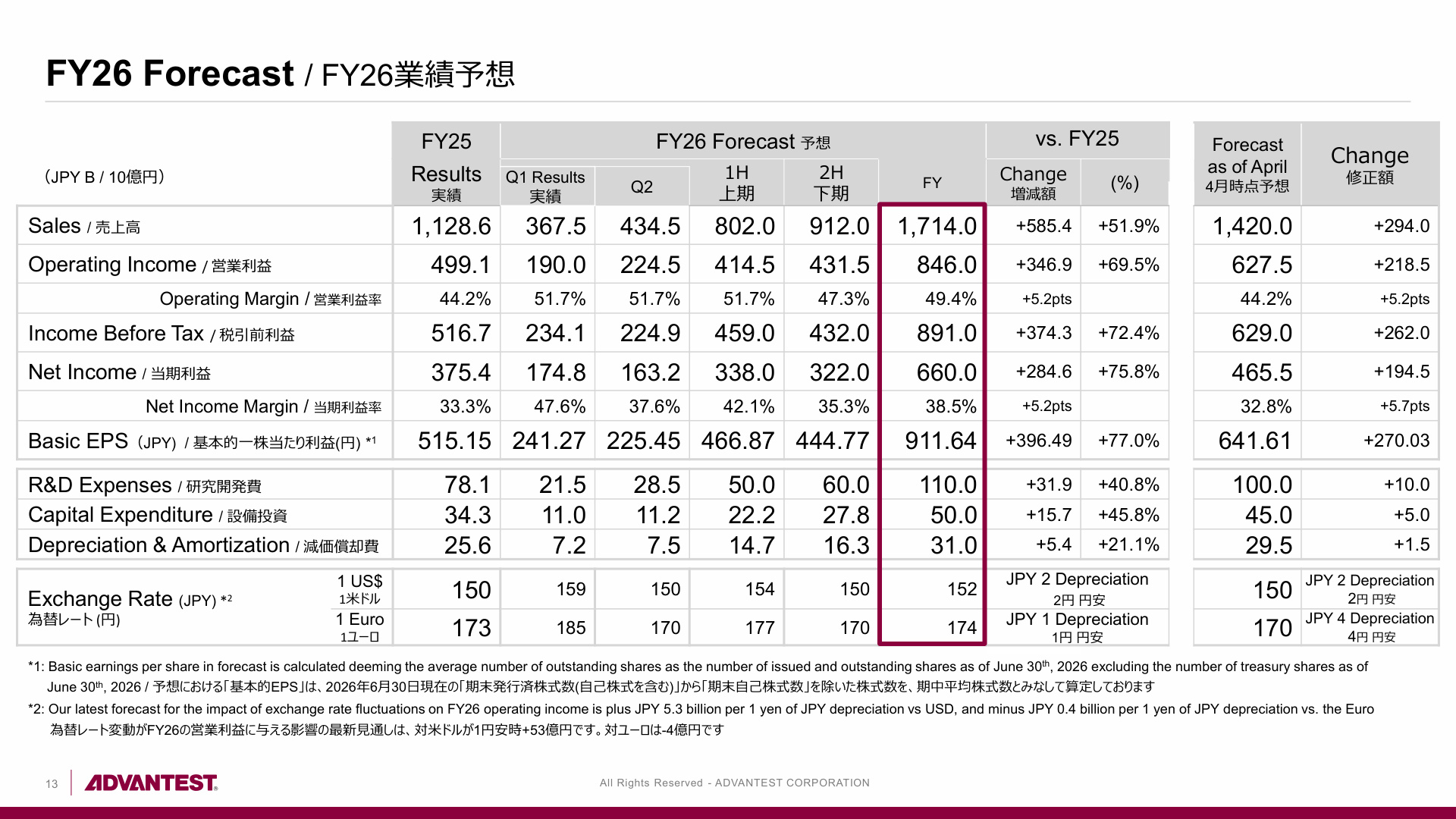
This slide is the most important document for understanding the company's future growth roadmap and profit levels. The revenue forecast has been raised from the April estimate of ¥1.42 trillion to ¥1.714 trillion (an increase of ¥294 billion, +51.9% YoY) . The operating profit forecast has been revised upward from ¥627.5 billion to ¥846.0 billion (an increase of ¥218.5 billion, +69.5% YoY) , with a full-year operating margin target of 49.4% .
Net income has also been raised from ¥465.5 billion to ¥660.0 billion (an increase of ¥194.5 billion) , with planned earnings per share (EPS) of ¥911.64 . While the revision partly reflects a slightly weaker yen assumption (revised to ¥152/USD and ¥174/EUR from the initial ¥150/USD and ¥170/EUR), the primary driver is substantial growth in actual demand and sales volume .
5. Detailed Analysis by Business Segment and Region
(1) SoC Test System Business
SoC test systems remain the core segment driving the company's growth. The FY26 full-year revenue forecast has been significantly increased from the previous ¥999.5 billion to ¥1.2435 trillion . Computing and communications applications maintain a 95% share of the segment, highlighting the overwhelming nature of AI-related demand. The company is actively promoting the acceleration of production capacity expansion to meet this robust demand.
(2) Memory Test System Business
The FY26 full-year revenue forecast for the memory test system business has also been raised from the previous ¥201.0 billion to ¥227.0 billion . In addition to increased sales of back-end testers for high-performance DRAM (such as HBM), sales for non-volatile memory (such as NAND) are also expected to turn positive. By application, DRAM is expected to account for 85% and non-volatile memory for 15% .
(3) Services, Support, and Others
The support and service business, including interface boards for testers, is also performing well. Driven by the steady increase in the global installed base of equipment, the FY26 full-year revenue forecast has been raised from the previous ¥123.0 billion to ¥139.0 billion .
(4) Ship to Region
Looking at Q1 revenue by region, Taiwan accounted for ¥178.6 billion , representing approximately half of the total, highlighting the intense tester demand in the Asian region where major foundries and OSATs (Outsourced Semiconductor Assembly and Test) are concentrated. This is followed by South Korea at ¥67.4 billion , China at ¥69.4 billion , and the Americas at ¥13.2 billion , confirming the company's strong ties to the advanced semiconductor manufacturing ecosystem.
6. Growth Investment, Financial Foundation, and Sustainability
(1) Expansion of R&D and Capital Expenditure
To address surging demand and product sophistication, the company is making aggressive growth investments. For the FY26 full-year plan, R&D expenses are projected at ¥110.0 billion (+40.8% YoY), and capital expenditures at ¥50.0 billion (+45.8% YoY). The company is maintaining an R&D-to-revenue ratio of approximately 6–7% while developing next-generation tester technology and expanding production capacity.
(2) Financial Health and Cash Flow
Regarding the financial position, total assets reached ¥1.5147 trillion as of the end of June 2026, with cash and deposits of ¥413.1 billion . The company maintains high financial health with an equity ratio of 68.8% . Q1 free cash flow was a positive ¥34.7 billion , demonstrating the cash-generating power that supports future investments and shareholder returns.
(3) External Evaluation and Sustainability
In customer satisfaction surveys, the company has been awarded the "Global Semiconductor Supplier Award" by TechInsights for seven consecutive years . Furthermore, it maintains high external evaluations in ESG and business foundations, including continuous selection for the DJSI Asia Pacific, an EcoVadis Silver Medal, and top ratings from CDP.
7. Summary (Recap of 10 Key Topics)
The key topics from this earnings announcement are summarized as follows:
- Record-breaking Q1 quarterly performance (Revenue ¥367.5 billion, Operating Profit ¥190.0 billion)
- High profit margins (Gross Margin 69.5%, Operating Margin 51.7%)
- Upward revision of CY26 tester TAM (Expanded to $13.0–$14.5 billion)
- Rapid emergence of the inference AI market driving demand for ASICs, CPUs, and DRAM
- Comprehensive upward revision of full-year earnings forecast (Revenue ¥1.714 trillion, Operating Profit ¥846.0 billion)
- Significant growth in SoC test system business (Raised to ¥1.2435 trillion)
- Expansion of memory test system business (Growth in DRAM back-end and non-volatile memory)
- Concentrated demand in Asian manufacturing hubs , led by Taiwan
- Aggressive expansion of production capacity, R&D, and capital investment (R&D plan of ¥110.0 billion)
- Strong equity ratio (68.8%) and high external recognition in customer satisfaction and ESG
Advantest is accurately capturing the qualitative and quantitative shifts in the semiconductor market—from generative AI to inference AI—and is following a growth trajectory accompanied by high profitability while strengthening its production capacity and development capabilities.
This content is not intended as investment advice or a recommendation. Any opinions expressed are solely the personal views of each article.