


Dentsu Soken H1 FY2026 Earnings Analysis: Strong Revenue and Profit Growth Driven by DX Demand, Solidifying Foundations for Mid-to-Long-Term Expansion

StockClub
Published: Jul 29, 2026, 09:56 AM
Sentiment Analysis
Dentsu Soken achieved significant year-on-year and forecast-beating growth in both revenue and profit for the first half of the fiscal year ending December 2026, fueled by expanding demand for digital transformation (DX) and robust IT investment appetite among major enterprises. With strong growth in both new orders and order backlogs, the company is building a solid foundation for future performance expansion.
Based on the earnings presentation materials, the following analysis provides an in-depth look at the financial highlights, factors behind profit fluctuations, segment-specific trends, and growth strategies for the future.
1. Earnings Summary and Overall Highlights
For the first half of FY2026, consolidated net sales reached 88,649 million yen (+10.5% YoY) , operating profit was 12,342 million yen (+15.8% YoY) , ordinary profit was 12,727 million yen (+14.6% YoY) , and net income attributable to owners of the parent was 8,888 million yen (+15.7% YoY) .
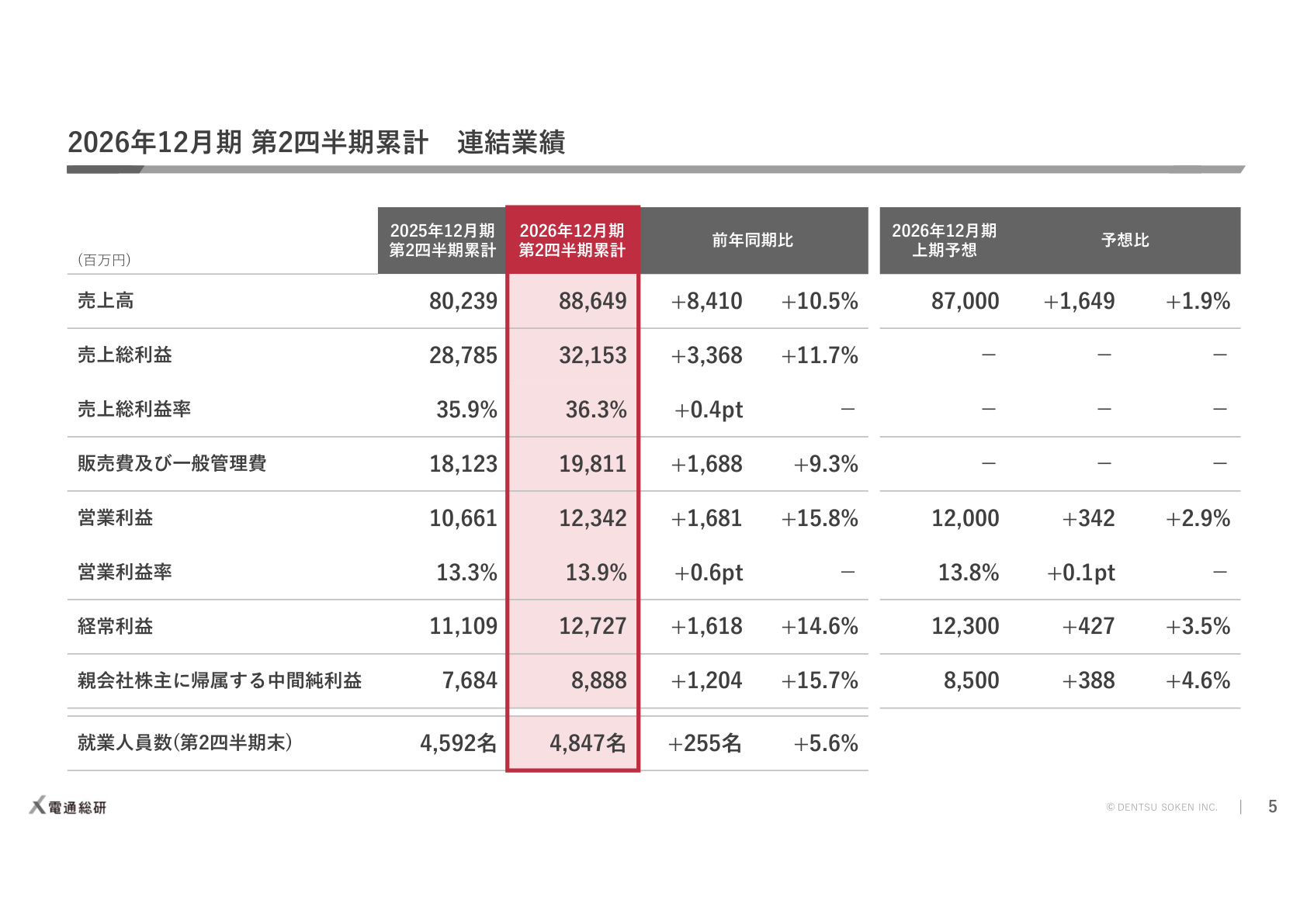
The consolidated performance table above (P.5) clearly illustrates the strength of these results. Net sales exceeded the initial forecast by 1,649 million yen (+1.9%) , and operating profit surpassed the forecast by 342 million yen (+2.9%) . The operating profit margin improved by 0.6 percentage points to 13.9% , up from 13.3% in the same period last year, indicating steady gains in profitability. Additionally, the number of employees reached 4,847 (+255, +5.6% YoY) , reflecting ongoing talent acquisition and organizational strengthening to support business expansion.
2. Analysis of Operating Profit Fluctuations
The increase in operating profit for the first half (+1.681 billion yen YoY) can be broken down as follows:
- Revenue Growth Effect (+3.01 billion yen): Profit boost driven by successful customer acquisition and large-scale projects across business segments.
- Improvement in Gross Profit Margin (+0.35 billion yen): Productivity gains and improved profitability in commissioned system development and software products pushed the gross profit margin from 35.9% to 36.3% (+0.4pt) .
- Increase in SG&A Expenses (-1.68 billion yen): Upfront investments for future growth, including personnel costs (+0.59 billion yen), R&D expenses (+0.57 billion yen), and outsourcing costs (+0.19 billion yen), increased SG&A expenses, but these were fully absorbed by revenue growth and improved gross margins.
Compared to initial forecasts, despite a decline in gross margin due to a decrease in consulting services (-0.44 billion yen), the company achieved an operating profit increase of +0.34 billion yen against the forecast , thanks to the revenue growth effect from higher-than-expected sales (+0.60 billion yen) and the containment of SG&A expenses, primarily in outsourcing costs (+0.18 billion yen).
3. Segment and Service-Specific Trends
A look at the reporting segments reveals clear drivers of overall performance as well as areas requiring attention.
Segment Performance (H1)
- Financial Solutions: Net sales 18,489 million yen (+13.0% YoY) , Operating profit 2,545 million yen (+33.6% YoY)
- Commissioned system development for trust banks and megabanks remained steady, while the adoption of the loan solution "BANK・R" expanded among government-affiliated and regional financial institutions.
- Business Solutions: Net sales 15,627 million yen (+19.2% YoY) , Operating profit 4,026 million yen (+37.4% YoY)
- Growth was driven by the expansion of the integrated HCM solution "POSITIVE" in the trading and electric power industries, as well as the consolidated accounting solution "STRAVIS" and group integrated accounting solution "Ci*X."
- Manufacturing Solutions: Net sales 30,989 million yen (-0.0% YoY) , Operating profit 3,187 million yen (-22.7% YoY)
- Despite growth in ALM (Application Lifecycle Management) and PLM (Product Lifecycle Management), profit declined due to a decrease in consulting projects for the transportation equipment industry and an increase in personnel and R&D expenses.
- Communication IT: Net sales 23,543 million yen (+19.1% YoY) , Operating profit 2,582 million yen (+51.6% YoY)
- Commissioned system development projects for the Dentsu Group and the transportation industry saw significant growth.
Service-Specific Trends
By service category, commissioned system development (20,032 million yen, +21.6% YoY) and software products (19,150 million yen, +19.1% YoY) were the primary drivers of overall growth. Conversely, consulting services (4,886 million yen, -12.9% YoY) contracted due to the impact of the decline in the transportation equipment sector. Sales to the Dentsu Group reached 12,298 million yen (+16.7% YoY) , maintaining steady growth.
4. Order Trends and Future Outlook (Leading Indicators)
New orders and order backlogs, which serve as leading indicators for future sales, have recorded exceptionally strong figures.
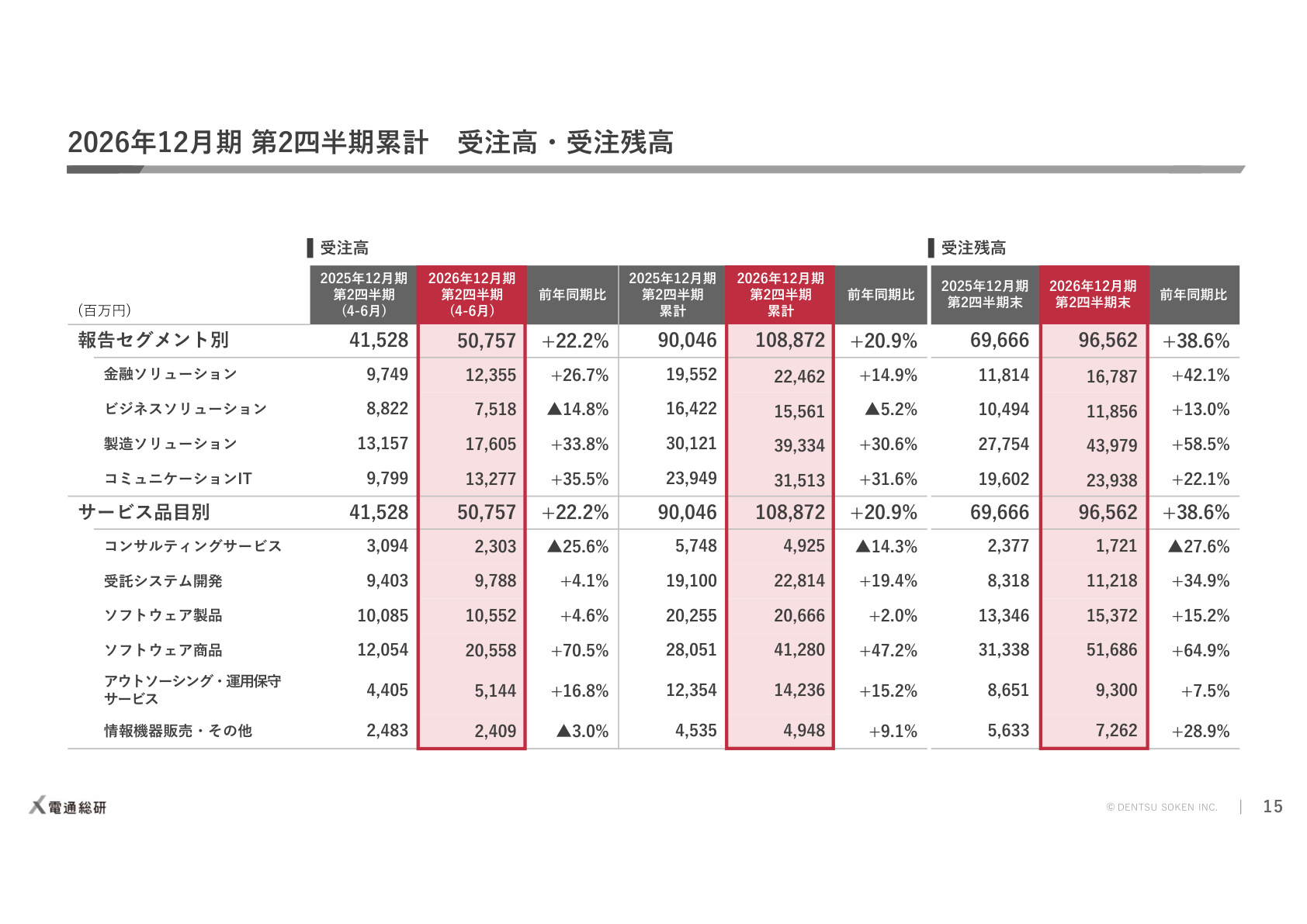
The slide above (P.15) provides critical data for forecasting Dentsu Soken’s future performance. New orders for the first half reached 108,872 million yen (+20.9% YoY) , and the order backlog at the end of the second quarter stood at 96,562 million yen (+38.6% YoY) , marking a significant high.
Of particular note is the surge in the manufacturing solutions order backlog to 43,979 million yen (+58.5% YoY) . While the manufacturing segment saw a temporary stagnation in H1 sales, the acquisition of large-scale projects indicates that a sufficient backlog has been secured for a recovery in the second half and beyond. By service category, the software product backlog has also accumulated significantly to 51,686 million yen (+64.9% YoY) .
5. Financial Soundness and Cash Flow
The balance sheet (B/S) and cash flow (C/F) statements confirm a robust management foundation.
- Assets, Liabilities, and Net Assets: Total assets increased by 16,511 million yen from the end of the previous fiscal year to 181,566 million yen . Increases in advance payments (+12,104 million yen) and deposits (+9,429 million yen) drove the rise in current assets. With the increase in retained earnings (+4,848 million yen), total net assets reached 105,433 million yen , reflecting the accumulation of equity capital.
- Cash Flow: Cash flow from operating activities resulted in an inflow of 13,783 million yen (+1,893 million yen YoY) . Cash generation remained steady, supported by income before income taxes of 12,727 million yen. After accounting for investment C/F (-2,443 million yen) and financing C/F (-4,423 million yen, including dividend payments), the balance of cash and cash equivalents at the end of the interim period remained abundant at 76,488 million yen (+7,068 million yen from the end of the previous fiscal year) .
6. Full-Year Forecast and Progress on Mid-Term Management Plan
Maintenance of Full-Year FY2026 Forecast
Although first-half results exceeded expectations, Dentsu Soken has decided to maintain its full-year consolidated earnings forecast announced on February 12, 2026:
- Net Sales: 182,000 million yen (+10.4% YoY)
- Operating Profit: 25,500 million yen (+11.4% YoY)
- Ordinary Profit: 26,100 million yen (+10.5% YoY)
- Net Income Attributable to Owners of the Parent: 18,000 million yen (+10.0% YoY)
The progress rate against the full-year plan at the end of the second quarter is 48.7% for net sales and 48.4% for operating profit , which is a very steady pace compared to the same period last year (48.7% for net sales, 46.6% for operating profit).
Mid-Term Management Plan and 2030 Long-Term Vision
Dentsu Soken has set ambitious growth targets for 2030: 300 billion yen in net sales (CAGR +12.6%) and 60 billion yen in operating profit (CAGR +24.0%) .
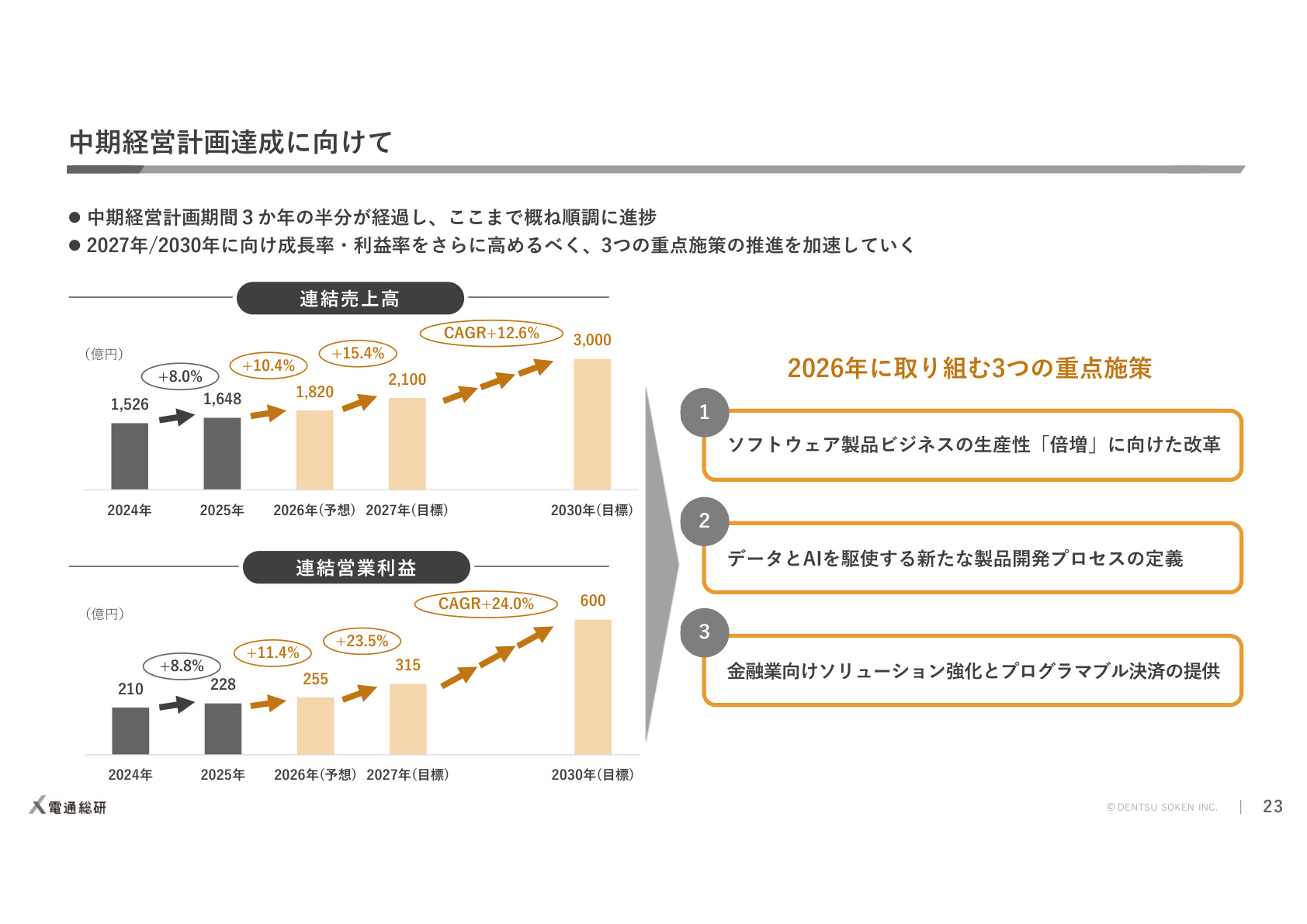
The slide above (P.23) outlines the strategic roadmap for the company’s mid-to-long-term growth trajectory and key initiatives. 2026 marks the halfway point of the three-year mid-term management plan, and the company is accelerating the following three priority measures :
- Reform to "Double" Productivity in Software Product Business: Establishing AI-driven development models in 2026, expanding application to actual projects in 2027, and aiming for full-scale application across all projects by 2030. This plan aims to expand software product sales to 75 billion yen by 2030 (FY2025 actual: 33.9 billion yen) .
- Defining New Product Development Processes Leveraging Data and AI: Developing an "AI-era product design and development platform" to transform manufacturing processes, with plans to launch sales in 2027 following PoCs with transportation equipment manufacturers.
- Strengthening Financial Solutions and Providing Programmable Payments: Accelerating the deployment of high-value-added financial solutions, such as developing advanced versions of loan solutions and providing tokenized deposit infrastructure in collaboration with UK-based Quant Network.
7. Conclusion
Dentsu Soken’s H1 FY2026 earnings not only achieved company-wide revenue and profit growth but also provided evidence for the feasibility of its mid-to-long-term growth scenario, highlighted by a remarkable increase in order backlog (+38.6% YoY) and concrete progress in AI-driven development and product reform . Moving forward, attention will be focused on the steady conversion of the expanding order backlog into revenue and the improvement in profitability resulting from the introduction of AI agents.
This content is not intended as investment advice or a recommendation. Any opinions expressed are solely the personal views of each article.