


Realgate Inc. Q3 FY2026 Earnings Deep Dive Report

StockClub
Published: Jul 28, 2026, 09:55 AM
Sentiment Analysis
Realgate Inc. (Securities Code: 5532) Q3 FY2026 Earnings Deep Dive Report
This report provides a detailed analysis of the Q3 FY2026 financial results for Realgate Inc. (Securities Code: 5532), categorized into 10 key topics including performance summaries, growth strategies, portfolio transformation, and changes in financial foundations.
1. Earnings Highlights and Progress Against Full-Year Targets
For the first nine months of the fiscal year (October 2025 – June 2026), the company reported net sales of 7,709 million JPY (down 5.5% YoY) , operating profit of 1,160 million JPY (up 18.5% YoY) , ordinary profit of 870 million JPY (up 3.0% YoY) , and net profit of 567 million JPY (down 1.9% YoY) .
The decline in net sales is attributed to the timing of large-scale flow-based revenue (such as property sales) which were concentrated in the previous second quarter. However, operating profit, which reflects the company's core earning power, achieved a significant 18.5% increase . The operating profit margin also improved by 3.1 percentage points, rising from 12.0% in the same period last year to 15.1% .
Progress against the full-year targets (net sales of 10,500 million JPY, operating profit of 1,470 million JPY) stands at approximately 73.4% for sales and 78.9% for operating profit, indicating a very steady pace as of the third quarter.
2. 2.5 Billion JPY Capital Raise and Strategic Partnership with Hulic
In May 2026, the company announced a public offering and a third-party allotment, successfully raising approximately 2.5 billion JPY . Of this, approximately 1.2 billion JPY was raised through a third-party allotment to the major real estate firm, Hulic Co., Ltd.
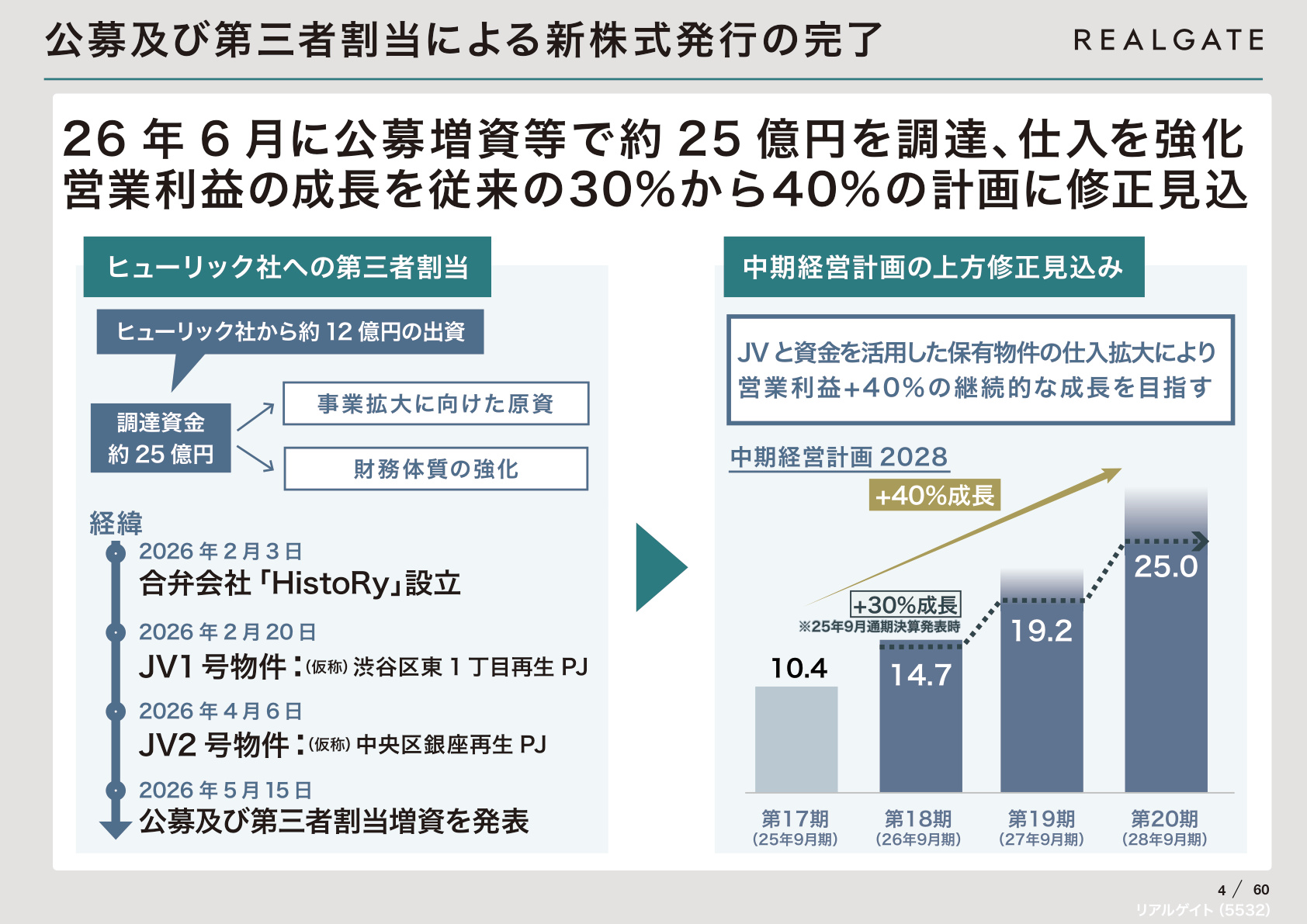
As shown in the slide above, this capital raise serves not only as financial reinforcement but as "growth capital" to dramatically accelerate the company's expansion. Specifically, the company established a joint venture (JV) named "History" with Hulic in February 2026 and has already successfully acquired large-scale JV projects, such as the "(Tentative) Shibuya-ku Higashi 1-chome Redevelopment Project" and the "(Tentative) Chuo-ku Ginza Redevelopment Project." By increasing liquidity, the company is now capable of acquiring larger-scale assets, directly contributing to the expansion of its mid-term earnings base.
3. Upward Revision of Mid-Term Management Plan: Raising Operating Profit Growth to +40%
Following the strengthening of its acquisition capabilities through the capital raise, the company has announced an upward revision of its mid-term growth trajectory.
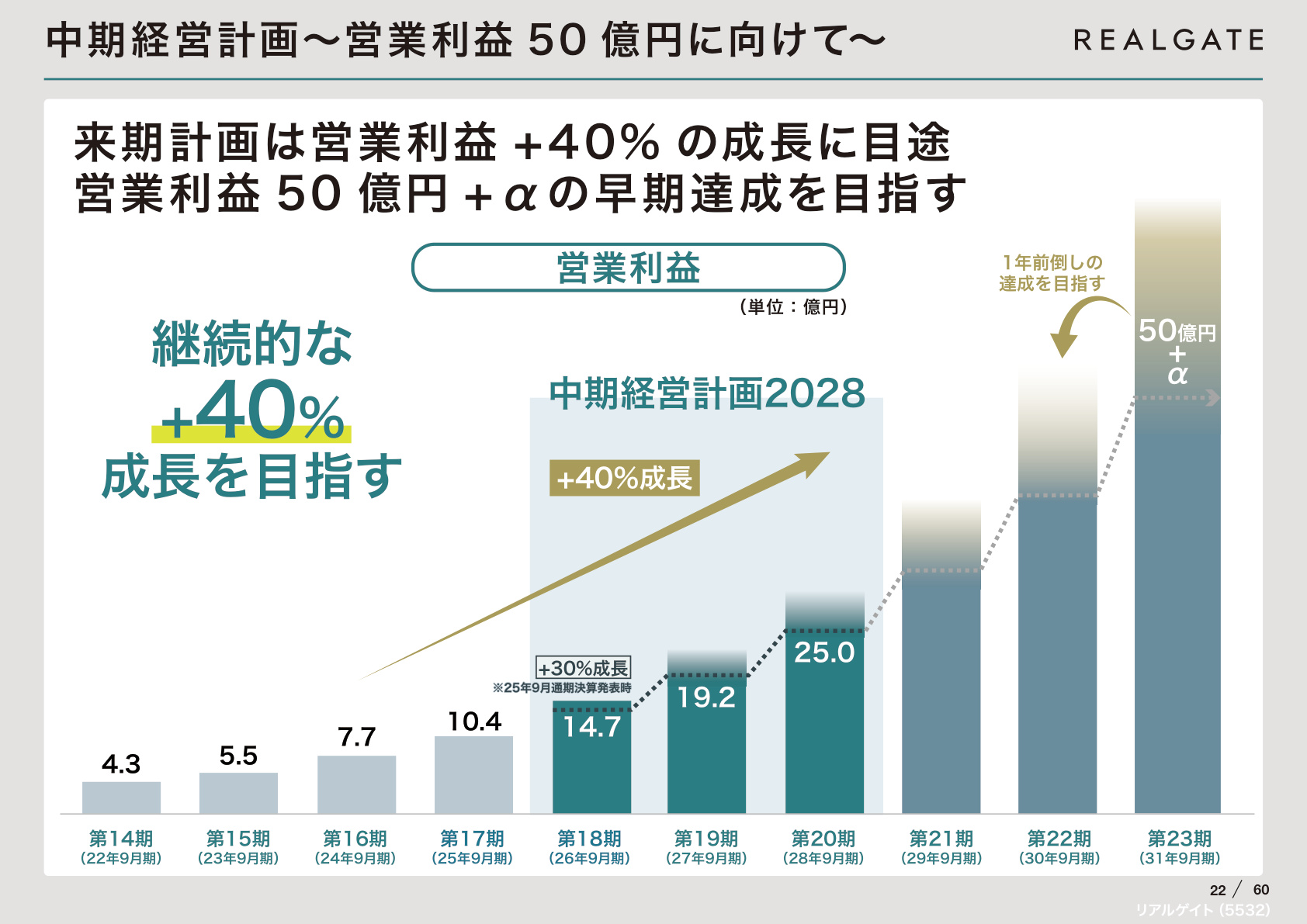
Previously, the target was an average annual operating profit growth of +30% . However, by fully leveraging the raised capital and JV structures to expand property acquisitions, the company has revised its growth target to +40% average annual growth . Specifically, against the FY2026 operating profit target of 1.47 billion JPY, the company aims to reach 1.92 billion JPY in the 19th fiscal year (FY2027) and 2.50 billion JPY in the 20th fiscal year (FY2028) . Furthermore, an aggressive growth vision has been presented to achieve the long-term goal of 50 billion JPY+ in operating profit one year ahead of schedule.
4. Revenue Structure Analysis: Covering Fixed Costs with Stock-based Gross Profit
The company's revenue structure is clearly divided into "stock-based revenue" (rental income and management fees) and "flow-based revenue" (property sales and design/construction contracts).
Cumulative stock-based revenue for the third quarter reached 4,829 million JPY (+6.2% YoY) , showing stable growth. This stock-based gross profit (1,748 million JPY for the period) fully covers fixed costs (1,259 million JPY for the period), such as personnel and general expenses, creating a business model highly resilient to downside risks. Regarding flow-based revenue, in addition to one property sale and completion delivery in Q1, one contracted property sale and two completion deliveries are scheduled for the fourth quarter (Q4) , ensuring a significant contribution to flow-based profit in the final quarter.
5. Portfolio Strategy: Concentrated Investment in High-Yield "Owned & Master Lease" Properties
The company is promoting a structural reform (qualitative shift) of its portfolio to simultaneously achieve business scale expansion and higher profit margins.
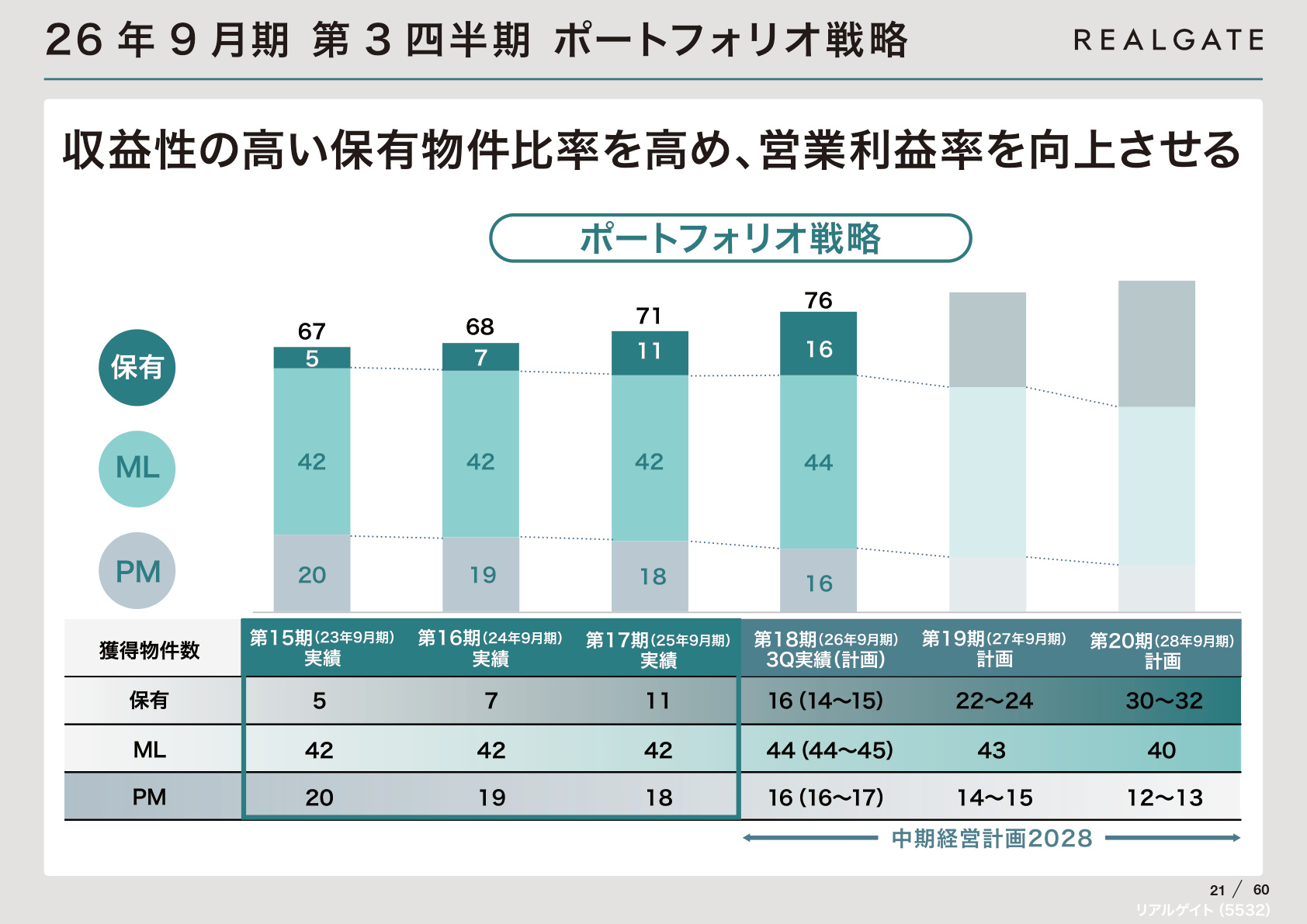
As shown in the slide above, the company is intentionally reducing the number of low-profitability PM (Property Management: operation entrustment only) projects while significantly increasing the proportion of high-margin "Owned" and "Master Lease (ML)" properties. The number of owned properties has surged from 5 in the 15th fiscal year to 16 as of Q3 of the 18th fiscal year (+5 compared to the end of the previous year) . The plan is to increase owned properties to 30–32 by the end of FY2028, executing a strategy to structurally boost the company's overall operating profit margin by placing the most profitable assets at the core of its portfolio.
6. Progress in Property Acquisition, Development, and Occupancy Rates
Regarding new property acquisitions, the company has already completed 9 acquisitions (6 owned, 2 ML, including JVs) as of the third quarter, exceeding the initial plan of 8. With one additional owned property (Minato-ku Minami-Aoyama Redevelopment Project) already secured for Q4, the company expects to acquire approximately 12 new properties for the full year.
Furthermore, the occupancy rate of properties under operation (ML, owned, and existing) remains at an exceptionally high level of 98.86% . The company's strong competitive advantage lies in its ability to maintain high occupancy and rental levels, supported by persistent demand for creative and small offices in central Tokyo.
7. Expansion into New Areas: Hotel Projects (SHIFT HOTEL)
In addition to its existing small-office redevelopment business, the company is expanding its "SHIFT HOTEL" projects, which are complex redevelopment projects combining "Hotel + Office + Shop."
To respond to the recovery in inbound demand and diversifying work-life styles, the company is advancing hotel projects in locations such as Shibuya-ku Jinnan, Minato-ku Shiba, and Chuo-ku Ginza, with a total of 6 properties and approximately 100 rooms planned for opening. By integrating hotel functions with office spaces, the company is increasing the revenue per unit of the entire building and maximizing the redevelopment value of the real estate.
8. Changes in Financial Foundation and Balance Sheet (BS)
With the 2.5 billion JPY capital raise, the company's balance sheet has been significantly strengthened:
- Net Assets : Increased sharply from 3,351 million JPY at the end of the previous fiscal year to 6,501 million JPY (+3,149 million JPY) .
- Equity Ratio : Improved significantly from 15.5% at the end of the previous fiscal year to 22.3% (+6.8 points) .
- Cash and Deposits : Expanded from 947 million JPY to 2,170 million JPY (+1,223 million JPY) .
Total assets also grew to 28,680 million JPY (+7,415 million JPY from the previous year-end). With the accumulation of tangible fixed assets (20,826 million JPY) alongside a substantial rise in the equity ratio, the company has significantly expanded its capacity for future leverage through bank borrowings.
9. Core of the Business Model: Expertise in Aging Building Redevelopment and Architectural Technology
The source of the company's competitive advantage lies in its in-house team of professional engineers, including first-class architects , and its integrated, end-to-end business model covering planning, design, construction management, brokerage, and operation management.
The company targets residential and office buildings that are 30–50 years old, performing fundamental improvements such as conversions, extensions, and seismic retrofitting. For example, in the "LANTIQUE BY IOQ" project, a 36-year-old residential apartment building was converted into a shared office and retail space, doubling the monthly rental income from 9.1 million JPY to 18.1 million JPY . This overwhelming value-add expertise supports the company's high gross profit margins.
10. Q4 Outlook and Certainty of Achieving Full-Year Targets
In the fourth quarter (July – September 2026), several key revenue-generating events are concentrated:
- Profit recognition from one contracted owned property sale (Meguro-ku Ohashi: building only).
- Profit recognition from two design/construction contract completions (Kamimeguro New Construction Project, Sendagaya Redevelopment Project).
- Continued accumulation of newly acquired properties.
Due to these factors, a significant increase in operating profit is expected in Q4, making the achievement of the full-year plan (net sales of 10.5 billion JPY, operating profit of 1.47 billion JPY, +40.9% YoY) almost certain . While the company is allocating the surplus from stock-based revenue to upfront investments (such as property acquisition costs and initial opening expenses), there is strong potential for the full-year profit to exceed the initial targets.
This content is not intended as investment advice or a recommendation. Any opinions expressed are solely the personal views of each article.