


Daido Steel Q1 FY2026 Earnings Analysis: Revenue and Profit Growth Driven by Industrial Machinery Demand Recovery and High-Performance Materials

StockClub
Published: Jul 28, 2026, 09:54 AM
Sentiment Analysis
1. Executive Summary
Daido Steel’s financial results for the first quarter of fiscal year 2026 (April–June 2026) were robust, achieving significant year-on-year growth in both revenue and profit across all levels .
Revenue reached 163.5 billion yen (+21.1 billion yen, +14.8% YoY) , operating profit was 13.1 billion yen (+4.4 billion yen, +50.6% YoY) , and adjusted operating profit —which reflects core earning power by excluding one-time special factors—stood at 11.5 billion yen (+2.3 billion yen, +25.0% YoY) . Profit attributable to owners of the parent also showed steady growth, reaching 9.1 billion yen (+2.7 billion yen, +42.2% YoY) .
This expansion was underpinned by a recovery in orders for industrial machinery and increased demand for semiconductor manufacturing equipment in the company's core business segments. Furthermore, performance exceeded the company’s initial forecast released on May 15, driven by higher-than-expected steel shipment volumes . Progress toward the full-year forecast remains on a very solid trajectory, with 33% progress in operating profit and 29% in adjusted operating profit .
2. Earnings Highlights and Progress Against Forecasts
The Q1 FY2026 results confirm that the company’s growth scenario is unfolding as planned.
Analysis of Key Metrics
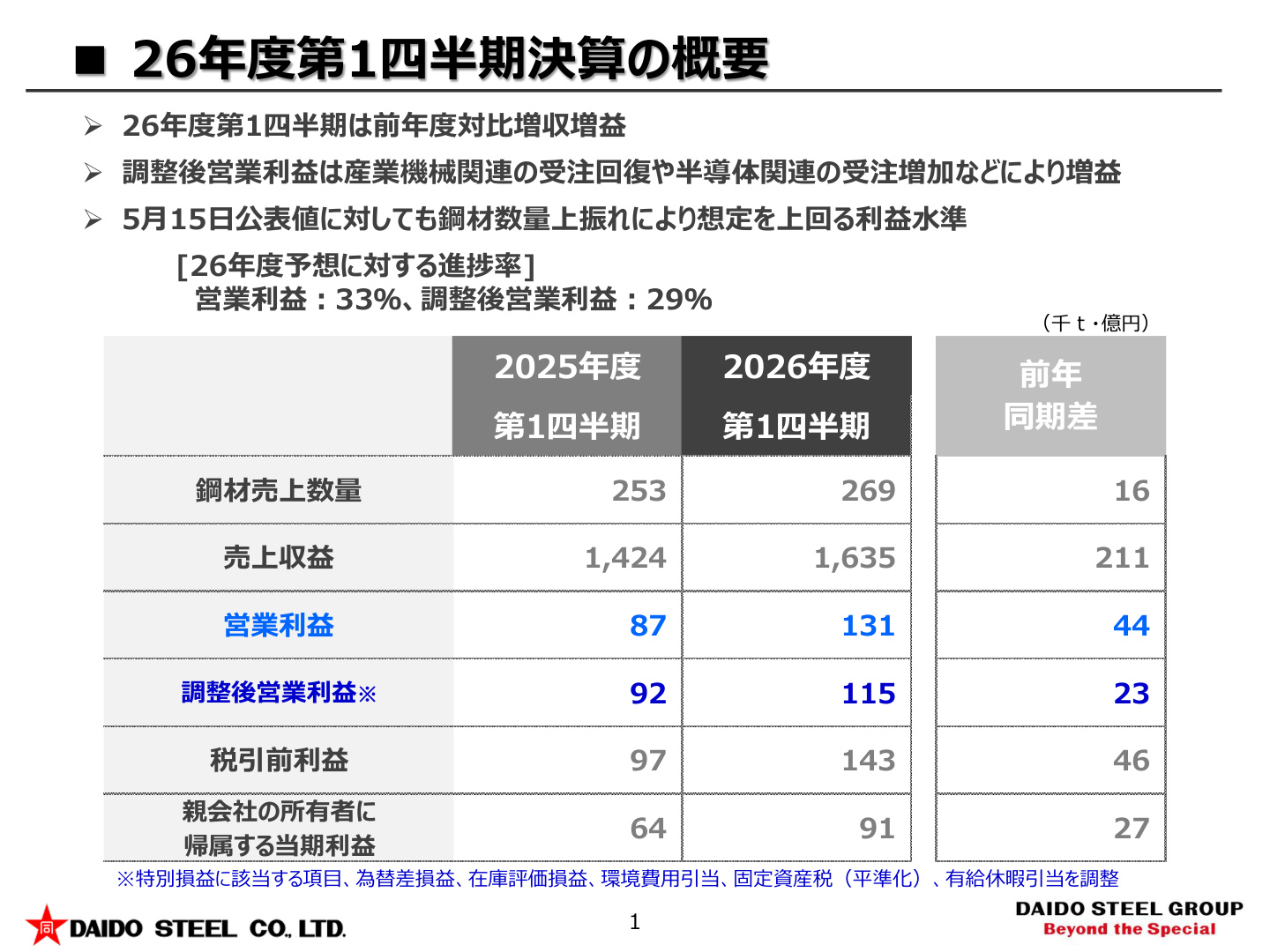
The slide above (Page 1) serves as the most critical summary, providing an at-a-glance overview of the Q1 FY2026 results and key KPIs . For investors, the inclusion of progress rates against initial company forecasts is particularly significant.
- Steel Sales Volume (Non-consolidated) : Steadily expanded to 269 thousand tons (+16 thousand tons YoY) .
- Revenue : 163.5 billion yen (+21.1 billion yen YoY) .
- Operating Profit : 13.1 billion yen (+4.4 billion yen YoY) .
- Adjusted Operating Profit : 11.5 billion yen (+2.3 billion yen YoY) .
- Profit Attributable to Owners of the Parent : 9.1 billion yen (+2.7 billion yen YoY) .
Of particular note is the high progress rate . With 33% of the operating profit target and 29% of the adjusted operating profit target achieved in the first quarter, the company has started the year stronger than anticipated, benefiting from favorable business conditions. Adjustments to operating profit include foreign exchange gains/losses, inventory valuation adjustments, environmental provision expenses, equalization of fixed asset taxes, and paid leave provisions. Excluding these, the underlying earning power has significantly increased compared to the same period last year.
3. Analysis of Changes in Adjusted Operating Profit (YoY)
A breakdown of the 2.3 billion yen increase in adjusted operating profit (from 9.2 billion yen to 11.5 billion yen) highlights shifts in the profit structure and the impact of the external environment.
Analysis of Profit Variance
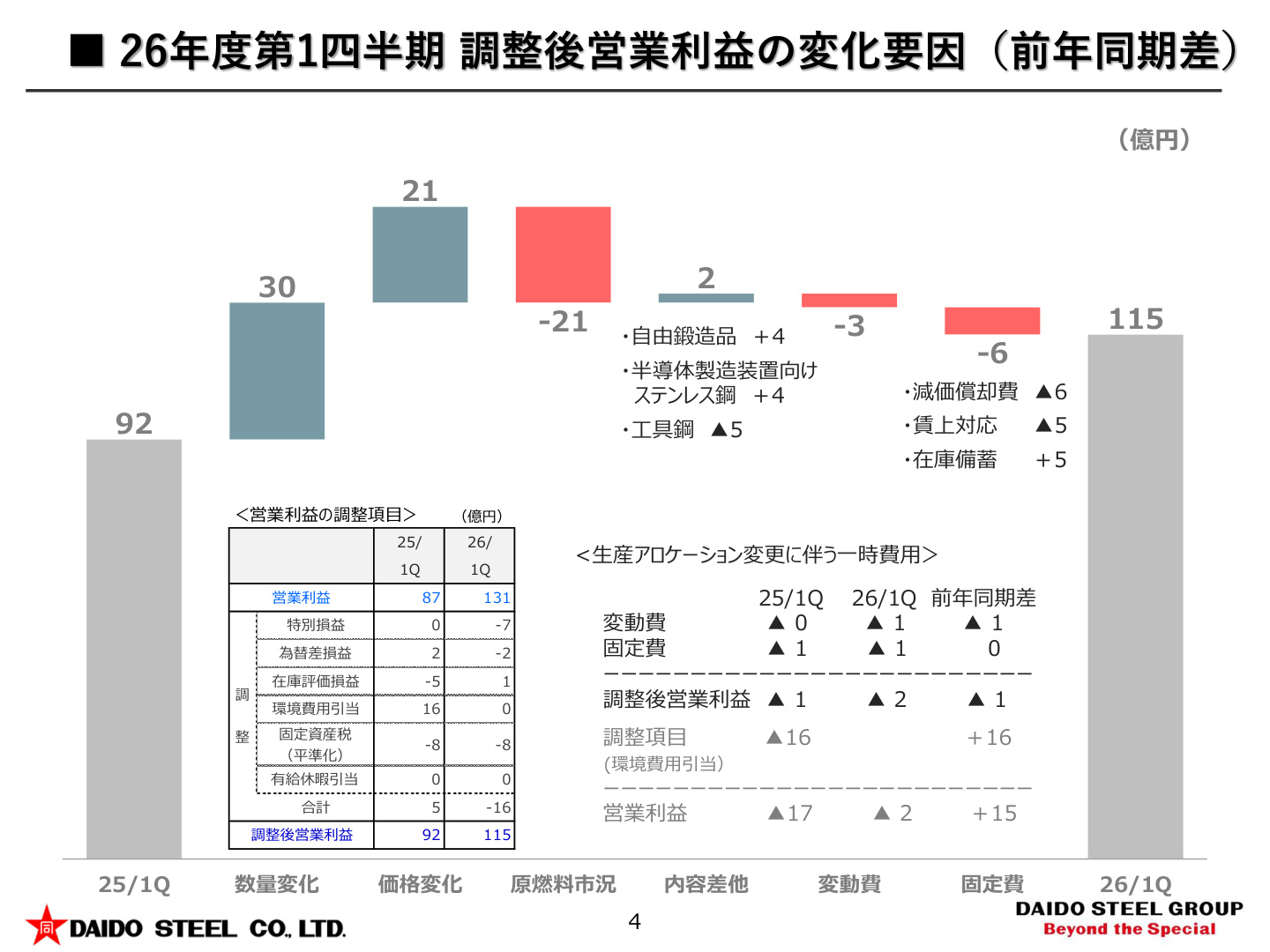
The slide above (Page 4) is a core visual representation of the "profit fluctuation mechanism," showing which factors boosted or pressured operating profit . Analyzing this waterfall chart reveals the company’s structural strengths and challenges.
Positive Drivers
- Volume Variance (+3.0 billion yen) : The recovery in demand for industrial machinery and semiconductors led to increased sales volumes of steel and high-performance materials.
- Price Variance (+2.1 billion yen) : Contributed by successful price pass-throughs and an improved product mix.
- Product Mix and Other (+0.2 billion yen) : High-value-added products such as free forgings (+0.4 billion yen) and stainless steel for semiconductor equipment (+0.4 billion yen) contributed positively, while tool steel (▲0.5 billion yen) acted as a partial drag.
Negative Drivers
- Raw Material and Fuel Market Conditions (▲2.1 billion yen) : Fluctuations in raw material and energy costs created a negative impact. Specifically, the slide gap —the timing lag in reflecting costs in sales prices—temporarily suppressed earnings.
- Variable Costs (▲0.3 billion yen) and Fixed Costs (▲0.6 billion yen) : The increase in fixed costs includes higher depreciation expenses (▲0.6 billion yen) due to capital investment, wage increases (▲0.5 billion yen) to combat inflation and secure labor, and inventory accumulation effects (+0.5 billion yen) toward the end of the period.
The combined positive impact of volume (+3.0 billion yen) and price (+2.1 billion yen), totaling +5.1 billion yen , significantly outweighed the negative factors of raw material market conditions and increased fixed costs (▲3.0 billion yen).
4. Segment Performance Analysis
The company operates across five segments, with the "Functional Materials & Magnetic Materials" segment serving as the primary growth driver this quarter.
(1) Specialty Steel Segment
- Revenue : 59.4 billion yen (+8.2 billion yen YoY)
- Operating Profit : 3.2 billion yen (+0.6 billion yen YoY)
- Adjusted Operating Profit : 2.9 billion yen (±0 YoY)
- Steel Sales Volume (Non-consolidated) : Recovered to a monthly average of 90 thousand tons (82% of FY2017 levels) .
Shipment volumes are trending upward due to the recovery in industrial machinery demand. However, adjusted operating profit remained flat YoY due to the temporary slide gap impact (▲0.5 billion yen) from raw material and fuel price fluctuations.
(2) Functional Materials & Magnetic Materials Segment
- Revenue : 58.0 billion yen (+9.7 billion yen YoY)
- Operating Profit : 5.8 billion yen (+2.7 billion yen YoY)
- Adjusted Operating Profit : 4.8 billion yen (+2.2 billion yen YoY)
Analysis of High-Value-Added Strategy
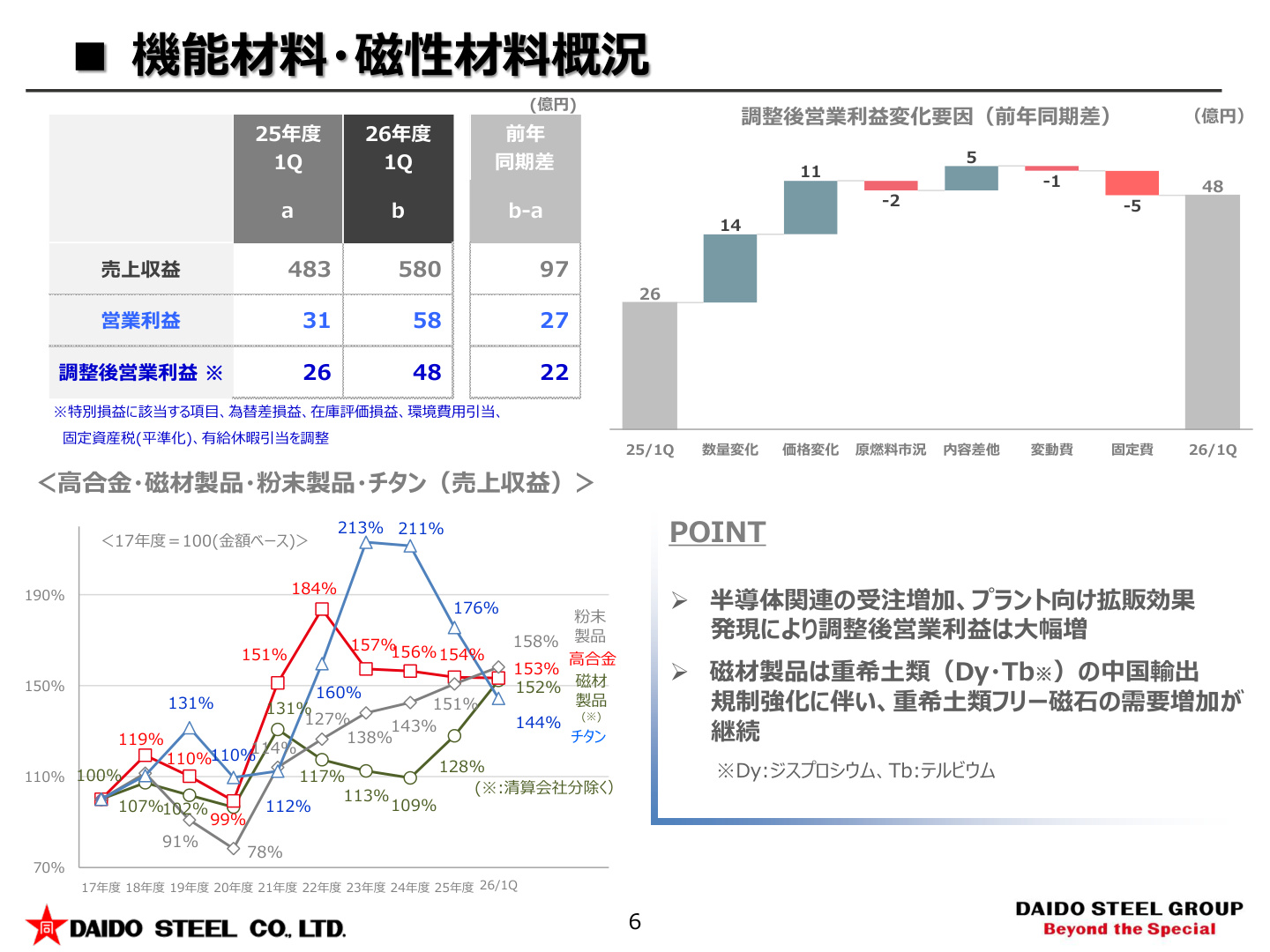
The slide above (Page 6) is crucial for understanding the drivers of this segment, which is the largest profit growth contributor this quarter . As shown in the line graph (FY2017=100), all product groups— high-alloy (153%) , magnetic products (152%) , powder products (158%) , and titanium (144%) —are maintaining or expanding at levels significantly higher than in FY2017.
Two factors drove this growth:
- Surge in semiconductor-related orders and plant expansion : Demand for high-purity, corrosion-resistant high-alloy and powder products has expanded rapidly due to generative AI and semiconductor investment.
- Continued demand for heavy rare-earth-free magnets : Following China’s tightened export restrictions on dysprosium (Dy) and terbium (Tb), demand for Daido Steel’s heavy rare-earth-free magnets have seen robust demand as a substitute.
(3) Automotive & Industrial Machinery Parts Segment
- Revenue : 31.6 billion yen (+2.3 billion yen YoY)
- Operating Profit : 2.9 billion yen (+1.5 billion yen YoY)
- Adjusted Operating Profit : 2.7 billion yen (+0.5 billion yen YoY)
Revenue from core free forgings grew to a monthly average of 4.3 billion yen (41% of segment revenue) . By application, orders for aircraft and heavy electrical equipment increased significantly , while marine valves remained high and semiconductor-related orders rose . North American engine valve shipments also remained strong.
(4) Engineering and Distribution & Service Segments
- Engineering : Revenue 7.3 billion yen (+0.5 billion yen), Adjusted Operating Profit 0.2 billion yen (▲0.5 billion yen). Profit declined due to the timing of equipment construction projects.
- Distribution & Service : Revenue 7.2 billion yen (+0.4 billion yen), Adjusted Operating Profit 0.9 billion yen (+0.1 billion yen). Maintained stable earnings.
5. Financial Soundness and Capital Efficiency
- Total Assets : Expanded to 905.9 billion yen (+49.5 billion yen from March 2026) , driven by increased trade receivables (169.9 billion yen) and inventory (228.7 billion yen) due to higher operating rates.
- Equity (Attributable to owners of the parent) : Accumulated to 484.2 billion yen .
- D/E Ratio : 0.43 (slightly up from 0.38 at the end of the previous fiscal year, but well within the safe range of around 0.4).
- ROE : 7.6% (steady improvement from 6.7% in FY2025), supported by a higher ratio of high-value-added products.
6. Comprehensive Analysis and Future Outlook
Daido Steel has demonstrated high sensitivity to demand recovery and strong differentiation in high-performance materials. Key points to monitor include:
- Sustainability of semiconductor/generative AI demand .
- Resilience of heavy rare-earth-free magnets against geopolitical risks .
- Growth in aircraft and heavy electrical equipment orders for free forgings .
- Timing of the resolution of the slide gap in raw material prices .
- Control of fixed cost increases (depreciation and wage hikes).
- Recovery pace of specialty steel shipment volumes .
- Potential for upward revisions to full-year forecasts .
- Demand trends in the North American automotive market .
- Continuous improvement in asset efficiency (ROE) .
- Response to environmental investment and new technology development .
By shifting its portfolio toward high-growth areas like semiconductors, decarbonization, and aerospace while capturing the recovery in traditional manufacturing, Daido Steel is solidifying its foundation for sustainable corporate value creation.
This content is not intended as investment advice or a recommendation. Any opinions expressed are solely the personal views of each article.