

Hankyu Hanshin REIT (8977) May 2026 Earnings Deep Dive Report: Internal and External Growth Strategies and Asset Replacement Driving Distribution Growth

StockClub
Published: Jul 17, 2026, 09:58 AM
Sentiment Analysis
Hankyu Hanshin REIT (Securities Code: 8977) announced its financial results for the May 2026 fiscal period, with distribution per unit (DPU) settling at 3,300 yen, exceeding forecasts . This strong performance was primarily driven by steady rental income increases and the acquisition of new properties, indicating a clear strategy for future sustainable growth. This report provides a detailed analysis of the key topics extracted from the earnings presentation materials, offering a deep understanding of the REIT's overall picture and future growth story.
May 2026 Financial Highlights and Distribution Performance
For the May 2026 fiscal period, DPU reached 3,300 yen , surpassing the initial forecast of 3,270 yen by 30 yen. This favorable outcome was mainly attributed to robust rental income performance from urban commercial facilities and a reduction in repair expenses. Conversely, hotels performed below expectations. Key portfolio health indicators also remained strong. Investment value (NAV per unit) increased by 1.0% period-on-period to 189,896 yen , and the portfolio NOI yield rose by 0.1pt period-on-period to 5.0% . The LTV (total asset LTV) remained stable at 47.5% , a decrease of 0.1pt period-on-period. Occupancy rates were high, with offices at 96.6% and commercial facilities at 99.1% . Notably, the acquisition of four new properties in the key investment area of Kansai contributed to the improvement in DPU.
The historical performance and key financial indicators are shown below.
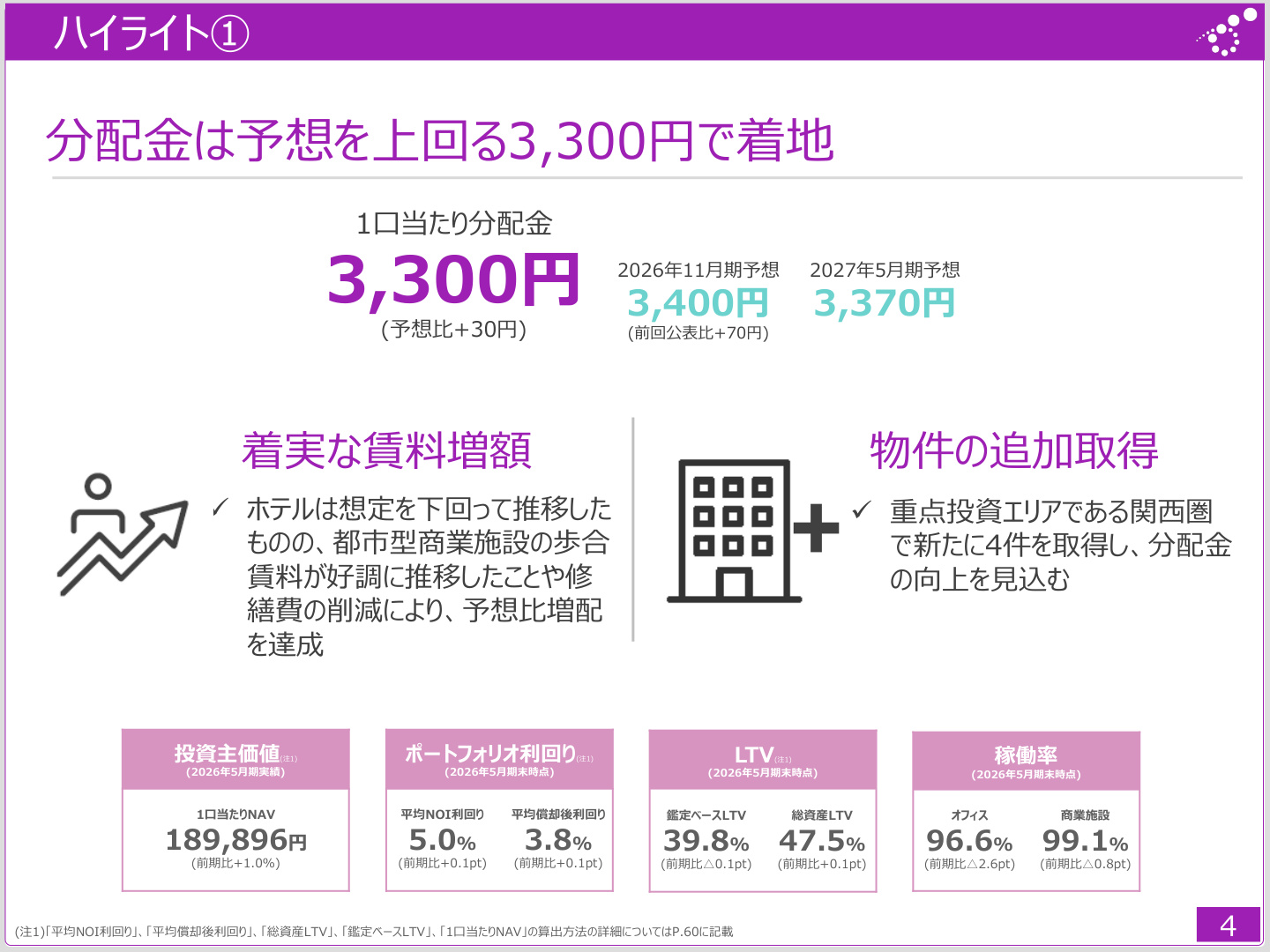 This slide clearly illustrates the actual DPU for the May 2026 period exceeding forecasts and highlights the contributions of rental income growth and property acquisitions to this performance. It also provides a comprehensive overview of key performance indicators (KPIs) such as NOI yield, LTV, and occupancy rates , which are crucial for understanding the REIT's current financial health and operational achievements. The stable LTV, in particular, is an important indicator of financial stability.
New Distribution Target and Overall Growth Strategy
Having achieved its 2027 DPU target of 3,300 yen ahead of schedule, Hankyu Hanshin REIT has set a new target of 3,500 yen per unit (equivalent to 7,000 yen annually) by around 2028 . The growth towards this target is primarily composed of three elements: "external growth," "internal growth," and "cost increase suppression." Specifically, the REIT anticipates an increase in DPU of approximately 250 yen from external growth and approximately 200 yen from internal growth . External growth will focus on improving profitability through asset replacement of underperforming properties and utilizing acquisition capacity for new properties. The recent acquisition of four properties is expected to contribute approximately 125 yen to DPU. Internal growth aims for an increase of approximately 150 yen through rental upside strategies tailored to each asset type. While an increase in interest costs of approximately 250 yen due to rising interest rates is factored in, the REIT aims to achieve its target through robust internal and external growth that outweighs these cost increases.
Details of the future distribution target and growth drivers are presented below.
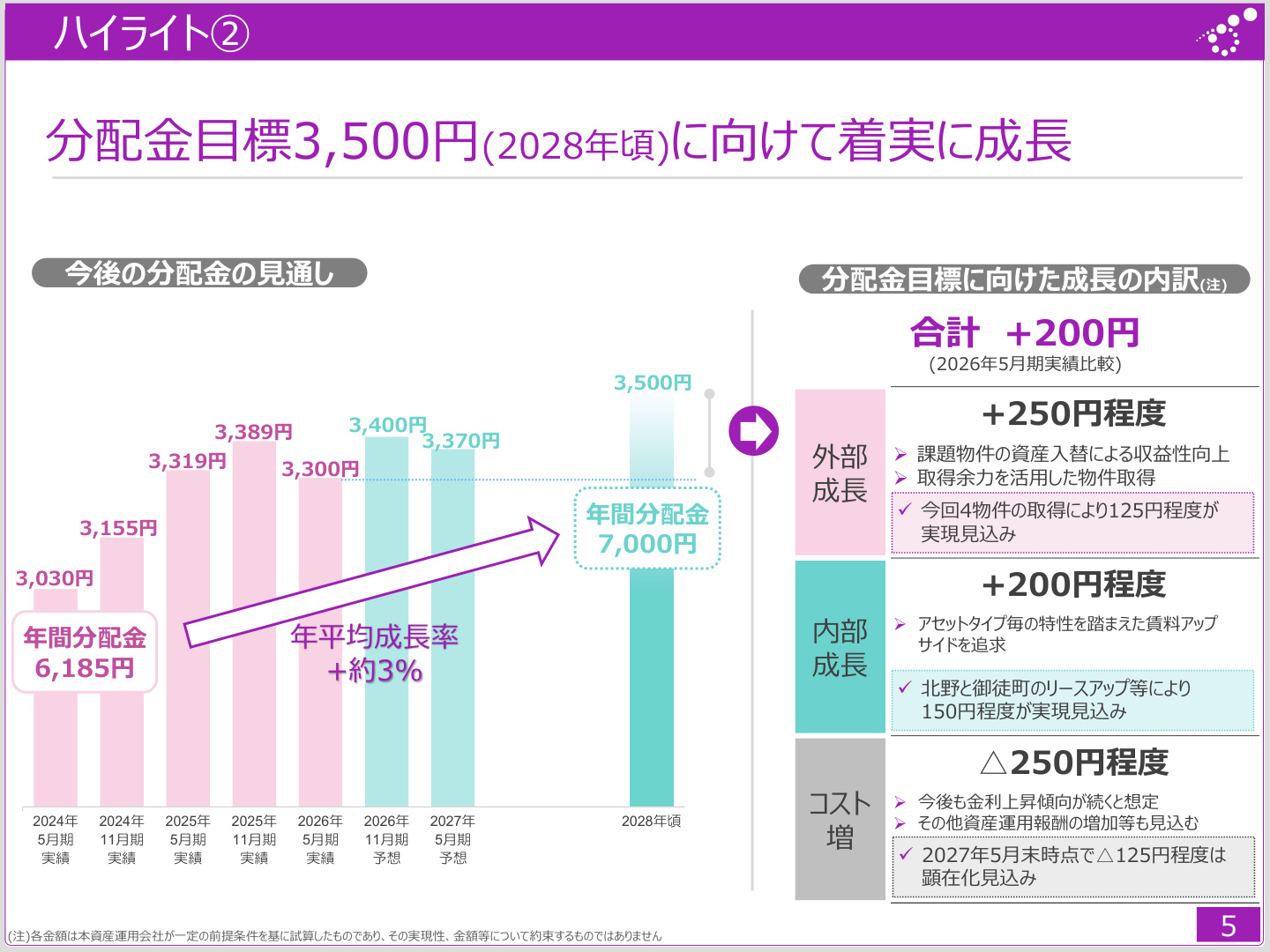 This slide represents the core of the REIT's medium-to-long-term growth strategy . It presents a concrete DPU target of 3,500 yen by around 2028 and clearly outlines the main drivers—"external growth," "internal growth," and "cost increase"—in monetary terms . This allows investors to visually understand the path to future DPU growth and the balance of specific measures supporting it. The breakdown of how much each of external and internal growth is expected to contribute to DPU is particularly important for enhancing strategic transparency.
Internal Growth Strategy and Status of Each Asset Type
The internal growth strategy is centered on pursuing rental upside and maintaining/improving occupancy rates. From November 2025 to May 2026, the rental income structure saw an increase in fixed rent from 80.8% to 81.7%, with variable rent slightly increasing from 14.3% to 14.4%. For urban commercial facilities , rental income trends remained solid, supported by the full-period contribution of large tenants and rent increases from newly acquired properties. However, hotels experienced a decline in ADR (Average Daily Rate) and RevPAR (Revenue Per Available Room) below 2024 levels due to a decrease in visitors from China, though a gradual recovery is anticipated. Regional commercial facilities saw steady rent increases and revisions, in addition to the positive impact of newly acquired properties. Notably, Hankyu Nishinomiya Gardens achieved record-high sales, indicating continued strong operational performance. For offices , aggressive rent revisions are being pursued against the backdrop of a favorable office market. The Osaka office market is expected to continue experiencing tight supply-demand conditions, leading to declining vacancy rates and rising rents. Significant rental revision opportunities are anticipated over the next three years, with approximately 40,000 sqm due for revision in May 2027 (including Kitano Hankyu Building and Ragza Osaka), approximately 80,000 sqm in May 2028 (including Hankyu Nishinomiya Gardens), and approximately 70,000 sqm in May 2029 (including Takatsuki Josei). This indicates substantial potential for internal growth.
External Growth Strategy and Progress in Asset Replacement
A cornerstone of the external growth strategy is asset replacement aimed at improving portfolio profitability . In 2026, the REIT acquired four new properties —PMO Umeda, Nishinomiya Kitaguchi Primary One, Conan Rinku Hagurazaki (land), and Life Takatsuki (land)—for approximately 10 billion yen . These properties are strategically located in key areas of the Kansai region and are expected to contribute stable earnings. For example, PMO Umeda is a mid-sized office building in the dominant Umeda area, where declining vacancy rates and rising rents are expected. Concurrently, the REIT is considering the disposition of properties with low post-depreciation NOI yields to enhance overall portfolio profitability and secure acquisition capacity. Regarding funding, the strategy involves utilizing existing cash and partially repaying debt through property dispositions, with the aim of maintaining LTV at previous levels in the medium to long term.
The specific policy for asset replacement and the status of low-yield properties in the portfolio are illustrated below.
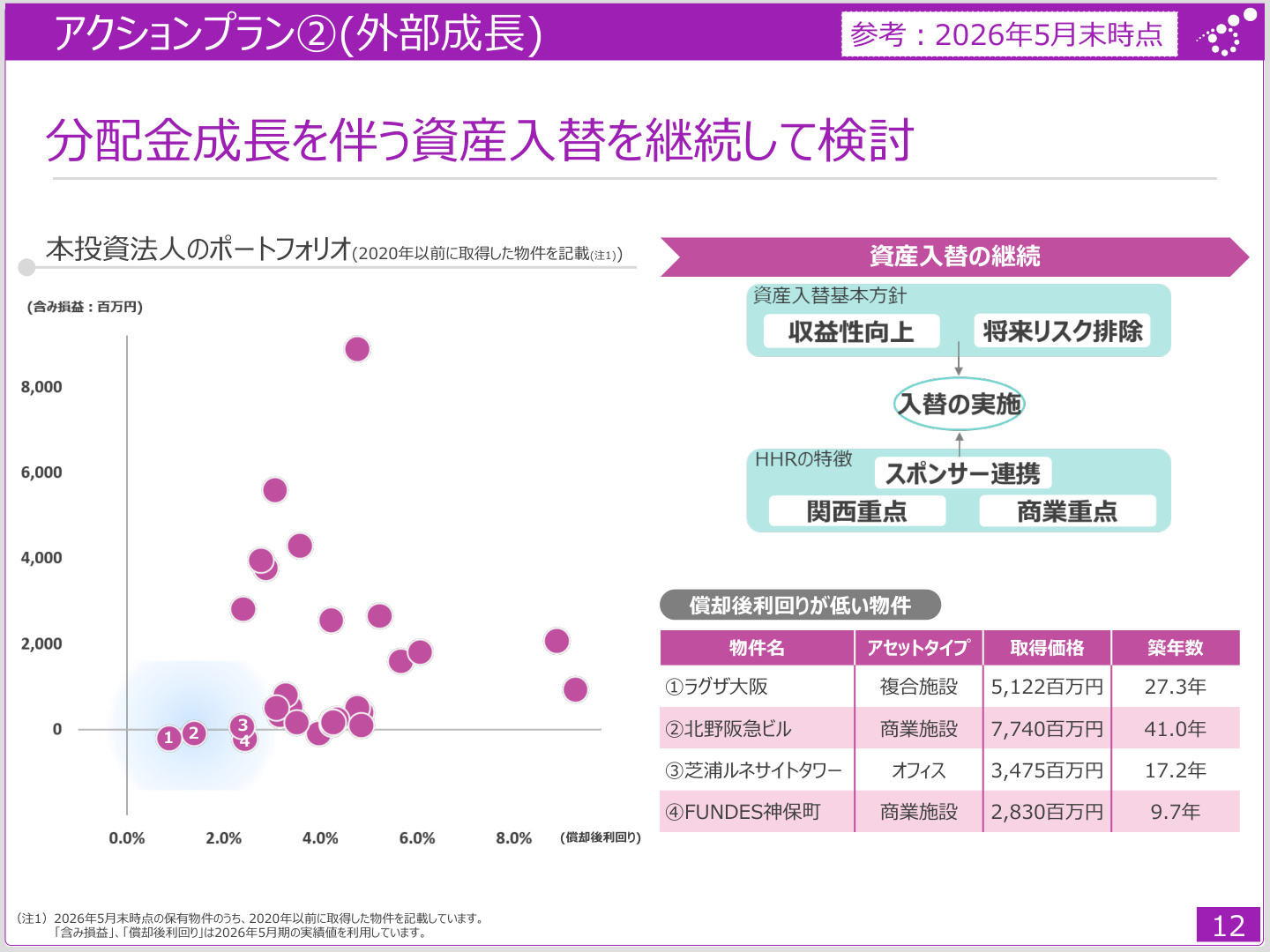 This slide visually represents the core concept of the external growth strategy: asset replacement . By plotting portfolio properties based on their post-depreciation NOI yield, it clearly illustrates the presence of low-yield properties and the strategy to dispose of them in favor of higher-yielding assets . The emphasis on the REIT's characteristics—Kansai focus and commercial property focus—and the advantage of acquiring quality properties through sponsor collaboration is highlighted, indicating concrete actions for future portfolio improvement.
Financial Strategy and Interest Rate Trends
In its financial strategy, the REIT aims to maintain a fixed-rate ratio of approximately 80% to ensure financial stability. Amid expectations of a gradual economic recovery in Japan and developments in the Middle East, an upward trend in interest rates is anticipated, with both short-term and long-term rates continuing to rise. In the May 2026 refinancing, the REIT procured approximately 8 billion yen from banks including Sumitomo Mitsui Trust Bank and Mizuho Bank, with an average interest rate of 0.98%. For future interest rate trends, one more rate hike (0.25%) is anticipated in the latter half of 2026. The plan is to control costs through flexible financial strategies until inflation can be passed on through rents. The average borrowing cost remained low at 0.98% in May 2026, and LTV is stable at 47.5% .
Key Policies and Action Plans for Achieving Distribution Targets
To achieve the new DPU target of 3,500 yen (around 2028), the REIT has set forth the following three key policies:
- Kansai Region Focus : Leverage the information and network rooted in the Hankyu Hanshin Holdings Group to focus investments in the Kansai region.
- Commercial Property Focus : Prioritize commercial-use properties as investment targets, specifically focusing on properties where commercial-use areas account for 50% or more.
- Deepening Sponsor Collaboration : Strengthen collaboration with the sponsor group to continuously acquire quality properties and secure preferential negotiation rights for development projects.
Specific action plans include external growth through asset replacement aimed at improving portfolio profitability and continuous acquisition of quality properties; internal growth through pursuing rental upside during tenant renewals and contract revisions, and ensuring high occupancy rates and sales (including tourist numbers); and financial strategy through implementing diverse funding methods in a rising interest rate environment and expanding scale and DPU growth through public offerings. These initiatives are expected to boost DPU. For instance, an increase of approximately 10 yen in DPU is expected from yield improvement through asset replacement, and approximately 4 yen from rent increases in regional commercial facilities, while a decrease of approximately 34 yen is anticipated due to increased interest expenses from rising interest rates.
Future Outlook and Portfolio Direction
Hankyu Hanshin REIT's strong financial results for the May 2026 period and the setting of a new DPU target of 3,500 yen by around 2028 demonstrate a strong commitment to sustainable growth . Under a clear strategy of focused investment in the Kansai region and commercial facilities , the REIT plans to drive both external growth through new property acquisitions and internal growth through rent revisions and improved occupancy rates of existing properties. The significant rental revision opportunities anticipated over the next few years are expected to be a major driver of internal growth. Furthermore, in response to changes in the external environment such as rising interest rates, the REIT aims to control costs while ensuring financial stability by maintaining a fixed-rate ratio and utilizing diverse funding methods. Through its asset replacement strategy and deepened sponsor collaboration, the REIT is expected to achieve stable distribution growth.
This content is not intended as investment advice or a recommendation. Any opinions expressed are solely the personal views of each article.