

Green Light Renewable Energy Infrastructure Investment Corporation (509A) Q2 Earnings Deep Dive Report

StockClub
Published: Jul 17, 2026, 09:56 AM
Sentiment Analysis

Green Light Renewable Energy Infrastructure Investment Corporation (Securities Code: 509A) has announced its financial results for the second fiscal period (ending May 2026). This report provides a detailed analysis of the second period's earnings highlights, asset management status, and future growth strategies and outlook, based on the attached materials.
Q2 Earnings Highlights and Distribution Summary
The second fiscal period (February 1, 2026, to May 31, 2026) had an effective operating period of 82 days. During this period, operating revenue was 282 million JPY, operating profit was 126 million JPY, ordinary profit was 9 million JPY, and net profit was 8 million JPY. Compared to the initial forecast at listing, operating revenue was 40 million JPY lower, and operating profit was 63 million JPY lower. However, ordinary profit exceeded the forecast by 2 million JPY, and net profit by 1 million JPY. The per-unit distribution was 118 JPY, exceeding the forecast by 2.9 JPY. Notably, the per-unit distribution including excess profit remained at 600 JPY as initially projected.
The primary reasons for the operating revenue falling short of the forecast include cable theft, snow damage, and output curtailment at some power plants, resulting in actual power generation being 88.3% of the forecast. On the other hand, the investment contribution cost of 82 million JPY incurred at the time of listing was lower than initially anticipated, contributing to net profit exceeding the forecast.
The following slide visually summarizes the Q2 earnings highlights and distribution. This slide is crucial for understanding the investment corporation's short-term financial performance and investor returns at a glance.
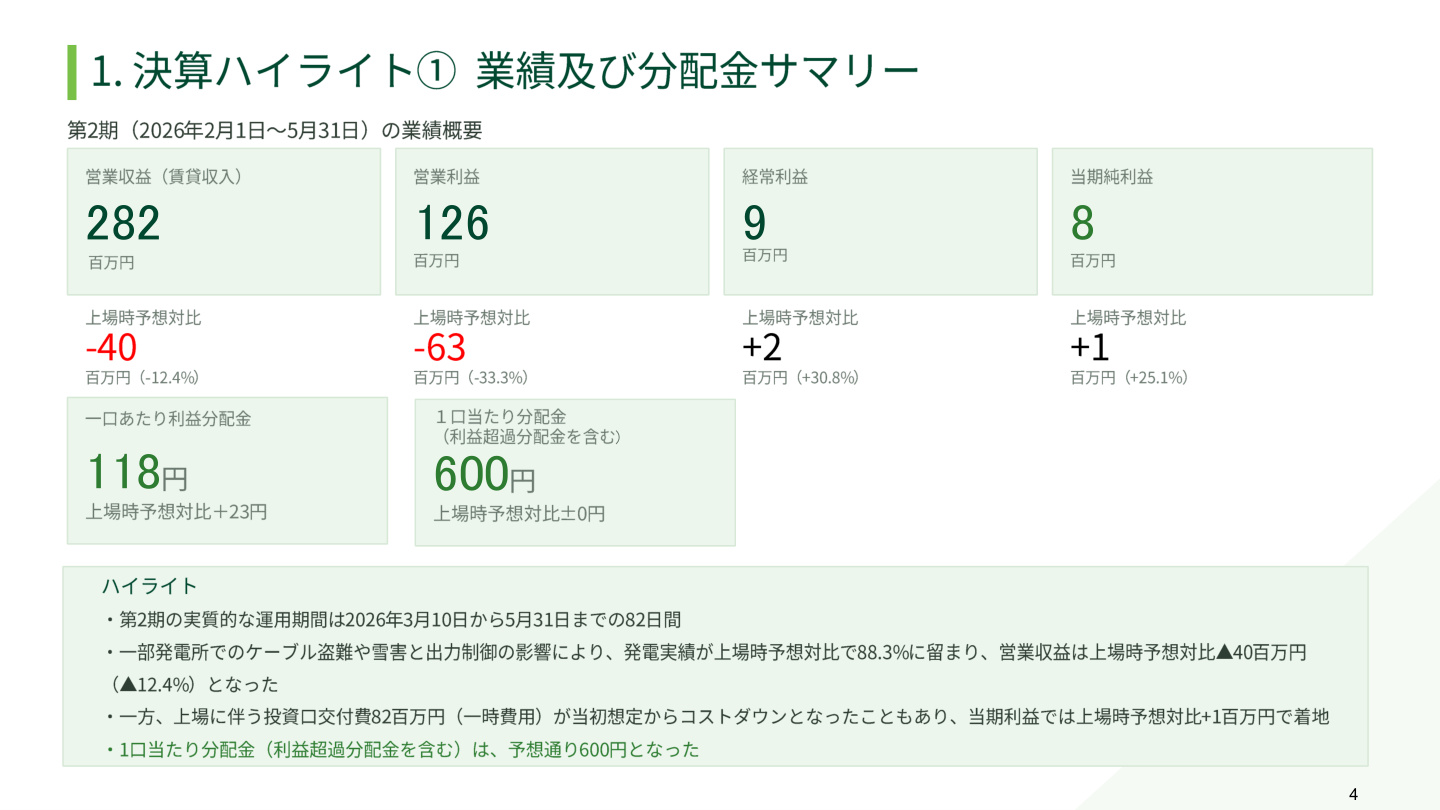
This chart reveals the context behind what might seem like contradictory results: operating revenue and profit fell below forecasts, while ordinary and net profits exceeded them. Crucially, the maintenance of a 600 JPY per-unit distribution including excess profit is a significant indicator of stable returns for investors. The highlights at the bottom further explain the reasons for the shortfall in power generation and the impact of reduced investment contribution costs on profit, providing key insights for a deeper understanding of the overall financial results.
Income Statement and Cost Structure
Looking at the income statement for the second period, operating revenue was 282 million JPY. Cost of goods sold amounted to 119 million JPY (including depreciation of 104 million JPY and insurance of 10 million JPY), and selling, general, and administrative expenses were 37 million JPY (including various consignment fees). Non-operating expenses totaled 118 million JPY, primarily consisting of investment contribution costs of 82 million JPY and interest expenses of 33 million JPY. The investment contribution cost is a direct expense associated with the issuance of new investment units and is temporary in nature.
Financial Stability
The investment corporation's financial position remains stable. Total assets stand at 12.6 billion JPY, and net assets at 5.8 billion JPY. The Loan-to-Value (LTV) ratio is 53.3% , maintaining a healthy level. Furthermore, the long-term issuer rating is 'A- Stable,' indicating the soundness of its financial foundation.
Power Generation Performance and Operational Challenges
Power generation in the second period was 88.3% of the forecast. The main reasons for this shortfall were:
- Cable Theft : Two incidents of power transmission cable theft occurred at a power plant in Tochigi Prefecture. In response, measures such as installing surveillance cameras and sensors, concluding security contracts, strengthening buried wiring routes, changing material (copper to aluminum wire), and transferring risk through insurance have been implemented.
- Snow Damage : Snowfall caused damage to panels and frames at a power plant in Iwate Prefecture. Prompt repairs were completed, and the impact on power generation was limited.
- Output Curtailment : A total of 139 days of output curtailment were implemented across the operational assets.
Response to Output Curtailment and Future Initiatives
The investment corporation is actively addressing output curtailment. Online output curtailment has been introduced for all projects , expected to reduce curtailment. Furthermore, considering that the priority will shift to FIT power sources over FIP power sources from FY2026, the corporation is exploring a transition to FIP . Additionally, consideration for introducing co-located battery storage , promotion of corporate PPAs for existing properties , and exploration of acquiring corporate PPA properties are underway.
Growth Strategy: Strengthening Sponsor Structure
To drive future growth, the investment corporation is strengthening its sponsor structure. Specifically, it has entered into a new support agreement with Blue Sky Energy , a group company of Blue Sky Solar. This agreement enables the investment corporation to benefit from Blue Sky Energy's information, development capabilities, technical expertise, and know-how related to battery storage. Furthermore, the establishment of an investment contribution holding company ensures that Blue Sky Investment (the asset management company) and related parties (Blue Sky Solar, Blue Sky Asset Management, and Blue Sky Energy executives and employees) hold investment units, contributing to maximizing unitholder value.
This slide summarizes the critical topics of the sponsor support agreement and the establishment of the investment contribution holding company. This strengthening of the structure is an indispensable element for understanding the investment corporation's future stability and growth potential.
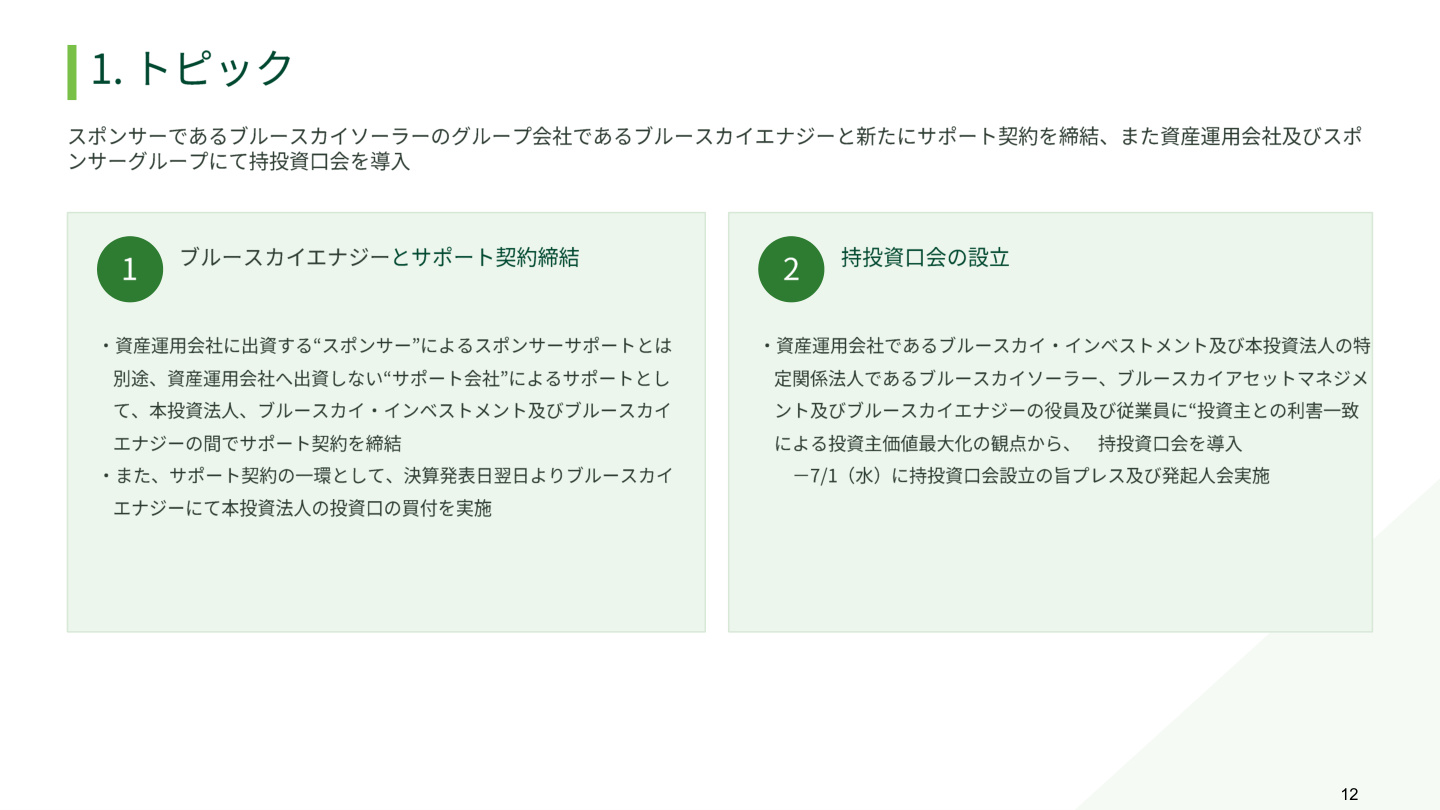
This slide clearly demonstrates the strengthening of the foundation supporting the investment corporation's growth . The support agreement with Blue Sky Energy is not merely about financial provision; it signifies multifaceted support, including specialized know-how in solar power generation, technical information on battery storage, and seed port investments. This will enable the investment corporation to acquire higher-quality assets and operate more efficiently, reinforcing its path to sustainable growth. Moreover, the establishment of the investment contribution holding company is a crucial governance enhancement that aligns the interests of the sponsor group with those of the unitholders, leading to long-term value creation.
External Growth Strategy: Market Environment and Post-FIT Response
The external growth strategy is underpinned by the expanding electricity demand in Japan. Particularly, with the new construction of data centers and semiconductor factories , the projected maximum electricity demand for FY2034 is expected to increase by 94.4% compared to FY2024, reaching approximately 164 million kW. This expansion in electricity demand creates investment opportunities for renewable energy generation facilities.
Furthermore, stabilizing revenue during the Post-FIT period is a key strategy. Through sponsor support for repowering, corporate PPAs (Power Purchase Agreements), and sales in the liberalized market, the corporation aims to secure stable revenue even after the FIT period ends.
External Growth Strategy: Robust Pipeline and Geographic Diversification
The investment corporation's external growth is supported by a robust pipeline from the Blue Sky Group. As of June 30, 2026, the pipeline with preferential negotiation rights includes 214.7 MW of panel output across 88 properties . The mid-term target is an asset scale of 65 billion JPY, with a long-term goal of further expanding the asset scale. Additionally, the strategy involves diversifying investments nationwide from the current focus on East Japan and the Kanto region, thereby reducing weather and output curtailment risks specific to certain areas and enhancing portfolio stability.
This slide illustrates the abundance of the investment corporation's pipeline in its external growth strategy and its future direction for geographic diversification. This information is highly significant for understanding the concrete path to future asset scale expansion.
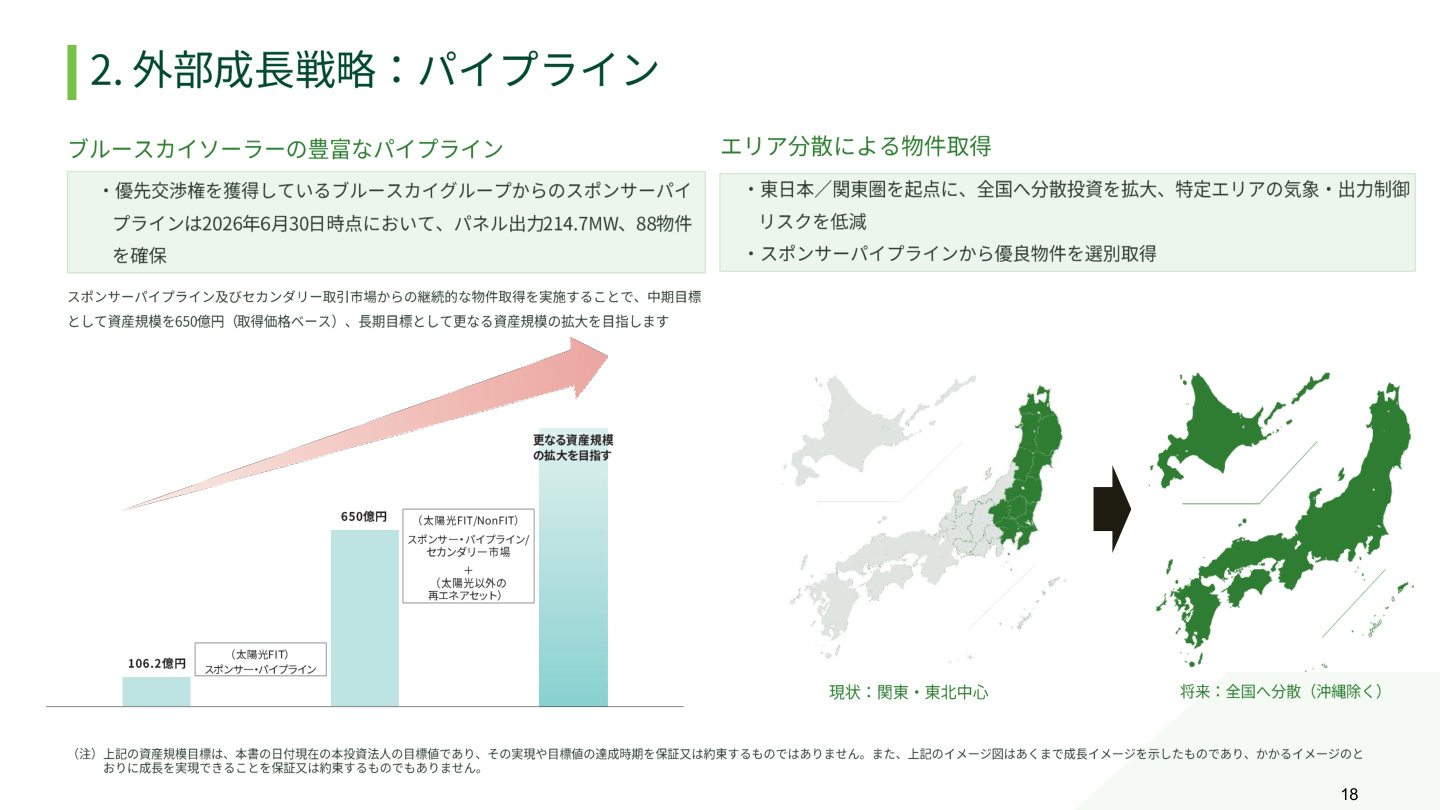
This slide specifically illustrates the future growth potential of the investment corporation. The pipeline with preferential negotiation rights from the Blue Sky Group serves as a stable source for asset acquisition, outlining a concrete path towards achieving the mid-term target of 65 billion JPY in asset scale. Furthermore, the visual representation using the map of Japan clearly conveys that the strategy of diversifying investment areas nationwide from the current focus on East Japan and Kanto aims to reduce regional risks and build a more robust and stable portfolio. This is crucial data demonstrating the solidity and future prospects of the external growth strategy.
Internal Growth Strategy: Consideration of Battery Storage Introduction
As an internal growth strategy to enhance portfolio profitability, the corporation is considering the introduction of battery storage (grid-connected and co-located) . The significance of battery storage introduction lies in storing surplus power during daytime curtailment for expanded nighttime sales revenue, leveraging price differences in the wholesale electricity market, and maximizing land efficiency by co-locating with existing power plants. Concrete studies are underway, including calculating necessary investment, ensuring compliance with conduit requirements, and examining funding methods. The investment corporation is also actively advocating for regulatory reforms related to grid-connected battery storage.
Outlook for Future Periods
The earnings outlook for the third (November 2026) and fourth (May 2027) fiscal periods has been provided. For the third period, operating revenue is projected to be 576 million JPY, net profit 216 million JPY, and per-unit distribution 2,948 JPY. For the fourth period, operating revenue is projected to be 550 million JPY, net profit 174 million JPY, and per-unit distribution 2,709 JPY.
Compared to the initial forecast at listing, the per-unit distribution for the third period is expected to be 112 JPY lower, and for the fourth period, 138 JPY lower. The main reasons for this are explained as the impact of rising interest rates during the period and the shorter operating period of 82 days in the second period, which affects the forecasts for the third period and beyond.
Conclusion
Green Light Renewable Energy Infrastructure Investment Corporation's Q2 results, despite some operational challenges at power plants and temporary expenses, maintained a per-unit distribution including excess profit of 600 JPY , achieving stable distributions. The financial foundation is stable, with a healthy LTV. For future growth, the corporation is focusing on strengthening its sponsor structure through the new support agreement with Blue Sky Energy and the establishment of an investment contribution holding company, external growth driven by expanding electricity demand due to new data center and semiconductor factory constructions, asset scale expansion through a robust pipeline , and internal growth through the introduction of battery storage . While the outlook for future periods indicates an impact from rising interest rates, the investment corporation is expected to enhance its presence in the renewable energy infrastructure investment market with a strong foundation and clear growth strategies.
This content is not intended as investment advice or a recommendation. Any opinions expressed are solely the personal views of each article.