


Silicon Studio (3907) Q2 FY2026 Earnings Deep Dive Report: Business Environment Challenges and Strategic Shift to Physical AI

StockClub
Published: Jul 17, 2026, 09:53 AM
Sentiment Analysis

Silicon Studio's Q2 FY2026 earnings report revealed a significant decline in revenue and profit, resulting in operating and net losses, primarily due to a challenging business environment and the deterioration of the domestic game market. However, in parallel with addressing existing business challenges, the company is pursuing a strategic transformation into a Physical AI Enablement Company , aiming to establish a new growth trajectory. This report provides a detailed analysis of the key financial figures and contributing factors, along with an in-depth discussion of future growth strategies and outlook.
Q2 Earnings Highlights and Overall Performance Overview
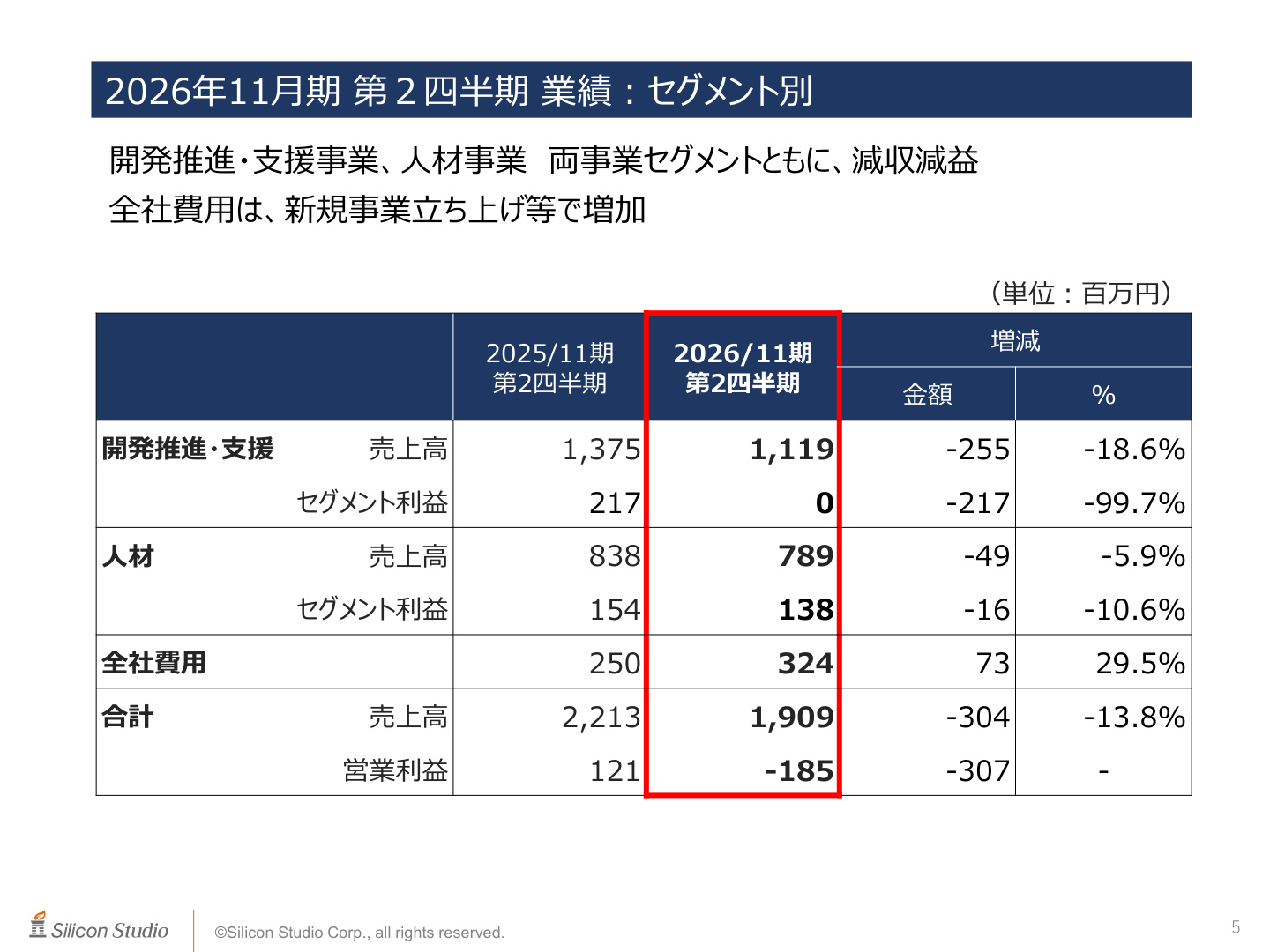
For the second quarter of FY2026, cumulative revenue stood at 1,909 million JPY, marking a 13.8% decrease year-over-year. In terms of profitability, the company reported an operating loss of △185 million JPY (compared to a profit of 121 million JPY in the prior year) and a net loss of △220 million JPY (compared to a profit of 178 million JPY in the prior year), indicating a substantial shift to unprofitability. The primary reasons for this performance deterioration include the impact of rising prices on personal consumption , uncertain international conditions , and particularly the deterioration of the domestic game industry market since 2024 , which significantly affected both the Development Support & Solutions and Talent segments.
This table clearly illustrates the significant deterioration in cumulative performance for Q2 FY2026 compared to the prior year. Notably, revenue decreased by 304 million JPY, and both operating and ordinary income shifted from profit to loss, with a substantial net loss recorded. The fact that the decrease in cost of sales was smaller than the decrease in revenue, leading to a worsened gross profit margin, combined with a 98 million JPY increase in selling, general, and administrative expenses, are identified as key factors contributing to the expanded operating loss. This challenging performance stems from issues within each segment, as detailed below.
Detailed Analysis of Segment Performance
Development Support & Solutions Business
The Development Support & Solutions business recorded revenue of 1,119 million JPY (down 18.6% year-over-year), with segment profit almost disappearing at 0 million JPY (down 99.7% year-over-year). The significant decline in revenue and profit is attributed to the following factors:
- Commissioned Development : While major projects concluded, the acquisition of new projects to compensate for them was delayed. Furthermore, the inability to recognize revenue for a 3DCG video production project during the current interim period, coupled with the loss of new order opportunities due to resource delays, led to the recognition of a 79 million JPY allowance for doubtful accounts in cost of sales, contributing to a 21.0% decrease in revenue.
- Online Solutions : Revenue decreased by 39.1% due to the termination of services for a major long-standing client, recognized as a long-term structural contraction.
- Middleware : Licensing revenue remained robust, with sales increasing by 4.4% year-over-year to 312 million JPY.
Talent Business
The Talent business reported revenue of 789 million JPY (down 5.9% year-over-year) and segment profit of 138 million JPY (down 10.6% year-over-year). Key performance indicators (KPIs) show the following trends:
- Paid Placement Contracts : 122 individuals (down 13.5% year-over-year)
- Dispatched Personnel : 1,102 individuals (down 5.7% year-over-year)
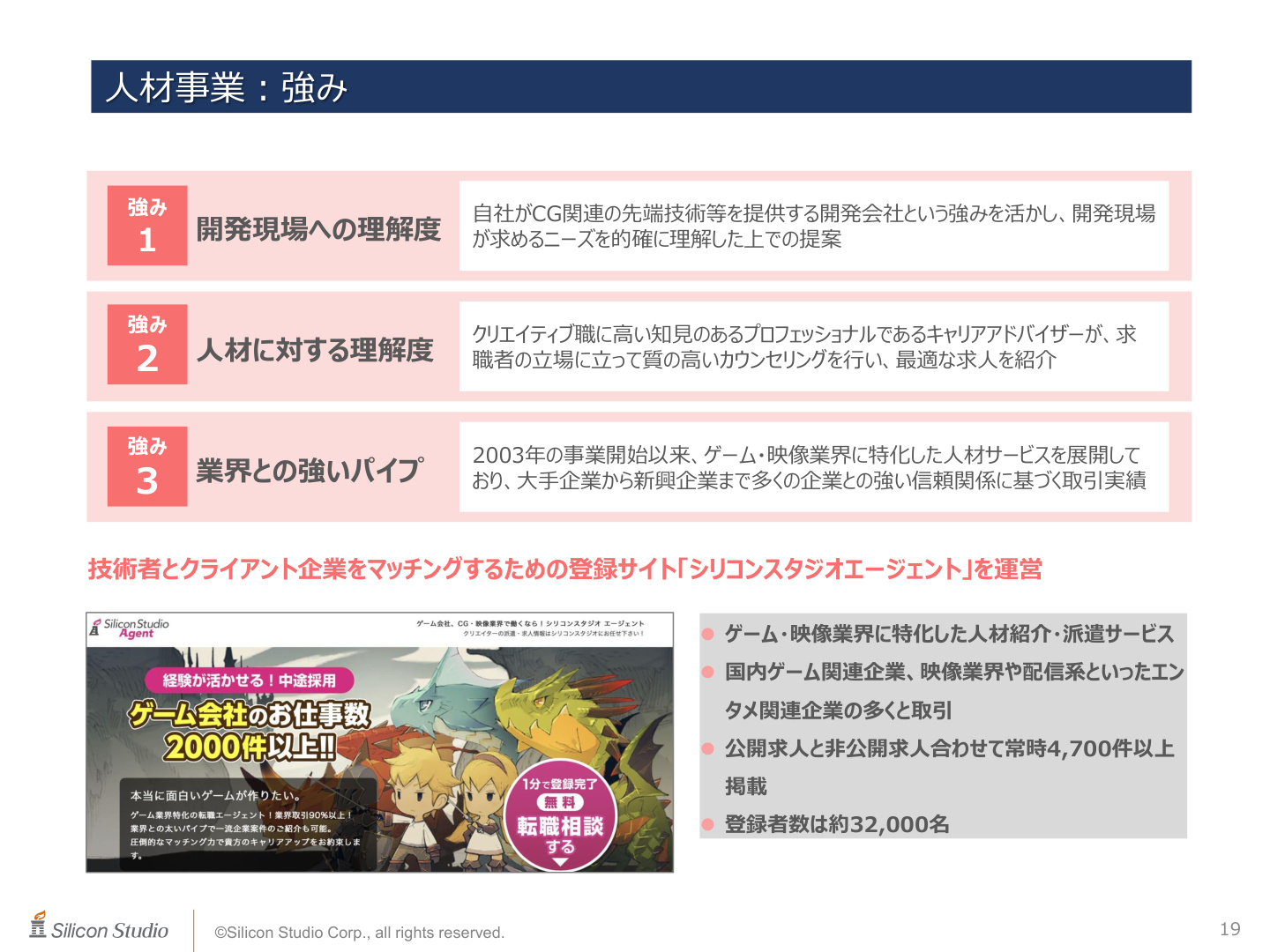
Despite efforts to expand sales targets from traditional major game industry clients to include streaming entertainment and small-to-medium studios, the market environment remains challenging. A significant issue is the mismatch between client demand for mid-to-high-class talent and job seekers primarily in the junior class , which is contributing to the difficulties faced by this segment.
Financial Position and Cash Flow
As of the end of May 2026, the equity ratio decreased by 3.8 percentage points from the previous fiscal year-end to 62.4% . Cash and cash equivalents also decreased by 407 million JPY from the previous period-end to 1,177 million JPY .
Looking at cash flow, cash flow from operating activities turned negative at △253 million JPY, from a positive 183 million JPY in the prior year. Cash flow from investing activities was also negative at △64 million JPY, and cash flow from financing activities was △89 million JPY. Consequently, the net change in cash and cash equivalents recorded a significant decrease of △407 million JPY. This indicates a stagnation in core business revenue generation and a reduction in cash and deposits.
Quarterly Trends of Key Businesses and Strategic Transformation
Quarterly Performance Trends and High-Value-Added Initiatives in Development Support & Solutions
This graph illustrates the quarterly trends in revenue and segment profit for the Development Support & Solutions business. While performance remained relatively stable until Q3 FY2025, a significant decline in revenue and a substantial deterioration in segment profit are clearly observable from Q4 FY2025 onwards, particularly in Q1 and Q2 FY2026. This suggests that factors such as the completion of major commissioned development projects and the structural contraction of online solutions have strongly impacted recent performance. Against this challenging backdrop, a strategic shift towards higher-value-added projects and expansion into the Physical AI domain has become essential for this business segment.
Transformation into a Physical AI Enablement Company
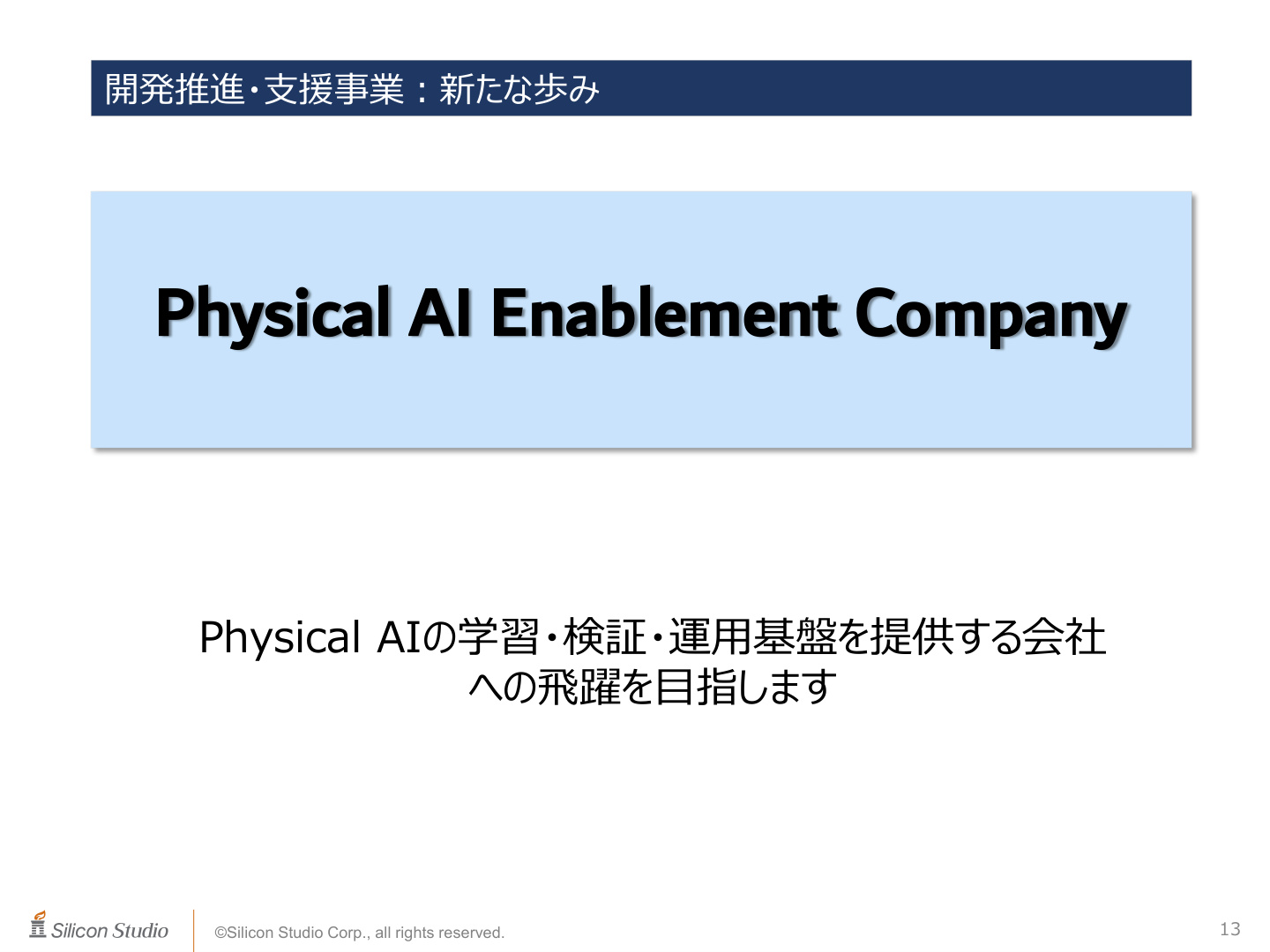
The company aims to leverage its long-cultivated real-time CG technology and digital twin construction expertise to become a "Physical AI Enablement Company" that provides platforms for Physical AI learning, verification, and operation.
- Market Trends : With the proliferation of hardware including GPUs, demand for computer-based learning, verification, and operational environments is expanding. Particularly, "Sim2Real," a reinforcement learning environment in virtual space, is indispensable for Physical AI development, and there are few domestic players specializing in Sim2Real platforms.
- Strategy : The company's strategy is to provide Sim2Real AI solutions necessary for AI learning and expand its customer base through partnerships with GPU workstation providers. Key target markets include manufacturing management, defense, disaster prevention, and space , aiming to horizontally deploy technology cultivated in the entertainment industry to industrial sectors.
Specific Growth Strategies for Development Support & Solutions
- Acquisition of High-Value-Added Projects Leveraging Technology : Strengthen investment in a specialized Physical AI team and verification development environment to secure high-value projects.
- Proactive Utilization of Alliances : Strengthen collaborations with sales and development partners to expand coverage in industrial and defense sector projects. Promote business alliances for specific industries and recruit specialist talent in the defense sector.
- Middleware Rebranding : Promote new initiatives and service developments through further penetration of Bone Dynamics and enhancement of YEBIS4/Enlighten functionalities.
- Enhanced Marketing for Project Acquisition : Apply data-driven project acquisition methods by revamping the company website, implementing analysis-based measures, and strengthening column content.
- Mid-to-Long-Term Product and Service Development : Develop new cloud-native online businesses (utilizing new graphics technology) to build a sustainable revenue base.
Quarterly Performance Trends and Service Improvement Initiatives in the Talent Business
This graph illustrates the quarterly trends in revenue and segment profit for the Talent business. It can be observed that both revenue and segment profit have been on a declining trend since peaking in Q2 FY2025. Particularly in Q1 and Q2 FY2026, revenue fell below the prior year's levels, and segment profit remained low. This indicates that challenges such as a decline in hiring enthusiasm from game companies and a mismatch between clients and job seekers have become apparent. In response to this situation, the company is strengthening its efforts to approach the streaming entertainment industry and other sectors and improve service levels to enhance satisfaction for both client companies and job seekers.
Growth Strategies and Shift to Stock-Type Business in the Talent Business
- Deepening Mid-to-High-Class Placements : Grow paid placement services and increase the number of dispatched personnel through enhanced sales efforts to drive business growth.
- Cultivating New Demand : Develop new demand through flexible strategies focusing on consumer behavior in online spaces, such as VTuber-related, streaming companies, and anime industries.
- Transition to a Stock-Type Talent Business : Aim to build a stock-type revenue model by matching mid-to-high-class talent, who are difficult to attract through traditional dispatch employment, as freelancers. This strategy seeks to align clients' needs for "mid-to-high-class talent" with job seekers' desires to "work as freelancers," thereby creating a new market.
FY2026 Full-Year Earnings Forecast and Future Outlook
The full-year earnings forecast for FY2026 projects revenue of 4,231 million JPY (down 1.7% year-over-year), an operating loss of △200 million JPY, an ordinary loss of △198 million JPY, and a net loss of △228 million JPY. This forecast significantly falls short of the initial plan and anticipates an operating loss .
Based on this earnings forecast, the annual dividend is projected to be 0 JPY (no dividend) .
This downward revision is a result of accounting for the 79 million JPY allowance for doubtful accounts related to a 3DCG video production project in the Development Support & Solutions business as cost of sales, along with considering subsequent changes in the business environment and project progress.
Conclusion
Silicon Studio experienced a significant deterioration in performance in Q2 FY2026, facing a challenging business environment and issues within its existing businesses. However, in response to these challenges, the company has articulated clear growth strategies: a strategic shift towards the Physical AI domain in the Development Support & Solutions business and the establishment of a stock-type business model through freelance placement of mid-to-high-class talent in the Talent business . The execution and progress of these strategies will be closely watched to see how they contribute to future performance. While short-term performance remains challenging, the company's commitment to mid-to-long-term business structural reform and new market development holds potential as future growth drivers.
This content is not intended as investment advice or a recommendation. Any opinions expressed are solely the personal views of each article.