


Japan Prologis REIT (3283) 27th Period Earnings Deep Dive Report: Accelerating DPU Growth Driven by Improved Market Conditions and Strategic Initiatives

StockClub
Published: Jul 17, 2026, 09:52 AM
Sentiment Analysis
Japan Prologis REIT (Securities Code: 3283) reported robust performance in the 27th period (May 2026), achieving the largest rent revision rate since its listing. Amidst a significantly improving supply-demand balance in the logistics real estate market, the REIT has outlined a strategy to pursue further DPU growth through strategic initiatives.
Overview of 27th Period Earnings and Key KPIs
The 27th period earnings report highlighted solid performance across key financial indicators. DPU (Distributions Per Unit) stood at 1,928 yen , with a high average occupancy rate of 98.0% maintained throughout the period. Net Operating Income (NOI) was 24,351 million yen, and the appraised LTV (Loan-to-Value) was 28.5%, indicating a stable financial foundation. A particularly noteworthy achievement is the average rent revision rate of +7.0% , signaling a significant acceleration in rent growth.
The performance overview is as follows:
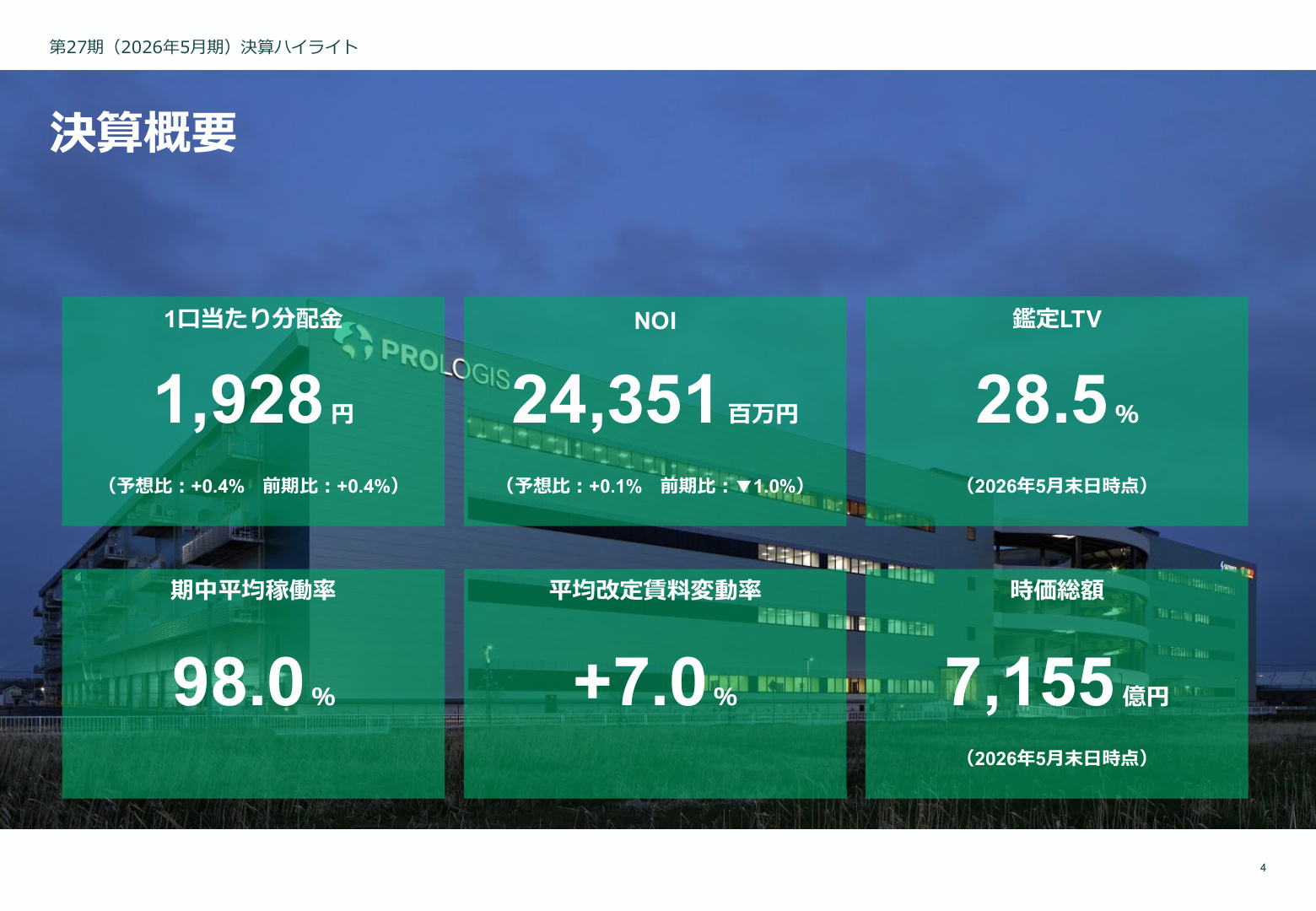 This earnings summary slide is crucial for investors as it provides an immediate grasp of the 27th period's key financial metrics. In addition to fundamental health indicators like DPU, NOI, occupancy, and LTV, the achievement of a high average rent revision rate of +7.0% stands out as a positive factor directly contributing to the portfolio's enhanced profitability.
Significant Acceleration in Rent Revision Rate and Maintenance of High Occupancy
The REIT achieved an average rent revision rate of +7.0% in the 27th period, the highest since its listing. This was driven by proactive rent negotiations and an improving supply-demand balance in the logistics real estate markets, particularly in the Greater Tokyo and Kinki regions. Compared to previous rent revision rates which ranged from +3.7% to +4.9%, +4.2%, and +3.8%, the current +7.0% suggests a notable acceleration in rent growth. Furthermore, the period-average occupancy rate remained exceptionally high at 98.0% , underscoring the strong market demand for the REIT's logistics facilities and their high valuation. Maintaining a high occupancy rate secures a favorable position in rent negotiations and forms a foundation for further rent increases.
Steady Internal Growth Outlook for NOI and DPU
NOI for the 27th period was 24,351 million yen, slightly exceeding expectations. For future periods, steady internal growth is projected, with NOI forecasted at 24,633 million yen for the 28th period (November 2026) and 24,690 million yen for the 29th period (May 2027). DPU is also expected to continue its upward trend, with a forecast of 1,938 yen for the 28th period and 1,940 yen for the 29th period , building on the 27th period's actual DPU of 1,928 yen. This DPU growth is planned to be achieved primarily through increased NOI, effective debt cost control, and the continued utilization of excess profit distributions.
Improvement in Logistics Real Estate Market Supply-Demand and Impact of Soaring Construction Costs
The supply-demand balance in the Greater Tokyo and Kinki logistics real estate markets has bottomed out, transitioning into an accelerated rent increase phase. New supply is expected to be limited from 2027 onwards, which is contributing to lower vacancy rates and upward pressure on rents across the market. Moreover, soaring construction costs are significantly curbing new supply , leading to a relative increase in the value of existing high-quality logistics facilities. This market environment, where new development is challenging, is advantageous for the REIT, which holds a portfolio of prime existing assets.
Improved Outlook for Vacancy Rates and Market Rents
The improvement in market conditions is reflected in concrete figures. The vacancy rate in the Greater Tokyo area is projected to decline from 8.9% in Q1 2026 to 6.3% by Q4 2027. Similarly, the Kinki area's vacancy rate is forecast to decrease from 2.3% to 1.4%. This improvement in vacancy rates and the limited new supply outlook are expected to further accelerate the pace of market rent increases. Market rents for the REIT's portfolio are projected to increase annually by +1.8% in 2026, +2.3% in 2027, and +2.1% in 2028, with an average growth rate of +0.8% anticipated.
The market improvement is detailed in the following slide:
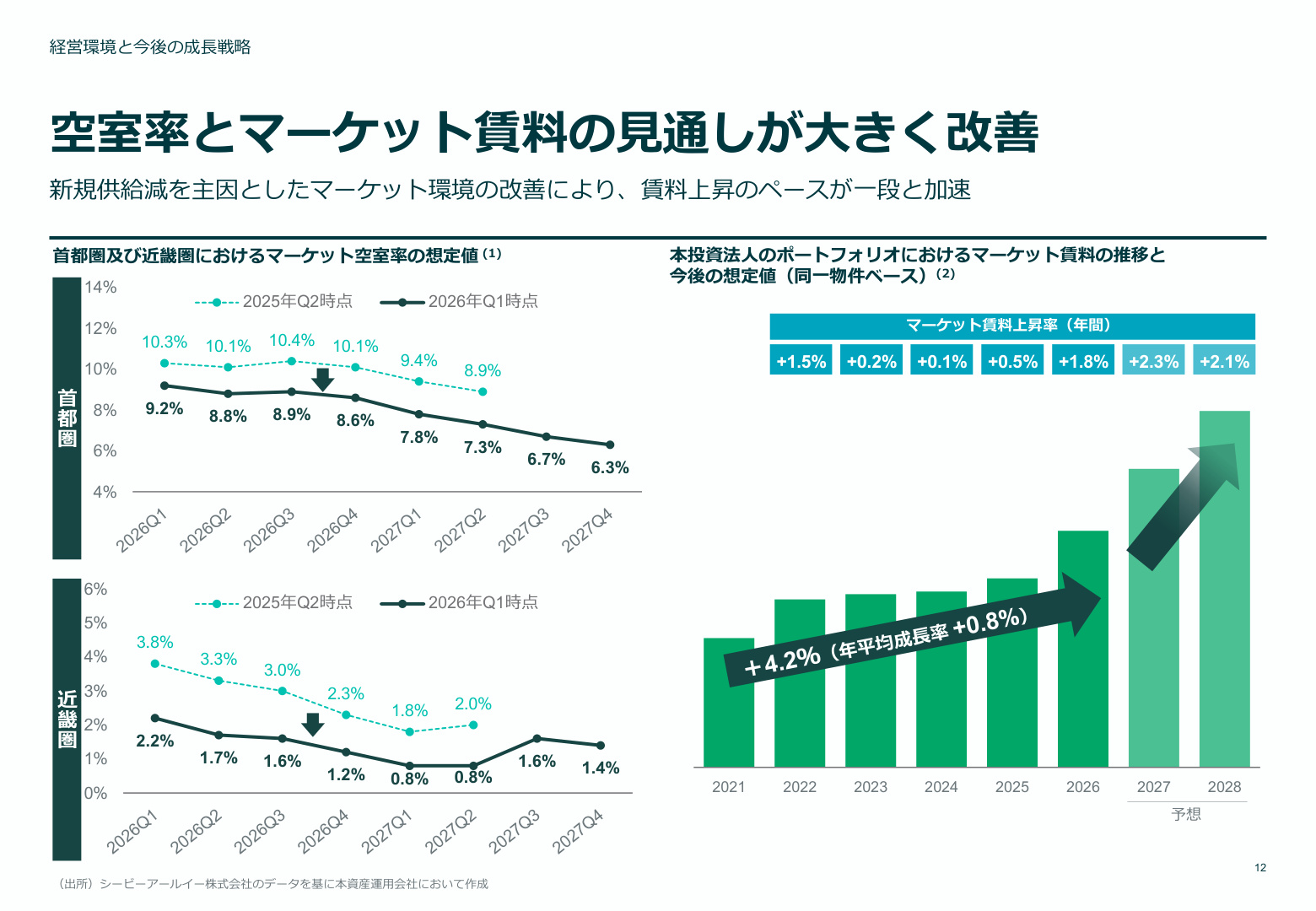 This slide clearly illustrates the trends in vacancy rates for the Greater Tokyo and Kinki regions, along with the future outlook for market rents within the REIT's portfolio. The consistent decline in vacancy rates and the projected increase in market rents are particularly important, as they serve as powerful drivers for future internal growth.
Expanding Rent Gap and Future Rent Upside
The acceleration of market rent increases has led to an expansion of the rent growth potential within the REIT's portfolio. A rent gap of approximately 4-5% exists between current rents and market rents, and a further gap of about 20% is observed between market rents and reconstruction costs. This rent gap signifies a substantial potential to raise current rents to market levels during future rent revisions or new contract signings. The presence of this gap is a key factor contributing to future increases in rental income.
Three Growth Strategies: Internal Growth, Capital Policy, and External Growth
To achieve sustainable growth, the REIT is pursuing three core strategies: "Internal Growth," "Capital Policy (Financial Strategy)," and "External Growth (Asset Replacement)."
- Internal Growth: The REIT aims to maintain an occupancy rate exceeding 98% while capitalizing on the improving supply-demand balance to accelerate rent growth. Specifically, it promotes the introduction of CPI-linked clauses and shorter lease terms to increase the frequency of rent adjustments.
- Capital Policy (Financial Strategy): This pillar emphasizes continued acquisition of own investment units when appropriate, optimization of the payout ratio, and robust debt cost control through flexible loan term settings and the introduction of variable interest rates.
- External Growth (Asset Replacement): Through asset replacement, the REIT seeks to build a resilient portfolio with long-term growth potential. This involves selling properties with limited growth potential or inherent risks and reinvesting the proceeds into initiatives that contribute to DPU growth (e.g., own investment unit acquisition, asset replacement). The strategy also includes exploring disciplined external growth opportunities, aiming for over 1% of portfolio replacement annually.
Inflation-Resistant Portfolio Construction and Strategic Leasing
As part of its internal growth strategy, the REIT is advancing the construction of an inflation-resistant portfolio. For lease contracts exceeding three years, rent revision clauses are, in principle, being introduced to secure frequent rent increases. Among lease contracts signed in the 27th period, 46% of those exceeding three years included rent revision clauses , and across all lease contracts, 37% of those with remaining terms over three years have such clauses. This is a crucial measure to ensure stable growth in rental income even in periods of rising interest rates or inflation. Strategic leasing activities, responsive to the supply-demand environment, have also yielded positive results. For instance, in the Kansai area, a new contract for approximately 7,500 tsubo achieved a rent increase of +9.1% and included a CPI-linked clause. In the Ken-O-Do area, an expansion of approximately 9,000 tsubo resulted in a rent increase of +4.5% , demonstrating successful rent increases and occupancy maintenance even for individual properties.
Strong Financial Foundation and DPU Growth Roadmap
The REIT has established a superior financial foundation compared to other J-REITs. Its fixed interest rate ratio stands at 93.2% (compared to the J-REIT average of 80.3%), and its average remaining loan term is 8.5 years (compared to the J-REIT average of 3.6 years), ensuring long-term and stable financing. This enables robust debt cost control even in a rising interest rate environment. Leveraging this strong financial base, the REIT has presented a roadmap targeting a cruising DPU of 1,900 yen for the 30th period. To achieve this goal, various factors are expected to contribute: internal growth (over +2.0%), debt cost increase (approximately ▼2.0%), capital allocation (over +1.5%), and payout ratio optimization (approximately +1.5%). The strategy clearly outlines how internal growth and capital policies will offset rising debt costs, aiming for additional growth.
The roadmap towards achieving the cruising DPU growth target is as follows:
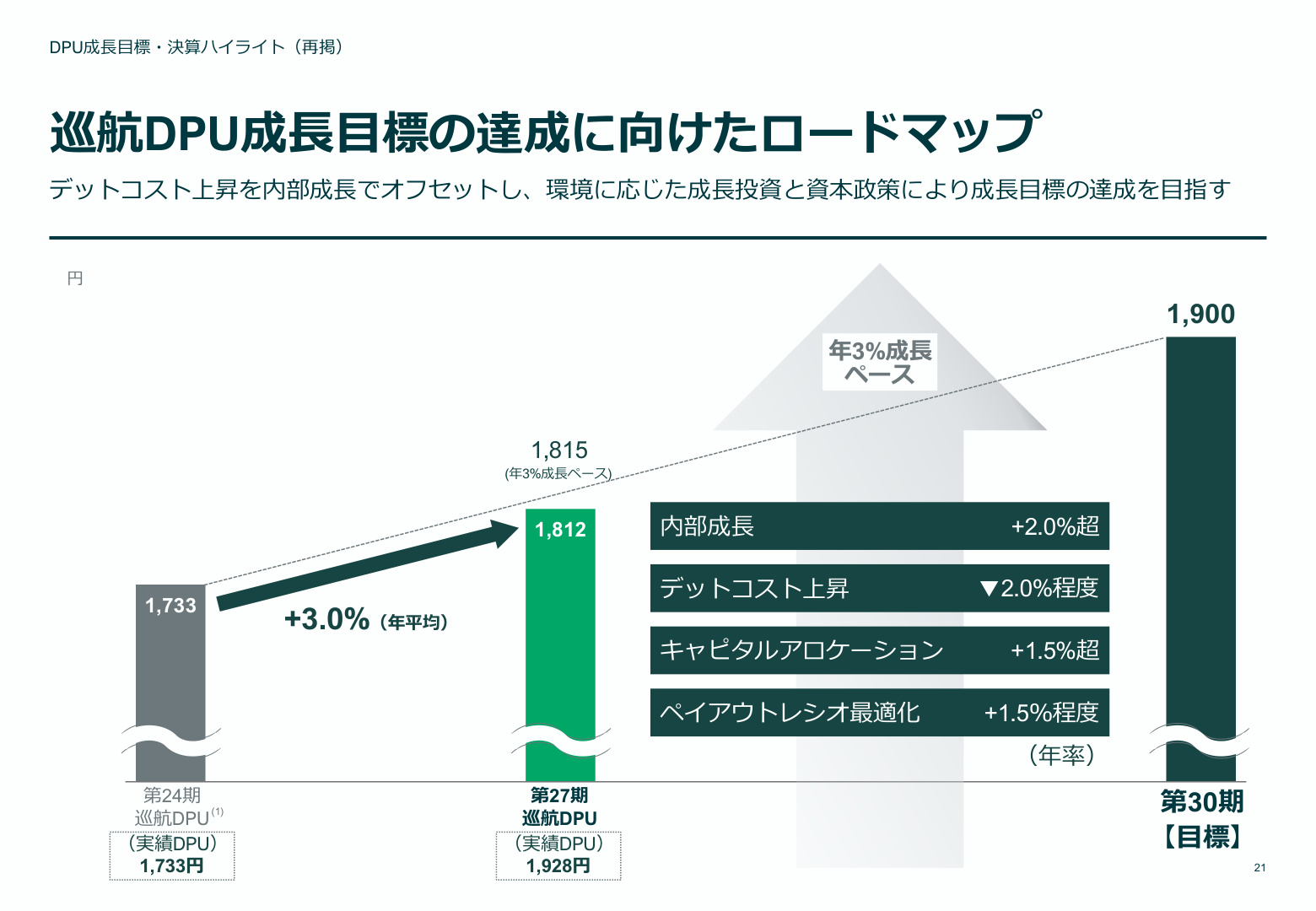 This roadmap is a critical guide illustrating how the REIT plans to achieve its future DPU growth. By breaking down the path to target achievement into specific components such as internal growth, debt cost control, capital allocation, and payout ratio optimization , investors can gain a deep understanding of the concrete nature and feasibility of the REIT's growth strategy.
Conclusion
Japan Prologis REIT delivered strong performance in the 27th period, accelerating rent growth against the backdrop of an improving market environment. The achievement of a significant increase in rent revision rates while maintaining a high occupancy rate demonstrates the high quality of its portfolio and the effectiveness of its operational strategy. Moving forward, in a tightening logistics real estate market, the REIT aims for sustainable DPU growth by pursuing an internal growth strategy that capitalizes on the expanding rent gap, robust debt cost control leveraging its strong financial foundation, and a disciplined asset replacement strategy for external growth. With a clear roadmap towards a cruising DPU target of 1,900 yen in the 30th period, the REIT's future trajectory warrants close attention.
This content is not intended as investment advice or a recommendation. Any opinions expressed are solely the personal views of each article.