


Enex Infrastructure Investment Corporation (9286) Deep Dive Report on 2026 May Period Financial Results and Medium-to-Long Term Management Policy

StockClub
Published: Jul 16, 2026, 11:18 AM
Sentiment Analysis
Enex Infrastructure Investment Corporation (Securities Code: 9286) is an investment corporation that aims to contribute to the realization of a sustainable society through investments in renewable energy power generation facilities. This report provides a detailed analysis of the financial results for the 2026 May period, future earnings forecasts, and the progress of its medium-to-long term management policy, based on the attached materials.
2026 May Period Financial Highlights
For the 2026 May period, net income reached 1,114 million yen , exceeding the initial forecast of 1,046 million yen by 67 million yen . The primary factors contributing to this outperformance include the recognition of gain on disposal of assets related to the acquisition of land for Takasaki A and B solar power plants, an upside in insurance claims due to power conditioner damage at Takasaki, and the deferral of repair costs at Matsusaka to the next period. While operating revenue fell short of the forecast, improvements in operating expenses and non-operating income led to net income surpassing expectations.
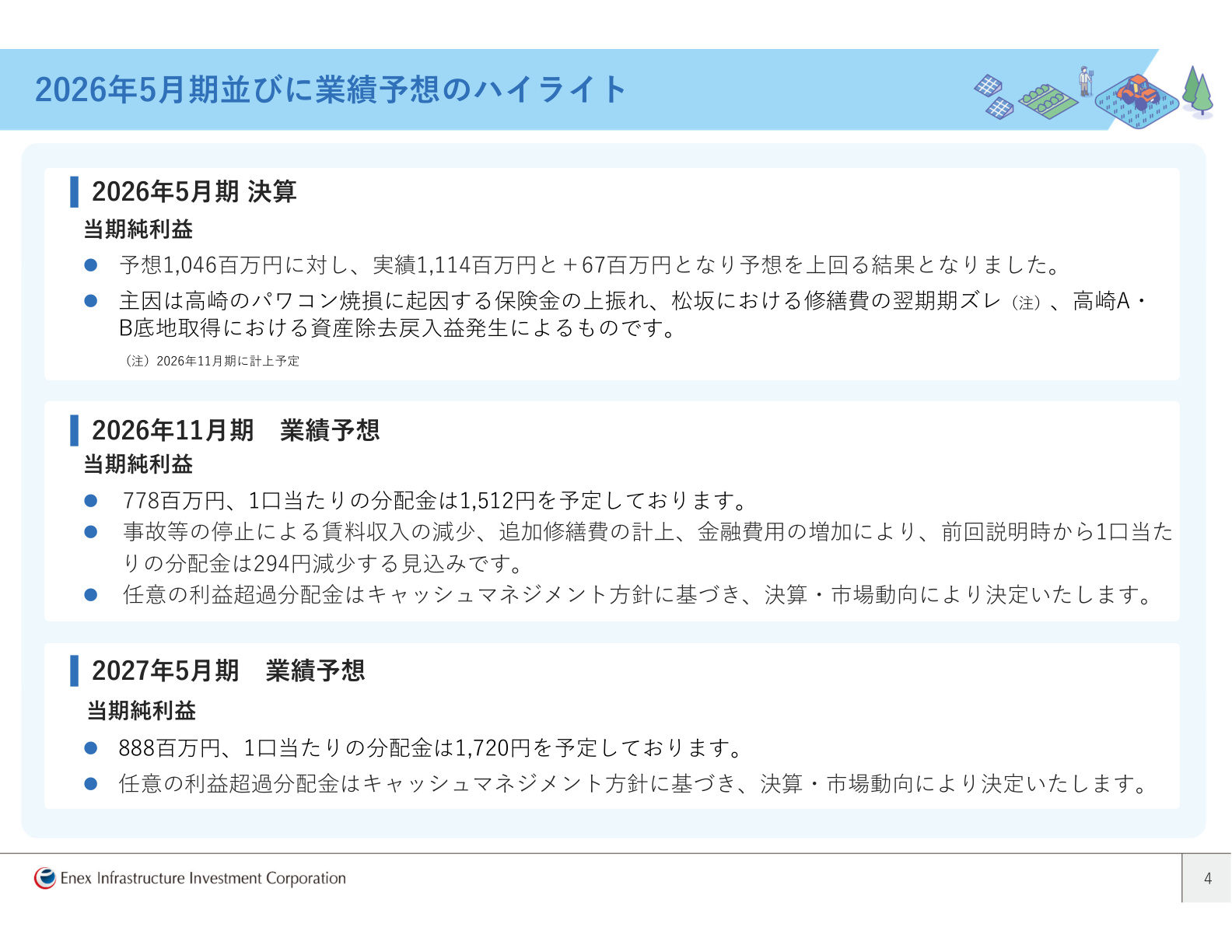
This slide concisely summarizes the financial results for the 2026 May period and the earnings forecasts for the upcoming 2026 November and 2027 May periods. It is crucial for understanding the investment corporation's short-term financial status and future outlook at a glance. Specifically, it highlights the reasons for net income exceeding the forecast and provides concrete figures for future distribution forecasts, serving as fundamental information for investment decisions.
Power Generation Performance and Portfolio Analysis
The total power generation for the 2026 May period was 136,980 MWh , achieving 93% of the planned 146,801 MWh . Key reasons for the shortfall include output curtailment (4,107 MWh) , equipment failures (4,334 MWh) , and system outages (995 MWh) . Specifically, power generation at Kamata Solar Power Plant, Monbetsu Solar Power Plant, and Tainai Wind Power Plant, among others, fell below plan. The portfolio consists of 12 assets with a total installed capacity of 243.4 MW , and a total acquisition price of 103.9 billion yen. In terms of regional composition, the Kanto and Chubu regions collectively account for 90% of the portfolio, indicating a concentration in areas with high electricity demand in Japan. According to 2022 regional electricity demand data, the Kanto region had 247 TWh and the Chubu region had 155 TWh, demonstrating higher demand compared to other regions. This regional concentration is considered a significant factor in building a stable revenue base.
Progress of Medium-to-Long Term Management Policy
The investment corporation aims to maximize business value (market capitalization) and achieve a NAV multiple of 1.0x or higher. In external growth , initiatives such as incorporating FIP assets, third-party development projects, and steadily integrating sponsor pipelines are mentioned, but no specific progress has been reported yet. For internal growth , the corporation is currently selecting a buyer for environmental value in preparation for the transition to FIP. On March 31, 2026, it acquired the land for Takasaki Solar Power Plants A and B . This measure eliminates the need for land lease payments, thereby improving profitability. Regarding financial strategy , the corporation has acquired a cumulative total of 29,638 investment units (cancelled) , which contributes to enhancing investment unit value. Additionally, refinancing was executed on March 31, 2026.
Financial Health and Key Indicators
Key indicators of the investment corporation's financial health are as follows: The credit rating is "A (JCR)" with a "Stable" outlook . This indicates a stable business foundation and financial condition. Total borrowings amount to 51.6 billion yen , with 13 financial institutions providing diverse funding sources. The average fixed-rate ratio is high at 95% , mitigating interest rate fluctuation risk. The LTV (Loan To Value) is 53% (as of May 2026) , which is a typical level for an infrastructure fund.
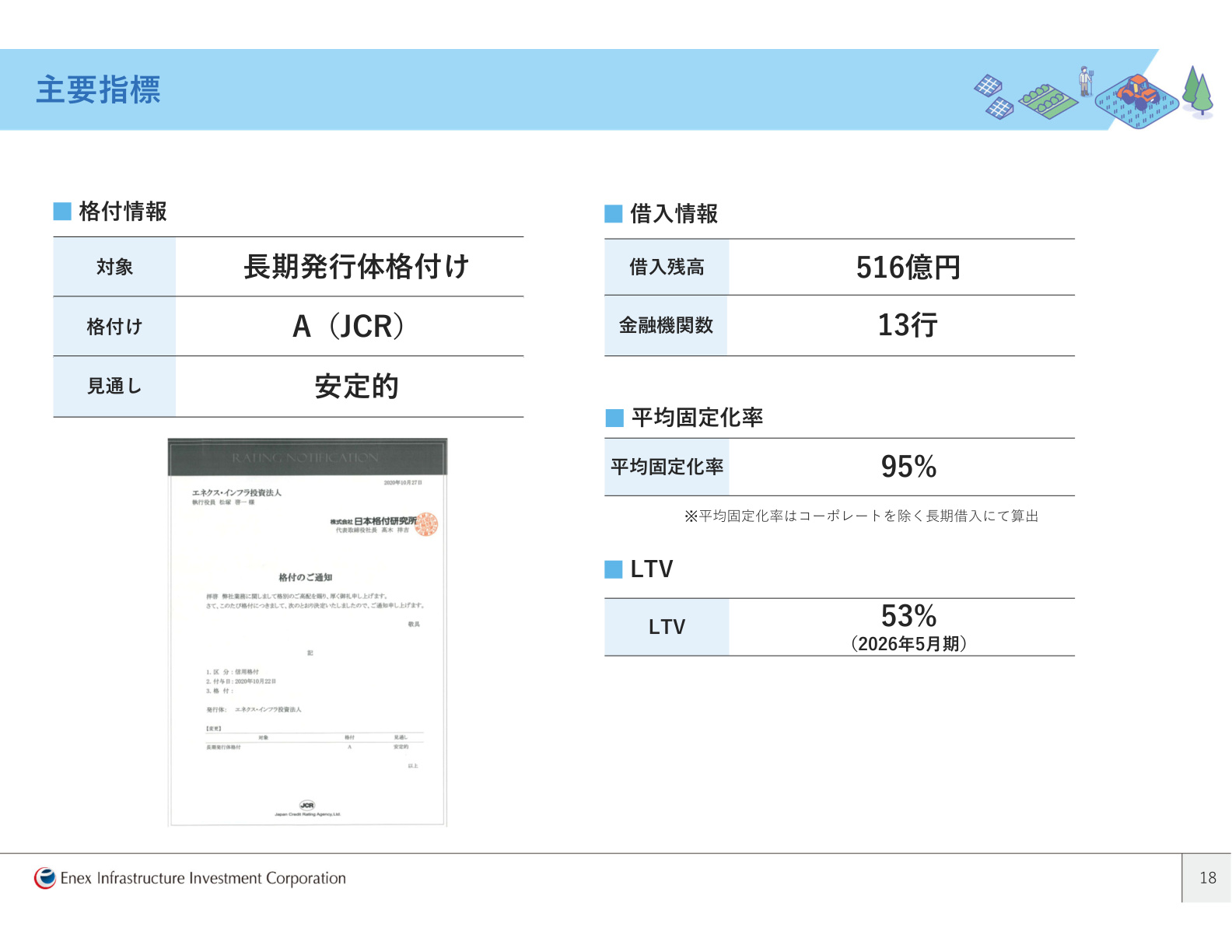
This slide presents a comprehensive overview of the key indicators demonstrating the investment corporation's financial stability, making it an indispensable resource for investors evaluating risk and return. Specifically, the "A (Stable)" credit rating suggests a favorable position in fundraising and financial credibility, while the LTV clearly illustrates the financial leverage. These indicators are crucial for assessing the investment corporation's sustainability.
Through the execution of refinancing, a portion of the loan repayment reserve was released and allocated to the acquisition of land for the Takasaki Solar Power Plant. Concurrently, a portion of existing borrowings was repaid , and the remaining principal, previously structured as a balloon-type amortization loan with a lump-sum repayment at the final due date, was restructured to flatten the repayment schedule , enhancing financial flexibility. This strengthens the corporation's readiness for future asset acquisitions and disaster risks.
Future Outlook and Growth Strategy
For the 2026 November period, the earnings forecast projects net income of 778 million yen and a distribution per unit (DPU) of 1,512 yen . The main factors cited are a decrease in rental income due to accident-related suspensions, additional repair costs, and increased financial expenses. For the 2027 May period, a recovery is anticipated, with net income projected at 888 million yen and a DPU of 1,720 yen . From a long-term perspective, the corporation aims to achieve net income of 1.22 billion yen and an EPU of 2,300 yen by the 2030 May period .
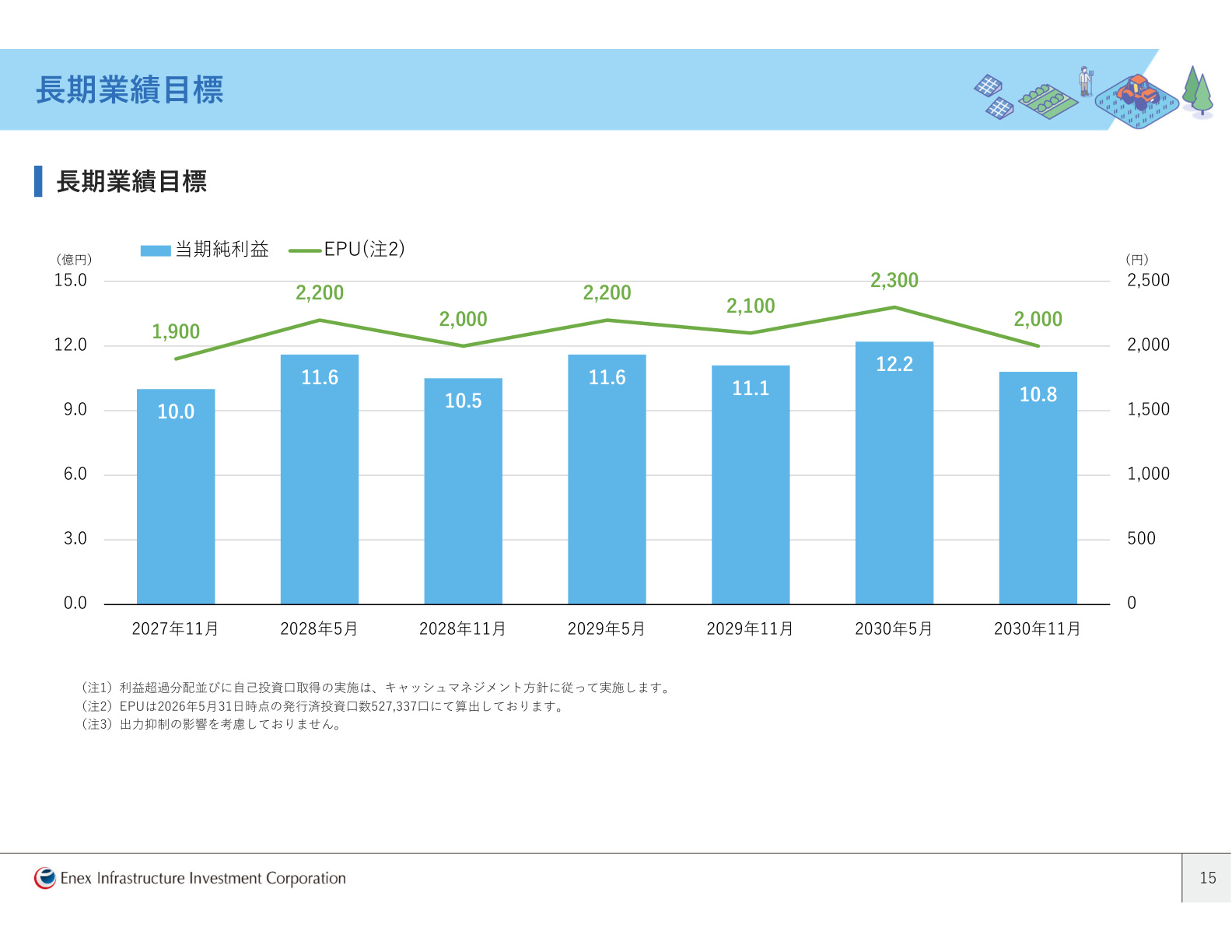
This slide clearly outlines the investment corporation's long-term performance targets, making it extremely important for understanding its future growth trajectory. The visual representation of net income and DPU trends allows for a concrete grasp of the pace at which the investment corporation aims to grow through specific numerical targets. This information is essential for evaluating the investment corporation's capacity for sustained value creation.
A key pillar of the growth strategy is revenue structure flexibility . The investment corporation's rent scheme adopts a mechanism where rent fluctuates based on power generation. Notably, if power generation exceeds expectations, the excess is retained as a reserve, contributing to stable future distributions . This is an innovative approach to manage the inherent power generation fluctuation risks of renewable energy projects while securing upside potential. Furthermore, the comprehensive support system provided by the sponsor group, primarily Itochu Enex Co., Ltd. , is a significant strength. Itochu Enex has established a business model that covers everything from power source development to supply-demand management and sales, forming a foundation for the stable operation of the investment corporation.
Conclusion
Enex Infrastructure Investment Corporation demonstrated solid operational performance in the 2026 May period, achieving net income that exceeded forecasts. While some output curtailment and equipment failures were observed at certain power plants, the corporation is steadily advancing internal growth strategies such as executing refinancing and acquiring land, thereby strengthening its financial foundation. From a medium-to-long term perspective, the corporation aims for stable distributions and EPU growth, underpinned by a regionally concentrated portfolio, a flexible rent scheme, and strong sponsor support, indicating a commitment to continuous value creation.
This content is not intended as investment advice or a recommendation. Any opinions expressed are solely the personal views of each article.