


Last One Mile (9252) Q3 FY2026 Earnings Deep Dive Report: Growth Strategy and KPI Progress

StockClub
Published: Jul 16, 2026, 11:16 AM
Sentiment Analysis

Last One Mile Co., Ltd. (Securities Code: 9252) achieved significant growth in both revenue and operating profit in its Q3 FY2026 earnings. The company is building a foundation for sustainable growth through diversified business development and an active M&A strategy. This report provides a detailed analysis of the company's earnings highlights, business strategy, progress on key performance indicators (KPIs), and future outlook.
1. Earnings Highlights and Key Factor Analysis
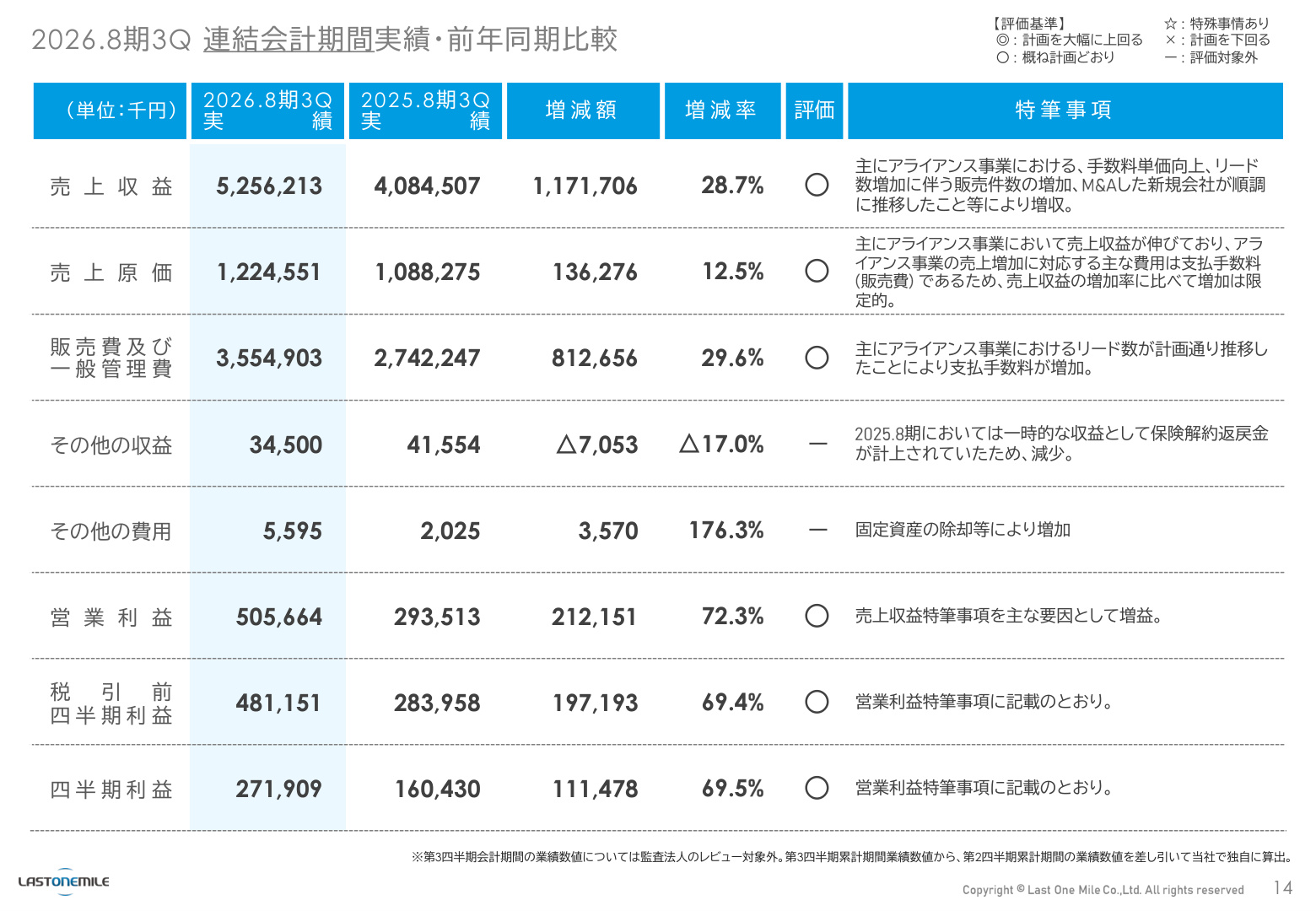
For the cumulative period of Q3 FY2026, consolidated performance showed remarkable growth, with revenue increasing by 29.7% year-on-year and operating profit by 68.4% year-on-year . Notably, EPS (earnings per share) rose by 70.4% year-on-year , clearly indicating an improvement in profitability.
This slide concisely illustrates the year-on-year growth rates of key financial indicators for the cumulative period of Q3 FY2026 . Achieving high growth rates across revenue, operating profit, stock-type revenue, and EPS, with operating profit and EPS significantly outperforming revenue growth, suggests improved profitability and efficient management . The steady increase in stock-type revenue indicates its contribution to building a stable revenue base, which will be discussed further.
A detailed look at the consolidated cumulative performance reveals revenue of 14,911 million yen (up 29.7% year-on-year) and operating profit of 1,681 million yen (up 68.4% year-on-year). The primary drivers for this increase in revenue and profit include improved commission rates and an increase in sales volume due to higher lead numbers in the core Alliance business , as well as the smooth integration of new companies acquired through M&A . Cost of sales increased at a slower rate than revenue, contributing to an improved gross profit margin. Selling, general, and administrative expenses increased by 33.2% year-on-year due to higher commission payments associated with the increased lead numbers in the Alliance business, but the strong growth in operating profit absorbed this, maintaining a high profit growth rate.
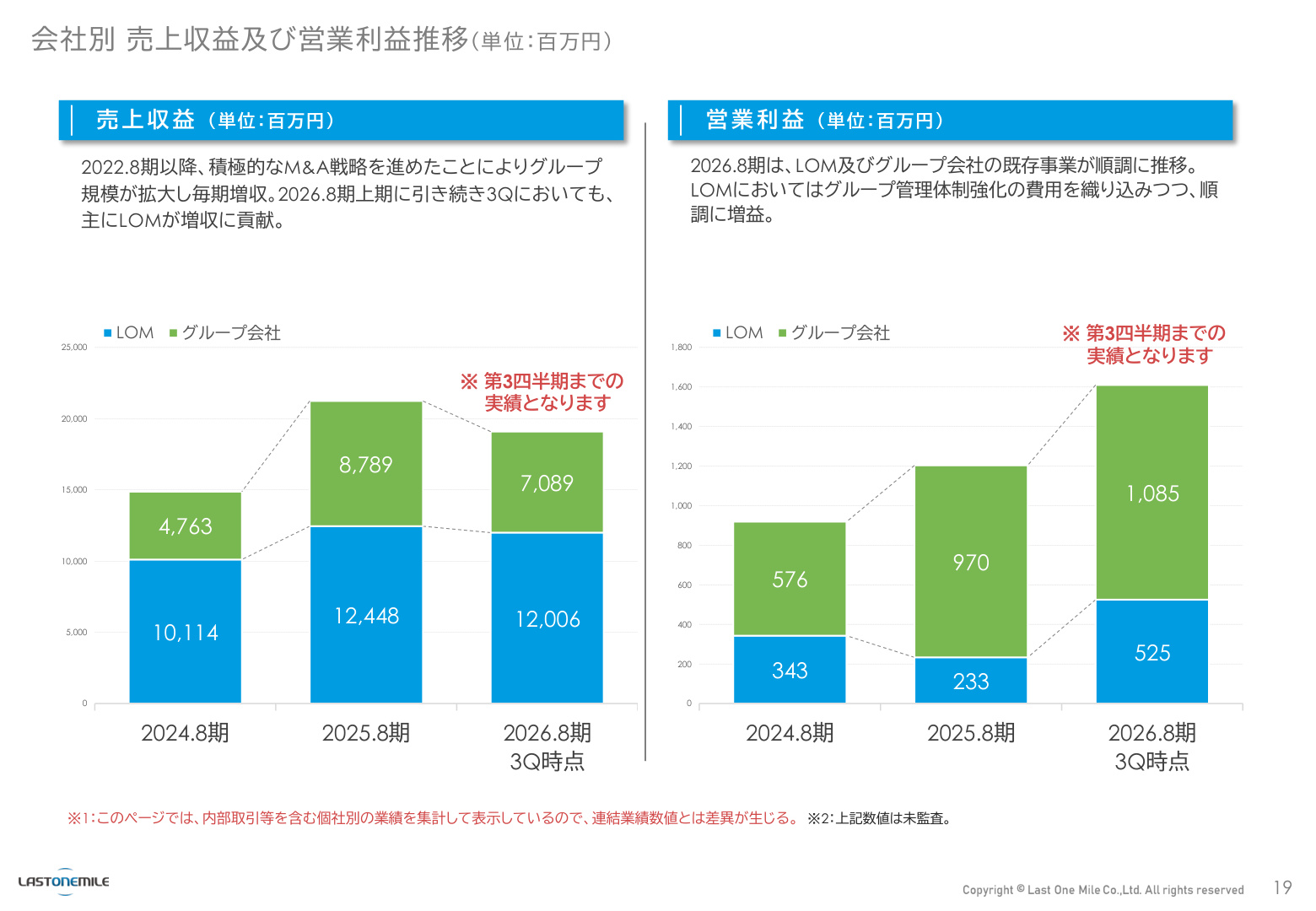
Quarterly trends in revenue and operating profit show consistent growth throughout FY2026. In particular, operating profit has seen a significant improvement since FY2025 , with 506 million yen recorded in Q3 FY2026 alone. This is attributed to increased revenue and the smooth progression of both cost of sales and SG&A expenses as planned.
This slide visually presents the quarterly trends in revenue and operating profit over the past three fiscal years . The revenue graph on the left clearly shows consistent growth in revenue from FY2024 to FY2026, driven by M&A strategies and the expansion of core businesses . Specifically, in FY2026, each quarter recorded higher revenue than the corresponding period in the previous year, indicating sustained growth momentum. The operating profit graph on the right, despite a temporary dip in FY2025, demonstrates a significant recovery and growth in FY2026 . This suggests that in addition to revenue growth, improvements in cost management and operational efficiency have contributed, underscoring a positive trend in profitability . This data is crucial for understanding the company's financial trajectory.
2. Business Model and KPI Progress
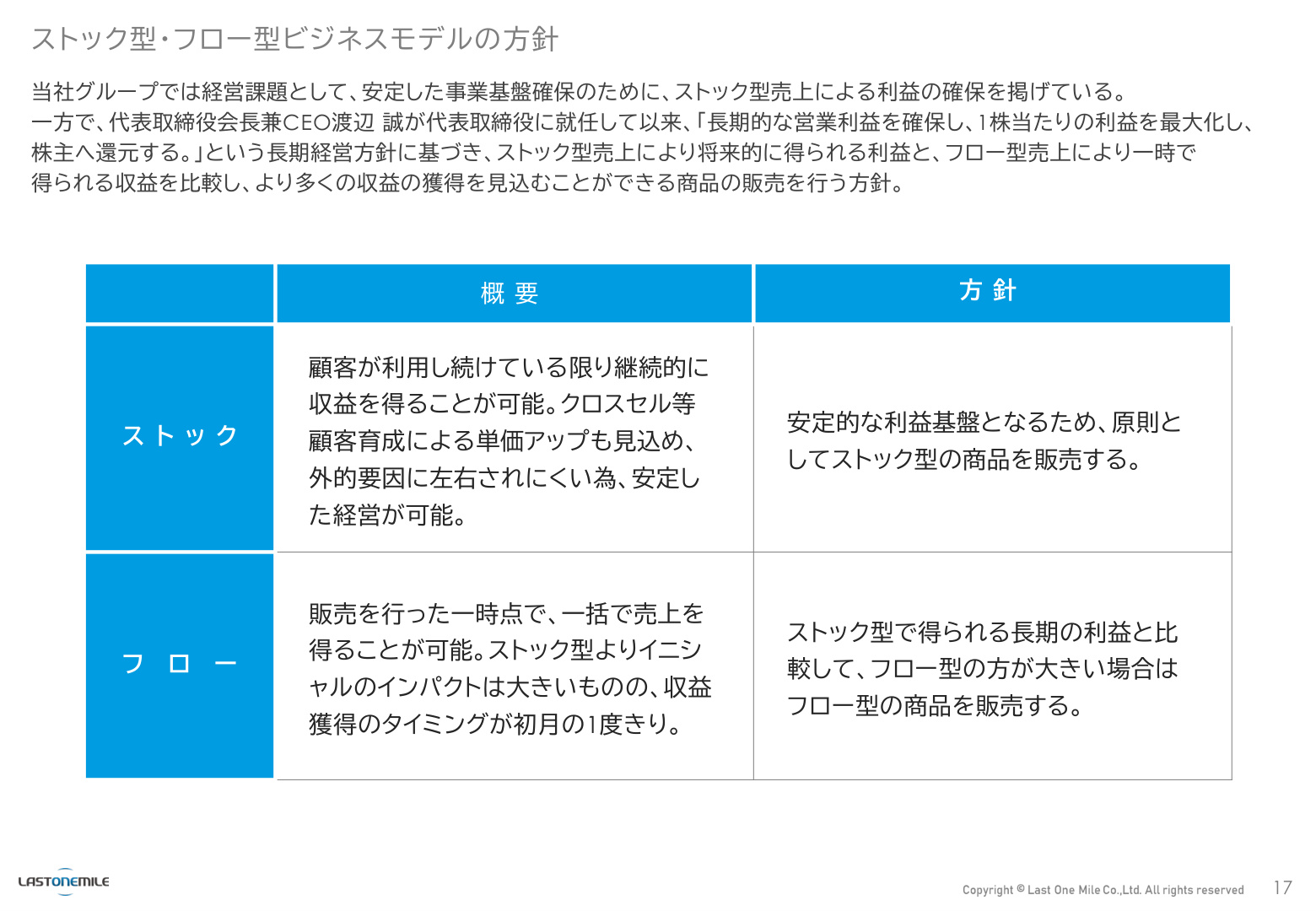
The Last One Mile Group aims to achieve a stable business foundation and maximize growth opportunities by combining both stock-type and flow-type business models . Stock-type revenue is recurring revenue generated from continuous customer service usage, with potential for cross-selling and increased average revenue per user through customer nurturing. This model allows for stable operations less susceptible to external factors. Conversely, flow-type revenue is recognized as a lump sum at the point of sale and is chosen when the initial impact is greater than that of stock-type revenue. The company's policy is to prioritize the sale of stock-type products as a principle for a stable profit base , while also pursuing flow-type products if they offer greater long-term profit compared to stock-type.
Looking at key KPI progress, stock-type revenue (excluding the hotel business) reached 5,625 million yen as of Q3 FY2026, representing a steady increase of 11.5% year-on-year . Growth was particularly strong in internet lines (including free internet services for multi-unit dwellings), electricity, gas, and water server businesses, with M&A contributing to the revenue of group companies. Flow-type revenue significantly increased to 14,319 million yen as of Q3 FY2026, marking a substantial 56.1% year-on-year increase . This was a result of increased leads in the Alliance business, fewer uncertainties regarding fuel price hikes for electricity and internet, and the aggressive acquisition of flow-type businesses through various service partnerships that offer substantial sales commissions.
This slide provides a detailed breakdown of the annual trends in stock-type and flow-type revenues, which are key KPIs excluding the hotel business . The stock-type revenue graph on the left shows that while the internet line business forms a stable foundation , other services such as electricity, gas, and water servers are also growing steadily . The increase in stock-type revenue is critically important for enhancing the company's revenue stability and future predictability . The flow-type revenue graph on the right indicates that services like electricity, gas, and internet contribute significantly , and the substantial growth observed in Q3 FY2026 clearly demonstrates the success of aggressive lead acquisition and sales strategies in the Alliance business . The growth in both these revenue types is understood to be driving the company's overall sales expansion.
The company's core businesses are categorized into six segments: Alliance business, free internet services for multi-unit dwellings, contact center business, hotel business, listing/media business, and other businesses. The strategy is to concentrate management resources on businesses with operating profits of approximately 100 million yen or more, which are deemed capable of generating long-term operating profits.
3. M&A Strategy and Impact of Organizational Restructuring
The Last One Mile Group considers an aggressive M&A strategy a crucial pillar of its growth. In FY2026, in addition to existing companies, Vendor, HS, and SHC became existing companies, and Telvel contributed to performance as a new company. M&A contributes not only to expanding business scale but also to creating synergies across the group, significantly boosting revenue.
The medium-term management policy also explicitly states that M&A will be actively pursued based on the company's established criteria, considering past achievements. This indicates that M&A will continue to be a vital component of the growth strategy.
4. Medium-to-Long Term Management Policy and Growth Strategy
The company's long-term management policy aims for long-term operating profit generation, maximization of earnings per share, and shareholder returns . The medium-term management policy (FY2025.8 – FY2027.8) outlines four key pillars:
- Streamline and strengthen inter-group operations , focusing management resources on expanding core businesses to solidify the business foundation.
- Share operational know-how among group companies to standardize processes and enhance overall group sales capabilities.
- Actively pursue M&A based on the company's established criteria, considering past performance.
- Determine shareholder returns comprehensively , taking into account past investment performance, financial condition, operating results, and cash flow.
For the medium-term revenue and operating profit plan, the company targets revenue of 22,000 million yen and operating profit of 2,208 million yen in FY2027.8. The Alliance business and free internet services for multi-unit dwellings are planned to be the main drivers of revenue. While focusing on stock-type revenue may lead to a deceleration in revenue growth, the company anticipates high profit growth by reducing indirect operational costs through streamlining inter-group operations and unifying systems, thereby suppressing increases in selling, general, and administrative expenses.
The growth strategy summary highlights expansion of existing core businesses and scale expansion through M&A as strategies for "core businesses." Furthermore, businesses with potential operating profits of approximately 100 million yen or more in the future are defined as "new businesses," with a policy to actively pursue entry into new areas through M&A .
5. Shareholder Return Policy
As part of its growth strategy, the company has decided to repurchase its own shares . The target shares are common stock, with an upper limit of 56,000 shares (2.05% of total outstanding shares) and a total acquisition cost limit of 200,000,000 yen. The acquisition period is from July 16, 2026, to December 15, 2026, and will be carried out through market purchases. This share repurchase is positioned as a measure to prepare for future M&A strategies and capital alliances , as well as a form of shareholder return .
Looking at EPS trends, despite an increase in outstanding shares due to M&A, steady profit growth has led to a significant increase in EPS , indicating a focus on enhancing shareholder value.
Conclusion
Last One Mile, in Q3 FY2026, achieved high growth in both revenue and operating profit, driven by the expansion of its core businesses and an aggressive M&A strategy . In particular, strengthening the stock-type business model and efficient cost management contributed to improved profitability. Based on its medium-to-long term management policy, the company continues to emphasize business expansion through M&A, creation of group synergies, and shareholder returns, clearly outlining a strategy aimed at sustainable corporate value enhancement .
This content is not intended as investment advice or a recommendation. Any opinions expressed are solely the personal views of each article.