


FP Partner Q2 FY2026 Earnings Deep Dive Report: Performance Recovery and Growth Strategies

StockClub
Published: Jul 16, 2026, 11:08 AM
Sentiment Analysis
FP Partner announced its Q2 FY2026 earnings, showing a year-over-year decline in some indicators but a recovery trend on a quarterly basis. This report provides a detailed analysis focusing on the company's business model, key KPI trends, changes in revenue structure, and future growth strategies.
1. Business Model and Strengths
FP Partner primarily offers free financial planning consultations nationwide, targeting customers in their 30s and 40s for life and non-life insurance sales, as well as investment trust sales tailored to their life planning needs. The company's strengths lie in its extensive network of 196 locations (160 branches, 36 stores) across all 47 prefectures and its 2,227 sales employees (as of May 2026) . This enables a continuous inflow of customers, leading to a steady increase in retained contracts (1.99 million) and retained customers (740,000 as of November 2025) year after year. The company plays a role in improving financial literacy and supporting asset building for the public. Customer acquisition is achieved through three main routes: corporate partnerships, self-generated leads, and sales employee self-development, with corporate partnerships being a primary source.
2. Q2 FY2026 Earnings Highlights
For the second quarter of FY2026 (cumulative six months), FP Partner reported net sales of 15,599 million yen (down 5.1% year-on-year), operating profit of 1,076 million yen (down 27.1%), ordinary profit of 1,073 million yen (down 27.8%), and net profit attributable to owners of the parent of 703 million yen (down 27.8%). However, looking at the second quarter alone (three months), net sales increased to 7,983 million yen (up 4.8% quarter-on-quarter), operating profit to 675 million yen (up 68.8%), ordinary profit to 676 million yen (up 70.0%), and net profit to 445 million yen (up 72.7%), indicating a significant recovery trend.
The performance trend is shown below:
 This chart clearly illustrates that while the cumulative performance for Q2 FY2026 saw a year-on-year decrease in profits, the recent single quarter (Q2) showed a substantial increase in net sales and all profit metrics compared to the previous quarter. The high growth rates, particularly around 70% for operating, ordinary, and net profits, suggest that the pace of recovery is accelerating. This is crucial data, indicating that the impact of temporary factors is easing, and business activities may be normalizing.
3. Impact on Revenue Structure and KPI Trends
Change in Life Insurance Fee Receipt Method
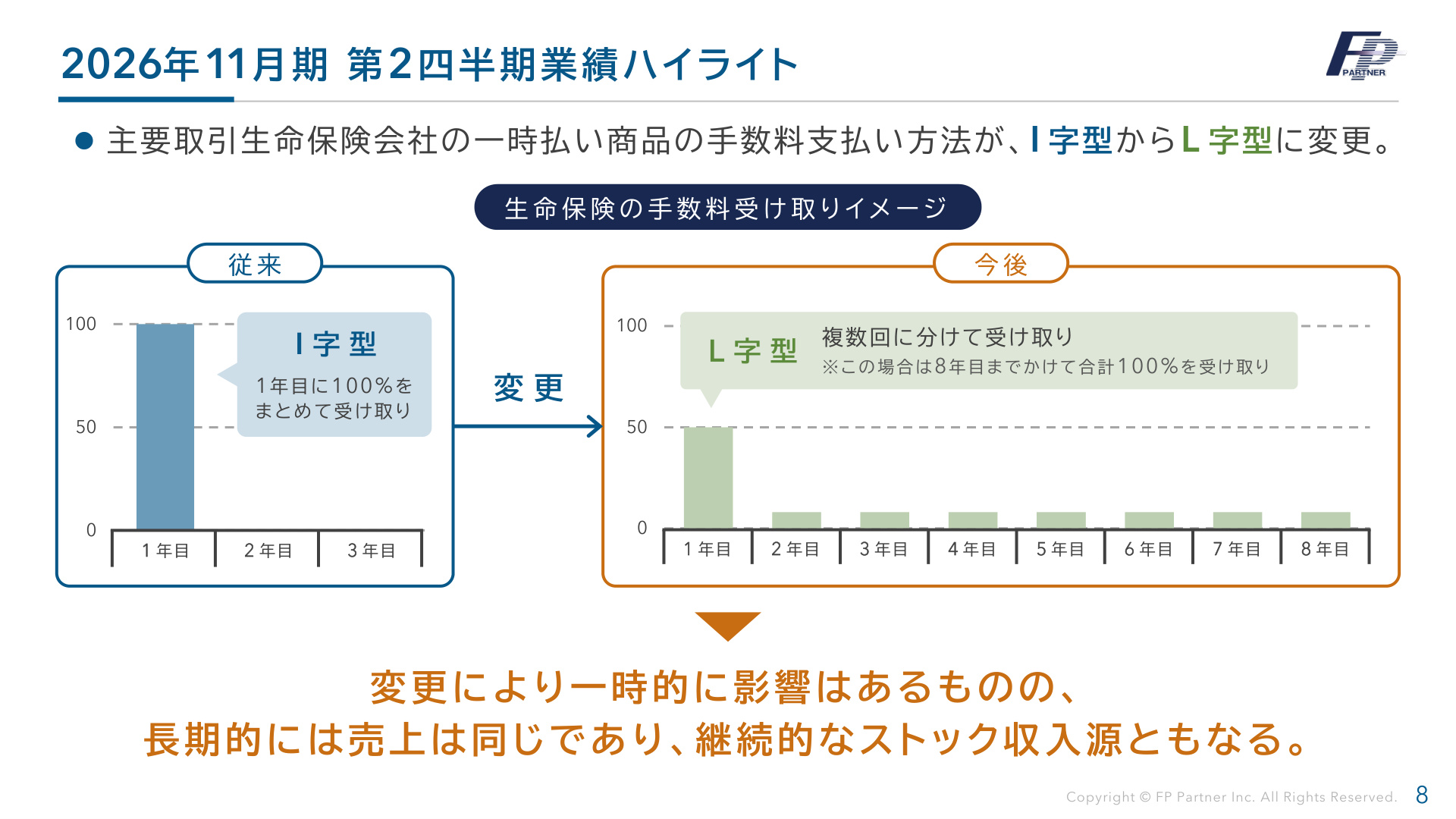
The method of receiving fees for lump-sum payment products from major life insurance companies has changed from the "I-type" to the "L-type." Previously, 100% of the fee was received in the first year. Now, it will be received in multiple installments (up to 8 years for a total of 100%). While this change will temporarily impact net sales , the total sales amount remains the same in the long term, and it is expected to improve the quality of revenue by creating a continuous stream of recurring income.
Key KPI Trends
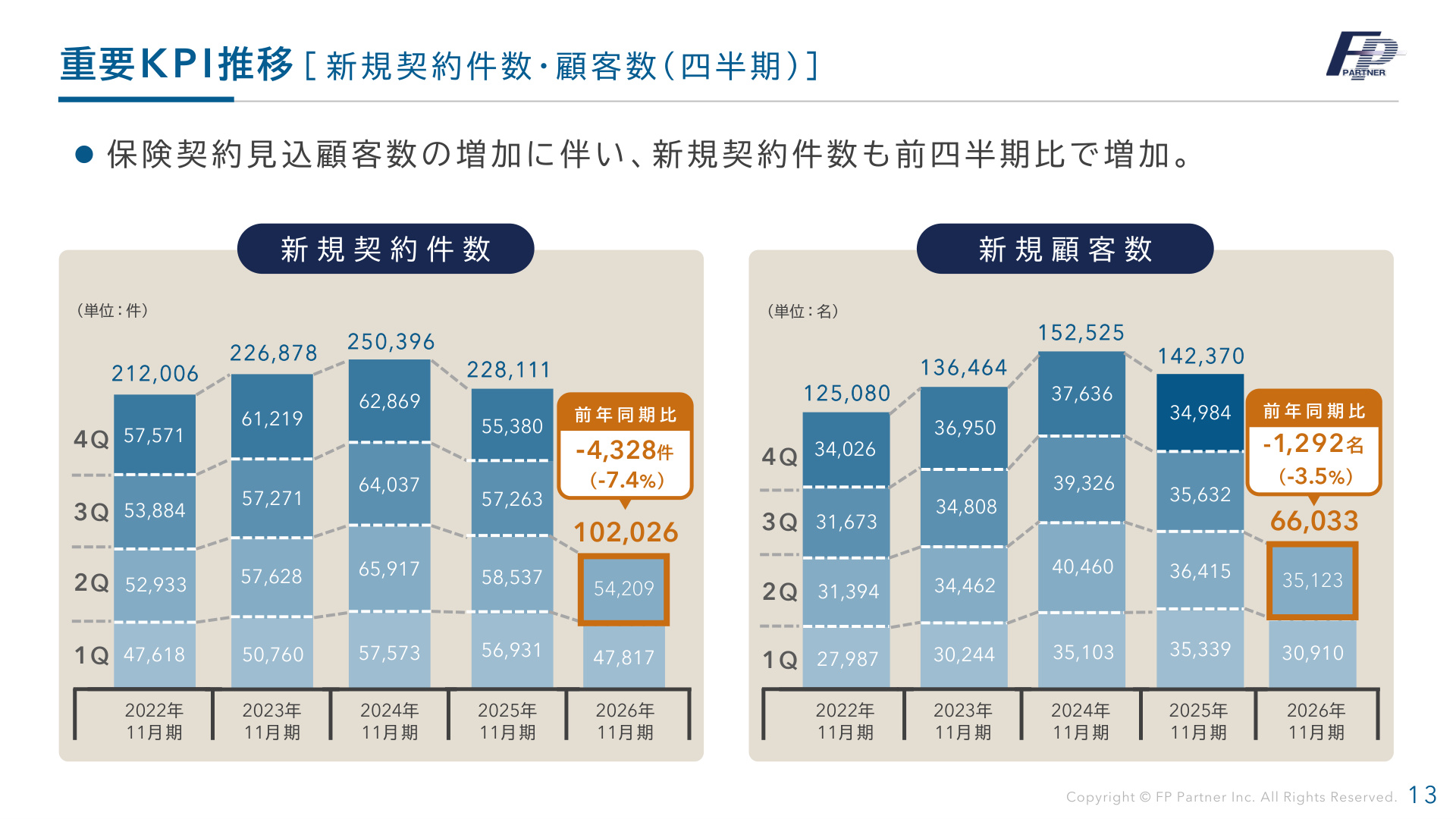
The number of sales employees for the cumulative interim period was 2,227 (down 11.7% year-on-year), but the net decrease in Q2 alone was limited to 38 employees quarter-on-quarter. New contracts for the cumulative interim period totaled 102,026 (down 11.6%), but Q2 alone saw a significant increase to 54,209 contracts (up 13.4% quarter-on-quarter). Similarly, the number of prospective insurance customers for the cumulative interim period was 63,778 (down 10.4%), but Q2 alone increased to 33,126 customers (up 8.1% quarter-on-quarter).
The trend in the number of sales employees is as follows:
 This slide indicates that while the net decrease in sales employees had been ongoing, the recent Q2 saw the net reduction limited to 38, and the number of new hires turned positive. The fact that new hires are showing signs of recovery is a significant indicator for the future recovery of sales capabilities. As sales employees are the foundation of insurance sales, this trend is a crucial factor directly impacting future performance.
Flat-Payment Products and Quality of Revenue Model
The company emphasizes that a higher number of flat-payment product sales leads to a more stable and long-term recurring revenue stream. In Q2 FY2026, the number of flat-payment product sales was 32,526, an increase from the previous quarter. This suggests that efforts to strengthen sales capabilities are progressing, laying the groundwork for recovery in the next fiscal year and beyond. The breakdown of life insurance fee income includes initial year fees, recurring fees, and business quality support payments, with recurring fees and business quality support payments acting as stable revenue sources. Life insurance fees, in particular, are on an upward trend, indicating a shift towards sales conscious of a sustainable revenue structure and an improvement in the quality of revenue.
Steady Increase in Retained Contracts and Customers
The company's retained contracts increased to 2,087,027 (up 10.7% year-on-year), and retained customers increased to 776,505 (up 9.0% year-on-year). This demonstrates the success of the company's business model in building long-term customer relationships and expanding its stock business, which is extremely important for forming a stable revenue base in the future.
4. Growth Strategies and Future Outlook
Recovery and Strengthening of Partnership Customer Acquisition
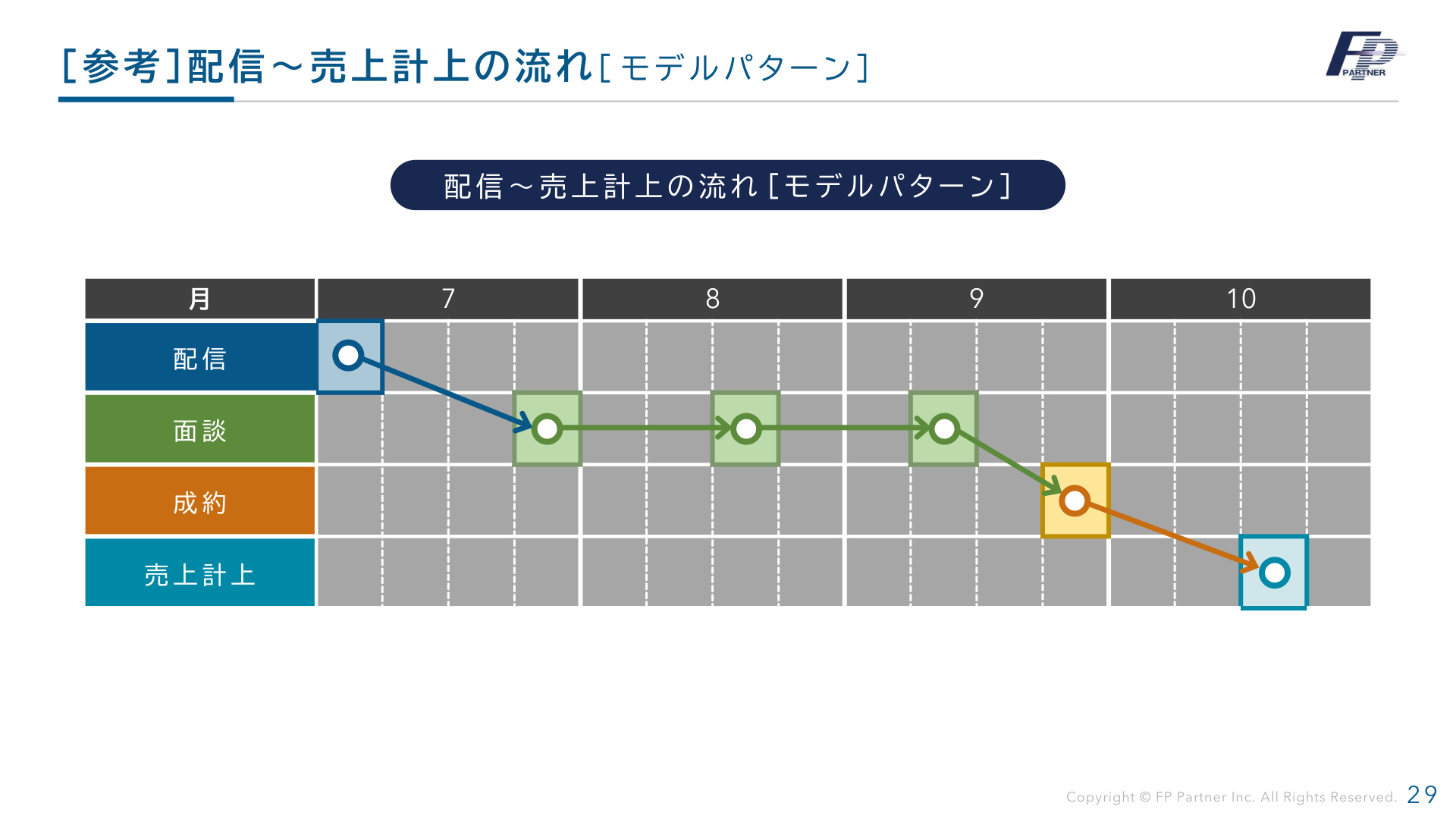
Partnership customer acquisition, which was temporarily sluggish, is now on a recovery trend. Although customer acquisition temporarily stalled due to a business improvement order from the Kanto Local Finance Bureau in November 2025, partnership customer acquisition has been recovering since November 2025. Specifically, in Q2 FY2026, the number of partnership-generated customers increased by 3,153 quarter-on-quarter, confirming the recovery trend.
The recovery trend for partnership customer acquisition is shown below:
 This graph illustrates that partnership customer acquisition has been steadily increasing since hitting a low in Q4 FY2025, continuing through Q1 and Q2 of FY2026. Furthermore, it projects further increases towards Q3 and Q4 FY2026, making this a crucial leading indicator for future sales recovery. The recovery in partnership customer acquisition is also a factor contributing to the net increase in sales employees and is a core element of the company's growth strategy. However, it is important to note that there is a time lag between customer acquisition and sales recognition, and lead acquisition-related costs are recognized as cost of sales in advance, so profit margins are expected to remain subdued in the current period.
Expansion of Contract Assignment Business
The company positions the expansion of its contract assignment business as a key growth strategy. Against the backdrop of revisions to the Insurance Business Act, inquiries for non-life agency contract assignments are increasing. In Q2 FY2026, the company agreed with three agencies, bringing the total number of cases to 34. In this business model, in addition to recurring fees from assigned contracts, the company expects to start acquiring new contracts within an average of three months after the assignment is completed. By making the assigned agencies group bases and expanding the new life and non-life insurance promotion model nationwide, the company aims to strengthen cross-selling from non-life to life insurance and enhance its after-sales follow-up system , thereby improving sales and customer satisfaction. The cumulative new ANP (Annualized New Premium) from contract assignments for Q2 FY2026 was 927,072 thousand yen (plan: 1,500,000 thousand yen), and future progress will be closely watched.
Full-Year Forecast Revision and Recovery Strategy
Based on the first half performance and future outlook, the full-year earnings forecast for FY2026 has been revised. The revised net sales are 31,793 million yen (up 1.0% year-on-year), operating profit is 2,300 million yen (down 22.9%), ordinary profit is 2,417 million yen (down 23.3%), and net profit is 1,617 million yen (down 20.8%). The main reasons for the revision include the continued net decrease in sales employees, the temporary slowdown in partnership customer acquisition due to the business improvement order, sluggish sales of highly profitable protection products due to increased demand for foreign currency-denominated lump-sum payment products driven by exchange rate fluctuations, and a decrease in the business quality fee rate due to reduced sales volume.
However, the company is implementing specific strategies for recovery. Regarding sales employees, although a net decrease continues, signs of a bottoming out are emerging. Partnership customer acquisition is on a recovery trend, and the company aims to improve profit margins in the future, taking into account the time lag until sales recognition. Furthermore, as part of improving the product sales mix , the company plans to strengthen sales of highly profitable protection products and reduce reliance on foreign currency-denominated lump-sum payment products. Through these measures, the company aims for sustainable growth and a recovery in profitability.
This content is not intended as investment advice or a recommendation. Any opinions expressed are solely the personal views of each article.