


Seraku (6199) Q3 FY2026 Earnings Deep Dive Report: Growth Strategy Aiming for High-Profit Structure through AI Shift

StockClub
Published: Jul 16, 2026, 10:52 AM
Sentiment Analysis
Introduction
Seraku (Securities Code: 6199) has announced its financial results for the third quarter of the fiscal year ending August 2026 (September 1, 2025 – May 31, 2026). This report provides a detailed analysis of the company's latest performance, segment-specific situations, and its AI-driven mid-term growth strategy, based on the attached materials.
I. Q3 FY2026 Consolidated Earnings Highlights and Full-Year Plan Progress
For the third quarter of the fiscal year ending August 2026, Seraku reported consolidated net sales of 18,910 million yen (up 2.0% year-on-year) and operating profit of 2,019 million yen (up 0.5% year-on-year) . Both net sales and operating profit achieved year-on-year growth. The progress rate against the full-year plan is 69.0% for net sales and 70.9% for operating profit, indicating steady progress generally in line with the plan. Education and investment aimed at permeating AI skills within the company, as well as investment in AI solution development, continue to be implemented.
The following slide details the consolidated financial results for Q3 FY2026.
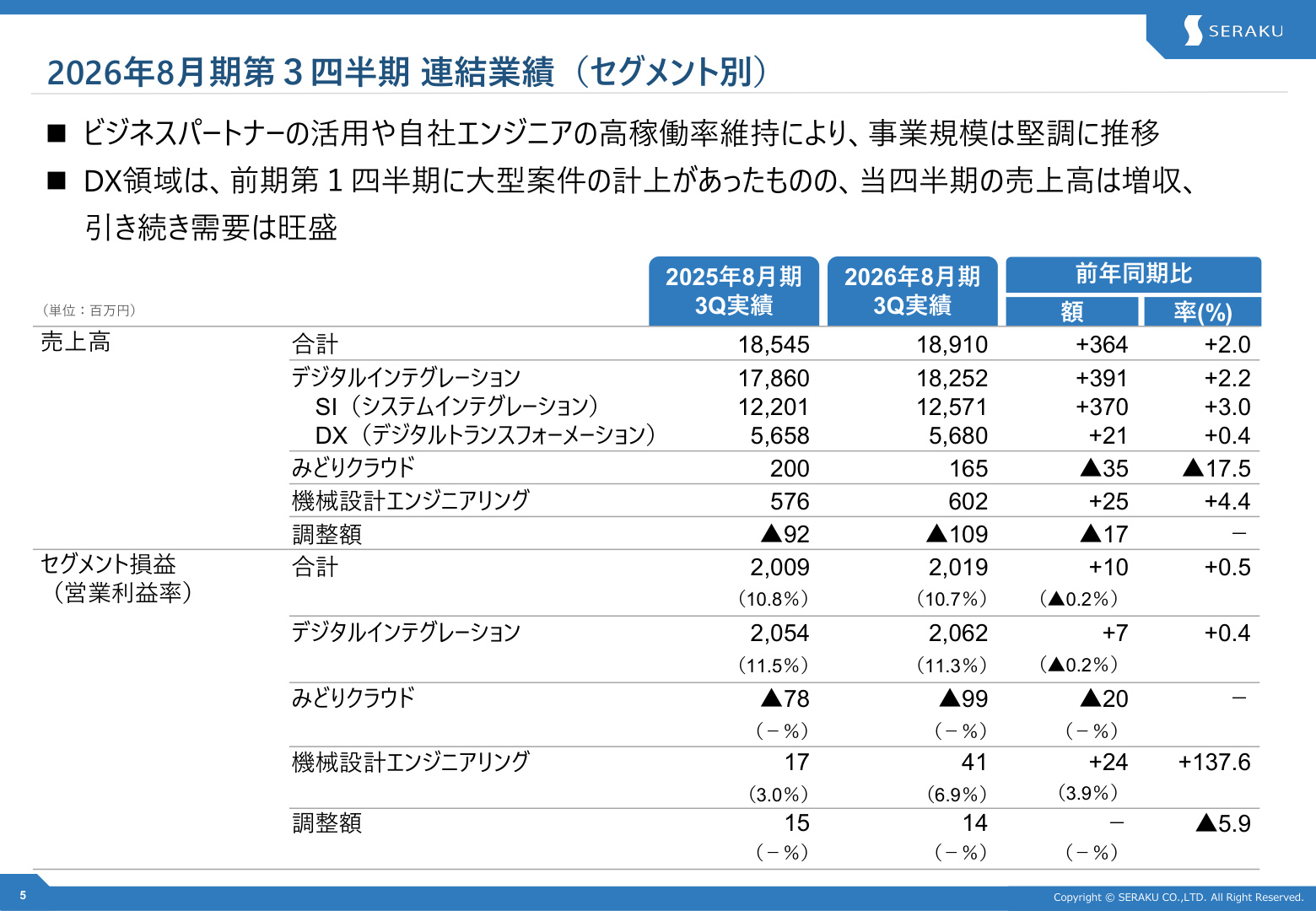 From this consolidated performance slide, it can be confirmed that net sales increased by 364 million yen year-on-year, and operating profit also increased by 10 million yen. Gross profit grew steadily at +4.0% year-on-year, but selling, general, and administrative expenses increased by +6.4%, which is considered one of the factors that suppressed the growth in operating profit. Notably, net profit attributable to owners of the parent decreased by 5.1% year-on-year to 1,247 million yen , primarily due to the impact of deferred tax accounting. Overall, net sales increased due to an increase in the number of partner engineers, and operating profit maintained growth while continuing to hire high-layer personnel and invest in AI-related education.
II. Segment Performance and Progress of Key Growth Indicators
By segment, the Digital Integration business performed strongly with net sales of 18,252 million yen (up 2.2% year-on-year) and operating profit of 2,062 million yen (up 0.4% year-on-year) . Operations and stabilization support for enterprises were robust, contributing to an increase in the number of active partner engineers. In particular, the DX (Digital Transformation) domain, despite a large project recorded in Q1, maintained sales growth in the current quarter, indicating continued strong demand.
On the other hand, the Midori Cloud business recorded net sales of 165 million yen (down 17.5% year-on-year) and an operating loss of 99 million yen . The company is focusing on upfront investment and the introduction of 'Rakuraku Shukka' (easy shipping) for JA (Japan Agricultural Cooperatives), with multiple JAs in the process of introduction and trials. The Mechanical Design Engineering business achieved net sales of 602 million yen (up 4.4% year-on-year) and operating profit of 41 million yen (up 137.6% year-on-year) , marking a significant increase in profit. Sales increased due to the expansion of project areas, and both the number of projects and utilization rates remained strong.
Regarding key growth indicators, DX shift and high-value-added projects (quasi-mandate/contract projects) progressed steadily . The number of partner companies on the IT talent platform expanded to 2,541 companies (up 654 companies year-on-year) , with a focus on securing partner companies for business expansion. The sales composition ratio of the DX domain is 30.6% (up 0.3% year-on-year) , and the order composition ratio of quasi-mandate/contract projects is 54.4% (up 3.2% year-on-year) , indicating a steady shift towards high-value-added projects.
III. Performance Analysis: Reasons for Partner Engineer Headcount Miss and Short-term Improvement Measures
In the performance analysis for Q3, a key challenge identified was that the number of active partner engineers fell short of the plan , resulting in the total number of engineers falling below target. While this has caused a delay in net sales compared to the full-year plan, operating profit is generally progressing as planned.
The reasons for the shortfall in active partner engineers are not due to a lack of demand, but primarily due to the following four points:
- Sales Resource Shortage : Insufficient sales resources to acquire new projects and assign partners.
- Delay in Improving Quasi-Mandate/Contract Ratio : While high-value-added projects are being ordered steadily, further expansion requires strengthening the sales and PM (Project Manager) structure.
- PM Shortage : Insufficient management personnel (PMs) to expand contract and high-value-added projects, requiring time for PM talent development.
- Inadequate Response to Project Completion Rate : The lead time for re-assignment after project completion is prolonged.
To address these issues, the company is implementing short-term improvement measures to strengthen its sales and PM structure and partner engineer activity management . Specifically, these include establishing a dedicated business partner department, strengthening the project assignment system, early identification and training of PM candidates, and early grasp of scheduled project completions and re-assignment management. The company aims for improvement from Q4 onwards.
IV. FY2026 Full-Year Consolidated Earnings Plan and Growth Rates
The full-year consolidated earnings plan for FY2026 targets net sales of 27,400 million yen (up 10.6% year-on-year) and operating profit of 2,850 million yen (up 11.7% year-on-year) . Looking at historical average growth rates, net sales have grown at +12.4% and operating profit at +16.0%, indicating strong sustained growth. With robust demand, the company plans for double-digit growth this fiscal year as well.
V. Shareholder Return Policy: Dividends and Share Buybacks/Cancellations
The company plans to increase its dividend per share for FY2026, in addition to performance-linked dividends, due to the cancellation of treasury shares . It continues to focus on shareholder returns through ongoing share buybacks and enhancing engagement opportunities with investors.
The following slide illustrates the trend of dividends per share and investor engagement.
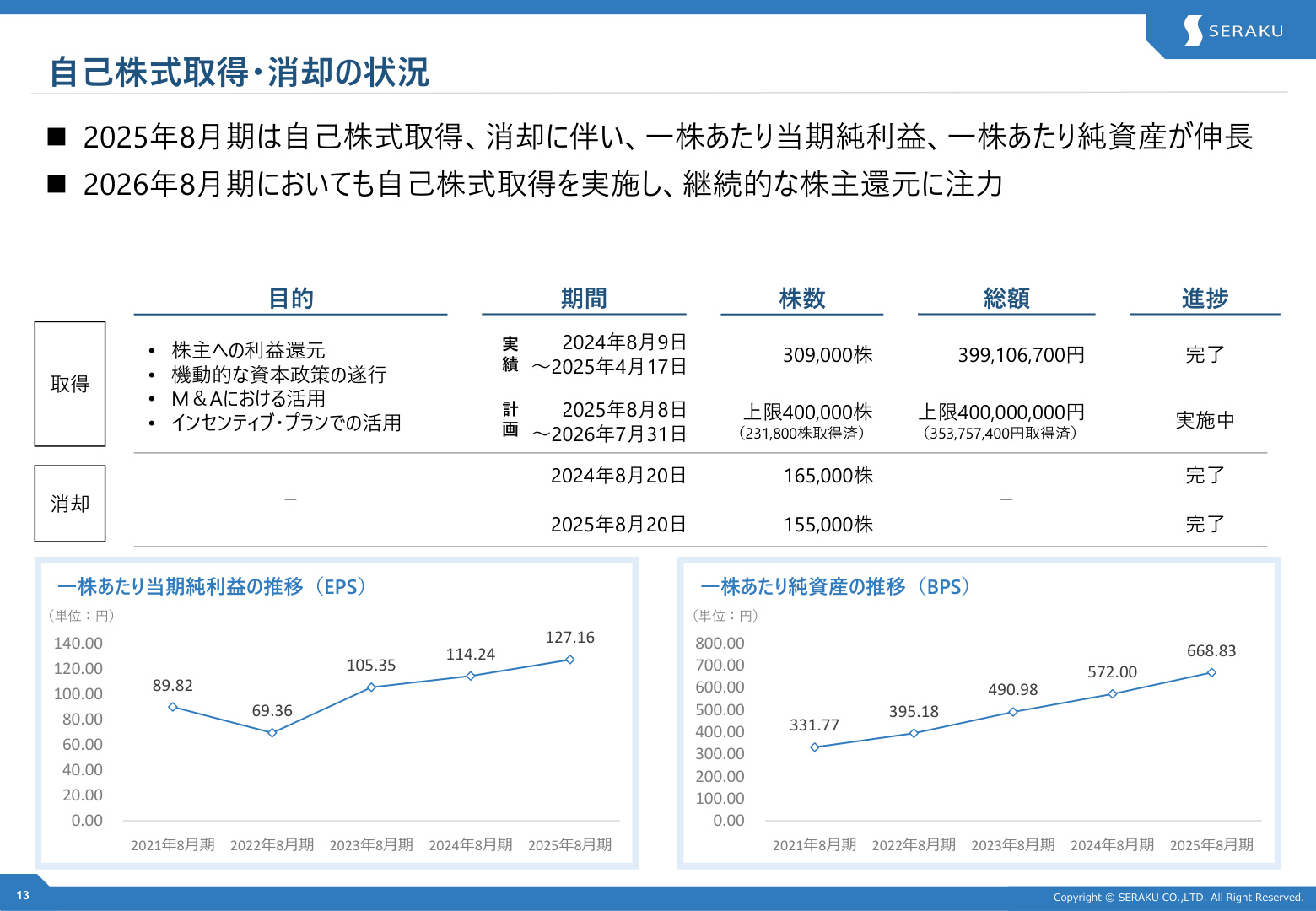 This slide shows a steady increase in dividends per share. For FY2026 (plan), 17.40 yen is projected, which would be approximately 7 times the dividend at the time of listing. Furthermore, in FY2025, the company conducted share buybacks and cancellations, contributing to the growth of earnings per share (EPS) and book value per share (BPS). Share buybacks are also underway in FY2026, demonstrating the company's commitment to continuous shareholder returns.
VI. Mid-term Growth Vision: Transformation into a High-Profit 'AI Solution Company'
Seraku has updated its growth strategy, envisioning a transformation into a high-profit 'AI Solution Company' in anticipation of societal changes driven by AI. The company positions AI utilization and AI services at the core of its future growth strategy, outlining a three-step vision to achieve growth:
The following slide presents the company's mid-term growth vision and growth strategy summary.
 This slide clearly outlines Seraku's roadmap for corporate transformation with AI at its core.
- STEP 1 (2026-2027): Establishment of AI Solution Business
- Focus on AI shift and scale expansion of existing businesses, and improving profitability through AI utilization.
- STEP 2 (2027-2030): Maximization of AI Talent and Realization of Profit Growth through AI Utilization
- Aims to expand the AI solution business and monetize the Midori Cloud business (strengthening AI service development capabilities).
- STEP 3 (2030-): Creation of New Businesses Leveraging Agriculture, DX, and AI
- Aims for entry into new businesses including M&A, AI transformation support for client companies, creation of new businesses in food and agriculture, and entry into existing industries with AI as a strength.
This vision reflects the company's strong determination to achieve sustainable high-profit growth by seizing the opportunities presented by changing AI needs and industrial structures, and by placing AI at the center of its growth strategy.
VII. Key Growth Strategy ①: Establishing AI Solution Business with Japanese FDE Model
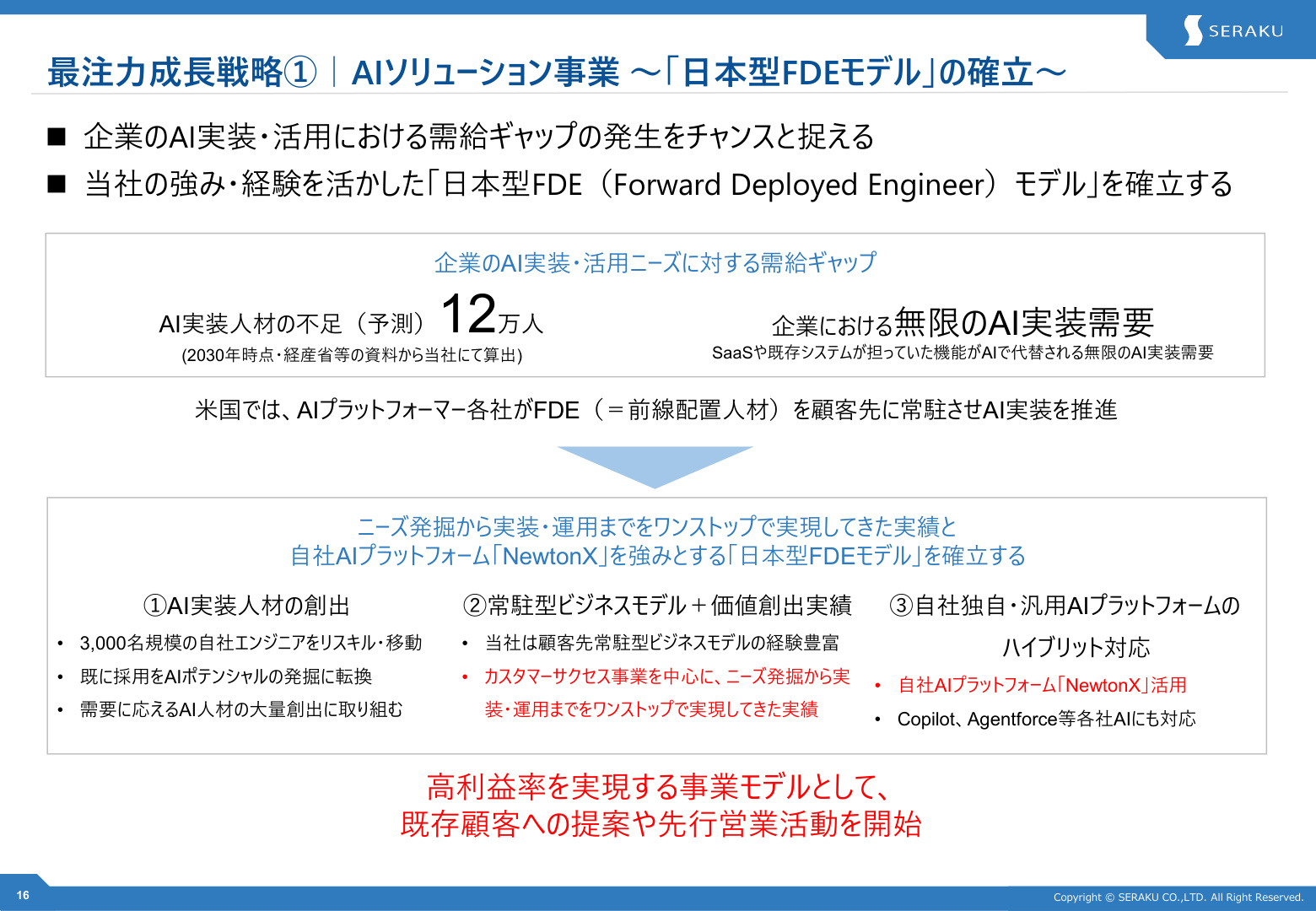
The company seizes the opportunity presented by the supply-demand gap in AI implementation and utilization to establish the 'Japanese FDE (Forward Deployed Engineer) Model' . This model involves engineers stationed at client sites, providing AI implementation support through a three-layer structure combining business consulting and AI platforms (proprietary 'NewtonX' service and powerful external platforms). A specialist team led by the CAIO (Chief AI Officer) spearheads AI implementation, driving the acquisition of high-unit-price quasi-mandate/contract projects. As a result, the company has begun proposing to existing clients and conducting proactive sales as a business model that achieves high profitability.
VIII. Growth Strategy ②: AI Shift in Existing Businesses and Expansion of IT Talent Platform
In its existing IT service business, the company plans for a future prediction of needs changes driven by AI and an AI shift in the talent domain. Specifically, it will promote ① operational automation by AI, ② strengthening of project management talent development, ③ shift to AI-driven development, ④ promotion of contracting, and ⑤ strengthening collaboration and partnerships with large enterprises . These initiatives aim to improve profitability.
By utilizing the IT talent platform (internal talent + partner talent), the company will maximize supply by procuring from the IT talent platform for the immediate volume zone. In the long term, it aims to build a partner ecosystem that responds to societal AI demand by supporting the AI transformation of partner companies. The number of registered partner companies has increased to over 2,500 , and by pursuing both scale growth through partner utilization and an upstream shift of its own professionals, as well as contracting and prime contracts, the company aims for a structure that simultaneously achieves scale growth and improved profitability.
IX. Growth Strategy ③④⑤: Internal AI Utilization, Midori Cloud Monetization, and AI Service Development
Establishing a high-profit structure through internal AI utilization is also a crucial strategy. Internal AI utilization will reduce general and administrative expenses, leading to an improvement in operating profit margin. The company will conduct AI contests and create/showcase leading examples of productivity improvement through AI, leveraging its own productivity improvement cases for client proposals.
In the Midori Cloud business , the number of 'Rakuraku Shukka' implementation cases is increasing, and sales activities continue to be a focus. Although the implementation lead time is long, the number of implemented/trial JAs is steadily increasing, with a target of 7,000 cases by August 2029 . Furthermore, the company aims to create new markets by diverting the unique and advanced core technologies acquired through 'Rakuraku Shukka' development (mass simultaneous reading by smartphones, labor-saving in slip creation/input, traceability, AI-driven automation/prediction technology) to other fields. Leveraging the AI development capabilities and service development functions cultivated through the Midori Cloud business, the company aims to create new services regardless of existing or new business areas. A dedicated AI team, including a CAIO, will lead internal and client-facing AI development.
X. Growth Strategy ⑥: New Business Addressing AI-driven Changes in Talent Needs and Industrial Structure
Anticipating changes in talent needs due to the widespread adoption of AI and the decline in Japan's working population, the company also plans to enter new businesses. With a projected shortage of 3.84 million workers by 2040, the company aims to establish 'AI-driven education' to shorten education costs and duration, thereby efficiently developing talent. Furthermore, as the existing industrial structure is expected to change with the widespread adoption of physical AI after 2030, the company sees an opportunity to enter industries with AI implementation capabilities, utilizing M&A to achieve high profitability in existing industries.
Conclusion
Seraku's Q3 FY2026 financial results show growth in both net sales and operating profit, indicating steady progress towards its full-year plan. While facing the challenge of falling short of its partner engineer headcount target, the company is implementing concrete improvement measures. The company has outlined a mid-term growth vision centered on AI, promoting a multifaceted strategy including establishing an AI solution business with the 'Japanese FDE Model' , shifting existing businesses to AI , establishing a high-profit structure through internal AI utilization , monetizing the Midori Cloud business and developing AI services , and entering new businesses that address AI-driven changes in talent needs and industrial structure . Through these strategies, the company aims to transform into a high-profit AI solution company and achieve sustainable growth.
This content is not intended as investment advice or a recommendation. Any opinions expressed are solely the personal views of each article.