


Mercury (5025) Q1 FY2027 Earnings Deep Dive Report

StockClub
Published: Jul 16, 2026, 10:43 AM
Sentiment Analysis

Mercury Co., Ltd. has announced its financial results for the first quarter of the fiscal year ending February 2027 (March 1, 2026 – May 31, 2026). In this quarter, the transition to a new pricing system for SaaS services, implemented in April 2026, contributed steadily, leading to an increase in net sales year-on-year, and significant growth in all profit items. Notably, the Digital Marketing business was a major driver of growth.
Q1 FY2027 Earnings Highlights
The financial performance for the first quarter of the fiscal year ending February 2027 progressed largely as planned against the full-year forecast. Net sales reached 421 million yen (up 6% year-on-year), operating profit was 28 million yen (up 21% year-on-year), ordinary profit was 30 million yen (up 19% year-on-year), and net profit attributable to owners of parent was 20 million yen (up 22% year-on-year). Gross profit achieved 180 million yen (up 14% year-on-year).
The progress rate against the full-year forecast was 25% for net sales, 24% for operating profit, 24% for ordinary profit, and 26% for net profit. Selling, general and administrative (SG&A) expenses increased by 12% year-on-year to 152 million yen, primarily due to higher-than-initially-planned expenses related to the company's office relocation, resulting in a progress rate of 28%, slightly ahead of schedule.
The overview of these financial results is presented in the table below.
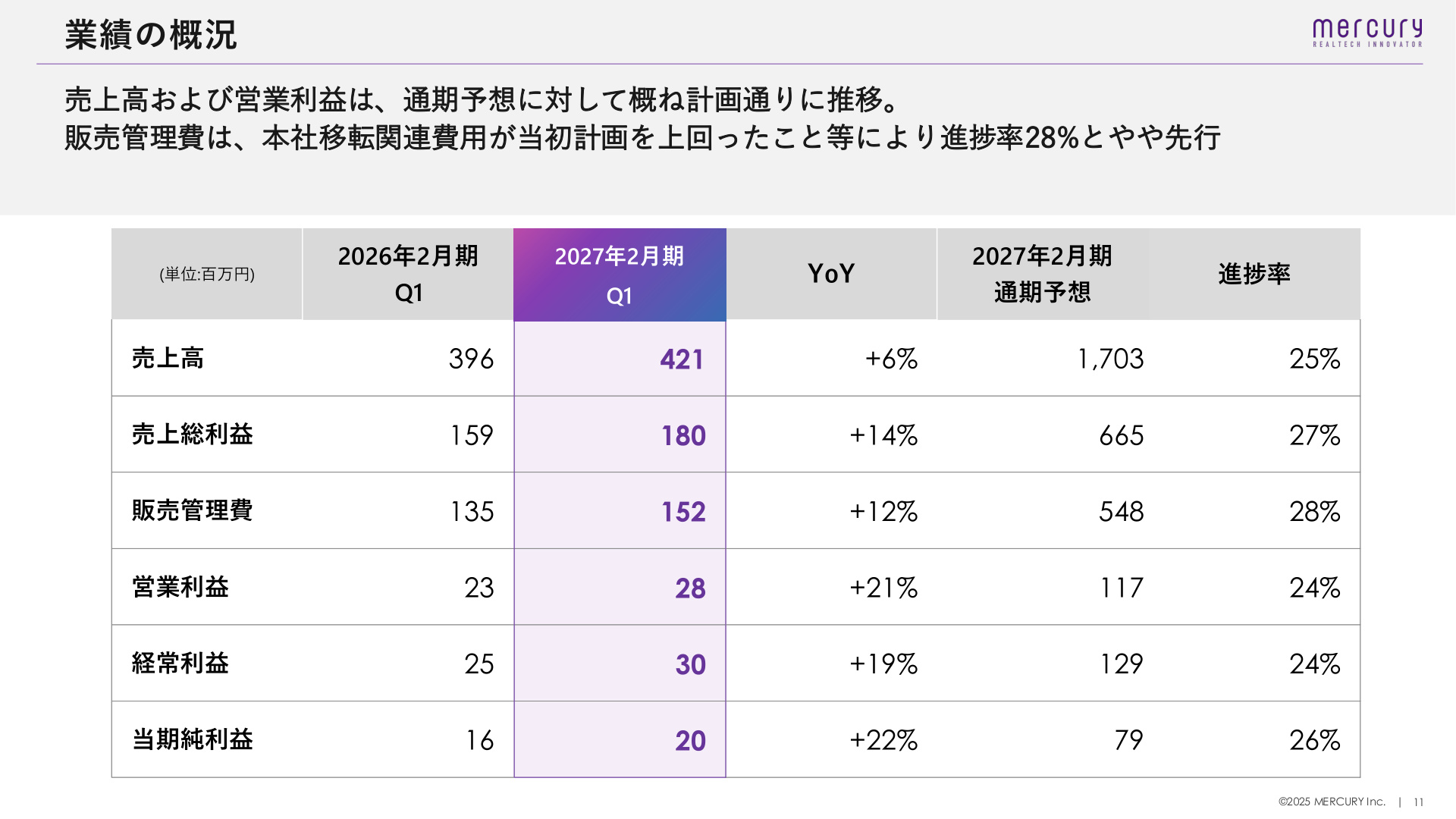 This table clearly indicates that net sales, gross profit, operating profit, ordinary profit, and net profit all increased compared to the same period last year. Notably, the growth rate of profits surpassed that of net sales, suggesting an improvement in profitability . The increase in SG&A expenses is attributed to a temporary factor, and overall, the company has made a solid start to the fiscal year.
Segment-Specific Performance Analysis
The business is primarily divided into "Platform Business" and "Digital Marketing Business."
Platform Business
Revenue from the Platform Business was 267 million yen (up 3% year-on-year). This business is further segmented into the New Construction Mansion domain and the Used Mansion domain.
-
New Construction Mansion Domain: Sales in this domain increased steadily by 7% year-on-year to 246 million yen . This growth was primarily driven by the successful transition to a new SaaS service pricing system in April 2026, which led to a significant 9.6% year-on-year increase in Average Revenue Per User (ARPU) to 274,000 yen . While there was no significant change in the number of customers, as the company already holds a high market share in the new construction mansion domain, the improvement in ARPU boosted revenue. Monthly Recurring Revenue (MRR) also continued its stable growth, increasing by 7.6% year-on-year to 226 million yen . The revenue churn rate, indicating the cancellation rate, decreased by 0.11 percentage points year-on-year to a very low 0.04% , suggesting a stable customer base has been established.
The trend of ARPU for SaaS products in the New Construction Mansion domain is shown in the graph below.
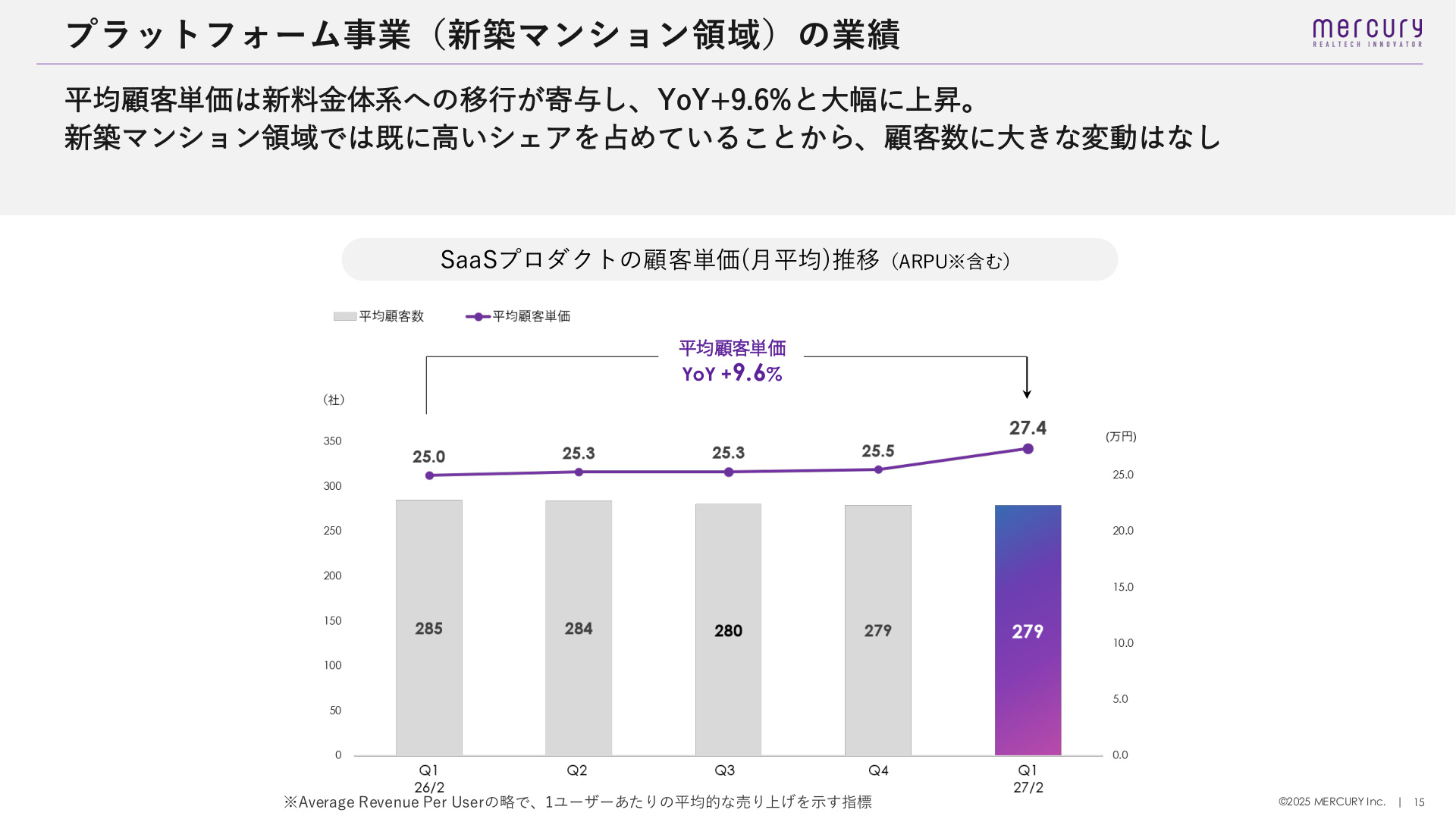 This graph illustrates that while the number of customers remained largely flat, the average revenue per customer has steadily increased, confirming the successful implementation of the new pricing system . The improvement in ARPU is evidence that the strategy of maximizing revenue from existing customers is functioning effectively.
 -
Used Mansion Domain: Sales were 21 million yen (down 30% year-on-year), but showed a recovery trend from the previous quarter (Q4). The average number of customers expanded to 3,989 companies , an increase of 14.3% year-on-year, indicating a steady expansion of the business foundation. The decline in sales is considered a temporary factor, and the increase in customer numbers could lead to future growth.
Digital Marketing Business
The Digital Marketing business achieved significant revenue growth, with sales of 140 million yen (up 17% year-on-year), largely driving the overall performance. Listing ad operations, a core service, performed well, with sales increasing by 12% year-on-year to 117 million yen. Additionally, demand for site creation contributed significantly to revenue, increasing by 113% year-on-year to 13 million yen. CGM ad operations also saw an increase of 16% year-on-year to 8 million yen.
Other Businesses
Other businesses saw a decrease of 18% year-on-year to 13 million yen , due to reduced orders for Town Mansion Plus (DM) and system development contracts.
Balance Sheet Status
As of the end of the first quarter of the fiscal year ending February 2027, current assets increased to 1,171 million yen (up 3% from the end of the previous fiscal year) due to the growth in cash and deposits from operating income. Fixed assets decreased to 202 million yen (down 8% from the end of the previous fiscal year) due to the progress of software amortization and the amortization of security deposits related to the head office relocation. On the liabilities side, current liabilities decreased to 234 million yen (down 2% from the end of the previous fiscal year) due to payments of accounts payable and corporate taxes. As a result, the equity ratio remained high at 78.9% , indicating financial stability .
Future Growth Strategies and Outlook
Mercury aims for future growth based on three pillars: strengthening the SaaS business foundation, monetizing rental data, and continuous growth in web advertising.
Strengthening the SaaS Business Foundation
By improving ARPU through the transition to the new pricing system and maximizing MRR, the company aims to solidify its revenue base. The strategy involves including previously charged content in standard packages, providing an environment where users can access services "anytime, anywhere," and maximizing the value of the product. This approach seeks to evolve into a service with a high retention rate, creating a virtuous cycle of business growth.
Monetizing Rental Data
In addition to the existing "New Construction Mansion domain" and "Used Mansion domain," the company plans to expand its target to the "Rental domain" (rental management companies and brokerage companies). The promotion of the new service "Rent Assessment DX," launched in March 2026, is central to this initiative. This service also plans to collaborate with DX services operated by ITANDI, a member of the GA technologies group, aiming to establish new revenue streams by supporting the efficiency of rental management and brokerage operations.
The image of target expansion for rental data monetization is as follows.
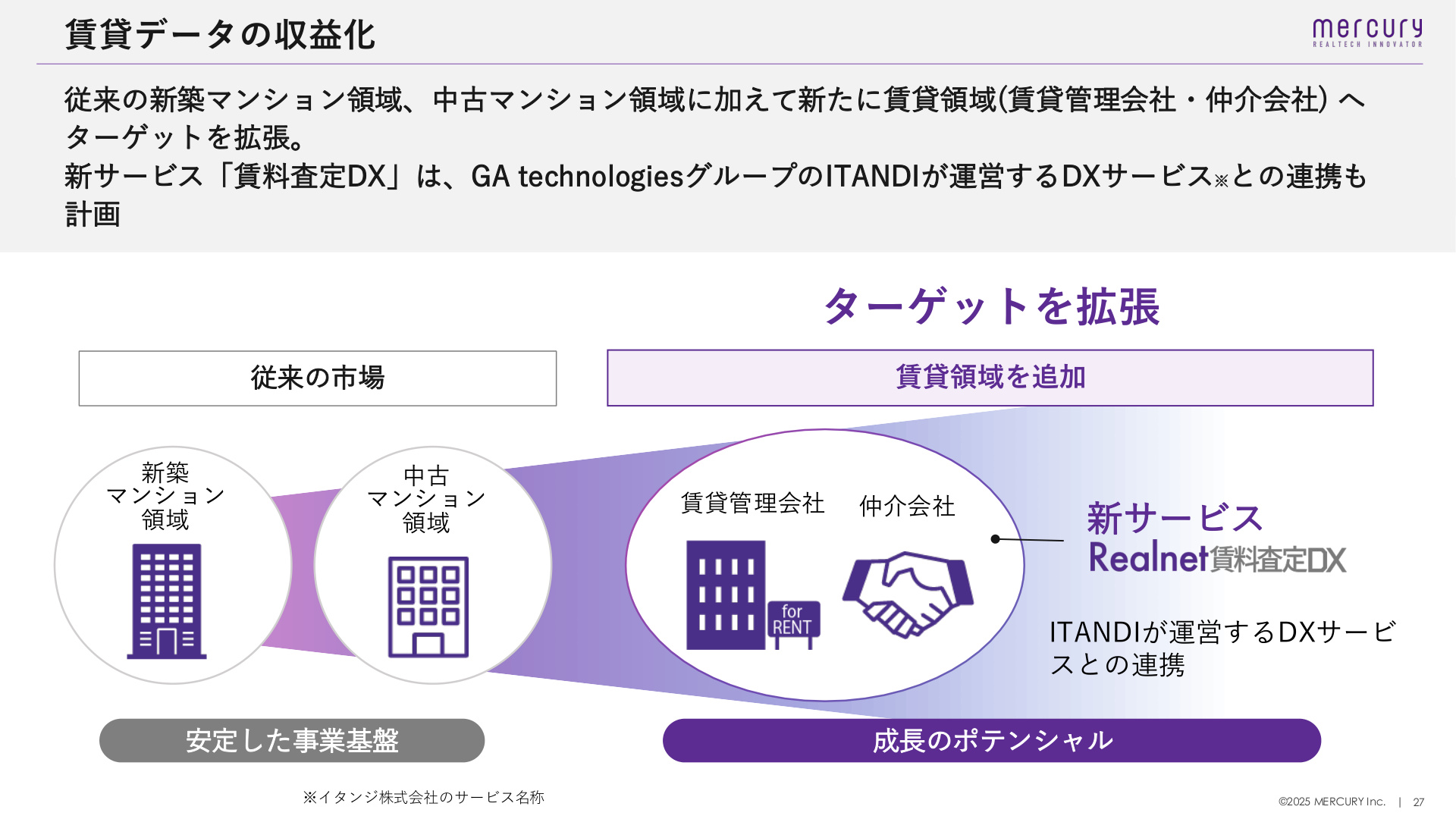 This diagram illustrates Mercury's strategy to leverage its accumulated real estate big data to expand its business into a new domain, the rental market , in addition to the new and used mansion markets. "Rent Assessment DX" is a core service in this strategy, and the planned collaboration with ITANDI indicates an intention to enter a market with high growth potential .
Continuous Growth in Web Advertising
In the Digital Marketing business, the company plans to review its organizational structure and strengthen its sales capabilities. Specifically, it will launch a dedicated planning team to standardize high-quality proposals that incorporate the latest knowledge and data, thereby improving the quality of proposals and increasing the project acquisition rate. This initiative aims to continuously achieve increased revenue and profit in the Digital Marketing business.
Conclusion
Mercury's first quarter of the fiscal year ending February 2027 saw the successful transition to a new SaaS pricing system, contributing to ARPU improvement and stable MRR growth in the Platform business. Furthermore, the Digital Marketing business achieved significant revenue growth, driving overall performance. Moving forward, the company's strategy involves strengthening the revenue base of existing businesses, expanding into the rental domain with "Rent Assessment DX," and enhancing the organizational capabilities of the Digital Marketing business to achieve sustainable growth. The steady execution of these strategies is expected to contribute to future financial performance.
This content is not intended as investment advice or a recommendation. Any opinions expressed are solely the personal views of each article.