

TeamSpirit (4397) Q3 FY2026 Earnings Deep Dive Report: Record High Operating Profit and Investments in Growth Strategy

StockClub
Published: Jul 16, 2026, 10:38 AM
Sentiment Analysis
TeamSpirit Inc. (Securities Code: 4397) reported its Q3 FY2026 earnings, demonstrating continued revenue and profit expansion, with standalone Q3 operating profit reaching a new all-time high. This report provides a detailed analysis of the company's latest financial results, key management indicators, future growth strategies, and business activity updates, including new product announcements.
Q3 FY2026 Earnings Highlights and Factor Analysis
For the third quarter of fiscal year 2026 (March-May 2026), TeamSpirit's standalone performance showed revenue increasing by 25.4% year-on-year to JPY 1,551 million , and operating profit rising by 48.2% year-on-year to JPY 198 million , resulting in an operating profit margin of 12.8%. This achievement was primarily driven by customer acquisition in the enterprise segment, marking a record-high operating profit for a standalone Q3.
The financial performance trends are illustrated below:
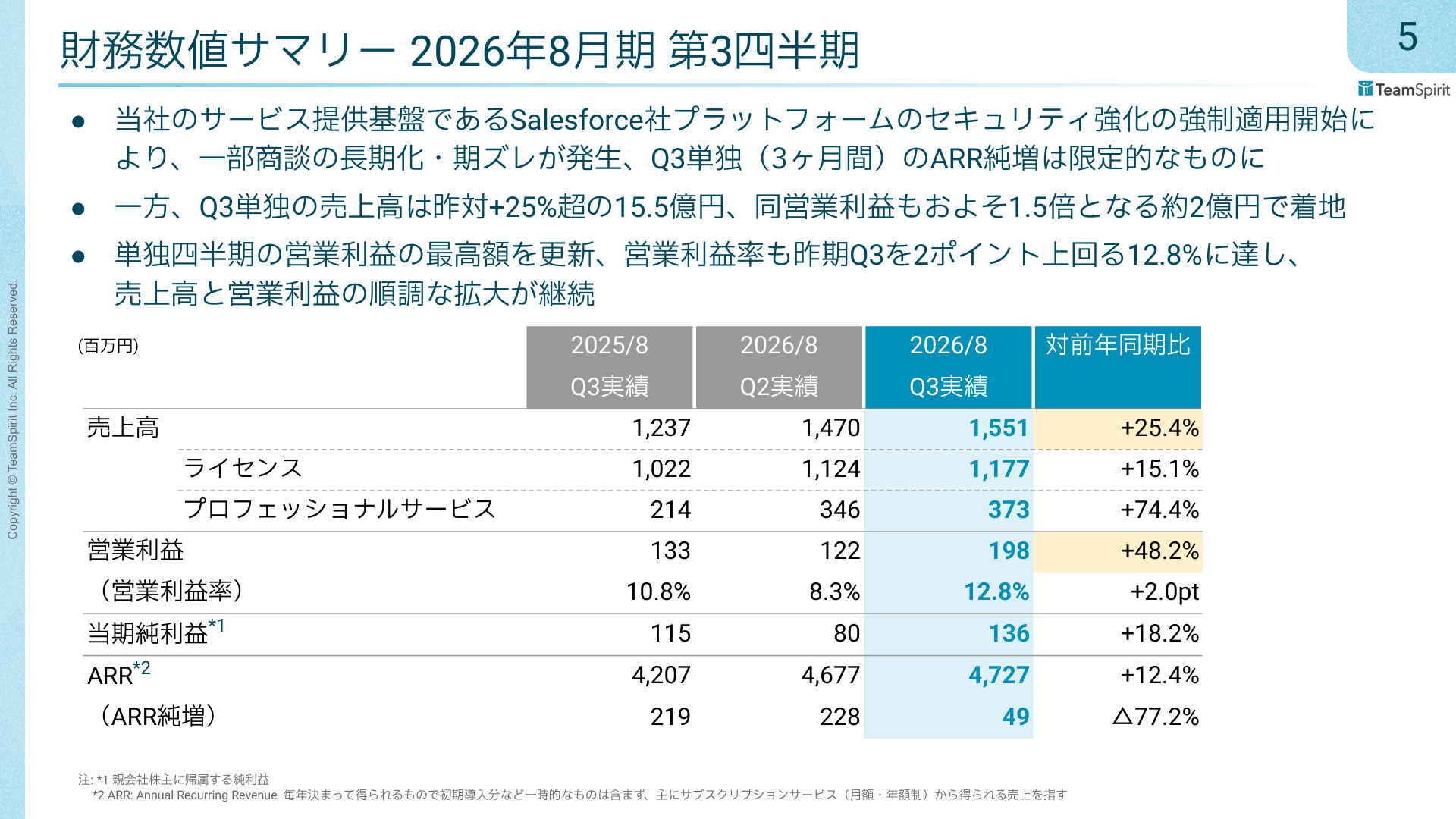 This financial summary confirms that license revenue grew by 15.1% year-on-year to JPY 1,177 million, and professional services revenue surged by 74.4% year-on-year to JPY 373 million, indicating particularly strong growth in professional services. Meanwhile, ARR (Annual Recurring Revenue), a critical metric for SaaS businesses, reached JPY 4,727 million, an increase of 12.4% year-on-year. However, the net increase in standalone Q3 ARR was JPY 49 million, a significant decrease of 77.2% year-on-year. This reduction in net ARR increase is primarily attributed to the mandatory application of Salesforce's security enhancements, which led to the prolongation of some business negotiations and temporary churn.
Regarding the full-year outlook, cumulative Q3 revenue increased by 24.7% year-on-year to JPY 4,432 million, and operating profit grew by 60.8% year-on-year to JPY 431 million, meaning operating profit has already achieved 100.2% of the full-year forecast. Despite this, the company has maintained its full-year forecast, anticipating investments in user support features for Salesforce security enhancements and further accelerating business growth in the next fiscal year and beyond.
Trends in Key KPIs and the Impact of Salesforce Security Enhancements
The trends in license count and ARR, crucial indicators of SaaS business growth, demonstrate that the enterprise segment continues to drive overall growth.
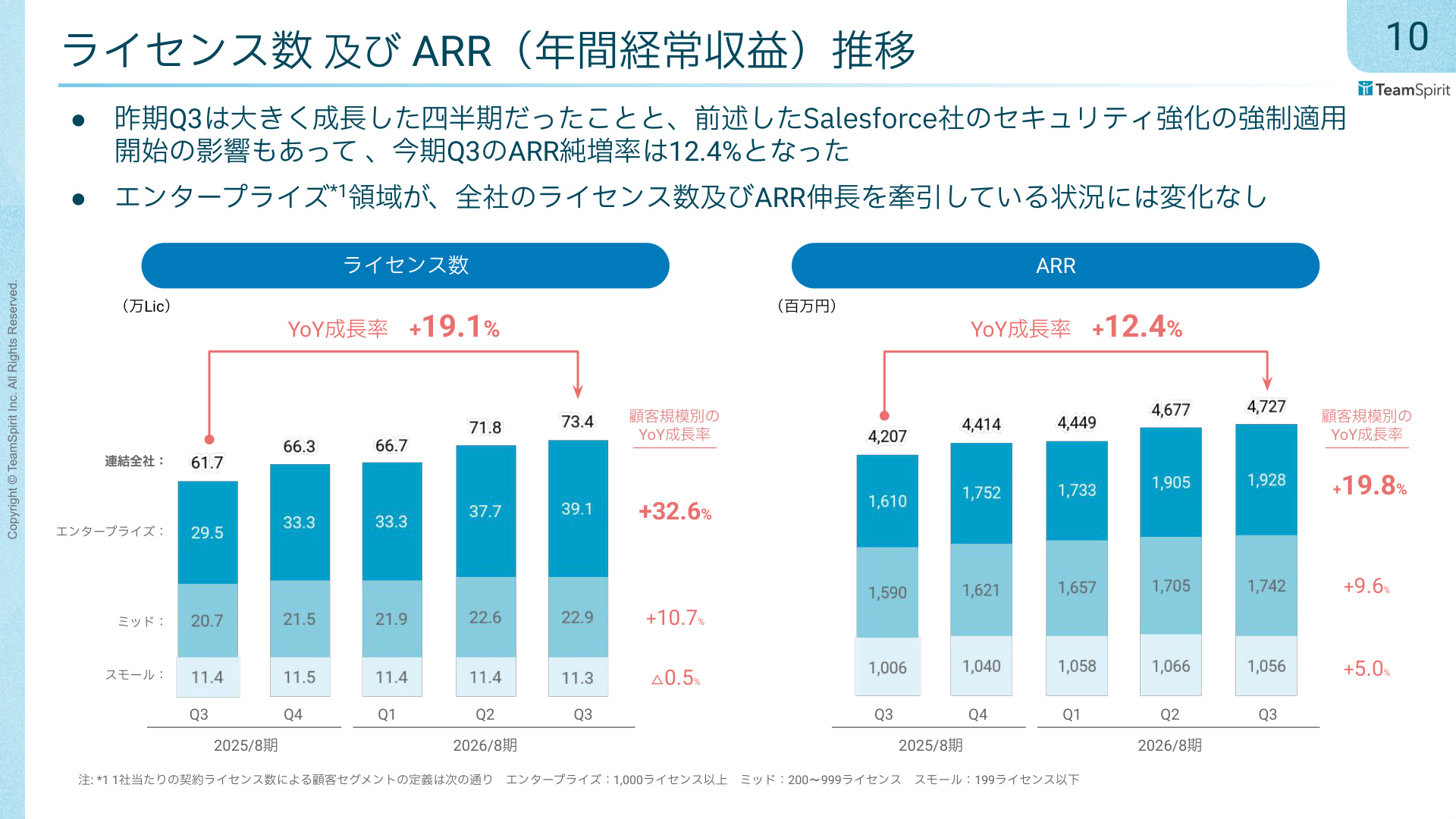 As shown in this graph, the total license count increased by 19.1% year-on-year , and ARR grew by 12.4% year-on-year , indicating steady progress. Specifically, the enterprise segment maintained high growth rates, with license count up 32.6% year-on-year and ARR up 19.8% year-on-year. This suggests that the company's strategy of penetrating the enterprise market is steadily advancing. However, as mentioned, the mandatory application of Salesforce's security enhancements has impacted the business by requiring responses for existing customers, prolonging and complicating ongoing negotiation processes, and affecting proposal activities for future potential customers. The company is addressing these impacts through investments in developing user support features.
Cost Structure Management and Productivity Improvement
The company continues to manage variable costs in line with revenue growth while intentionally controlling fixed costs. {{PAGE_11}} From this cost trend graph, it is evident that the revenue-to-personnel cost ratio for standalone Q3 improved to 30.9%, a 22.6 percentage point improvement year-on-year. This indicates that by leveraging AI for operational efficiency and keeping headcount increases modest, the company has achieved a 20.5% improvement in revenue per employee year-on-year , leading to continuous productivity enhancement. These efforts in both cost control and productivity improvement have contributed to the achievement of a high operating profit margin.
Announcement of New Product "TeamSpirit AI Shift Agent"
In Q3 FY2026, TeamSpirit held its first company conference since the COVID-19 pandemic, "TeamSpirit ONE 2026 ~法を、翼に。 (Law, to the Wings)," where it announced its new product, "TeamSpirit AI Shift Agent." This new product aims to address stricter labor law revisions (e.g., ban on 14 consecutive working days, introduction of inter-shift intervals, mandatory pre-designation of legal holidays) by utilizing AI to achieve both efficient and compliant shift scheduling.
"TeamSpirit AI Shift Agent" is developed and implemented on Oracle Cloud Infrastructure (OCI) and Oracle Autonomous Database with the support of Oracle Japan. It leverages a highly secure, performant, and reliable cloud environment to support shift scheduling based on trustworthy data. This represents a strategic product launch that addresses market needs arising from labor law revisions and further enhances the value of existing time and attendance management solutions.
Mid-to-Long-Term Growth Strategy and 2030 Vision
TeamSpirit has set a mid-to-long-term vision to achieve ARR of JPY 10 billion, an operating profit margin of 20%, and satisfy the "Rule of 40%" by 2030.
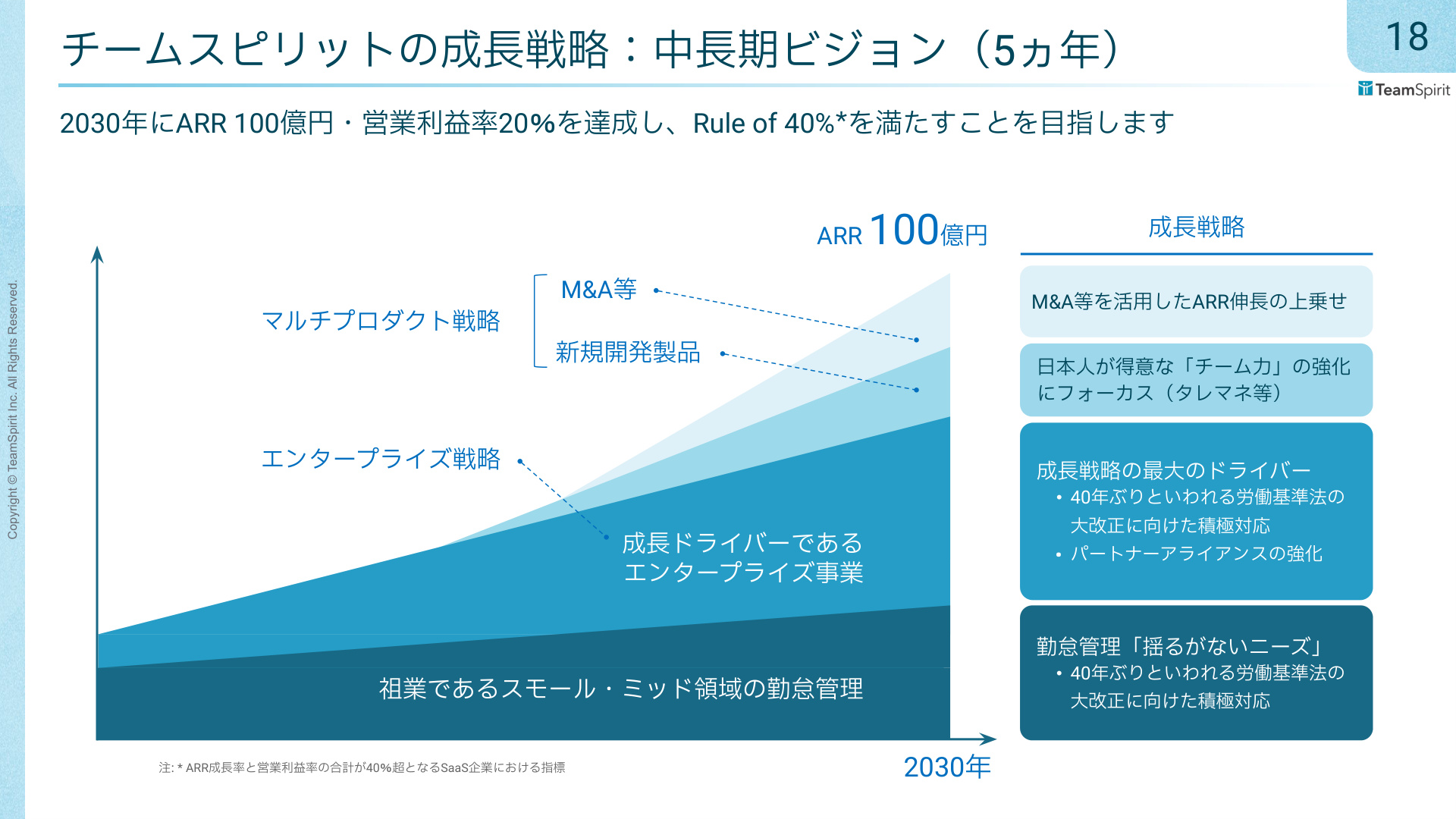 This growth strategy chart illustrates the diverse drivers of the company's growth. The main growth drivers are as follows:
- Enterprise Strategy: Achieving "deeper market penetration" with a strong core product (time and attendance management). The enterprise segment has doubled in size over the past three years.
- Multi-Product Strategy: Promoting multi-product expansion, primarily targeting existing customers in the small and mid-market segments, with the core product as the axis.
- M&A and Alliances: Adding external growth.
- New Product Development: Launching new products like "TeamSpirit AI Shift Agent."
- Proactive Response to Major Labor Law Revisions: The labor law revisions, said to be the first in 40 years, are creating new market needs.
- Strengthening Partner Alliances: Expanding the market through collaborations.
The mid-term management plan (3 years) targets ARR of JPY 7 billion and an operating profit margin of 15% by August 2028. Deepening penetration in the enterprise market, multi-product expansion, and the utilization of AI technology will be crucial pillars for achieving these goals.
Customer Base Expansion and Segment-Specific Status
The company's customer base is steadily expanding, reaching over 700,000 users and more than 2,200 companies. A breakdown of license counts shows that enterprise (1,000+ employees) accounts for 391,000 (53%), mid-market (200-999 employees) for 229,000 (31%), and small businesses (up to 199 employees) for 113,000 (16%). This clearly indicates that adoption by enterprise companies constitutes over half of the total and is driving growth.
Capital Allocation Policy and Shareholder Returns
The company prioritizes growth investments in its capital allocation policy, aiming for the optimal approach to enhance corporate value and shareholder returns. Specifically, it emphasizes organic growth through human capital and R&D investments, as well as external growth through M&A and partnerships. Concurrently, it seeks to optimize its WACC (Weighted Average Cost of Capital) by expanding borrowings and implements shareholder returns such as a shareholder benefit program and share buybacks. For FY2026, the company continues to award points to shareholders holding 4,000 or more shares, with the number of such shareholders increasing by 1.5 times compared to the introduction of the benefit program at the end of the previous fiscal half.
Conclusion
In Q3 FY2026, TeamSpirit achieved record-high operating profit , driven by strong performance in the enterprise segment and efficient cost management. While a temporary slowdown in net ARR increase was observed due to Salesforce's security enhancements, the company has clearly articulated a mid-to-long-term growth strategy focusing on deepening enterprise market penetration, multi-product expansion, AI utilization, and adapting to labor law revisions, actively pursuing strategic investments. The announcement of the new product, "TeamSpirit AI Shift Agent," addresses market needs arising from legal changes and holds the potential to create synergies with existing businesses. The company's future growth will depend on these strategic investments and its adaptability to evolving market conditions.
This content is not intended as investment advice or a recommendation. Any opinions expressed are solely the personal views of each article.