


TSI Holdings Q1 FY2027 Earnings Deep Dive Report

StockClub
Published: Jul 16, 2026, 10:24 AM
Sentiment Analysis
TSI Holdings (Securities Code: 3608) achieved significant increases in both net sales and operating profit in the first quarter of the fiscal year ending February 2027, with operating profit reaching a record high for a first quarter . This strong performance is attributed to a combination of factors: the expansion of the consolidated scope through M&A, the recovery of sales in existing businesses, and cost control measures stemming from structural reforms.
1. Earnings Highlights and Key Factor Analysis
For the first quarter of the fiscal year ending February 2027, consolidated results showed net sales of 46.2 billion yen (up 30.0% year-on-year) , operating profit of 2.5 billion yen (up 65.8% year-on-year) , and net profit of 2.1 billion yen (up 6.8% year-on-year) . Progress is on track with the company's plans.
The significant increase in sales and profits is primarily due to the following factors:
- Contribution from M&A: The consolidation of Daytona International, which became a consolidated subsidiary in September 2025, and Waterfront, which became a consolidated subsidiary in December 2025, significantly boosted net sales.
- Growth and Recovery of Existing Businesses: Sales of key brands are on a recovery trend, leading to increased sales on an existing business basis.
- Results of Cost Control: In addition to increased sales, focused cost control measures contributed significantly to the substantial increase in operating profit.
The past performance trends are as follows:
This slide is extremely important for visually grasping the overall picture of TSI Holdings' performance in the first quarter and its historical trends . It clearly presents specific figures for net sales, operating profit, and net profit, along with year-on-year comparisons, allowing for an immediate understanding of how the contributions from M&A, growth in existing businesses, and cost control measures are reflected in concrete numbers. In particular, the graphs showing trends in net sales, gross profit margin, and selling, general and administrative (SG&A) expense ratio are crucial indicators of how the company's revenue structure has changed and improved.
Gross profit increased to 26.0 billion yen (up 27.3% year-on-year), but the gross profit margin decreased by 1.2 percentage points year-on-year due to the business composition of the two M&A companies. However, in existing businesses, the gross profit margin improved by 0.2 percentage points year-on-year due to ongoing cost of goods sold improvements. SG&A expenses increased to 23.5 billion yen (up 24.3% year-on-year), but the SG&A expense ratio improved by 2.4 percentage points year-on-year due to the business composition of the two M&A companies. This was also contributed by the recovery of sales in existing businesses, improved efficiency in personnel and fixed costs, and a strategic shift to actively invest in advertising and promotional expenses based on improved efficiency.
2. Operating Profit Structural Reforms and Historical Trends
Looking at the breakdown of the 2.5 billion yen increase in operating profit year-on-year, +0.42 billion yen came from improved sales in existing businesses , +0.45 billion yen from structural reforms and cost control , and +0.13 billion yen from new/withdrawn businesses (including M&A) , indicating that multifaceted initiatives contributed to profit improvement. In particular, the company advanced its structural reform approach, continuing to improve the cost of goods sold while strategically investing in advertising and promotional expenses, and implementing focused control across all costs, which led to improved profitability.
Reviewing the operating profit trend over the past five years, the company achieved its highest operating profit ever for a first quarter , demonstrating that the initiatives for profit improvement under “TIP27 (TSI Innovation Program 2027)” are steadily reflected in the figures. The recovery of sales in existing businesses and the improvement in profit levels, along with further enhancement of profitability through structural reforms, contributed to this record-high profit.
3. Trends by Sales Channel
By sales channel, domestic real store sales increased by 19.9% year-on-year , performing strongly. Directly managed stores, in particular, saw a significant increase of 24.3% year-on-year , driven by strong performance in existing men's casual brands and M&A effects. Department stores, however, saw a 1.3% decrease year-on-year due to business withdrawals. Other domestic sales increased by 25.4% year-on-year due to positive impacts from golf business wholesale. Overseas sales decreased by 35.5% year-on-year due to business withdrawals in the previous year and struggles in HUF wholesale in the US.
Particularly noteworthy is the remarkable growth in EC sales . Domestic EC sales soared to 12.8 billion yen (up 88.3% year-on-year) , with the EC ratio reaching 32.6% of domestic retail sales. The two M&A companies significantly contributed to both proprietary EC and third-party EC, with proprietary domestic EC growing by 86.7% and third-party domestic EC by 89.4%. While overseas EC sales decreased by 41.8% due to the transfer of some US businesses, total EC sales reached 13.1 billion yen (up 74.0% year-on-year) , making it a crucial channel driving overall sales.
Detailed sales figures by sales channel are as follows:

This slide provides essential information for a deep understanding of TSI Holdings' sales strategy and the growth drivers for each channel . It clearly shows sales figures and year-on-year comparisons for key sales channels such as domestic retail, EC, and overseas. In particular, the overwhelming growth rate of the EC channel (88.3% increase for total domestic EC, 74.0% increase for total EC sales) vividly illustrates the results of M&A effects and the digital shift strategy for existing businesses. Challenges in department store and overseas businesses are also indicated, making this data crucial for a comprehensive assessment of the company's business portfolio strengths and weaknesses.
4. Brand Strategy and M&A Business Progress
Among key brands , sales of women's brands are on a recovery trend, particularly growing in existing stores and proprietary EC. Men's brands, including 'AVIREX' and 'FREAK'S STORE', also maintained strong performance.
- FREAK'S STORE: Achieved business growth exceeding the previous year. For overseas expansion, POP-UPs in Taiwan were well-received, and a street store in Taiwan is planned to open in autumn.
- AVIREX: Standard items, collaboration products, and novelty fairs were well-received, leading to significant sales growth.
- MARGARET HOWELL: Linen shirts were popular, and coordinated measures between stores and proprietary EC were successful.
- NATURAL BEAUTY BASIC: Despite store reorganizations and closures, existing store customer numbers increased, and overall sales surpassed the previous year. Inventory turnover improved due to a review of product offerings.
Growing and strong brands include 'Schott', 'JILL by JILL STUART', and 'STUSSY'. 'JILL by JILL STUART' is expanding into new markets, such as starting operations in Taiwan.
Progress in newly consolidated M&A subsidiaries is also steady.
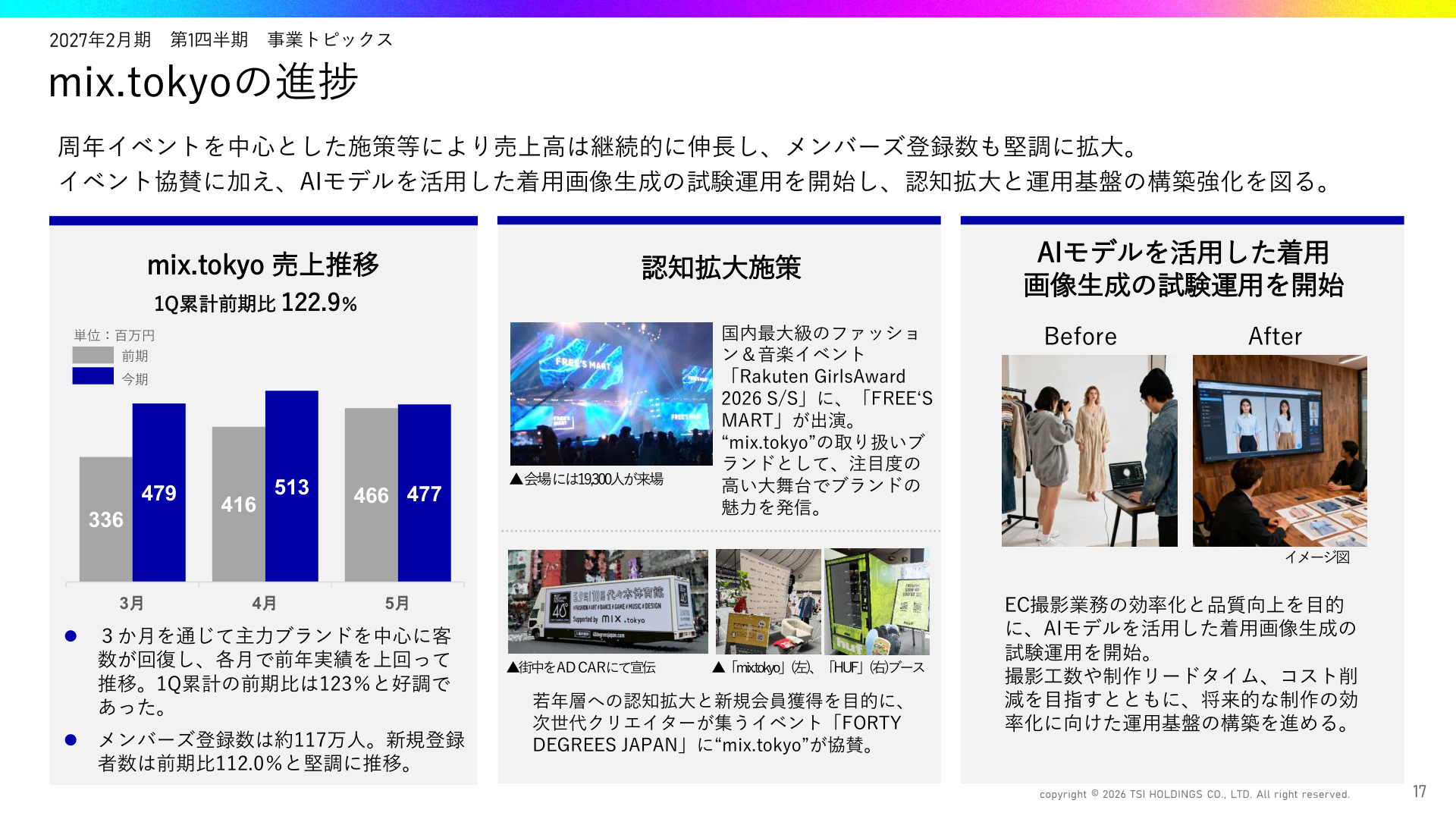
- Waterfront: Waterfront, which became a consolidated subsidiary in December 2025, performed steadily with a 10.0% increase year-on-year. The company is working to expand brand recognition and sales through promotional activities such as POP-UP events. It has also started handling products through group company proprietary EC sites like 'Daytona Park' and 'mix.tokyo', expanding customer touchpoints.
- mix.tokyo: Sales continue to grow steadily through anniversary events and other initiatives, and the number of registered members is also expanding. In particular, the company has begun trial operations for generating wearing images using AI models , aiming to improve the efficiency of EC photography and product quality, while strengthening the operational foundation for further recognition and utilization.
5. Promotion of Sustainability Management
TSI Holdings is strengthening its efforts to address environmental issues across the entire supply chain, and has received an 'A' rating in the CDP Supplier Engagement Rating for two consecutive years . This indicates the company's continued commitment to climate change response throughout its supply chain.
In terms of environmental initiatives, 'AVIREX' officially opened its reuse sales site, 'AVIREX ARCHIVE MARKET', launching a project to collect and maintain customers' beloved items and pass them on to new owners, allowing them to experience the brand's history and circularity. On the social front, the company continues its regional support activities in Kamikawa Town, Hokkaido, through a comprehensive partnership agreement, conducting golf experiences with the golf apparel brand 'Jack Bunny!!' and workshops utilizing leftover fabric to support the learning and growth of local children.
6. Strategy for the Second Quarter and Beyond
Following the strong results in the first quarter, TSI Holdings plans to pursue the following strategies for the second quarter and beyond:
- Enhancing 'Selling Power': Both consolidated and existing businesses achieved increased sales and profits, and the company feels confident in improving its 'selling power,' which was a challenge in the previous period, in addition to the results of structural reforms.
- Fostering Group Unity: With Daytona International and Waterfront joining the group, the company is promoting a sense of unity and consciousness reform across all existing businesses within the TSI Group.
- Improving Corporate Value: The company aims to enhance corporate value by strengthening all aspects: profit improvement and sales growth in existing businesses, growth investments (new business development and M&A), and shareholder returns (share buybacks and dividends).
The roadmap for improving corporate value is as follows:
This slide is highly significant as it clearly illustrates TSI Holdings' overall vision for enhancing corporate value and its specific resource allocation strategy to achieve it . The diagram shows the company's approach to allocating funds generated from cash flow to 'existing businesses,' 'growth investments,' and 'shareholder returns,' indicating that the company is pursuing a balanced approach to both short-term profits and long-term growth and shareholder returns. In particular, it demonstrates a multifaceted approach that builds upon profit improvement and sales growth in existing businesses, actively pursues growth investments such as new business development and M&A, and simultaneously strengthens shareholder returns through share buybacks and dividends.
Conclusion
TSI Holdings' first-quarter results for the fiscal year ending February 2027 show that the expansion of business scale through M&A, the recovery of existing businesses, and improvements in profitability through structural reforms created synergistic effects, leading to record-high operating profit . The growth of the EC channel, in particular, has been remarkable, clearly demonstrating the success of the digital shift strategy. M&A businesses such as Waterfront and mix.tokyo are also progressing steadily, with new initiatives like the utilization of AI models underway. The company's proactive stance on sustainability management is also commendable, and it aims to achieve sustained corporate value improvement in the second quarter and beyond through enhanced 'selling power' and fostered group unity.
This content is not intended as investment advice or a recommendation. Any opinions expressed are solely the personal views of each article.