

JADE GROUP (3558) Q1 FY2027 Earnings Deep Dive Report

StockClub
Published: Jul 16, 2026, 10:23 AM
Sentiment Analysis
JADE GROUP (Securities Code: 3558) reported significant growth across all key financial metrics for the first quarter of fiscal year 2027, including gross merchandise value (GMV), net sales, operating profit, EBITDA, and net income . This substantial increase in profitability is a clear indication of the successful implementation of its aggressive M&A strategy and subsequent Post-Merger Integration (PMI). The company is driving a continuous M&A strategy based on its 'Trinity' ecosystem and has set an ambitious long-term vision to achieve a GMV of ¥100 billion and an operating profit of ¥10 billion by 2030.
Q1 FY2027 Financial Highlights
For the first quarter of fiscal year 2027, consolidated results showed GMV (before offset) of ¥11.8 billion (up 1.3% year-on-year) and net sales of ¥5.73 billion (up 26.1% year-on-year) . In terms of profitability, operating profit reached ¥0.9 billion (up 61.2% year-on-year) , EBITDA was ¥1.04 billion (up 41.2% year-on-year) , and net income was ¥0.58 billion (up 61.5% year-on-year) , all recording substantial increases. The progress rate against the annual plan was also favorable, with operating profit at 35.9%.
This strong performance is attributed to the successful integration of companies acquired through M&A, such as Magaseek, ARIGATO (Thank You!), and Royal Logistics, with their logistics and IT integration contributing significantly. The PMI efforts continued to yield positive results in this quarter. Notably, the 'd fashion' segment within the EC Mall business experienced significant growth, while organic growth also continued to contribute.
The following slide provides a detailed overview of the current quarter's financial highlights.
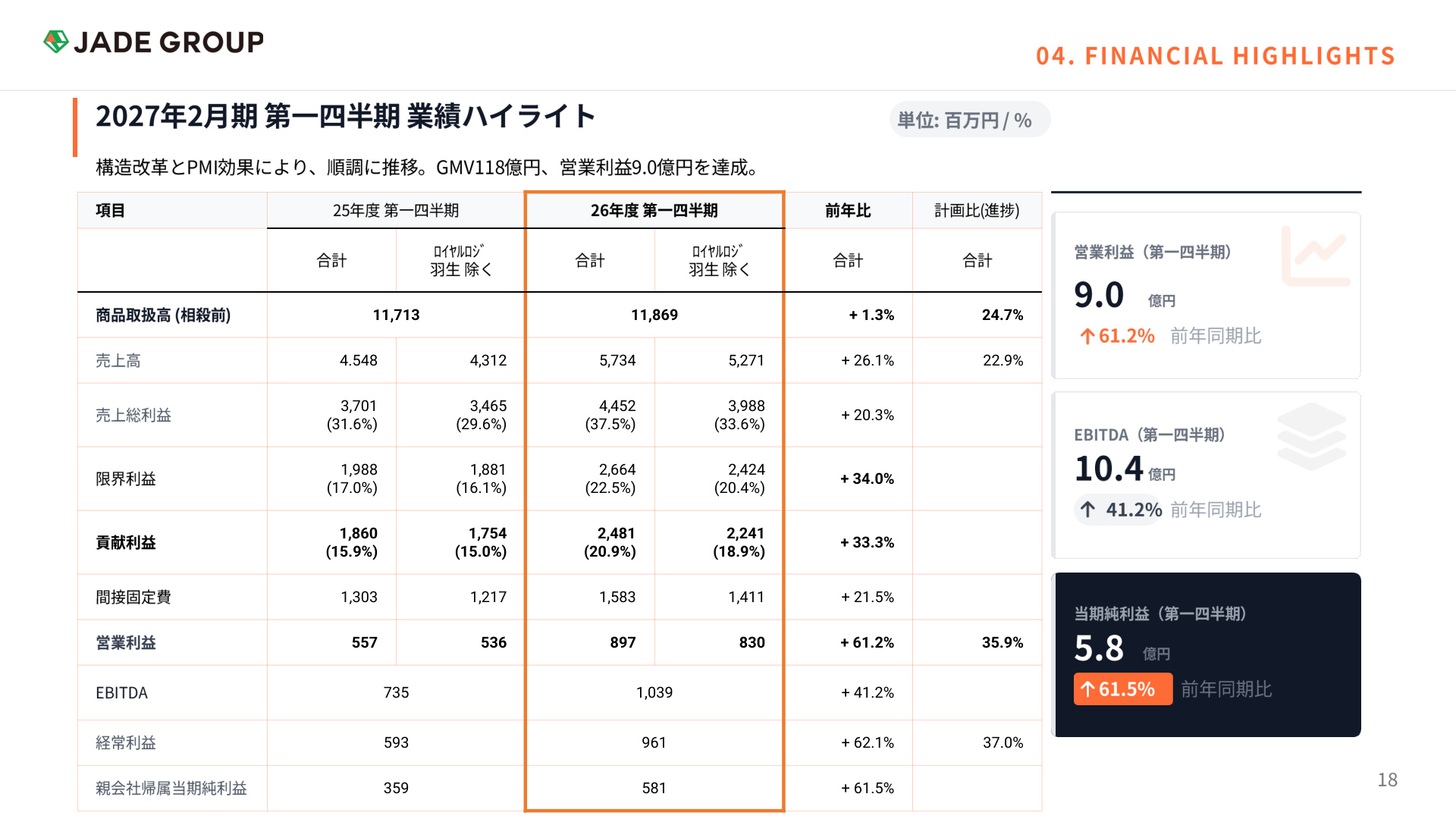 This slide clearly demonstrates significant year-on-year improvements across all major financial indicators , including GMV, net sales, operating profit, EBITDA, and net income. The substantial increase in profitability, particularly the 61.2% rise in operating profit and 61.5% rise in net income year-on-year, is noteworthy. This suggests that not only is revenue expanding, but the profitability is also improving steadily due to the integration effects of M&A . The slide also includes the progress rate against the annual plan, which is crucial for understanding the company's trajectory towards its full-year targets.
Profitability and Financial Health
The company primarily uses operating profit as its key performance indicator (KPI) for business profitability, while also considering EBITDA and net income as important metrics. In M&A activities, the goal is to increase not only EBITDA but also operating profit and net income. The 61.2% increase in operating profit this quarter is presented as evidence of the accuracy of their M&A valuation.
In terms of capital efficiency, based on LTM (Last Twelve Months) net income of ¥1.79 billion and average net assets of ¥7.87 billion for the same period, the ROE stands at 26.9% , maintaining a high level. This significantly exceeds the benchmark of 'ROE 10% or higher,' indicating the company's high capital efficiency . Furthermore, with an equity ratio of 59.1% (51.8% excluding non-controlling interests), the company maintains an extremely strong financial position. This robust financial foundation provides ample capacity for future aggressive M&A, as evidenced by its zero debt from financial institutions.
Regarding stock valuation, the PER is 9.2x based on LTM net income, which is considered low. Bringing this stock price level up to the industry average is identified as a key management theme. Additionally, with a dividend yield of 5.1% (including a ¥5,000 coupon and dividend yield), shareholder returns are also being strengthened.
Business Segment Performance
Looking at GMV by business segment, the EC Mall business recorded ¥6.19 billion (down 9.2% year-on-year) . This decrease was primarily due to sluggish performance in the Magaseek business, particularly 'd fashion' (EC Mall business), and the termination of contracts with ECS (PF business, JADE GROUP's BOEM) partner shops. In contrast, the Platform business generated ¥2.73 billion (down 19.9% year-on-year) , while the Brand business saw a significant increase to ¥2.81 billion (up 90.0% year-on-year) . The Brand business performed strongly, driven by the M&A effect of Thank You!. Overall, GMV showed a slight increase of 1.3% year-on-year.
M&A Strategy and PMI Model
The core of JADE GROUP's growth strategy lies in continuous M&A and PMI leveraging its 'Trinity' ecosystem . This ecosystem comprises three interconnected elements: 1. EC Mall, 2. Platform (PF), and 3. Brand , which collaborate to create synergies.
- EC Mall: EC sites like Locondo and d fashion. Strengths include try-before-you-buy services and one of the largest selections of women's shoes.
- Platform (PF): Achieves high-speed, high-quality operations and low costs through inventory sharing, infrastructure sharing, and shared logistics/IT infrastructure. It serves as the logistics hub for all businesses and is digitally managed.
- Brand: Own brands and brands acquired through M&A (e.g., Reebok Japan). Focuses on enhancing product differentiation and branding to achieve high profitability.
The company has established the 'JADE PMI MODEL' as a key to its M&A success. This model consists of three steps: STEP 01: CORE DRIVER (optimization of cost structure and common infrastructure through logistics x IT integration) , STEP 02: QUALITY (overwhelming improvement in quality, productivity, and speed through thorough QCD management) , and STEP 03: MANAGEMENT (maximization of ROI and speed of decision-making through ROI-focused management) . The company particularly emphasizes 'functional sharing type' M&A , which involves complete integration of logistics and IT functions. This approach is claimed to reliably lead to profit improvement, with a track record of '100% success rate.'
M&A investment criteria include 'payback within 3-5 years' (cumulative net income or after-tax contribution profit exceeding the investment amount) and 'profitable operation not only before but also after investment recovery' (focus on short-term P/L improvement, as well as medium- to long-term synergies and growth). Numerous past M&A achievements are presented, with PMI progress categorized as 'fully integrated,' 'substantially integrated,' or 'independently operated.'
Long-Term Vision and Growth Strategy Towards 2030
JADE GROUP has unveiled an ambitious long-term vision for 2030, aiming for 'both scale and profitability,' targeting a GMV of ¥100 billion and an operating profit of ¥10 billion . This represents significant growth from the 2025 GMV of ¥45.9 billion to ¥100 billion by 2030.
The following slide illustrates the trajectory of GMV in the long-term vision.
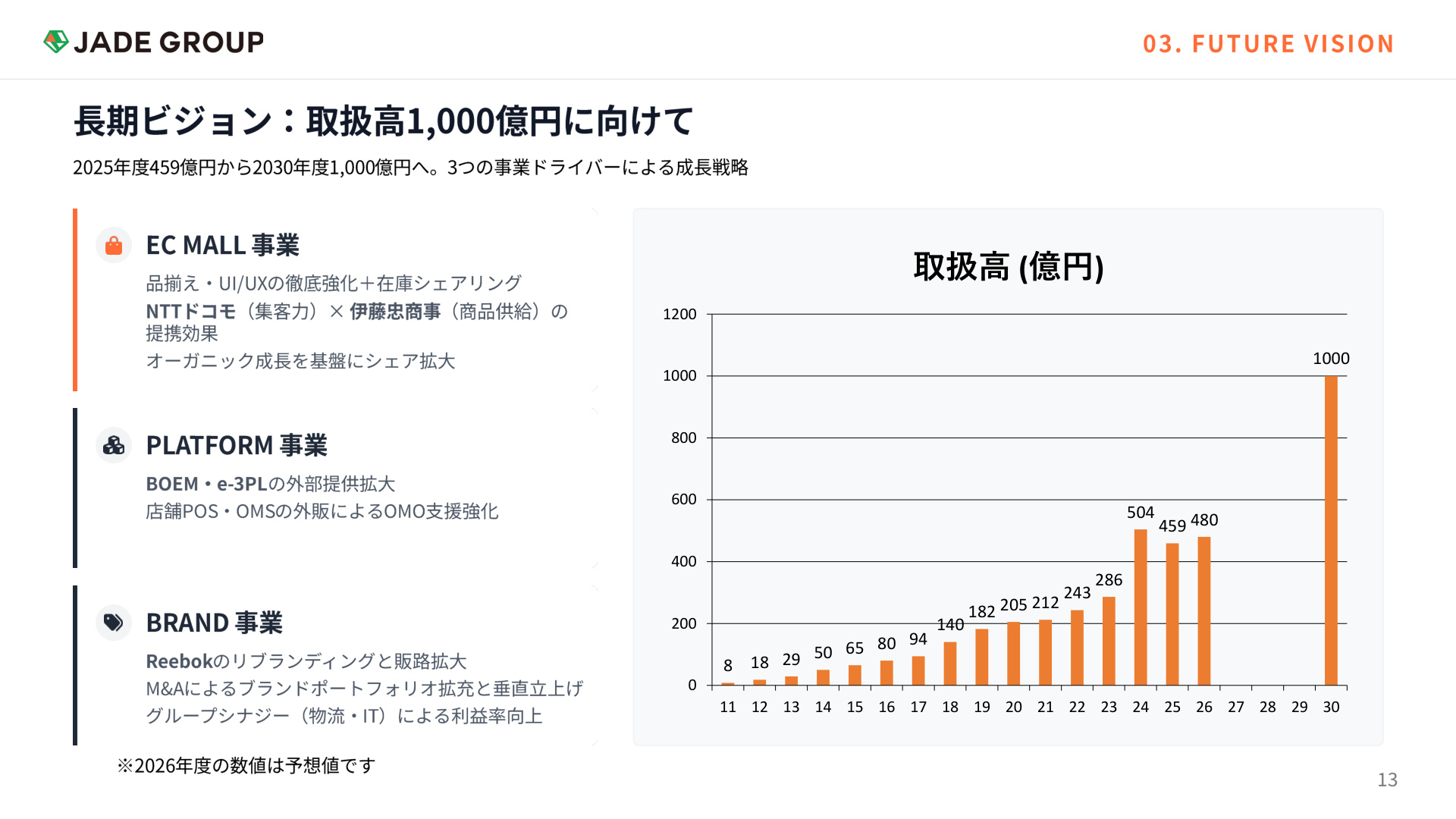 This slide visually represents the scale of JADE GROUP's ambitious target of ¥100 billion GMV by 2030 and its historical growth trajectory . The past GMV trends show rapid growth, particularly since the acceleration of M&A in recent years. The leap from ¥45.9 billion in FY2025 to ¥100 billion by 2030 reflects the company's strong commitment to aggressive M&A and organic growth strategies , making it a crucial graph for understanding the direction of future business expansion.
To achieve this goal, three key business drivers have been identified:
- EC MALL Business: Aims for enhanced product assortment, UI/UX improvements, inventory sharing, collaboration effects with NTT Docomo (customer acquisition) and Itochu Corporation (product supply), and market share expansion based on organic growth.
- PLATFORM Business: Seeks to expand external provision of BOEM and e-3PL services, and strengthen OMO support through external sales of store POS and OMS.
- BRAND Business: Focuses on rebranding and expanding sales channels for Reebok, expanding the brand portfolio through M&A and vertical integration, and improving profit margins through group synergies (logistics x IT).
The operating profit target of ¥10 billion is planned to be achieved through ¥100 billion in GMV, maintaining a contribution margin ratio of 16.0%, and controlling indirect fixed costs to ¥6.0 billion . The contribution margin ratio, excluding Royal Logistics and Magaseek's Hanyu, is targeted to be maintained at 16% or higher. Indirect fixed costs are planned to be controlled to ¥6.0 billion by 2030, from ¥5.1 billion in FY2025. By suppressing the increase in indirect fixed costs despite a significant expansion in GMV (from ¥45.9 billion to ¥100 billion), the company aims to maximize 'economies of scale' and achieve a lean cost structure to meet its targets.
Quarterly Trends in Operating Profit and EBITDA
Driven by the M&A effect of Royal, both operating profit and EBITDA have reached record high levels on a quarterly basis. The sharp increase from Q4 2026 to Q1 2027 is particularly notable.
The following slide illustrates the quarterly trends in operating profit and EBITDA.
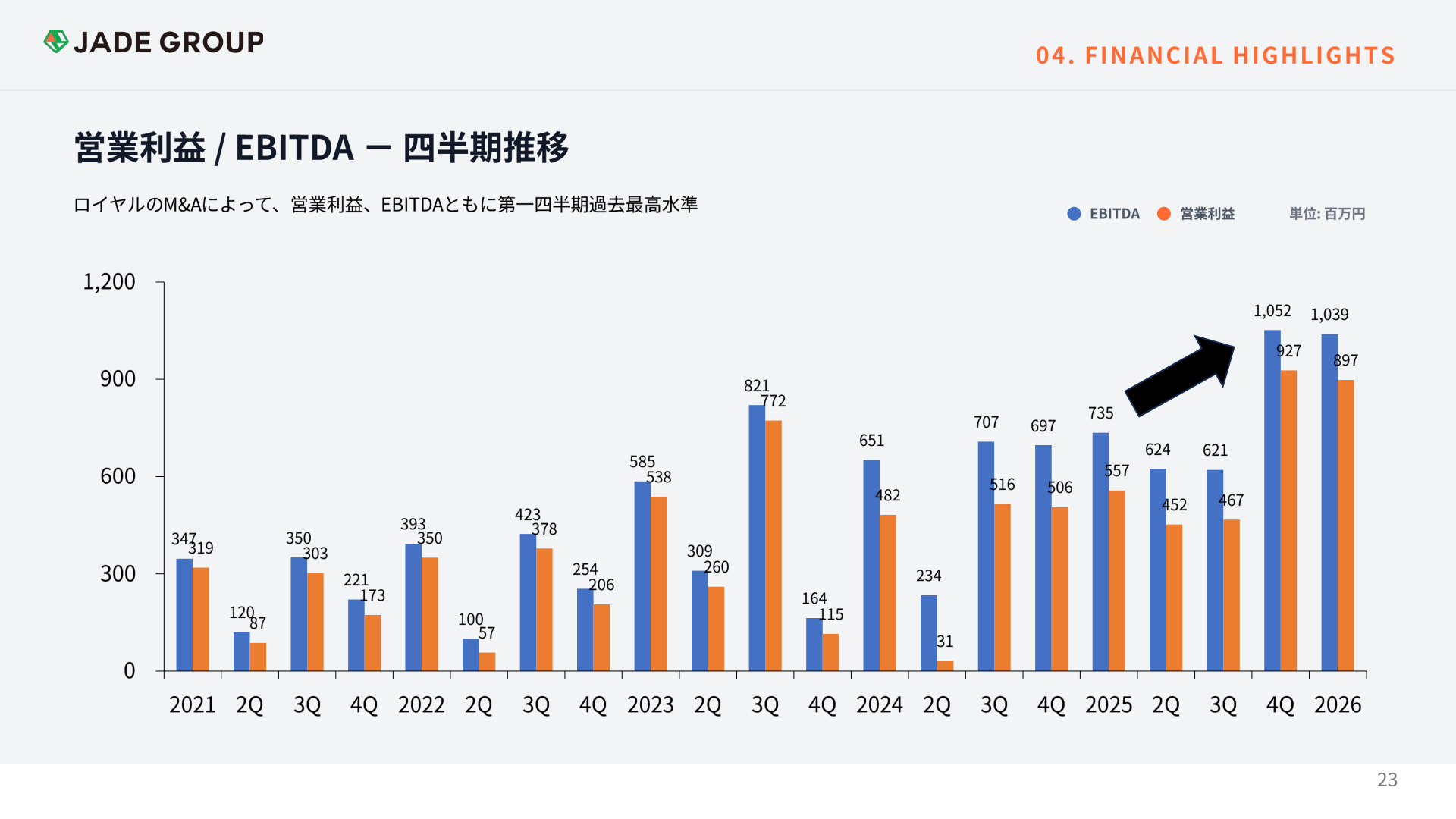 This slide clearly demonstrates how JADE GROUP's operating profit and EBITDA have trended on a quarterly basis . The effects of M&A, particularly those from 2024 onwards (such as Royal), are clearly visible, with both operating profit and EBITDA reaching record high levels . This graph supports the narrative that the company's M&A strategy and PMI are contributing to improved profitability, indicating a trend of sustained profit growth .
An analysis of operating profit year-on-year shows that increased GMV and changes in gross profit margin were significant positive factors, absorbing increases in costs such as rent, personnel expenses, and advertising expenses. This indicates that profitability improvements are being realized through structural reforms and PMI effects .
Financial Health and M&A Agility
While executing aggressive M&A, the company maintains a strong financial foundation through early PMI-driven profit improvements. Current assets stand at ¥10,157 million , of which cash accounts for ¥2,306 million , representing 22% of current assets. The current ratio is high at 188% , indicating strong short-term liquidity. Furthermore, with a very high equity ratio of 59.1% and effectively zero debt , the company is well-positioned with sufficient financial agility for future M&A activities.
This content is not intended as investment advice or a recommendation. Any opinions expressed are solely the personal views of each article.