


Nikke (Nippon Keori) (3201) Q2 FY2026 Earnings Deep Dive Report

StockClub
Published: Jul 16, 2026, 10:14 AM
Sentiment Analysis
Nippon Keori Co., Ltd. (Securities Code: 3201) achieved increased revenue and profit in its Q2 FY2026 earnings. Consolidated net sales reached JPY 59.71 billion (up 1.9% year-on-year), operating income was JPY 5.59 billion (up 13.6%), ordinary income was JPY 6.15 billion (up 12.8%), and net income attributable to owners of the parent was JPY 4.51 billion (up 27.4%). Notably, the operating profit margin improved by 1.0 percentage point from 8.4% in the previous year to 9.4%, indicating an improvement in profitability .
This strong performance was primarily driven by the consolidation effect of Kakotexnos in the Industrial Materials Business and the full-scale contribution of revenue from Yaesu-dori Fill Terrace in the Human & Future Development Business. On the other hand, the Apparel & Textile Business faced challenges due to an oversupply of school uniform inventory.
Below is a detailed analysis based on the key topics extracted from the latest financial results materials.
1. Q2 FY2026 Consolidated Earnings Highlights
Nikke's consolidated results for Q2 FY2026 showed net sales of JPY 59,710 million (up 1.9% year-on-year), operating income of JPY 5,590 million (up 13.6%), ordinary income of JPY 6,158 million (up 12.8%), and net income attributable to owners of the parent of JPY 4,512 million (up 27.4%). The increase in net sales was primarily due to the consolidation effect of Kakotexnos in the Industrial Materials Business. Operating income increased despite the impact of an oversupply of school uniform inventory in the Apparel & Textile Business, thanks to the consolidation effect of Kakotexnos and the full-scale revenue contribution from Yaesu-dori Fill Terrace in the Human & Future Development Business.
The overview of these consolidated results is detailed in the following slide.
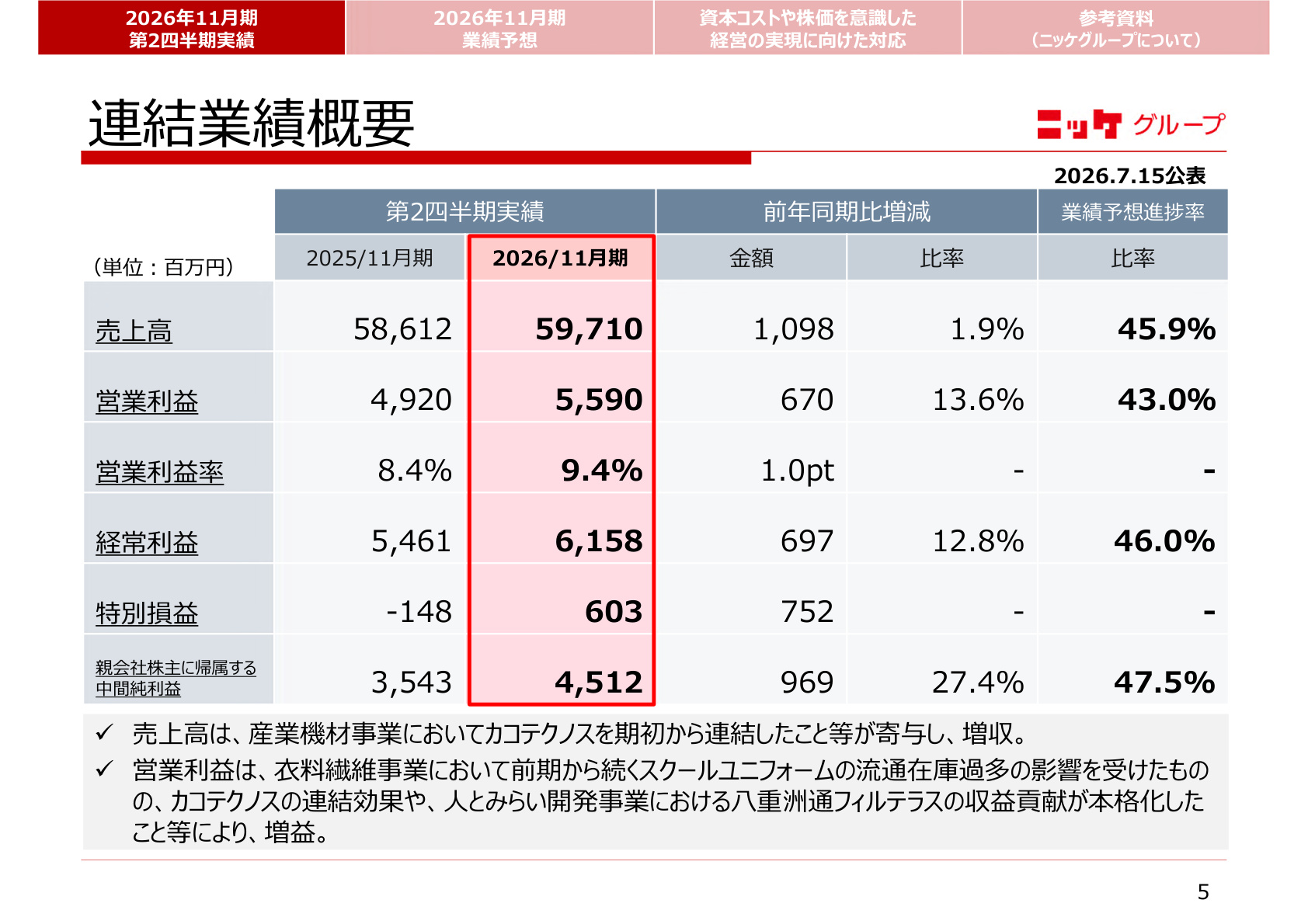
This slide is crucial for assessing the company's overall performance , as it clearly shows the year-on-year changes in consolidated net sales, operating income, ordinary income, and net income attributable to owners of the parent, as well as the progress rate towards the full-year forecast. The explicit mention of the Kakotexnos consolidation effect as a driver for increased net sales, and the improvement in operating profit margin from 8.4% to 9.4%, are key indicators of the company's improving profitability . The significant 27.4% increase in net income attributable to owners of the parent is also noteworthy.
2. Segment-Specific Performance Overview and Factor Analysis
Performance by segment is as follows:
- Apparel & Textile Business : Net sales of JPY 13,682 million (down 0.7% year-on-year), operating income of JPY 280 million (down 36.8%). The oversupply of school uniform materials impacted revenue and profit, but materials for government and public uniforms, particularly for police, performed strongly. Overseas textile sales also extended.
- Industrial Materials Business : Net sales of JPY 19,623 million (up 11.6% year-on-year), operating income of JPY 1,458 million (up 20.9%). Mobility-related products for FA contributed to increased sales, with the consolidation effect of Kakotexnos being a significant factor. OA-related materials and semiconductor-related equipment also contributed to increased sales.
- Human & Future Development Business : Net sales of JPY 12,882 million (down 1.6% year-on-year), operating income of JPY 3,878 million (up 15.5%). The revenue contribution from Yaesu-dori Fill Terrace in the real estate leasing business significantly boosted profits. Construction projects progressed steadily despite rising personnel costs, but the communication and new services segment was withdrawn in April 2026 due to business risks.
- Lifestyle & Distribution Business : Net sales of JPY 11,198 million (down 7.8% year-on-year), operating income of JPY 560 million (down 3.8%). While general merchandise and bedding saw reduced sales, equestrian products benefited from price revisions.
The quarterly trend of operating income by segment can be seen in the following slide.
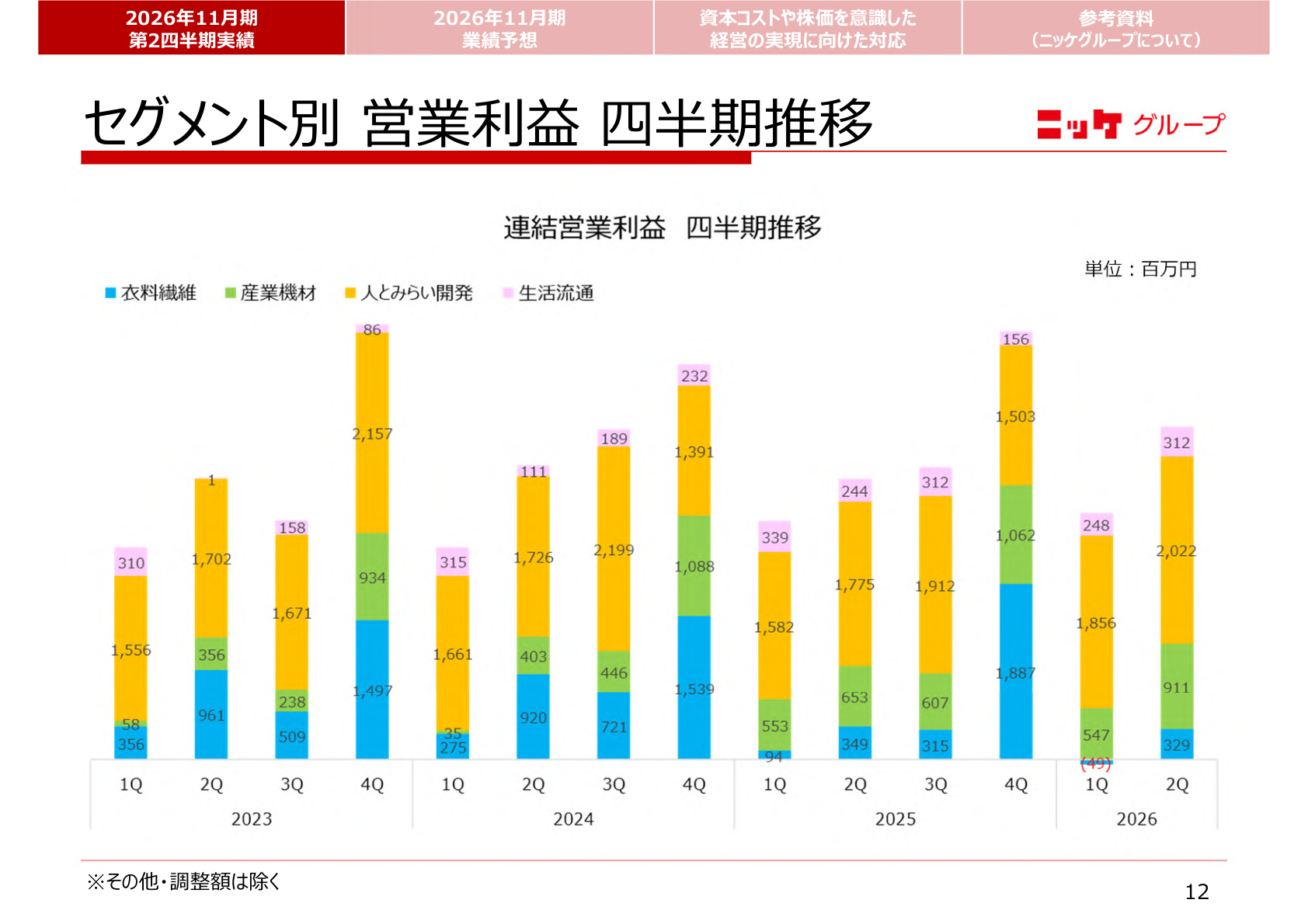
This slide is highly important for gaining a deeper understanding of the business structure , as it visually represents how operating income for each segment has trended quarter by quarter. From the graph, it can be observed that the Human & Future Development Business consistently generates high profits, the Industrial Materials Business has been increasing its profits in recent years, and the Apparel & Textile Business tends to have fluctuating profits. The situation where consolidated adjustments (other adjustments) are reducing profits can also be confirmed, allowing for tracking of seasonality, growth trends, and changes in profit contribution across each business over time .
3. Financial Position and Capital Expenditures
On the consolidated balance sheet, total assets at the end of May 2026 were JPY 195,326 million (up JPY 5,570 million from the end of the previous period), and total net assets were JPY 135,671 million (up JPY 3,518 million). Operating cash flow significantly increased to JPY 9,690 million, indicating that financial health is maintained.
Regarding capital expenditures, the plan for FY2026 is JPY 7.8 billion, with actual spending of approximately JPY 1.3 billion up to Q2. Key investment areas include real estate redevelopment (approx. JPY 1.32 billion), apparel fiber recycling and spinning equipment (approx. JPY 0.83 billion), apparel fiber core system (approx. JPY 0.57 billion), and non-woven fabric and felt-related equipment (approx. JPY 1.81 billion). Prudent investments are being made with an awareness of investment efficiency , and large-scale projects such as real estate redevelopment are generally progressing as planned.
4. Growth Strategies and Key Initiatives
Nikke is advancing the following strategies and initiatives for medium-to-long-term growth:
- Strengthening Domestic Integrated Production System (New Top Making Process at Gifu Plant) : The company aims to enhance its competitiveness in overseas markets by establishing a domestic production system. The objectives include strengthening competitiveness with high-quality 'Made in Japan wool,' reducing risks during raw material imports, enhancing traceability, and reducing environmental impact (20% reduction in CO2 emissions). Operations are scheduled to begin in March 2027.
- Promoting the WAONAS Circular Project : Through collaboration with local governments, schools, and infrastructure companies, Nikke aims to accelerate the recycling of wool-blend clothing from 'garment to garment' and contribute to a decarbonized and circular society. Concrete collaborations are underway with Kasuga City in Fukuoka Prefecture and the Keisei Group.
- Strengthening Non-woven Fabric and Felt Business as a Growth Driver : The non-woven fabric and felt business, a core part of the Industrial Materials Business, has expanded its scale through M&A (acquisition of Kakotexnos and Kureha Tech), leading to a fourfold increase in sales and a sixfold increase in operating income since 2020 . Going forward, the plan is to expand overseas sales, primarily in North America and the ASEAN region, with a focus on strengthening the production system in Vietnam and Indonesia.
5. Business Environment Recognition and Impact of Middle East Situation
Business environment recognition for each segment is as follows:
- Apparel & Textile Business : While the domestic market is shrinking due to the declining birthrate, the global market is expected to grow. Challenges include strengthening the domestic integrated production system and rebuilding the value chain. The business is also affected by rising raw material and energy costs.
- Industrial Materials Business : The automotive-related sector is affected by US tariff policies and market conditions in China, but the environmental-related sector sees expanding global business opportunities. The expansion of the recycling business and SDG-conscious markets is also anticipated.
- Human & Future Development Business : Shopping centers require community-rooted operations. In real estate development, value enhancement of ZEB Ready certified properties is important, and the care-related market in the life support sector is expected to grow, but a shortage of care workers is a challenge.
- Lifestyle & Distribution Business : While the convenience of the e-commerce market is increasing, competition is intensifying due to the entry of overseas players and direct sales by manufacturers. Raw material and logistics costs continue to rise, as do advertising expenses.
The impact of rising raw material and energy costs due to the Middle East situation is expected to be a downward factor of approximately JPY 150 million on current period operating income. However, countermeasures such as early procurement, production rationalization, and product price pass-through are being implemented.
6. Full-Year FY2026 Earnings Forecast
The full-year earnings forecast for FY22026 remains unchanged, anticipating increased revenue and profit . Net sales are projected to be JPY 130 billion (up 8.9% year-on-year), operating income JPY 13 billion (up 9.1%), ordinary income JPY 13.4 billion (up 3.3%), and net income attributable to owners of the parent JPY 9.5 billion (up 4.5%). By segment, the Apparel & Textile Business and Lifestyle & Distribution Business have revised their operating income forecasts downwards due to current business conditions, while the Industrial Materials Business has revised its operating income forecast upwards due to strong performance.
7. Management Conscious of Capital Costs and Share Prices, and Medium-to-Long-Term Vision 'RN130'
Nikke is strengthening its initiatives towards realizing management conscious of capital costs and share prices . Specifically, it aims to enhance profitability, improve asset efficiency, strengthen capital policy, and reinforce IR activities.
- Strengthening Profit Generation : Promotion of the RN130 3rd Medium-Term Management Plan and review of the business portfolio.
- Improving Asset Efficiency : Further optimization of owned real estate, compression of non-operating assets, and using ROE as an investment criterion (target 8%, minimum 5%).
- Strengthening Capital Policy : Shareholder returns (dividend payout ratio target 35%), M&A, and treasury stock acquisition.
- Reinforcing IR : Dialogue with stakeholders, explanation of M&A strategies and business diversification, and expansion of information disclosure.
Through these efforts, the company aims to achieve an ROE target of 8% and a PBR of over 1x .
The medium-to-long-term vision 'RN130' sets targets for the future towards the company's 130th anniversary: net sales of JPY 200 billion, operating income of JPY 13 billion, and ROE of 8% or more . The 3rd Medium-Term Management Plan, with FY2026 as its final year, targets net sales of JPY 130 billion, operating income of JPY 13 billion, and ROE of 8% or more. In FY2025, the company achieved its targets for ordinary income and net income attributable to owners of the parent. For FY2026, as the final year of the medium-term plan, the company plans to further grow sales and profits and improve capital efficiency, while strengthening its foundation for future growth.
This medium-to-long-term vision is presented in its entirety in the following slide.
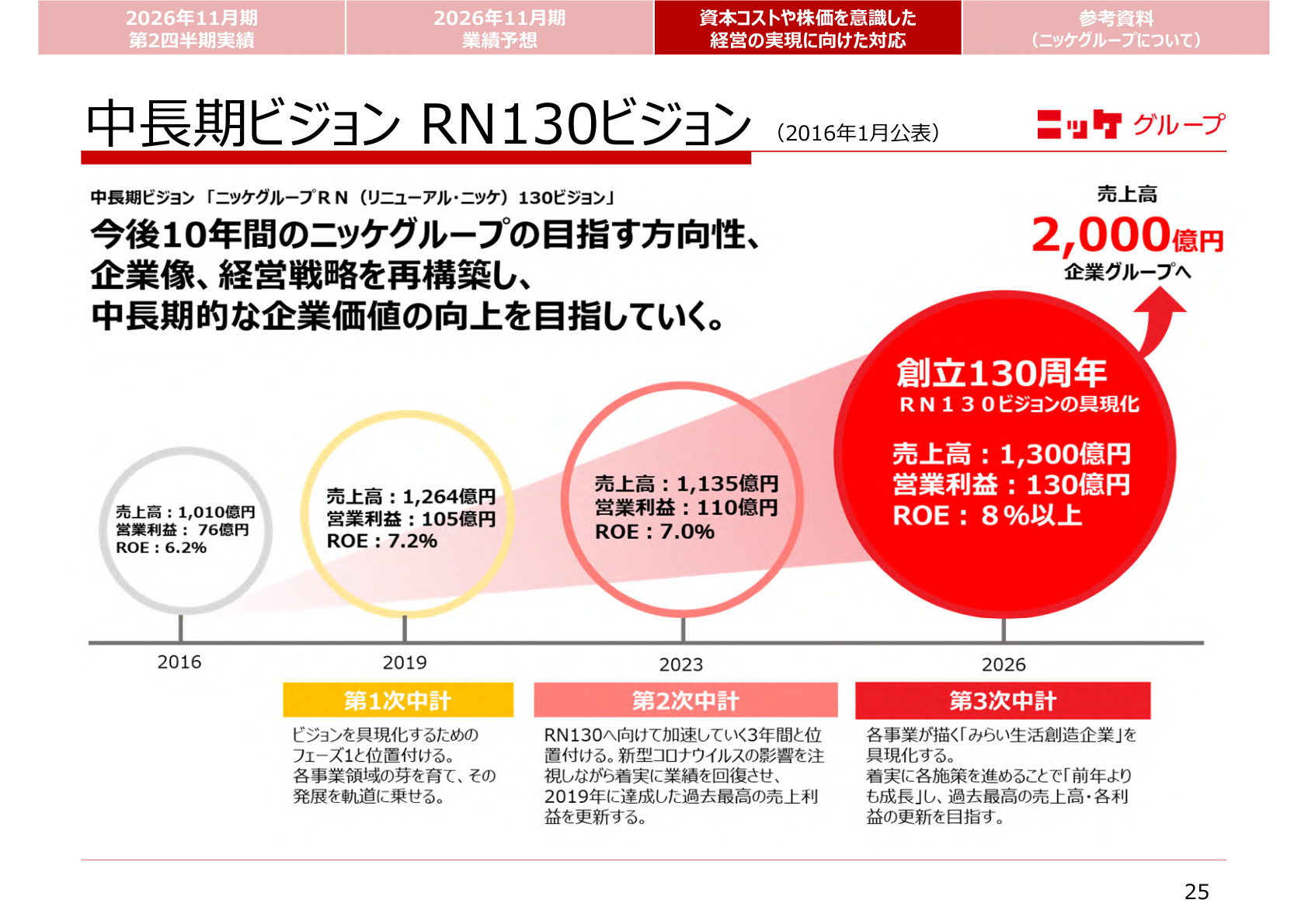
This slide is extremely important for evaluating the company's long-term growth potential and management's commitment , as it outlines the company's long-term growth strategy and specific numerical targets. The targets for the 3rd Medium-Term Management Plan, which concludes in FY2026, and the vision for the '130th Anniversary of Foundation' are clearly defined, indicating a strong will to enhance corporate value through aggressive growth investments and business portfolio transformation, rather than merely maintaining the status quo . In particular, the ROE target of 8% or more is a concrete indicator for realizing management conscious of capital costs, suggesting a high awareness of shareholder value creation .
Conclusion
Nikke achieved increased revenue and profit in Q2 FY2026, primarily driven by its Industrial Materials Business and Human & Future Development Business. While challenges are observed in the Apparel & Textile Business, the company aims to strengthen competitiveness and contribute to sustainability through new initiatives such as strengthening its domestic integrated production system and the WAONAS circular project. Furthermore, the non-woven fabric and felt business is positioned as a growth driver, with active promotion of M&A and overseas expansion. From a medium-to-long-term perspective, Nikke has clearly articulated its policy to pursue management conscious of capital costs and share prices based on the 'RN130' vision, aiming to achieve an ROE target of 8% and a PBR of over 1x . The progress of future business portfolio transformation and capital efficiency improvements will be closely watched.
This content is not intended as investment advice or a recommendation. Any opinions expressed are solely the personal views of each article.