


Horiifood Service (3077) FY2026 Q2 Earnings Deep Dive Report: Laying the Groundwork for Sustainable Growth through High Growth and Strategic Investments

StockClub
Published: Jul 16, 2026, 10:13 AM
Sentiment Analysis
Horiifood Service (Securities Code: 3077) achieved significant increases in sales and all profit items, recording a high progress rate towards its full-year earnings forecast for the second quarter of the fiscal year ending November 2026 (December 2025 - May 2026). This strong performance can be attributed to a combination of improvements in existing businesses, promotion of DX, capture of inbound demand, and the development of new high-profitability business formats.
Earnings Highlights and Full-Year Progress
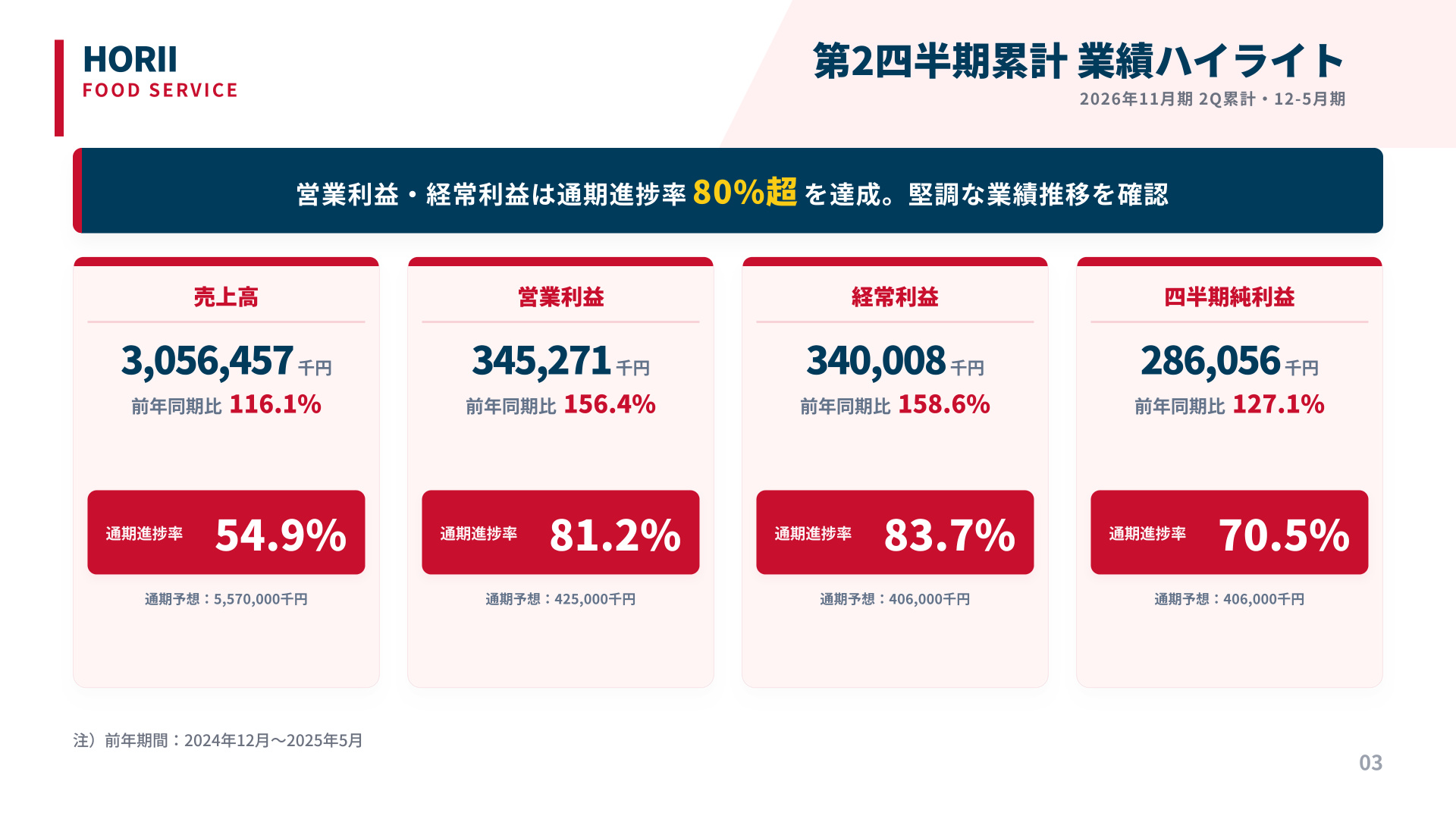
For the cumulative second quarter, sales reached 3,056,457 thousand yen (up 116.1% year-on-year), operating profit was 345,271 thousand yen (up 156.4%), ordinary profit was 340,008 thousand yen (up 158.6%), and net profit was 286,056 thousand yen (up 127.1%). Notably, operating profit and ordinary profit showed a high progress rate exceeding 80% against the full-year forecast , indicating performance significantly ahead of initial plans.
The following slide presents the earnings highlights for the cumulative second quarter. It clearly shows that sales, operating profit, ordinary profit, and net profit have all achieved significant year-on-year growth. Furthermore, the fact that the progress rate against the full-year forecast exceeds 80% for each profit item suggests that the company is well on track to meet its initial targets, clearly demonstrating the business's momentum.
This performance demonstrates remarkable growth even when compared to the previous full fiscal year (an 8-month shortened period). The operating profit for the current cumulative second quarter (6 months) was 345,271 thousand yen, a substantial increase of 195,998 thousand yen over the previous full year's (8 months) operating profit of 149,273 thousand yen in just six months. Ordinary profit also recorded a similar increase of 180,753 thousand yen, clearly indicating an acceleration in profitability improvement.
Upward Revision of Earnings Forecast and Contributing Factors
In response to the strong second-quarter results, the company revised its full-year earnings forecast upwards. Sales were increased by 270,000 thousand yen (+9.7%) from the previously announced forecast of 2,786,000 thousand yen to 3,056,000 thousand yen. Operating profit was raised by 93,000 thousand yen (+36.9%) from 252,000 thousand yen to 345,000 thousand yen. Ordinary profit increased by 98,000 thousand yen (+40.5%) from 242,000 thousand yen to 340,000 thousand yen, and net profit attributable to owners of the parent increased by 44,000 thousand yen (+18.2%) from 242,000 thousand yen to 286,000 thousand yen.
The main reasons for this upward revision include higher-than-expected reservation acquisition during peak seasons starting in December and January, efficiency improvements through DX promotion, strong performance of new business formats catering to inbound demand, business model changes in existing stores, and the implementation of grand menu reviews and cost optimization.
Segmental Performance and Growth Drivers
By business segment, the domestic business showed solid growth with sales of 2,917,310 thousand yen (up 10.9% year-on-year) and operating profit of 298,431 thousand yen (up 35.2%). In addition, the inbound business is significantly contributing as a new revenue pillar , reporting sales of 139,147 thousand yen, operating profit of 46,840 thousand yen, and a high operating profit margin of 33.6% . As the inbound business did not exist in the previous period, its contribution this fiscal year represents a net increase in performance.
In existing businesses, DX (Digital Transformation) initiatives have significantly contributed to sales improvement and operational efficiency . The introduction of mobile ordering, optimization of reservation channels, rapid management decisions based on headquarters data utilization, and the implementation of AI operator "miraio" are progressing. Overall store sales increased by 116.6% year-on-year, and existing store sales also showed a solid increase of 108.4%. Notably, a clear correlation between Google review scores and sales has been confirmed , indicating a strategy where improving review scores leads to sales expansion.
Profit Structure Improvement and Success of New Business Formats
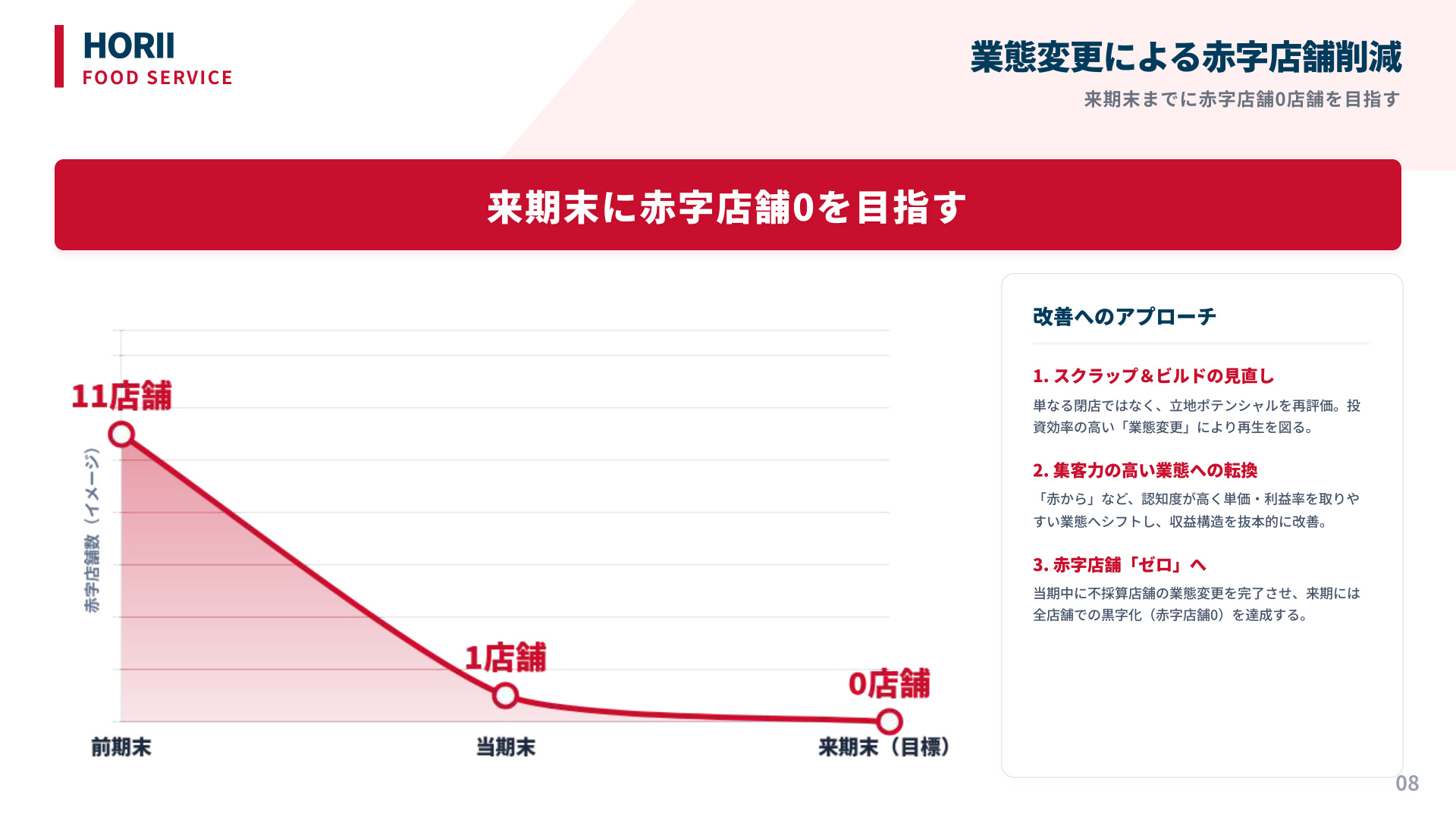
The company is also actively working to improve the profitability of underperforming stores. The number of loss-making stores, which was 11 at the beginning of the period, has been reduced to 1 by the end of the current period, with a clear goal of achieving zero loss-making stores by the end of the next fiscal year . This approach involves not just closures, but rather re-evaluating location potential and revitalizing stores through conversion to highly efficient business formats.
The following slide illustrates the trend of reducing loss-making stores and the target. It visually shows the reduction from 11 loss-making stores at the beginning of the period to 1 by the end of the current period, with a concrete goal of 0 stores by the end of the next fiscal year. This demonstrates the progress of a crucial strategy to strengthen the company's overall profit structure through exiting unprofitable businesses or converting them to high-profitability formats.
This strategy has already yielded concrete results. For example, the "Akakara Tagajo store" saw sales increase by 287.6% year-on-year and operating profit by 387.0%, achieving profitability. The "Akakara Aeon Mall Mito Uchihara store" also showed astonishing growth, with sales up 355.2% and operating profit up 1,254.5%. These success stories underscore the effectiveness of the strategy to maximize the utilization of existing assets and convert them into high-profitability models .
Furthermore, the new business format, "KOBE Beef Emperor Steak," is establishing itself as a new growth driver . The Shinjuku Kabukicho store has established a high-profitability model with monthly sales of 20 million yen and an annual operating profit of 100 million yen. Moreover, the Kyoto Sanjo store, which opened on May 1st, achieved sales of 13 million yen in its first month and became profitable, verifying the success of the "sky-high model" even in locations less dependent on street-level visibility . This enables the deployment of a high-profitability model with low location dependency, paving the way for future multi-store expansion.
M&A Strategy and Future Growth Outlook
The M&A strategy is also being actively pursued, with the roll-up model for Seiko Corporation currently in progress. In the cumulative second quarter, it recorded sales of 111.35 million yen and operating profit of 23.18 million yen, with synergy effects being pursued through PMI (Post-Merger Integration) including operational improvements, personnel exchange, and enhanced digital customer acquisition. Additionally, on June 1, 2026, the company acquired Kumagaki Foods, which operates a takeout sushi and bento business, aiming to expand into the Western Japan area and strengthen its ready-to-eat meal business.
The future growth strategy is centered around four key themes: "further profit improvement of existing stores," "business model changes," "acceleration of new business formats," and "acceleration of M&A." Specifically, the company aims to establish a 20% profit margin structure by 2028 , planning a significant improvement from the current operating profit margin of 11.3%.
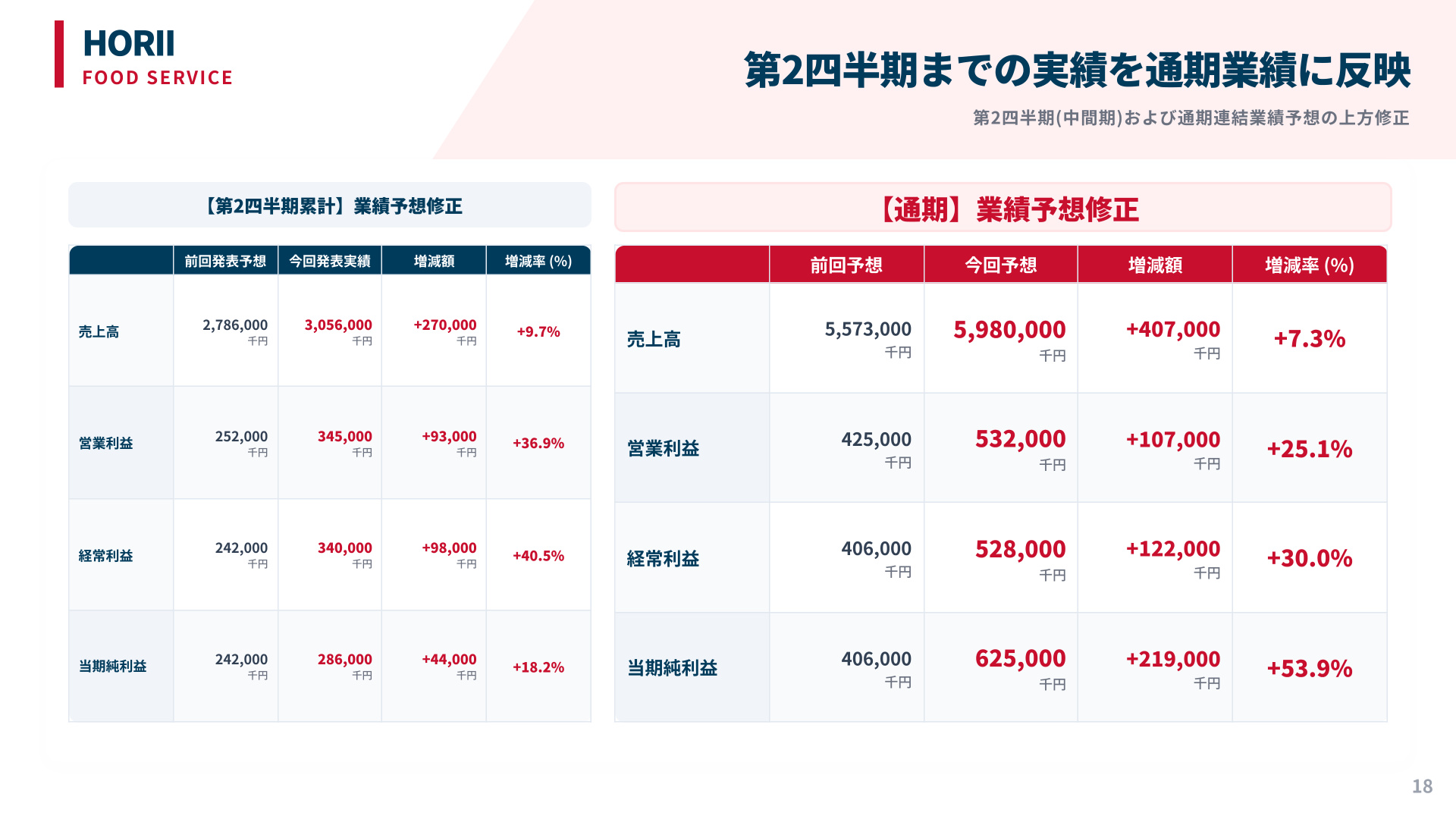
The full-year earnings forecast has been revised upwards again, reflecting the strong performance up to the second quarter. Sales are projected to be 5,980,000 thousand yen (up 7.3% from the previous forecast), operating profit 532,000 thousand yen (up 25.1%), ordinary profit 528,000 thousand yen (up 30.0%), and net profit 625,000 thousand yen (up 53.9%).
The following slide details the revised full-year earnings forecast based on the performance up to the second quarter. It shows a significant upward revision from the previous forecast across all items: sales, operating profit, ordinary profit, and net profit. Notably, the change in net profit is very high at +53.9%, reflecting strong expectations for improved overall corporate profitability. This revision incorporates both the strong past performance and strategic investment plans for the second half of the year.
Behind this upward revision is the strategic positioning of the second half as a "preparation period for sustainable growth towards the next fiscal year," involving proactive strategic investments in new store opening costs, rebranding expenses for profitable stores, and M&A-related costs (including PMI costs). While these strategic investments may temporarily suppress short-term profits, they are considered crucial groundwork for achieving significant growth and the 20% profit margin structure in the fiscal years to come.
For new store openings, a total of 6 stores are planned, comprising 2 existing business format stores and 4 new business format stores. The expansion of the new "KOBE Beef Emperor Steak" format is positioned as a key growth driver for increasing average customer spend. The company aims to open flagship stores in urban areas like Osaka Namba and Shibuya Center-gai, combining inbound demand with experiential value, and has specifically outlined a business acceleration scenario targeting an annual profit contribution of 300 million yen from these initiatives.
This content is not intended as investment advice or a recommendation. Any opinions expressed are solely the personal views of each article.