

INGS (245A) Q3 FY2026 Earnings Deep Dive Report

StockClub
Published: Jul 16, 2026, 10:10 AM
Sentiment Analysis
INGS (Securities Code: 245A) achieved significant growth in both net sales and operating profit in the third quarter of the fiscal year ending August 2026. Robust performance from existing stores, coupled with aggressive new store openings, drove the results, indicating steady progress towards achieving full-year targets.
I. Q3 FY226 Earnings Highlights
1. Sales and Profit Growth
For the cumulative third quarter of the fiscal year ending August 2026, net sales reached 6,926 million JPY , marking a substantial increase of 1,228 million JPY ( +21.6% ) compared to the same period last year. This growth was primarily driven by the strong performance of existing stores, with ramen business sales at 101.6% and restaurant business sales at 103.4% year-on-year, further bolstered by contributions from new store openings.
In terms of profitability, operating profit reached 480 million JPY (up 104 million JPY year-on-year, +27.9% ), and the operating profit margin improved to 6.9% (up 0.3 percentage points year-on-year). The gross profit margin also improved to 67.2% (up 0.4 percentage points year-on-year), attributed to factors such as menu changes, recipe revisions, and an increased proportion of direct store sales. Ordinary profit was 463 million JPY (up 36.4% year-on-year), and net profit was 307 million JPY (up 37.5% year-on-year), all demonstrating high growth rates.
2. Progress of Key Performance Indicators (KPIs)
Key performance indicators, crucial for measuring corporate growth, showed favorable trends in both new store openings and existing store sales. The net sales growth rate for the cumulative third quarter reached 21.6% , a result of the combined effect of new store contributions and the growth of existing stores across both business segments. 11 direct stores and 12 franchise stores were newly opened, steadily expanding the store network. Existing store sales for the ramen business were 101.6% year-on-year, and for the restaurant business, 103.4% year-on-year, both exceeding the previous year's levels, suggesting that the customer attraction and profitability of existing stores are being maintained.
The following slide visually presents these key KPIs, making it clear that the primary drivers of sales growth are both new store openings and the robust performance of existing stores.
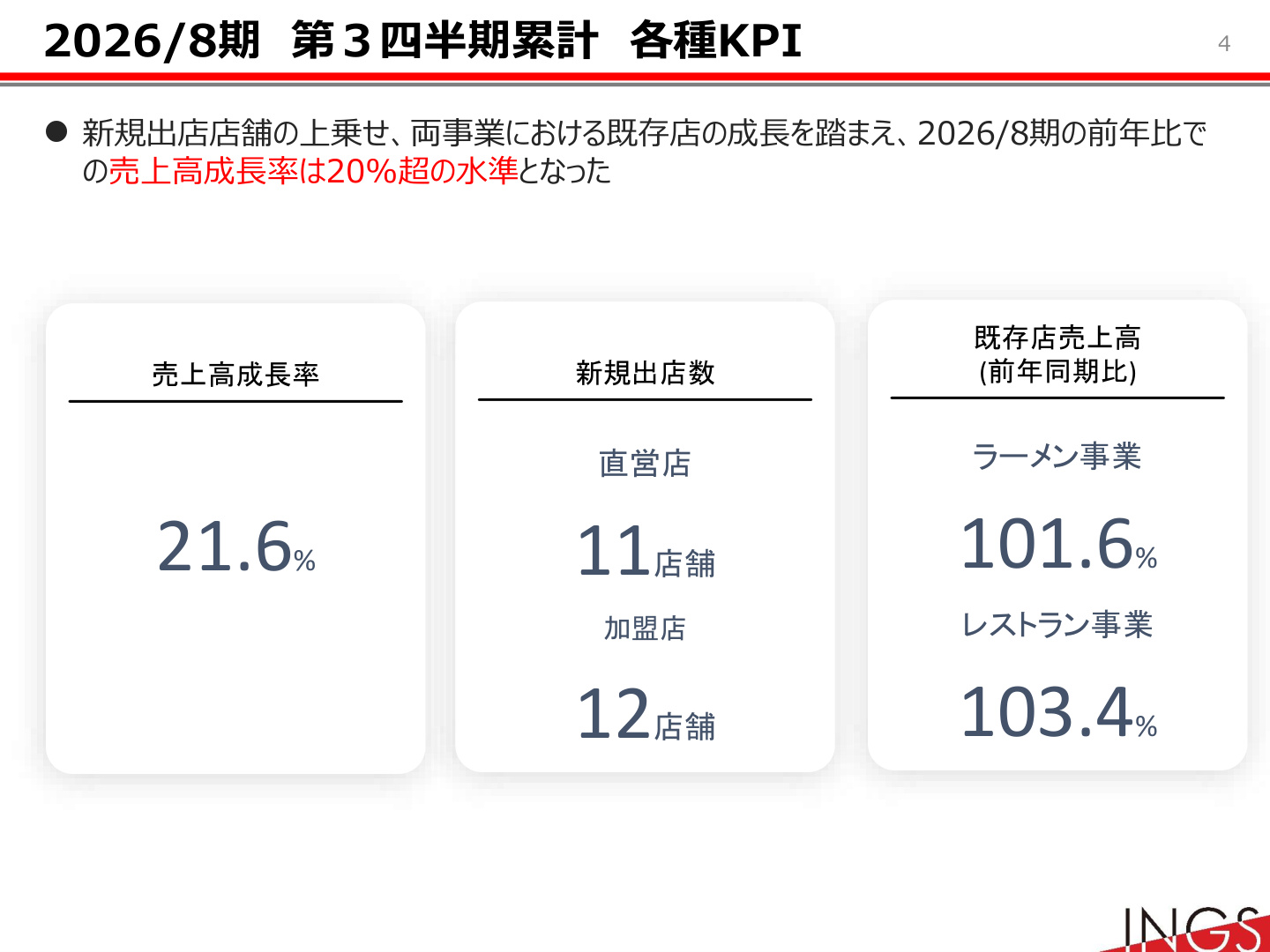 This slide succinctly illustrates that INGS's growth strategy is built on two pillars: expanding the store network through new openings and maintaining/improving sales at existing stores. The fact that existing store sales exceed 100% in both businesses is a crucial indicator, affirming not only an increase in store count but also the sustained operational efficiency and brand power of each location.
3. Segment Performance Analysis
From a business segment perspective, both the ramen and restaurant businesses contributed to performance expansion.
- Ramen Business : Net sales were 3,763 million JPY (up 765 million JPY year-on-year), and operating profit was 359 million JPY (up 64 million JPY year-on-year). The operating profit margin remained high at 9.6%.
- Restaurant Business : Net sales were 3,163 million JPY (up 463 million JPY year-on-year), and operating profit was 121 million JPY (up 40 million JPY year-on-year). The operating profit margin showed an improving trend at 6.4% (up 0.4 percentage points year-on-year).
Both segments saw increases in net sales and operating profit, with the improvement in the restaurant business's profit margin being particularly noteworthy. This suggests that each business is maintaining its competitiveness and enhancing profitability in its respective market.
4. Balance Sheet Overview
As of the end of the third quarter of the fiscal year ending August 2026, total assets stood at 5,110 million JPY , an increase of 546 million JPY from the end of the same period last year. Net assets also increased by 310 million JPY to 2,271 million JPY. The primary reason for this asset growth is capital investment related to new store openings (increase in tangible and other investment assets) , utilizing funds from the IPO, indicating active investment for business expansion. Intangible fixed assets decreased due to amortization of goodwill and similar items.
II. Growth Strategy and Business Development
1. Acceleration of Direct Store Expansion
In the third quarter, INGS opened 3 new direct stores in the ramen business and 1 in the restaurant business. In the ramen business, new openings included "Ramen Hayashida" and "Yokohama Iekei Ramen Midori" in Sendai, indicating active expansion into regional cities . In the restaurant business, one new "CONA" store was opened, expanding the network of key brands.
2. Expansion Strategy for Produce/License Business
Alongside direct store expansion, the produce/license business is also a crucial pillar of growth. In the restaurant business, one new franchise store opened, and expansion is spreading not only in the Tokyo metropolitan area but also into regional areas . This strategy allows for flexible store openings tailored to regional market characteristics, aiming for nationwide brand penetration.
3. Ramen Business Brand Strategy and Produce Division Advantages
In the direct store division of the ramen business, "Ramen Hayashida" is the main brand with 29 stores, and "Yokohama Iekei Ramen Midori" has newly opened 3 stores. By offering various genres of ramen, the company caters to a wide range of customers.
Particularly noteworthy is the Ramen Business Produce Division . This division provides support for opening ramen stores and sells private label (PB) products. The biggest feature is that owners can operate stores under their own unique brand names . Furthermore, with zero franchise fees and training costs , and a low monthly fee of 50,000 JPY, owners can open stores with significantly reduced initial investment . The possibility of opening stores in existing premises also contributes to an extremely low barrier to entry for new participants , facilitating rapid store network expansion.
The following slide explains this innovative business model of the Produce Division. This low-risk, low-cost model for owners to start independent businesses is a powerful driver accelerating the growth of INGS's ramen business and is expected to contribute significantly to future store count increases.
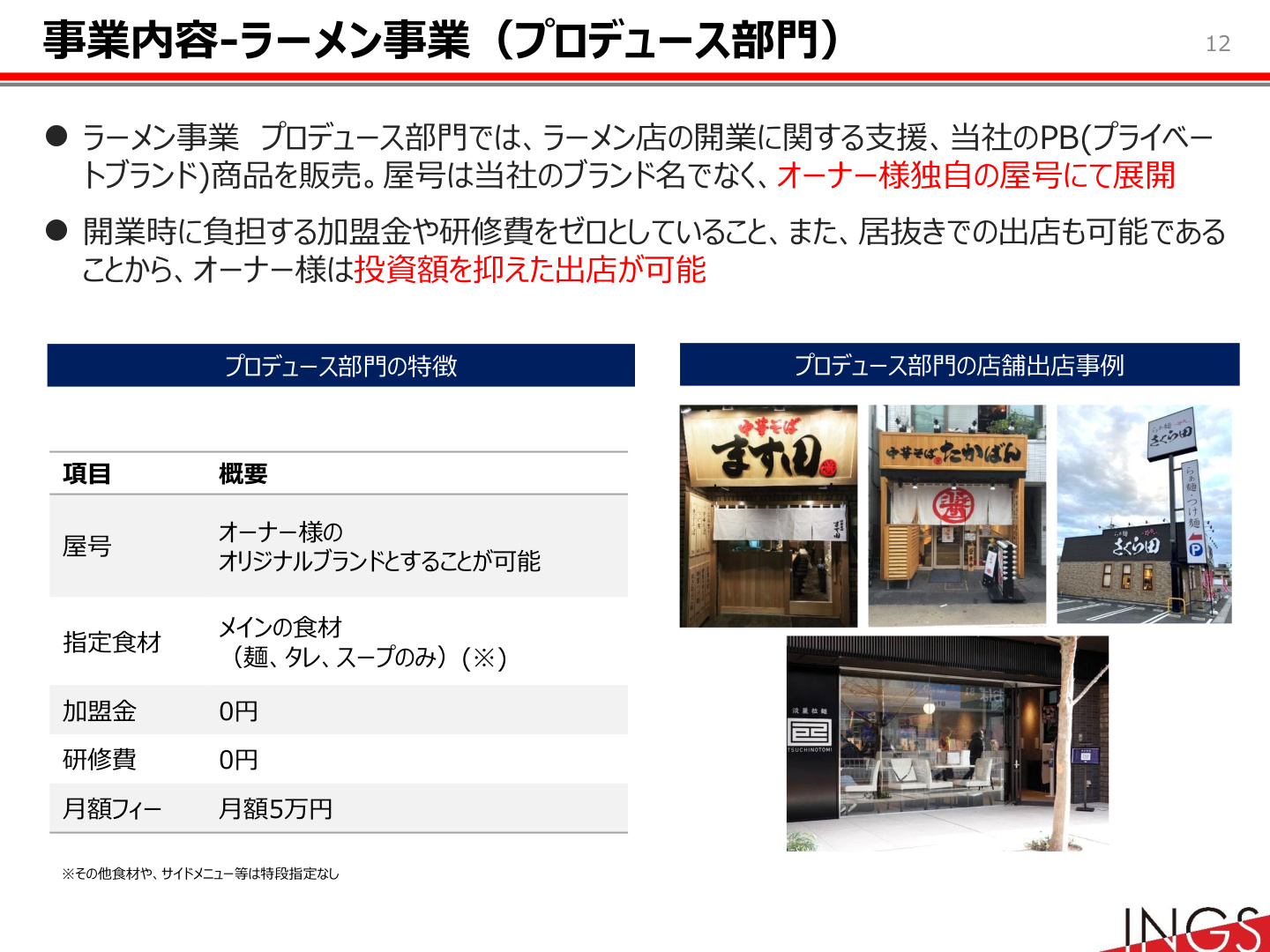 This slide demonstrates that INGS is not merely pursuing direct store expansion but is innovatively evolving the franchise model . The flexibility for owners to operate under their own brand and the zero franchise/training fees, which significantly lower initial investment, represent a highly attractive proposition for many independent chefs and entrepreneurs. This allows INGS to leverage its brand power while expanding its store count in a capital-efficient manner.
4. Restaurant Business Brand Strategy and Nationwide Expansion Model
In the restaurant business, INGS operates two brands: "CONA" (handmade kiln-baked pizza) and "Shumai no Joe" (dumplings and Chinese cuisine). Both brands offer reasonable price points with an average customer spend of around 2,500 JPY, and they have established a model for nationwide expansion, including regional areas, through both direct and licensed stores . "Shumai no Joe" particularly focuses on attracting younger customers by offering visually appealing, SNS-friendly menu items.
III. Outlook and Growth Plan
1. Store Count Expansion Plan
INGS has consistently increased its store count, even during the COVID-19 pandemic. While the total store count was 174 as of August 2025, the company plans a net increase of 19 direct stores (11 ramen, 8 restaurant) and 17 produce/license stores for the fiscal year ending August 2026, targeting a total of 208 stores . This signifies an annual increase of approximately 20% in store count , indicating a continuation of its aggressive growth strategy.
The following slide clearly illustrates the historical trend of store counts and the new store opening plan for FY2026, showing that sustainable store network expansion is at the core of INGS's growth.
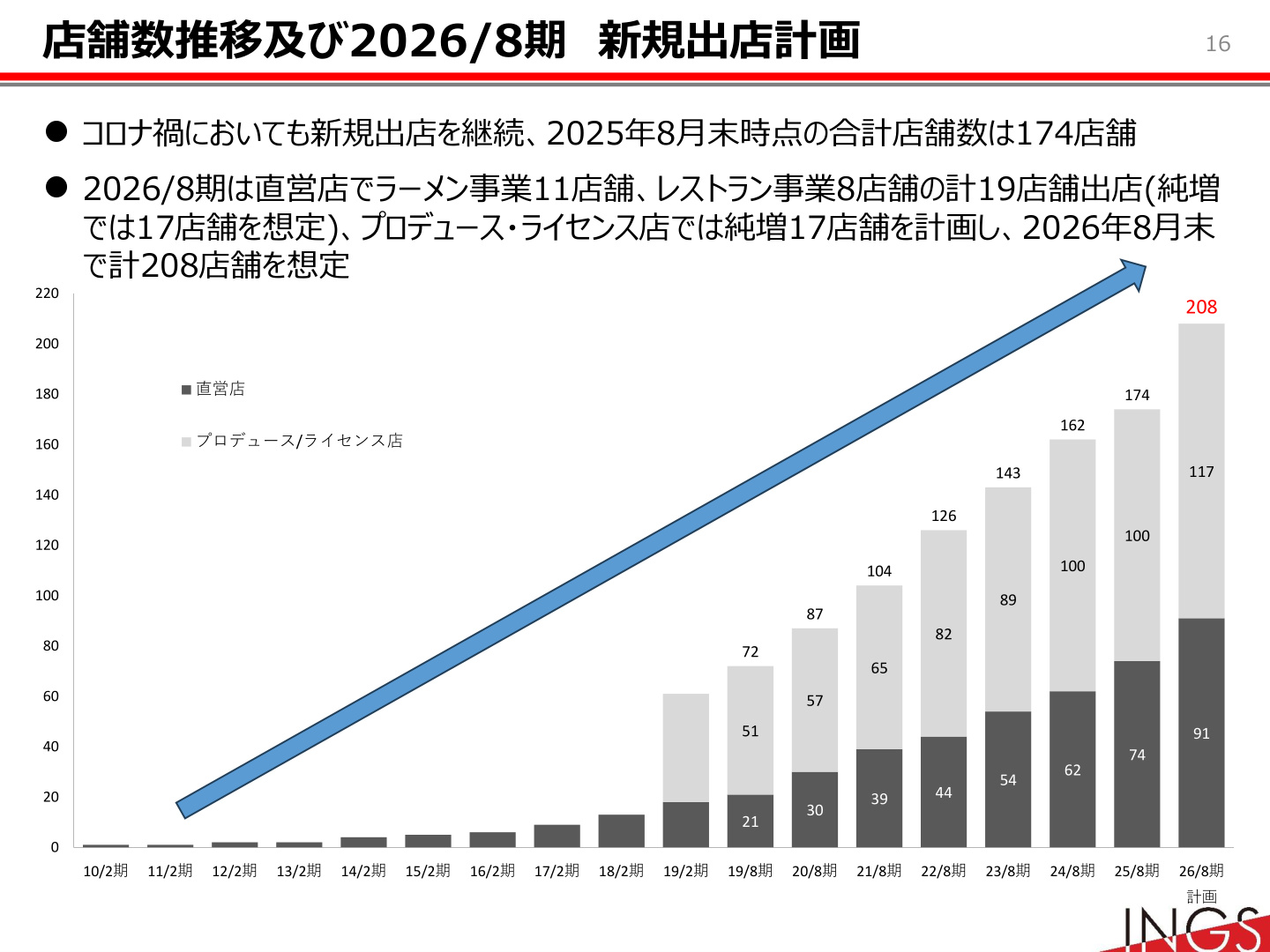 This graph demonstrates INGS's track record of consistent store growth over several years and its plan to maintain that momentum. The strategy of increasing store count in a balanced manner across both direct and produce/license stores can be interpreted as an effort to achieve both risk diversification and efficient growth. The target of 208 stores will be an important milestone in further enhancing the company's presence in the market.
2. Full-Year Earnings Forecast
The full-year earnings forecast for the fiscal year ending August 2026 remains unchanged, projecting net sales of 9,590 million JPY (up 24.0% year-on-year) and operating profit of 596 million JPY (up 21.4% year-on-year). The composition of net sales is expected to continue showing an increased proportion of direct stores compared to the previous year, with a projected company-wide growth rate of 24%. Regarding the operating profit margin, it is expected to remain at a similar level to the previous year, taking into account increased personnel costs but also a reduction in the fixed cost ratio. Existing store sales levels are anticipated to be around 100% year-on-year for both businesses, with additional contributions expected from new store openings on a solid growth foundation.
Conclusion
In the third quarter of the fiscal year ending August 2026, INGS achieved strong growth in both net sales and profit, supported by new store openings and robust performance from existing stores . Particularly, the low-risk, low-cost opening support model in the ramen business's produce division holds significant potential as a powerful driver for future store count expansion and market share acquisition . The restaurant business is also enhancing its brand power and aiming for nationwide expansion. The aggressive store expansion plan and solid full-year earnings forecast underscore the company's confidence in its sustainable growth. With the steady execution of these strategies, INGS is expected to further strengthen its presence in the food service industry.
This content is not intended as investment advice or a recommendation. Any opinions expressed are solely the personal views of each article.