


BASE FOOD (2936) Q1 FY2027 Earnings Deep Dive: Strategic Investment and Return to Growth Trajectory

StockClub
Published: Jul 15, 2026, 05:53 PM
Sentiment Analysis
BASE FOOD (Securities Code: 2936)'s Q1 FY2027 earnings report positions the company in a strategic upfront investment phase . While net sales saw only a slight year-on-year increase, the renewal of key products and aggressive advertising investments have laid a strong foundation for customer base expansion and future growth. Operating profit temporarily turned negative, but this was a planned outcome of advertising investments, with profit contributions expected from Q2 onwards.
1. Q1 FY2027 Performance Highlights and Overview
For the first quarter of FY2027 (March 1 to May 31, 2026), net sales reached 3.97 billion yen (YoY +0.8%), and gross profit was 2.24 billion yen (YoY +0.5%). However, operating profit was -0.18 billion yen (YoY -0.11 billion yen), turning negative. This was primarily due to strengthened advertising investment in Q1, which is a period of high demand . Net sales increased by +5.9% quarter-on-quarter, and the results of Q1 are expected to drive growth from Q2 onwards.
By channel, Self-EC sales were strong at 2.66 billion yen (YoY +1.2%). This was driven by successful measures such as TV commercials following the BASE BREAD 'Chocolate' renewal in April and outbound calls to inactive customers, leading to an increase in regular purchasers to 256,000 (up 21,000 from the end of the previous quarter). Wholesale sales decreased to 0.95 billion yen (YoY -5.4%), but this was influenced by March's performance; sales in April and May after the renewal achieved year-on-year growth. Other EC sales saw a significant increase to 0.32 billion yen (YoY +29.1%), while overseas sales were 0.03 billion yen (YoY -30.2%).
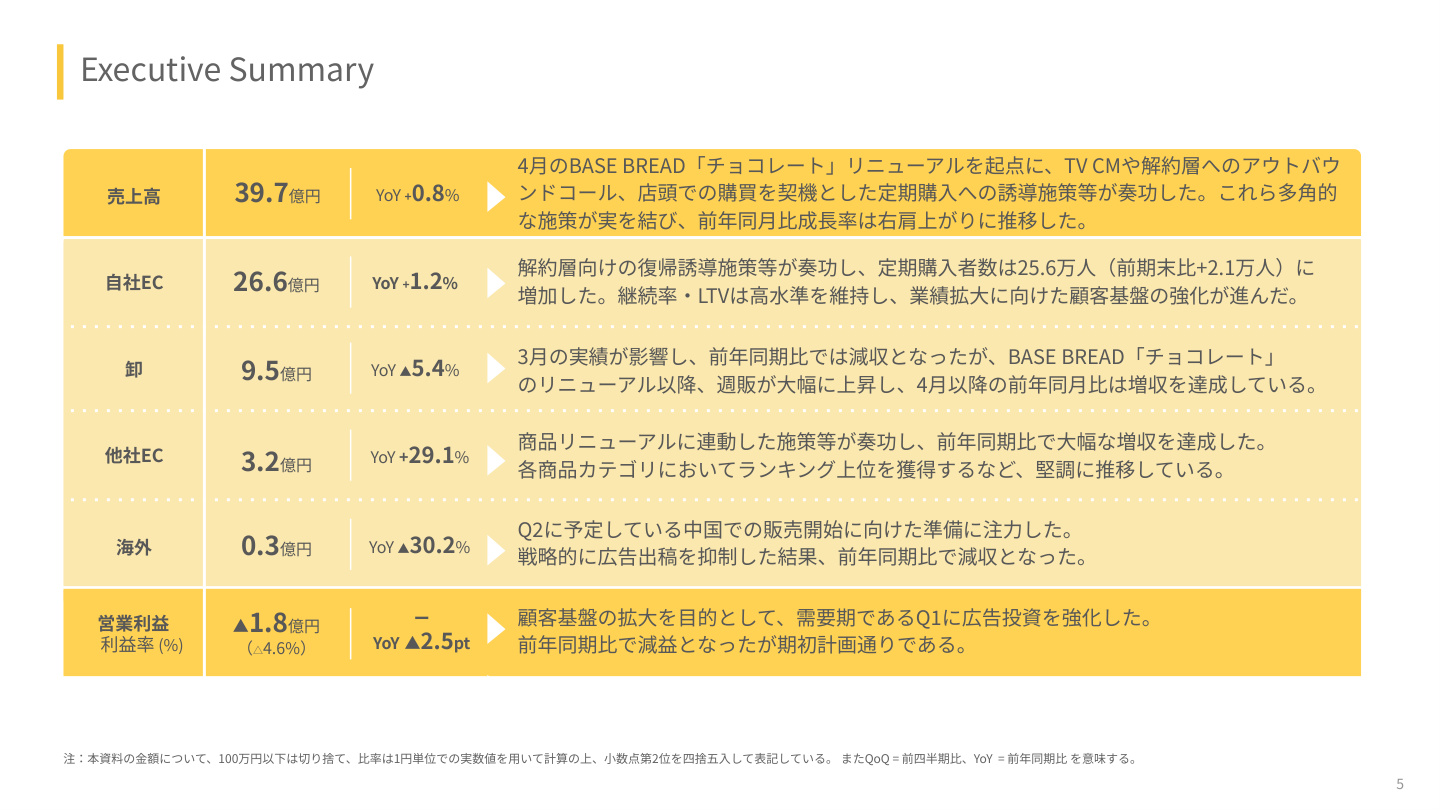
This 'Executive Summary' slide is the most crucial source of information for quickly grasping the overall picture of these financial results . It concisely summarizes net sales, the contribution of each channel, and the operating profit situation, condensing the key points investors should check first. Specifically, it clearly states that the negative operating profit, despite a slight increase in net sales, was due to 'strengthening Q1 advertising investment aimed at expanding the customer base,' indicating a strategic decision prioritizing long-term growth over short-term profit . The linkage between channel-specific growth rates and concrete measures is also essential for a deeper understanding of the performance drivers.
2. Detailed Channel Analysis and KPI Trends
In the Self-EC channel , the number of regular purchasers steadily increased, and the retention rate and LTV (Life Time Value) remained high. The cancellation rate remained low at 3.6%, indicating that the quality of the customer base is being maintained. The average customer unit price was stable at 5,670 yen, and new customer acquisition through renewals and TV commercials is believed to have contributed to LTV improvement.
For the Wholesale channel , Q1 overall sales decreased due to March's performance, but after the BASE BREAD 'Chocolate' renewal, sales in April and May turned to year-on-year growth. Despite a slight decrease in the number of stores (48,890 stores), monthly sales per store remained solid at 6,772 yen . Notably, approximately 59% of new Self-EC customers have previous retail purchase experience, reaffirming the wholesale channel's role as an important inflow route to Self-EC.
Overseas business focused on preparations for sales launch in China, scheduled for Q2. Strategic advertising spend was suppressed, resulting in a year-on-year decrease in sales. Hong Kong is in an expansion phase, with 7-Eleven stores reaching a total of 500. China is in a 'preparation phase' with manufacturing and sales preparations underway through partnerships with major local food companies, while Taiwan and South Korea are in a 'verification phase' testing sales on EC malls, indicating different strategic stages in each region.
3. Profitability Analysis and Background of Strategic Advertising Investment
Despite a challenging external environment with high raw material costs and a weak yen, the gross profit margin was maintained at a high level of 56.5% due to continuous cost reduction measures. This suggests the company's product competitiveness and effective cost management. However, the operating profit margin significantly declined to -4.6% year-on-year. As mentioned earlier, this was due to strengthened advertising investment in Q1, a period of high demand .
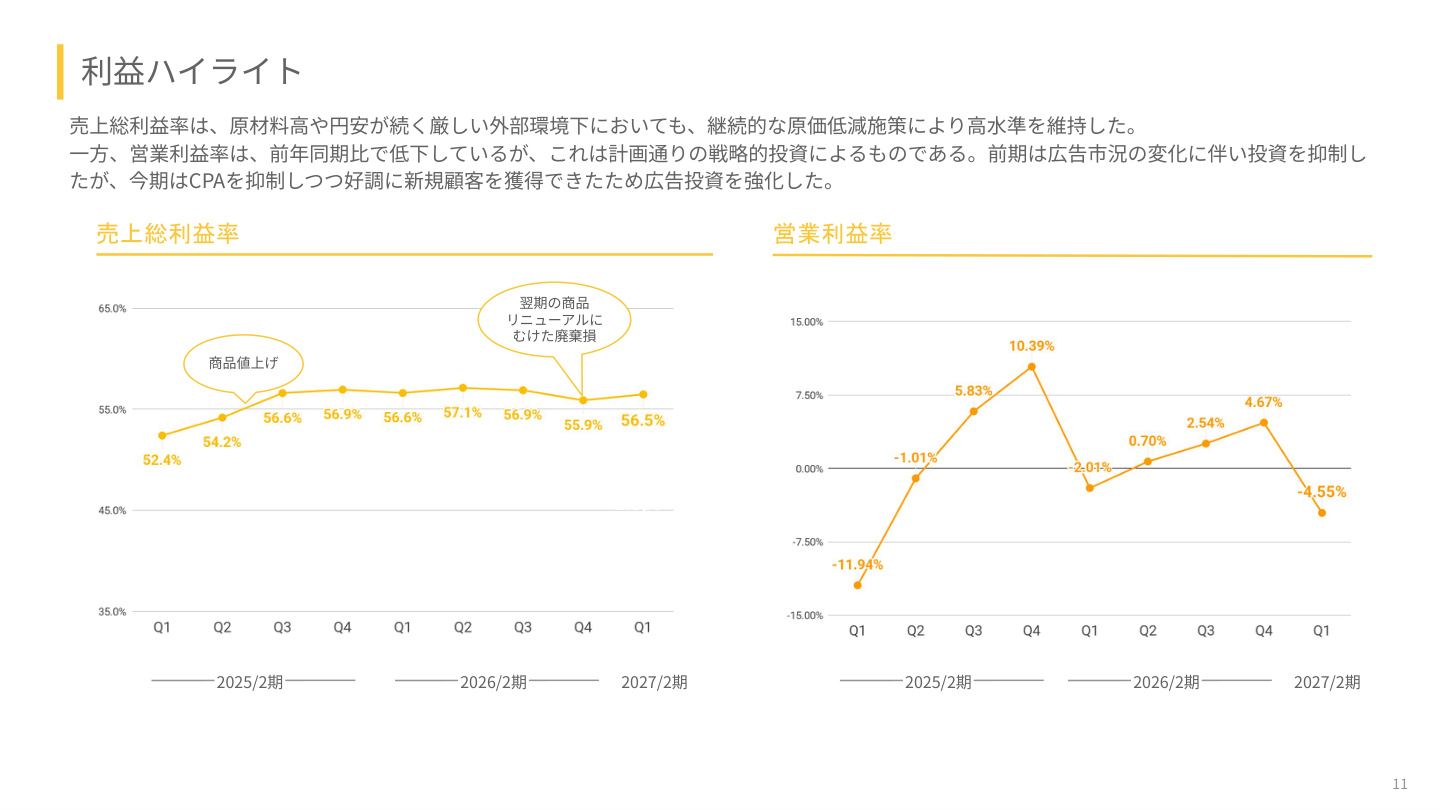
This 'Profit Highlights' slide is extremely important for understanding BASE FOOD's profit structure and strategic investment decisions . The consistently high gross profit margin demonstrates the company's strong product competitiveness and cost management capabilities. Conversely, the significant drop in operating profit margin in Q1 is a result of a management decision to prioritize future growth by making upfront advertising investments, even at the expense of short-term profit . By viewing this graph, investors can visually grasp how the company balances maintaining profitability with growth investments. This Q1 movement is a crucial starting point for understanding the profit recovery scenario from Q2 onwards.
Looking at the breakdown of SG&A expenses, advertising and promotion expenses increased by +13.8% year-on-year to 1.19 billion yen, and the ratio to net sales also rose by 3.4 percentage points from 26.7% to 30.1%. This was a result of strategic investment in TV commercials and outbound calls aimed at the BASE BREAD 'Chocolate' renewal and inactive customer reactivation, successfully acquiring new customers efficiently . Other SG&A expenses, excluding one-time costs related to R&D facility relocation, were compressed overall, indicating that a 'lean profit structure' has been established .
4. Achievements of New Product and Product Renewal Strategy
In Q1, the major renewal of BASE BREAD 'Chocolate' yielded the most significant results. Sales began in March, and the renewed product launched in mid-April, accompanied by a new TV commercial featuring actress Nanao, led to a substantial increase in new purchasers by 21,000 from the end of the previous quarter, significantly contributing to Q1 performance. Furthermore, the BASE PASTA series, 'YAKISOBA' and 'RAMEN,' were also renewed. YAKISOBA, in particular, contributed to new customer acquisition online and achieved top rankings in wholesale, with expanded sales areas in convenience stores in the Tokai and Chubu regions from May.
From Q2 onwards, a new 'Caramel' flavor will be launched for the BASE Pound Cake series . This product is expected to contribute to an increase in customer unit price, and measures to improve the unit price of sub-series are also being planned.
5. Full-Year Outlook and Recovery Scenario from Q2 Onwards
The full-year forecast for FY2027 remains unchanged from the initial plan, with net sales projected at 16.25 billion yen (YoY +7.0%) and operating profit at 0.06 billion yen (YoY -71.4%). Although operating profit was negative in Q1, this is considered a result of strategic advertising investment during a high-demand period, and profit contributions are expected from Q2 onwards. Specifically, new customers acquired in Q1 are expected to contribute to performance from Q2, along with a growth strategy that does not rely on digital advertising, increased acquisition through digital advertising with suppressed CPA, and high retention rates, all aiming to achieve the full-year performance forecast .
6. Future Growth Strategies: Sales Expansion and LTV Improvement
BASE FOOD's growth strategy for the current fiscal year aims to reduce reliance on digital advertising and improve CPA, following constraints experienced in the previous period due to rising digital advertising CPA. In Q1, this growth strategy was successful, leading to increased acquisition through digital advertising while suppressing CPA.
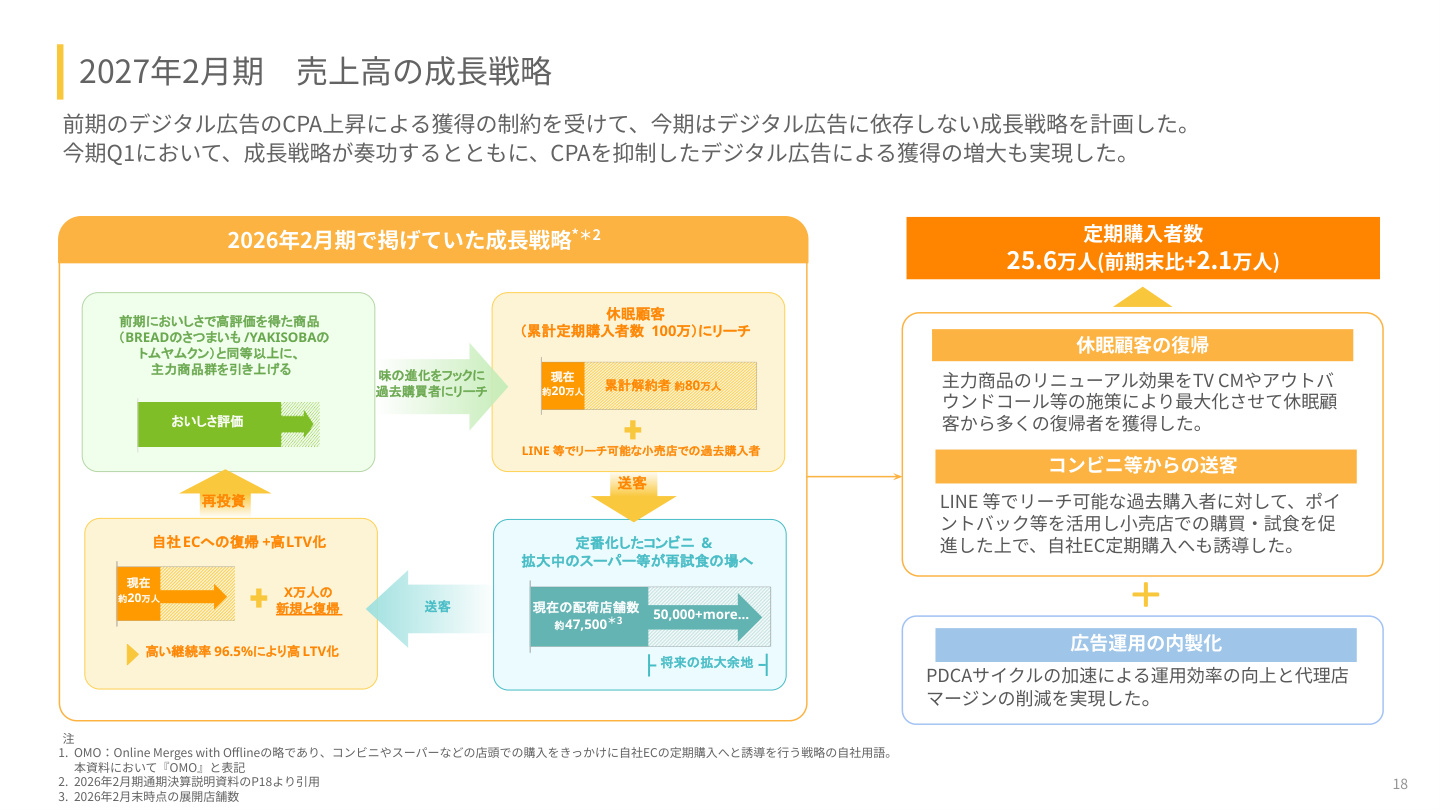
This 'Sales Growth Strategy' slide is highly strategically valuable, as it concretely outlines how BASE FOOD plans to expand its sales going forward . It clearly shows a definitive direction to move away from excessive reliance on digital advertising and pursue sustainable growth by combining multi-faceted customer acquisition channels and LTV improvement measures . Specifically, concrete action plans such as reactivating inactive customers, attracting customers from convenience stores, and internalizing advertising operations are detailed. This slide serves as a roadmap for tracking how these measures will contribute to future performance. Investors can gain a deep understanding of how sales growth and improved profitability will be achieved through the execution of this strategy.
Specific growth strategies include:
- Reducing reliance on digital advertising and suppressing CPA: Accelerating the PDCA cycle for internalizing advertising operations to improve efficiency and reduce agency margins.
- Reactivating inactive customers and attracting customers from convenience stores: Utilizing the effects of key product renewals with TV commercials and outbound calls to encourage reactivation. Also, promoting purchases at retail stores for reachable past purchasers via LINE, etc., and attracting them to Self-EC.
- Expanding sales channels and product categories: Leveraging significant room for expansion in drugstores and supermarkets (approx. 80%), aiming for continuous distribution after introduction with product strategies and packaging suitable for each channel's user base. Also, expanding categories beyond bread and noodles to increase in-store visibility.
- Improving Self-EC user LTV: Increasing the proportion of users with relatively high LTV (male users, households with children), improving purchase unit price (cross-selling from core products, improving unit price on service side). Also, working on improving the cancellation rate by continuously introducing new products and learning from past performance.
7. Mid-to-Long Term Growth Policy and R&D Strategy
BASE FOOD's mid-to-long term policy remains unchanged: to aim for a sales growth rate of +10% to +30% while improving profitability . The company aims to achieve this goal by enhancing its accumulated R&D know-how, human resources, brand assets, and product quality.
In its R&D strategy , the company positions deep tech and digital tech as drivers to accelerate business growth and achieve its mission earlier. Specifically, it is driven by the following four pillars:
- Speedy Product Development and Improvement: Operating a PDCA cycle that quickly develops prototypes based on user needs.
- Enhancing Deliciousness: Utilizing protein texture manipulation technologies based on molecular engineering and microbial engineering to achieve complete nutrition with equal or greater deliciousness.
- Manufacturing Efficiency: Continuing cost reduction through recipe updates, process rationalization, and innovation and DX in manufacturing.
- Thorough Safety and Security: Collaborating with external organizations (Tokyo University of Agriculture Food Safety Research Center), accumulating technology and data for complete nutrition long-life bread, and digitizing quality assurance.
Conclusion
BASE FOOD's Q1 FY2027 earnings were characterized by strategic investments aimed at mid-to-long term growth rather than short-term profit . The renewal of key products and aggressive advertising investments are steadily advancing customer base expansion and brand awareness. The operating profit deficit is considered temporary, and from Q2 onwards, achievement of full-year performance targets and profit recovery are expected, driven by profit contributions from new customers acquired in Q1 and the execution of efficient growth strategies. In particular, multi-faceted growth strategies such as reducing reliance on digital advertising, reactivating inactive customers, expanding sales channels, and improving LTV will form a strong foundation for the company's sustainable growth. Investors should pay close attention to performance trends from Q2 onwards and the concrete progress of these growth strategies.
This content is not intended as investment advice or a recommendation. Any opinions expressed are solely the personal views of each article.