


Yoshimura Food Holdings (2884) FY2021/2 3Q Earnings Deep Dive Report: Resilience of Business Structure Amidst COVID-19 and Progress in Overseas Strategy

StockClub
Published: Jul 15, 2026, 05:52 PM
Sentiment Analysis
Yoshimura Food Holdings Co., Ltd. (hereinafter, "the Company") has built a unique business model in the food industry, with a mission to "protect, nurture, and deliver local delicacies to the world." At its core are two growth engines: the "SME Support Platform" and the "Expansion of Existing Businesses." The Company aims for sustainable growth by welcoming small and medium-sized food companies facing succession issues or management challenges into its group, providing support across various functions such as sales, manufacturing, procurement, product development, quality control, management, and overseas sales, thereby creating synergies across the entire group.
FY2021/2 3Q Earnings Highlights: Contrasting Fortunes Amidst COVID-19
The consolidated financial results for the third quarter of the fiscal year ending February 2021 (March 1, 2020, to November 30, 2020) showed the impact of the novel coronavirus infection manifesting differently both domestically and internationally.
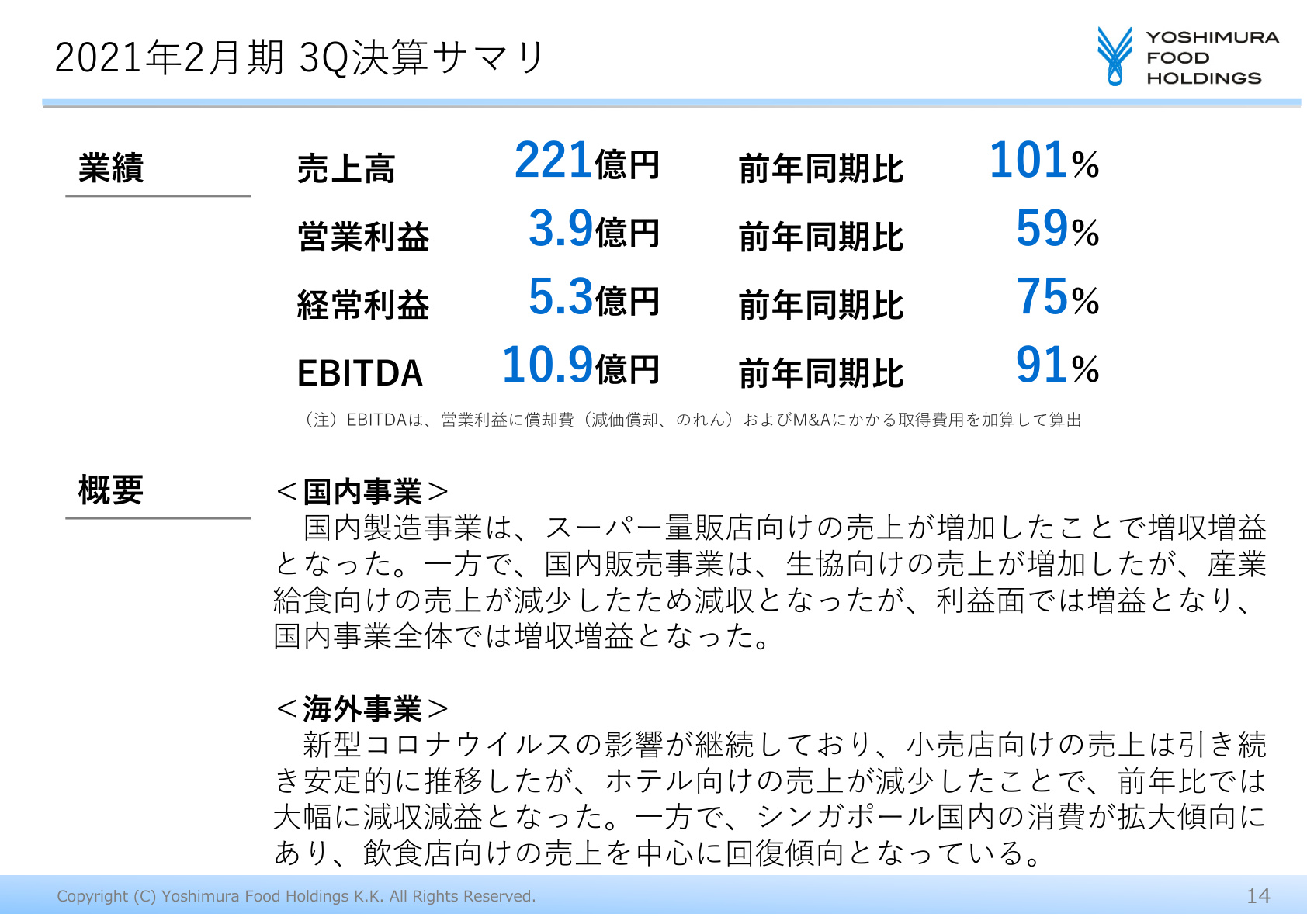
This slide is the most crucial summary for a concise overview of the consolidated performance for the quarter. It presents key financial indicators such as net sales, operating profit, ordinary profit, and EBITDA, along with year-on-year comparisons, consolidating the information investors should check first. While consolidated net sales achieved a slight increase to 22.1 billion yen (101% year-on-year), operating profit was 0.39 billion yen (59% year-on-year), ordinary profit was 0.53 billion yen (75% year-on-year), and EBITDA was 1.09 billion yen (91% year-on-year), all falling below the previous year's figures. The overview section suggests that this was due to a contrasting situation where domestic business performed steadily, while overseas business experienced a significant decline in both revenue and profit.
Detailed Performance Analysis: Domestic Resilience and Overseas Challenges
Factors Behind Operating Profit Fluctuation: The Weight of Overseas Business
A detailed look at the operating profit fluctuations clearly reveals the underlying factors.
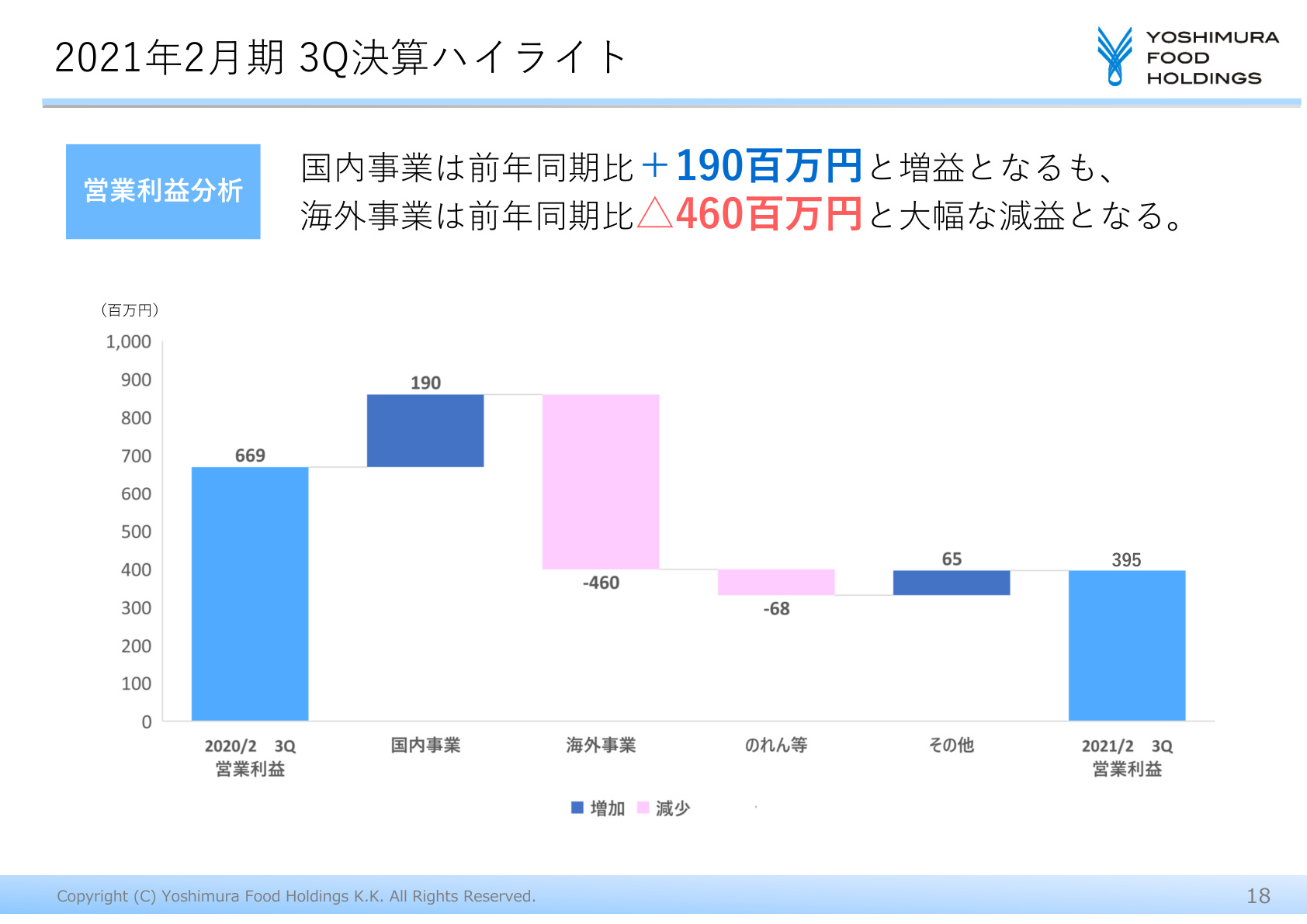
This waterfall chart analyzing operating profit is extremely important for visually understanding the main drivers of profit fluctuation in the current quarter. Compared to the operating profit of 0.66 billion yen in the previous year, this quarter saw 0.39 billion yen. The primary cause of this decrease was the significant decline in overseas business profit. Although domestic business achieved an increase of +190 million yen year-on-year, the substantial drop of △460 million yen in overseas business had a major impact. This was due to travel restrictions and stay-at-home orders overseas caused by COVID-19, which directly hit sales to hotels and restaurants. Meanwhile, "goodwill, etc." (including goodwill amortization and M&A-related expenses) accounted for △68 million yen, and other factors contributed +65 million yen, resulting in a final operating profit of 0.39 billion yen. This graph tells the core story of this quarter's performance: the robustness of domestic business was not enough to fully offset the decline in overseas business.
Detailed Domestic and Overseas Performance: Strong Supermarket Sales, Struggling Foodservice/Hotels
Domestic business saw increased revenue and profit due to higher sales to supermarkets and mass retailers. This was driven by robust sales of household food products, benefiting from increased demand for at-home consumption. However, within the domestic sales business, there were mixed results, with increased sales to co-ops but decreased sales to industrial catering.
Conversely, overseas business was severely impacted by COVID-19. Sales to hotels, in particular, significantly decreased, leading to a substantial decline in overall revenue and profit. While domestic consumption in Singapore is expanding, and restaurant sales are showing signs of recovery, a full recovery is expected to take time.
Revenue by Segment: Steady Manufacturing and Challenges in Sales
Looking at revenue by segment, different situations are observed in the manufacturing and sales segments.
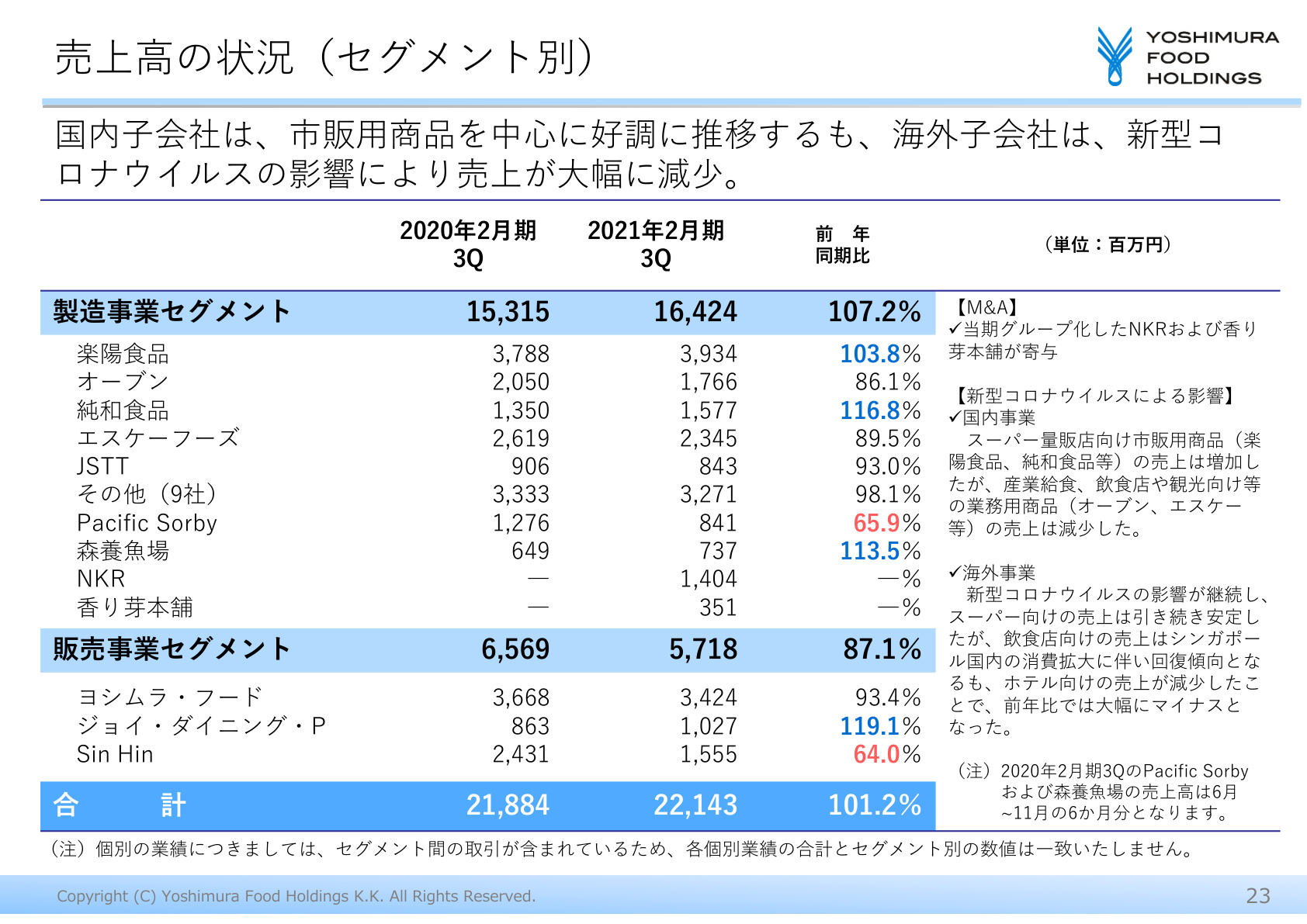
This slide detailing revenue by segment is indispensable for understanding how each group company and product category contributes to performance and how they are affected by COVID-19. The Manufacturing Business Segment performed steadily, with total revenue of 16.424 billion yen (107.2% year-on-year). Contributions came particularly from NKR and Kaorifujihonpo, which were integrated into the group through M&A, as well as increased sales of consumer-facing products to supermarkets (e.g., Rakuyo Foods, Junwa Foods). This indicates that there were clearly businesses that benefited from the stay-at-home demand. However, sales of commercial-use foods (e.g., Open, S.K. Foods) and tourism-related products (e.g., Mori Aquaculture) decreased due to the impact of COVID-19.
The Sales Business Segment experienced a decline in revenue, totaling 5.718 billion yen (87.1% year-on-year). This was primarily due to a significant decrease in overseas business sales. Sales to hotels, in particular, faced severe conditions, resulting in a substantial year-on-year negative performance. This detailed breakdown highlights the diversity of the Company's business portfolio and the differing external environments faced by each business.
Future Growth Strategy and Outlook: Overcoming COVID-19 and Accelerating Overseas Expansion
Deepening the SME Support Platform and ESG Management
The core of the Company's growth strategy continues to be the deepening of the SME Support Platform. By further integrating functions among group companies, leveraging each company's strengths, and compensating for weaknesses, the Company aims to enhance the overall competitiveness of the group. Furthermore, by promoting ESG management , including sustainable product manufacturing with environmental considerations, contributions to local communities, and strengthening governance, the Company seeks to improve corporate value and achieve sustainable growth. Supporting business succession for companies without successors is precisely an embodiment of ESG management, contributing to the revitalization of local economies.
Business Outlook Under the Impact of COVID-19
Regarding the future business outlook, it is necessary to carefully assess the impact of COVID-19.
{{PAGE_24}}
This slide specifically outlines the impact of COVID-19 on future performance and the Company's outlook , making it highly important for evaluating future profitability. In domestic business , sales to supermarkets and mass retailers are expected to continue an increasing trend due to ongoing demand for at-home consumption. On the other hand, sales to foodservice and tourism-related businesses, which had shown a temporary recovery trend due to the "Go To" campaigns, are now facing increased uncertainty with the re-issuance of the state of emergency. Sales of domestic subsidiaries are expected to remain stable towards the end of the fiscal year and the next period, but there is a possibility of fluctuations due to the impact of the state of emergency.
In overseas business , sales to hotels in Singapore remain challenging due to travel restrictions and event cancellations. However, with Singapore residents unable to travel abroad, domestic consumption has become more active, and restaurant sales are showing an increasing trend, which is expected to continue. Sales of overseas subsidiaries have shown a recovery trend since the third quarter, particularly in the fourth quarter. A full-scale recovery depends on the containment of COVID-19 in Asia and remains a fluid situation. This outlook clearly demonstrates the duality of the current business environment, with domestic stability and overseas uncertainty.
Specific Overseas Growth Strategy: Leveraging Singapore as a Hub
As part of its overseas growth strategy, the Company positions Singapore as a crucial hub and is implementing specific initiatives. JSTT Singapore operates sushi corners in supermarkets and is strengthening the sales of products from Japanese group companies. Additionally, Junwa Foods has developed private-brand products for BreadTalk, a bakery chain operating in Asia with Singapore as its base, and has begun selling them in approximately 46 BreadTalk stores in Singapore. These initiatives embody the expansion of "local delicacies" in overseas markets and the creation of group synergies.
Conclusion: Resilient Business Structure and Expectations for Overseas Expansion
In the third quarter of the fiscal year ending February 2021, Yoshimura Food Holdings demonstrated a resilient business structure that maintained consolidated net sales despite challenges in its overseas business due to the impact of COVID-19. While operating profit was affected by the decline in overseas business, the increase in domestic business profit underscores the strength of the diverse business portfolio within the Company's SME Support Platform.
Moving forward, while monitoring the continued demand for at-home consumption in Japan and the recovery trends in foodservice and tourism, the Company is expected to accelerate its overseas expansion in the Asian market, using Singapore as a foothold. In particular, strengthening product sales through collaborations with JSTT and BreadTalk holds the potential to become a new growth driver overseas. Even in the highly uncertain environment of the COVID-19 pandemic, the sustainable growth strategy centered on ESG management and proactive expansion in overseas markets are expected to contribute to the Company's future corporate value enhancement.
This content is not intended as investment advice or a recommendation. Any opinions expressed are solely the personal views of each article.