


Taiyo Bussan Q3 FY2026 Earnings Analysis: Food Segment Growth and SG&A Cost Reduction Drive Profitability; Acquisition of Ichigo HD Accelerates Financial and Business Restructuring

StockClub
公開日時: Sep 18, 2026, 06:55 PM GMT+9
Sentiment Analysis
1. Q3 FY2026 Earnings Summary
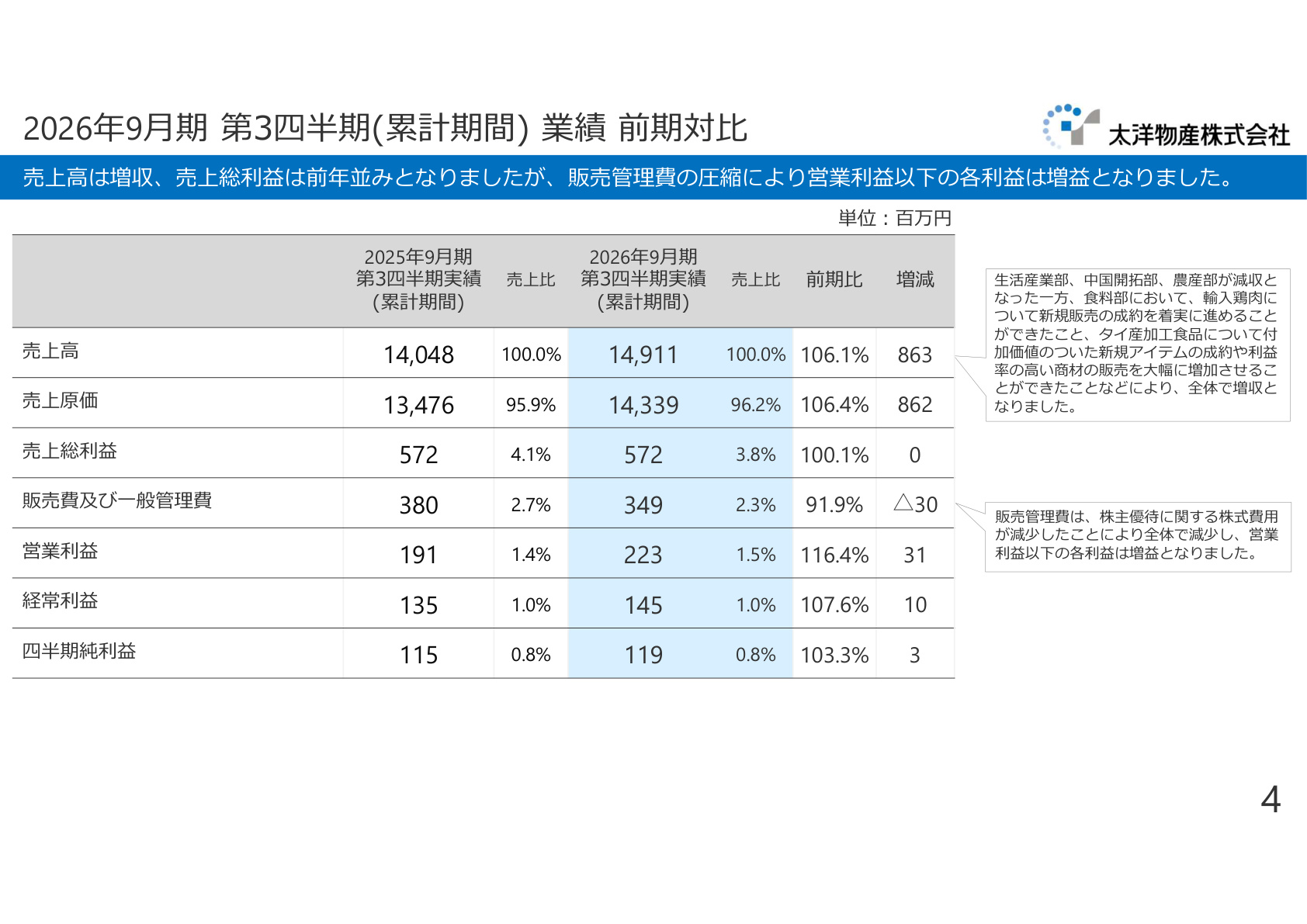
Taiyo Bussan Co., Ltd. reported its non-consolidated financial results for the first nine months of the fiscal year ending September 2026 (October 1, 2025 through June 30, 2026), achieving growth in both revenue and profit across all stages: net sales of 14,911 million yen (+6.1% YoY) , gross profit of 572 million yen (+0.1% YoY) , operating profit of 223 million yen (+16.4% YoY) , ordinary profit of 145 million yen (+7.6% YoY) , and quarterly net profit of 119 million yen (+3.3% YoY) .
Revenue was driven by the core Food segment, which saw a significant expansion in the trading volume of imported chicken and high-value-added processed foods. Regarding profitability, while gross profit remained at the same level as the previous year, the operating profit margin improved from 1.4% to 1.5% due to successful compression of selling, general and administrative (SG&A) expenses.
Structural Analysis of Earnings and Factors Behind SG&A Reduction
As shown in the slide above, gross profit remained flat at 572 million yen compared to the same period last year. Although the gross profit margin declined by 0.3 percentage points to 3.8% from 4.1% in the previous year, SG&A expenses were significantly curtailed to 349 million yen (down 8.1% YoY, a reduction of 30 million yen) .
The primary driver for the decrease in SG&A expenses was the reduction in share-related costs associated with shareholder benefits . These costs, which totaled 41 million yen in the first nine months of the fiscal year ending September 2025 (Q1: 29 million yen, Q2: 12 million yen), dropped significantly to 5 million yen in the current period (Q1: 2 million yen, Q2: 0 million yen, Q3: 3 million yen). This reduction directly contributed to an increase in operating profit (+31 million yen YoY). Rigorous management of fixed costs and expense leveling have contributed to the stabilization of the earnings structure.
2. Segment Performance: Food Segment Growth and Challenges in Other Divisions
By segment, the Food segment , which accounts for over 60% of the sales composition, strongly drove overall performance. Conversely, the Agricultural Products, China Development, and Lifestyle Industry segments experienced revenue declines due to challenging market environments and external factors.
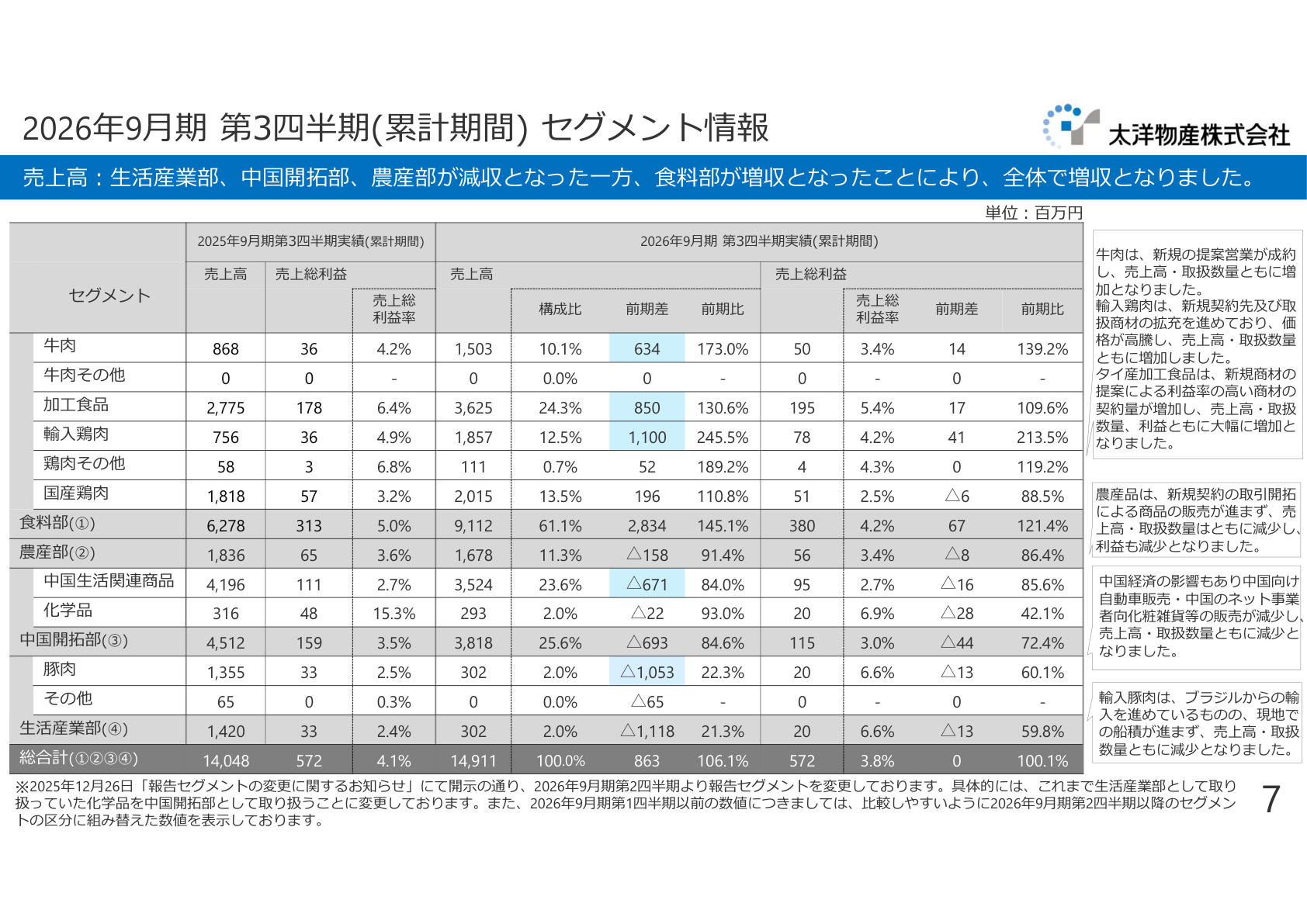
① Food Segment: Net Sales of 9,112 million yen (+45.1% YoY), Gross Profit of 380 million yen (+21.4% YoY)
As the largest pillar, the Food segment generates 61.1% of total company sales and 66.4% of gross profit.
- Beef : Achieved significant growth with net sales of 1,503 million yen (+73.0% YoY) and gross profit of 50 million yen (+39.2% YoY) due to successful new proposal-based sales.
- Imported Chicken : Recorded more than double the performance of the previous year, with net sales of 1,857 million yen (+145.5% YoY) and gross profit of 78 million yen (+113.5% YoY), driven by the development of new contracts and rising international market prices.
- Thai Processed Foods : Achieved stable growth with net sales of 3,625 million yen (+30.6% YoY) and gross profit of 195 million yen (+9.6% YoY), as new product proposals led to an increase in contract volumes for high-margin items.
- Domestic Chicken : While maintaining revenue growth at 2,015 million yen (+10.8% YoY), gross profit saw a slight margin compression to 51 million yen (-11.5% YoY).
② Agricultural Products Segment: Net Sales of 1,678 million yen (-8.6% YoY), Gross Profit of 56 million yen (-13.6% YoY)
The Agricultural Products segment, which handles items such as soybeans and buckwheat, saw declines in trading volume, sales, and profit compared to the previous year, as sales efforts for new contracts did not progress as planned.
③ China Development Segment: Net Sales of 3,818 million yen (-15.4% YoY), Gross Profit of 115 million yen (-27.6% YoY)
Demand for China-related lifestyle products (such as automotive sales and cosmetic goods for online operators) weakened due to local economic trends in China, leading to a decrease in trading volume. For chemicals, the gross profit margin fell from 15.3% to 6.9%, resulting in a profit decline for the segment as a whole.
④ Lifestyle Industry Segment: Net Sales of 302 million yen (-78.7% YoY), Gross Profit of 20 million yen (-40.2% YoY)
Although the company is promoting imports of pork from sources such as Brazil, trading volume dropped significantly due to logistical factors, including shipping delays at the origin.
3. Management Efficiency and KPI Progress
Taiyo Bussan has set a medium-to-long-term management target of a gross profit margin of 4.0% or higher . The cumulative gross profit margin for the third quarter was 3.8% . On a quarterly basis, the margins were 4.1% (Q1), 3.8% (Q2), and 3.7% (Q3), maintaining a pace that exceeds the 3.1% assumption used for the full-year company forecast.
Furthermore, the company emphasizes total asset turnover and working capital turnover period as indicators for the efficiency of its trading company functions. The working capital turnover period at the end of the third quarter was 3.96 months (+0.24 months from the end of the previous fiscal year). The company is promoting the optimization of capital efficiency through the acquisition of agile transactions that avoid surplus inventory, the review of procurement sources, and the utilization of intermediary trade.
4. Strengthening Financial Foundation and Capital Policy (Acquisition of Ichigo HD)
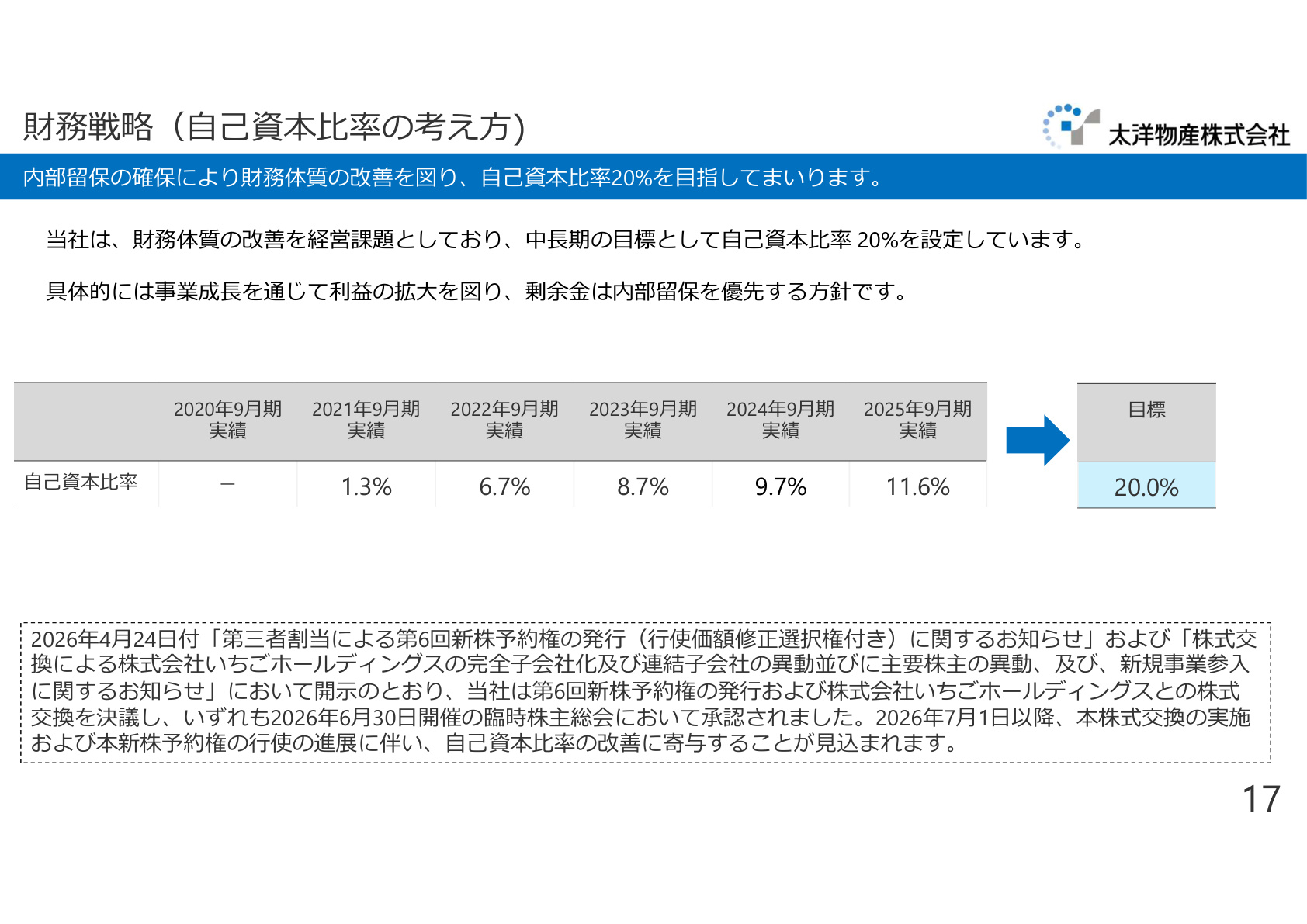
The company has positioned the fundamental improvement of its financial position as its most important management task, setting a medium-to-long-term target for the equity ratio at 20.0% .
Progress in Financial Strategy and Impact of Capital Alliance
The equity ratio at the end of the third quarter was 12.1% , an improvement of +0.5 percentage points from 11.6% at the end of the previous fiscal year. This reflects steady accumulation of retained earnings from the 1.3% level seen in the fiscal year ended September 2021.
Furthermore, the major capital policy resolved on April 24, 2026, and approved at the extraordinary general meeting of shareholders on June 30, marks a major turning point for the company's future financial and business structure:
- Making Ichigo Holdings Co., Ltd. a wholly-owned subsidiary (share exchange) : Effective July 1, 2026, this aims to diversify the business portfolio and expand the revenue base.
- Issuance of the 6th Series of Stock Acquisition Rights via third-party allotment (with an exercise price revision clause) : Aims to achieve the 20% equity ratio target early through the strengthening of equity capital as the rights are exercised.
- Use of Proceeds : Funds will be allocated to growth areas, including the promotion of new businesses such as cross-border e-commerce, business expansion for local Chinese subsidiaries, and the overseas development of ramen brands.
5. Full-Year Earnings Forecast, Progress, and Future Growth Strategy
The presentation reports the following progress rates for the cumulative third-quarter results against the full-year earnings forecast for the fiscal year ending September 2026, which was announced on November 14, 2025 and remains unchanged:
- Net Sales : 14,911 million yen / Forecast 25,052 million yen ( Progress: 59.5% )
- Gross Profit : 572 million yen / Forecast 778 million yen ( Progress: 73.5% )
- Operating Profit : 223 million yen / Forecast 290 million yen ( Progress: 77.0% )
- Ordinary Profit : 145 million yen / Forecast 228 million yen ( Progress: 63.8% )
- Net Profit : 119 million yen / Forecast 182 million yen ( Progress: 65.6% )
The company presentation reports progress rates of 59.5% for net sales and 77.0% for operating profit . These percentages compare the cumulative third-quarter results with the forecast shown in the presentation; they do not guarantee achievement of the full-year forecast.
Key Future Growth Initiatives
- Strengthening Sales for Overseas Expansion of Domestic Restaurant Chains : Providing a global supply chain network for chicken, pork, beef, and processed foods as major domestic chains expand their overseas store ratios.
- Avoiding Price Competition and Optimizing Suppliers : Prioritizing transactions that avoid price competition with rivals and do not carry surplus inventory. Promoting the diversification of procurement sources and strengthening intermediary trade.
- Shareholder Return Policy : For the time being, the company plans to continue with no dividends, prioritizing the securing of retained earnings and the improvement of the equity ratio. However, it has indicated a policy to consider future dividend resumption in line with progress in financial stabilization.
Correction (September 19, 2026): The cumulative third-quarter results have been corrected to non-consolidated, and the wording of the full-year forecast has been aligned with the source materials. Verification source: Financial Results for the Third Quarter of the Fiscal Year Ending September 2026 (released August 12, 2026; Japanese).
個別の投資に関する推奨やアドバイスを提供することを意図しておりません。ここで述べられている意見や見解は、あくまでも各記事の個人的見解です。