

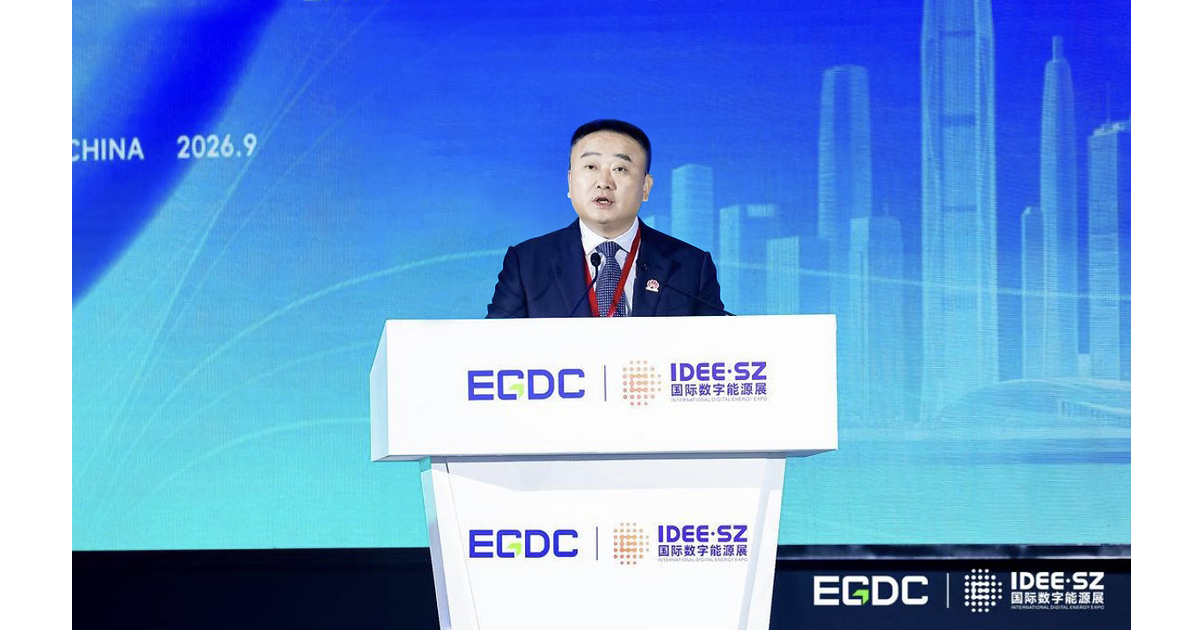
Zhou Jianjun from Huawei: Building a Grid-Interactive AIDC Solution to Maximize Tokens Per Watt
PRNewsWire
公開日時: Sep 17, 2026, 11:21 AM GMT+9
Sentiment Analysis
The Green Energy Development Conference & International Digital Energy Expo 2026, kicked off in Shenzhen. Zhou Jianjun, Vice President of Huawei and President of Global Marketing, Sales and Services, Huawei Digital Power, attended the opening ceremony and unveiled Huawei's grid-interactive AI data center (AIDC) solution during the key industry achievement release session. This solution aims to tackle the new challenges of power acquisition, high-density power supply, high-density heat dissipation, and complex delivery, operation, and maintenance in AIDC construction during the AI era, by leveraging system-level compute-electricity synergy to maximize tokens per watt.
The global AI industry is rapidly accelerating from R&D to large-scale deployment. The fast iteration of large models and the surging demand for AI applications are driving exponential growth in token consumption. As the basic unit for invoking, consuming, and billing AI services, tokens are becoming increasingly valuable. Major global tech companies, operators, cloud service providers, and energy enterprises are ramping up investments in AI infrastructure. AIDC campuses are scaling from traditional megawatts to hundreds of megawatts or even gigawatts. Power acquisition, power supply and cooling in high-density compute scenarios, delivery, operation, and maintenance capabilities, and construction speed have become new challenges for AIDC construction.
Zhou Jianjun stated: "Electricity is essential for computing. Today, in the AI era, the startup, shutdown, and load fluctuations of a large AIDC campus can all impact grid operations." He emphasized that as the penetration of renewable energy continues to rise, the power grid itself is also evolving, with local grid strength declining and volatility and uncertainty increasing. Future AIDCs must not only adapt to weak grids and maintain stable operation during grid fluctuations, but also support the grid and become a key "grid-friendly" node. Therefore, the integration of generation, grid, load, and storage has become an inevitable choice for AIDC development.
Huawei proposes a "3+1" system redefinition across three domains—Watt (electricity), Bit (digital), and Heat (thermal)—along with the construction model, to build a grid-interactive AIDC solution. The core of the redefinition is as follows:
Watt (electricity): Shifting from stable power consumption to supporting the power grid. On the generation-grid-storage side, Huawei enhances the AIDC facility's adaptability to weak power grids and large load fluctuations through grid-forming control and energy storage synergy. The industry's first 1000 V grid-forming inverter FusionSolar series and the world's first 1000 V Smart String Grid Forming ESS Platform LUTERRA, both launched by Huawei, have significantly boosted the grid-forming capability of renewable energy. On the load side, Huawei builds an integrated grid-forming energy router based on the solid-state transformer (SST) technology. Moreover, Huawei has become the first vendor in the industry to pass the wideband oscillation damping test conducted by Shanghai Electrical Apparatus Research Institute, driving UPS in the AIDC era to evolve from "reliable power supply" to "grid-friendly."
Heat (thermal): from "reliability of individual components" to "reliability of the entire system." The key to AIDC liquid cooling is not just cooling, but controllability; not just the reliability of individual components, but the reliability of the entire system from chips to cooling sources. Huawei's Thermal Management Unit (TMU) and AI-enabled MW-level liquid cooling system provide a paradigm for highly reliable cooling in the AIDC indus...
Source: PRNewsWire
個別の投資に関する推奨やアドバイスを提供することを意図しておりません。ここで述べられている意見や見解は、あくまでも各記事の個人的見解です。