


TRaaS on Product Q2 FY2027 Earnings Deep Dive: Business Model Transformation and Growth Scenario for Second-Half Profitability

StockClub
公開日時: Sep 10, 2026, 10:01 AM
Sentiment Analysis

TRaaS on Product Q2 FY2027 Earnings Deep Dive
TRaaS on Product (Securities Code: 6696) , listed on the Tokyo Stock Exchange Growth Market, announced its financial results for the second quarter (interim period) of the fiscal year ending January 2027 on September 10, 2026. Despite the reactionary decline from large-scale projects in the previous fiscal year and the impact of soaring semiconductor costs, the company is aggressively driving improvements in gross margins, realizing synergies from its subsidiary Axt East Japan, and executing its "shift from hardware sales to a SaaS-based monthly subscription model (TRaaS)." This report provides a detailed analysis of performance trends, segment-specific developments, key growth initiatives, and full-year forecasts based on disclosed materials.
1. Q2 FY2027 Cumulative Earnings Highlights
The consolidated financial results for the first half of the fiscal year ending January 2027 (February to July 2026) were generally in line with initial projections:
- Net Sales : 169 million JPY (down 31.5% YoY , a decrease of 77 million JPY)
- Gross Profit : 83 million JPY (down 27.9% YoY ; gross profit margin improved by +2.4pt to 49.2% )
- Operating Profit : -49 million JPY (compared to -3 million JPY in the same period last year)
- Ordinary Profit : -50 million JPY (compared to -2 million JPY in the same period last year)
- Net Income Attributable to Owners of Parent : -56 million JPY (compared to -3 million JPY in the same period last year)
While the company experienced a decline in revenue and an expansion of operating losses due to the completion of high-margin large-scale projects from the previous year, the standalone Q2 performance showed net sales of 94 million JPY and an operating loss of 10 million JPY , representing a significant narrowing of losses compared to Q1 (net sales of 74 million JPY, operating loss of 39 million JPY).
2. Segment Performance and Factor Analysis
The performance and drivers for each business segment are as follows:
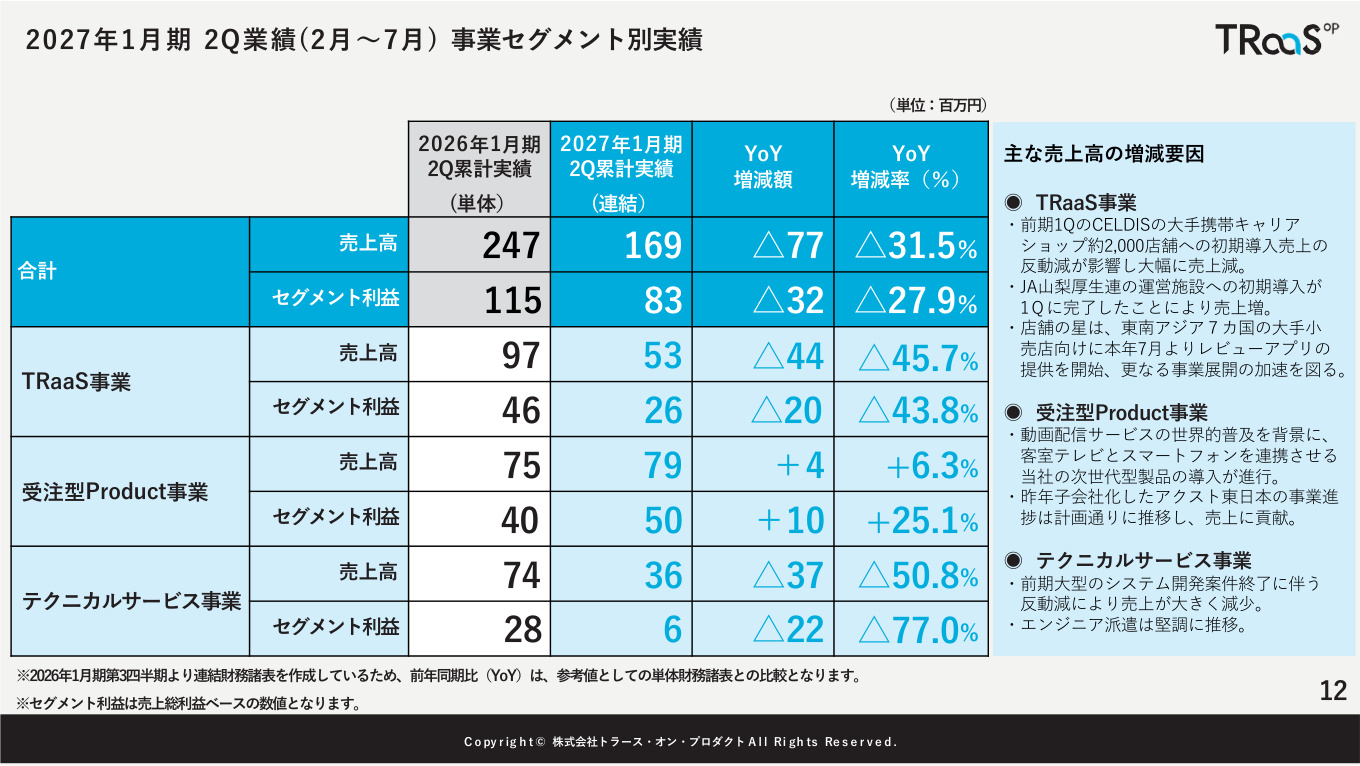
The slide above clearly illustrates the company's business structure and the factors behind the fluctuations in each segment. Details are as follows:
① TRaaS Business
- Net Sales : 53 million JPY (down 45.7% YoY )
- Segment Profit : 26 million JPY (down 43.8% YoY )
The results were significantly impacted by the reactionary decline from the initial installation revenue of the "CELDIS" digital signage platform for approximately 2,000 mobile carrier shops recorded in Q1 of the previous year. Conversely, the company is expanding its recurring revenue base, with initial installations for JA Yamanashi Koseiren completed in Q1 and the launch of its store-based DX solution "Tenpo no Hoshi" for major retailers across seven Southeast Asian countries in July 2026.
② Order-based Product Business
- Net Sales : 79 million JPY (up +6.3% YoY )
- Segment Profit : 50 million JPY (up +25.1% YoY )
Driven by the recovery of the hotel market due to rebounding inbound demand, the company saw progress in the adoption of next-generation STBs (set-top boxes) that link guest room TVs with smartphones. Additionally, the calling bell business of Axt East Japan , acquired in August 2025, performed according to plan, contributing to both revenue and profit growth.
③ Technical Service Business
- Net Sales : 36 million JPY (down 50.8% YoY )
- Segment Profit : 6 million JPY (down 77.0% YoY )
Revenue declined significantly due to the completion of a large-scale core system development project from the previous year, though the resident engineer dispatch business maintains stable operations.
3. Key Topics and Progress of Upfront Investments
Key business topics during the second quarter include:
- Response to Rising Semiconductor Prices : In light of the global semiconductor and memory shortage and price hikes driven by AI demand, the company is adjusting sales prices to customers in line with demand timing.
- Synergies from Axt East Japan Acquisition : Beyond traditional restaurant calling bells, inquiries from non-restaurant sectors are surging. The company is expanding functionality as a "Multi-Network GATEWAY" linked with its STBs.
- Joint Development of Spherical Signage with Coretronic (Taiwan) : The first development sample was exhibited at "DSJ2026" in June 2026, garnering significant interest. The company plans to begin full-scale OEM sales to third parties starting with the second development sample, scheduled for completion in September 2026.
- Re-entering the Hotel VOD Market : With a track record of over 200,000 room installations, the company is accelerating the market penetration of its next-generation STBs compatible with streaming services like Netflix and YouTube.
- Southeast Asian Expansion of "Tenpo no Hoshi" : By integrating proprietary review app add-ons, the company is promoting OMO (Online Merges with Offline) solutions.
4. Financial Health (Balance Sheet)
The financial position as of the end of Q2 FY2027 is as follows:
- Total Assets : 464 million JPY (down 99 million JPY from the end of the previous fiscal year)
- Cash and Deposits : 247 million JPY (down 31 million JPY)
- Net Assets : 294 million JPY (down 56 million JPY due to interim net loss)
- Equity Ratio : 63.2% (up +1.2pt from 62.0% at the end of the previous fiscal year)
Despite an increase in interest-bearing debt due to M&A in the previous year, the company continues to repay long-term loans and maintains a robust equity ratio.
5. Full-Year FY2027 Consolidated Forecast and Profitability Scenario
The company has maintained its full-year consolidated earnings forecast and expects to turn profitable at the operating level for the full year.
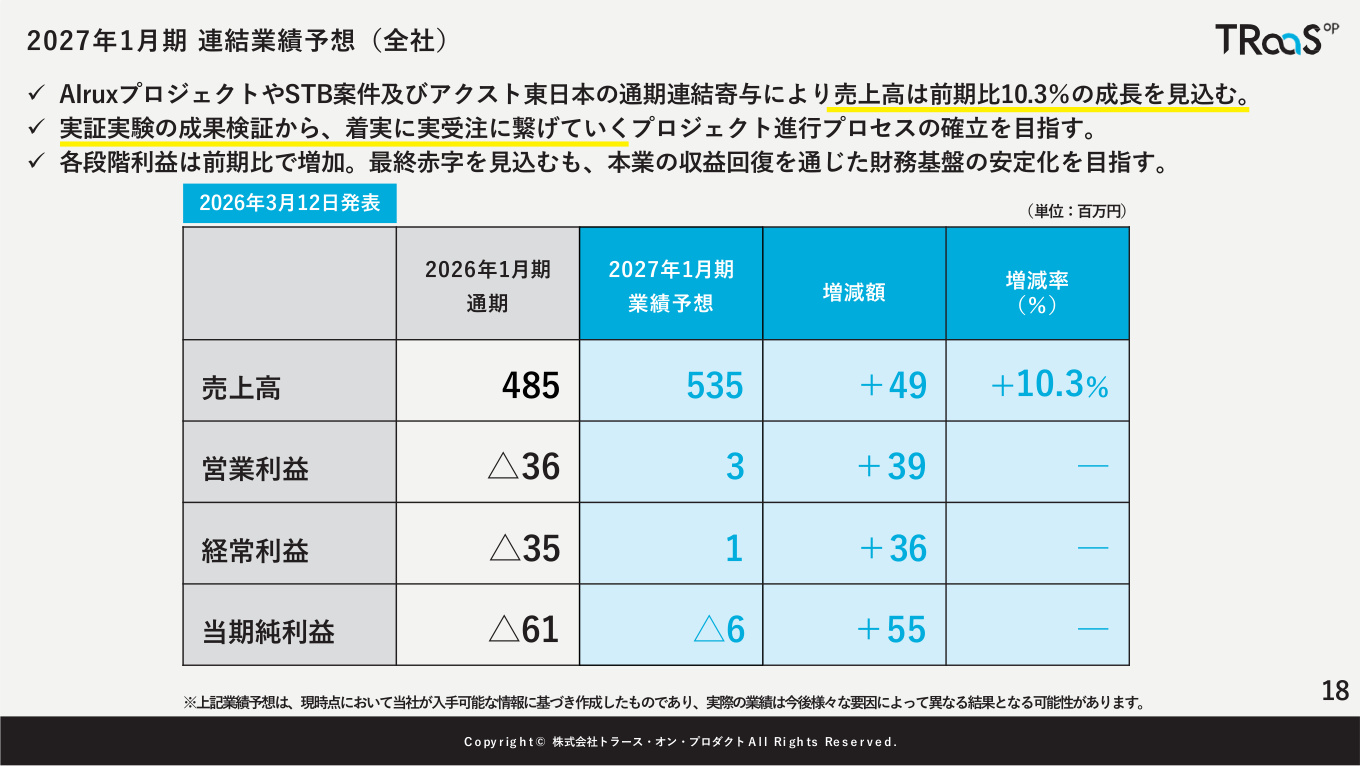
Key indicators for the full-year plan are as follows:
- Net Sales : 535 million JPY (up +10.3% YoY )
- Operating Profit : 3 million JPY (a turnaround to profit from -36 million JPY in the previous year)
- Ordinary Profit : 1 million JPY (a turnaround to profit from -35 million JPY in the previous year)
- Net Income : -6 million JPY (significant reduction in losses)
Progress Rate and Second-Half Weighting
As of the end of Q2, the progress rate toward the full-year sales target is 31.6% (169 million JPY / 535 million JPY). This second-half weighting is supported by the following revenue drivers:
- TRaaS Business (Full-year forecast 182 million JPY, +27.5% YoY) : Full-year contribution of monthly fees from 2,000 "CELDIS" stores, horizontal expansion of the AI power-saving system "Alrux" (leveraging the JA Yamanashi Koseiren track record), and domestic/international expansion of "Tenpo no Hoshi."
- Order-based Product Business (Full-year forecast 281 million JPY, +28.6% YoY) : Recovery in STB demand for hotels and restaurants, delivery of delayed large-scale STB projects, and cross-selling IoT products to Axt East Japan's customer base (1,500 companies).
6. Mid-to-Long-Term Growth Strategy: Transition to TRaaS
The core of the company's mid-to-long-term growth is the structural reform of its business model.
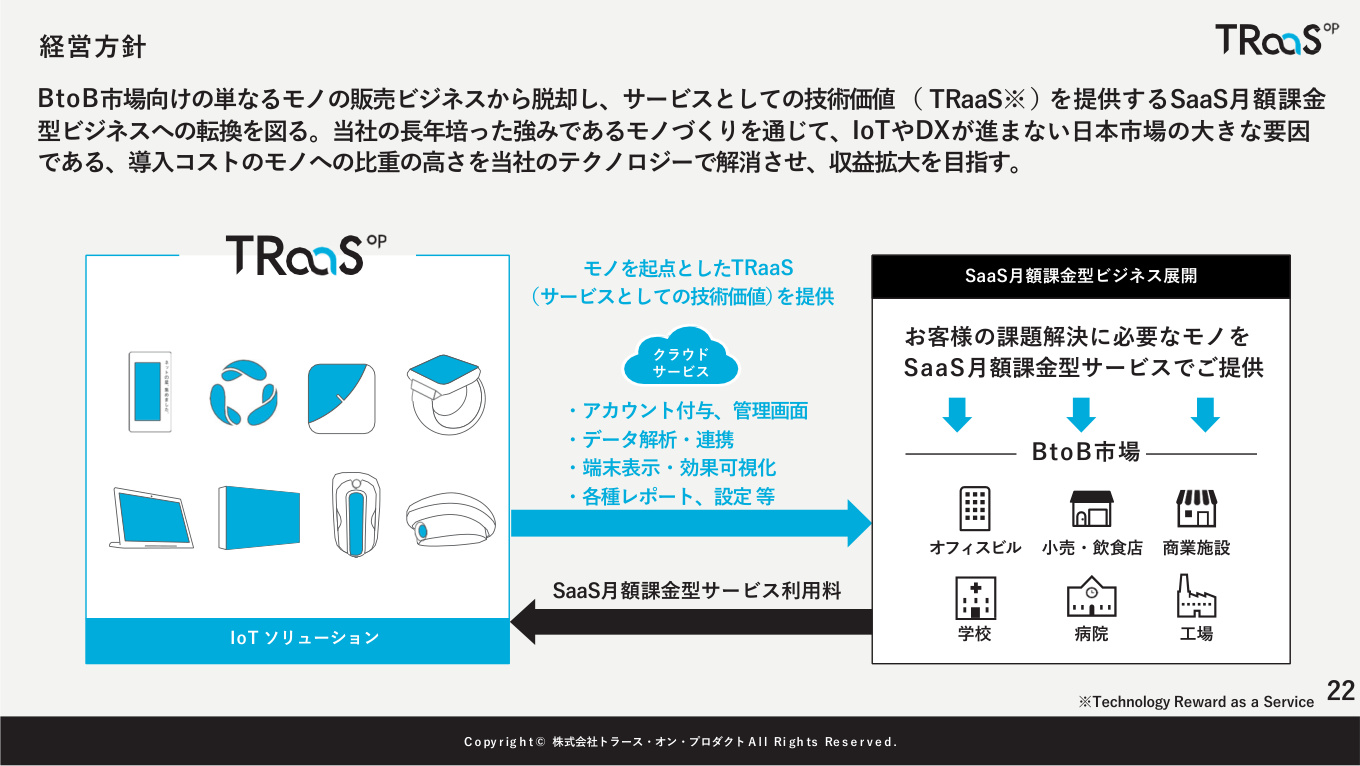
Essence of Management Policy
The company is aggressively pushing for a transition from a traditional "one-off hardware sales business" to "TRaaS (Technology Reward as a Service = SaaS monthly subscription model)," which provides cloud services centered on devices.
- Evolution of AIrux8 (AI Power Cost Reduction System) : By automatically controlling air conditioning and lighting through nodes such as motion sensors, the system achieves up to 50.9% reduction in air conditioning power. It is evolving from simple energy saving to a "comprehensive building control DX solution," shifting the decision-maker from general affairs to the IT department.
- Building an OMO Network for Retail and Dining : Evolving Axt East Japan's calling chime network into a "Multi-Network GATEWAY" to provide a platform that centrally manages data from QR ordering, AI voice ordering, and delivery robots.
7. Conclusion
TRaaS on Product's Q2 FY2027 was a period of temporary earnings adjustment due to the completion of large-scale projects from the previous year. However, it also marked steady progress in improving gross profit margins (49.2%), realizing M&A synergies, and transitioning to a SaaS-based recurring revenue model. The expansion of actual "Alrux" orders, the completion of STB deliveries for hotels and restaurants, and the OEM rollout of spherical signage in the second half are the most critical factors for achieving the full-year profitability target (3 million JPY in operating profit).
個別の投資に関する推奨やアドバイスを提供することを意図しておりません。ここで述べられている意見や見解は、あくまでも各記事の個人的見解です。