

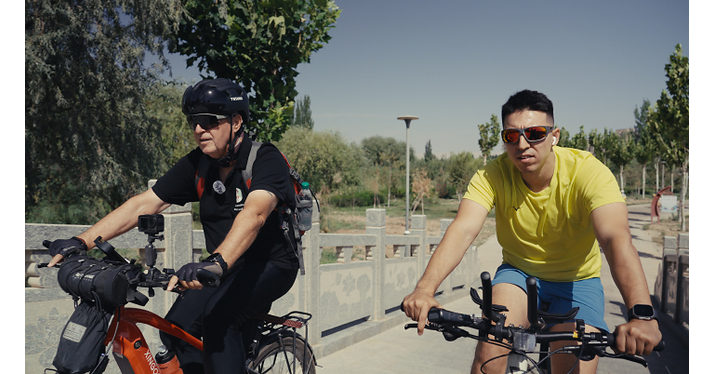
Xinjiang Today: A Bike's-Eye View
PRNewsWire
公開日時: Sep 11, 2026, 06:26 AM
Sentiment Analysis
Jerry Grey, a British-born Australian national, has lived in Zhongshan, Guangdong Province, for over two decades. A former police officer in London, the United Kingdom, and a retired educator in China, Grey is a cycling enthusiast and an active commentator on X (@Jerry_grey2002) with over 95,000 followers.
Having cycled extensively across China, he has visited Xinjiang multiple times, developing a nuanced understanding of the region's rapid development and local realities.
On his latest expedition, Grey embarked on a long-distance cycling journey across the country alongside his Chinese wife and two companions. During a stopover in Kashi (Kashgar), he spoke with Xinjiang Today reporter Frieda Li to share his firsthand observations on poverty alleviation, public safety and cultural preservation in the region.
Edited excerpts from the interview follow:
Xinjiang Today: Could you briefly introduce your route?
Jerry Grey: We traveled from Zhongshan to Hohhot in Inner Mongolia Autonomous Region by green trains [with relatively low speed] in May to begin this cycling journey. Our route took us across Qinghai Province, located on the Qinghai-Xizang Plateau—the world's highest and largest plateau, often referred to as the "Roof of the World." Much of the route was above 4,000 meters, where the thin air and lack of oxygen made riding especially challenging.
From there, we crossed vast stretches of barren desert that looked almost Martian. It was an unforgiving landscape, with hundreds of kilometers where virtually no one lives. One section, about 900 km of true no man's land, was simply too dangerous to cycle, so we transported our bikes by vehicle before continuing.
We then descended from the Qinghai-Xizang Plateau into Milan in Ruoqiang County, which is our first stop in Xinjiang. From there, we rode west through Kuerle (Korla), Kuche (Kucha or Kuqa) and Aksu before finally reaching Kashi along the northern edge of the Tarim Basin.
For me, there were two particularly difficult stages. The first was crossing the mountain passes west of Xining on the Qinghai-Xizang Plateau, where we climbed to nearly 4,000 meters. The second was the desert stretch between Aksu and Kashi, where almost nothing grows.
There was never a moment when I wanted to give up or end the journey. But there were certainly many days when I found myself thinking, "I just wish today were over." I would look forward to reaching a hotel, taking a shower, enjoying a cold drink and getting some rest. Then I'd remind myself that tomorrow would be another day.
You've been to Kashi several times. What differences have you noticed?
This is my third trip to Kashi. Although my first visit here was only about 14 or 15 months ago, my first trip to Xinjiang was back in 2005. The changes since then have been remarkable, and the most striking one, in my view, is poverty alleviation.
I first came to Xinjiang with my father. We visited Hami, Tulufan (Turpan) and Urumqi, and what I saw at the time was genuine poverty. It was the first time in my life I'd ever seen camels walking through a city center. The city's Grand Bazaar was also very different then. It felt much more like a traditional Turkish-style street bazaar than the modern complex that stands today. Personally, I preferred the character of the old market. But from the perspective of the people who live and work there, today's bazaar offers far better conditions.
People often say that China has torn down its old towns—that Kashi's ancient city or Beijing's narrow alleyways (hutongs) have disappeared. That's simply not true. Much of the historic architecture has been preserved, while other parts have been rebuilt to improve living conditions. Kashi is in an earthquake-prone region. Many of the old homes were built from mud and straw and were highly vulnerab...
Source: PRNewsWire
個別の投資に関する推奨やアドバイスを提供することを意図しておりません。ここで述べられている意見や見解は、あくまでも各記事の個人的見解です。