


Liberaware FY2026 Full-Year Financial Results: Accelerating Strategic Investment and Expanding Business Foundation; Poised for a Leap Forward with the Launch of the Domestic Drone Platform 'HINOTATE'

StockClub
公開日時: Sep 14, 2026, 09:53 AM
Sentiment Analysis

1. FY2026 Financial Highlights and Overview
For the fiscal year ended July 2026, Liberaware Co., Ltd. reported net sales of ¥1,595 million (+13.4% YoY) , gross profit of ¥676 million (+1.0% YoY, gross margin of 42.4%) , recurring loss of ¥807 million (compared to a profit of ¥46 million in the previous year; adjusted recurring loss of ¥603 million), and a net loss of ¥811 million .
Prioritizing long-term corporate value over short-term profit maximization, the company aggressively invested in R&D, human capital, and business infrastructure, resulting in wider losses at each profit level. However, the recurring loss includes a ¥168 million timing mismatch between SBIR (Small Business Innovation Research) R&D expenditures (¥1,706 million) and received subsidies (¥1,538 million), as well as ¥36 million in stock-based compensation expenses. On an operational basis, the adjusted recurring loss stands at ¥603 million.
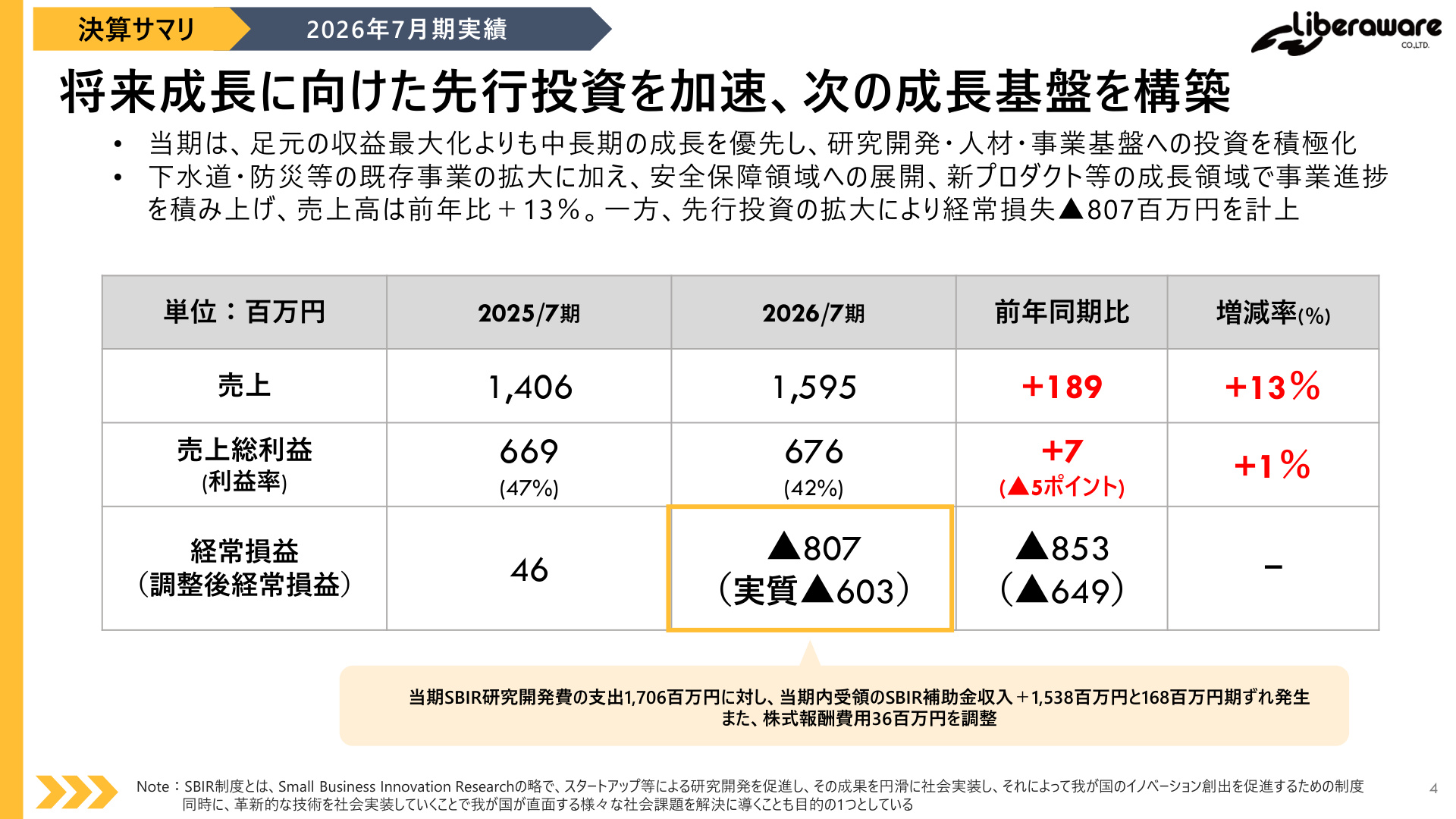
Analysis of Performance Factors
As shown in the summary slide above, while the company achieved revenue growth, it remains clearly in a phase of strategic investment.
- Revenue Growth Drivers : Growth was driven by sales of the "IBIS" series of drones for confined space inspection (+¥43 million YoY), rental services (+¥31 million), the digital twin business (+¥89 million), and solution development (+¥26 million).
- Factors for Margin Compression : The gross profit margin declined by 5.2 percentage points from 47.6% to 42.4%. This was due to complimentary surveys and small-scale projects associated with promoting standardization in the sewage sector, as well as temporary, lower-margin large-scale projects in the digital twin business. These are considered strategic, temporary factors for market expansion rather than a structural decline in profitability.
- Increase in SG&A and R&D Expenses : The number of employees increased significantly from 107 at the end of the previous fiscal year to 155 (including 77 engineers, approximately 50% of the workforce) , leading to higher personnel and recruitment costs. Additionally, investments in next-generation aircraft development and the new "Torinosu" product also contributed to the increase.
2. Revenue Structure: Dual Growth in Hardware Sales and Recurring Revenue
Liberaware’s business model is characterized by a hybrid structure of high-value-added hardware sales and stable, recurring revenue streams.
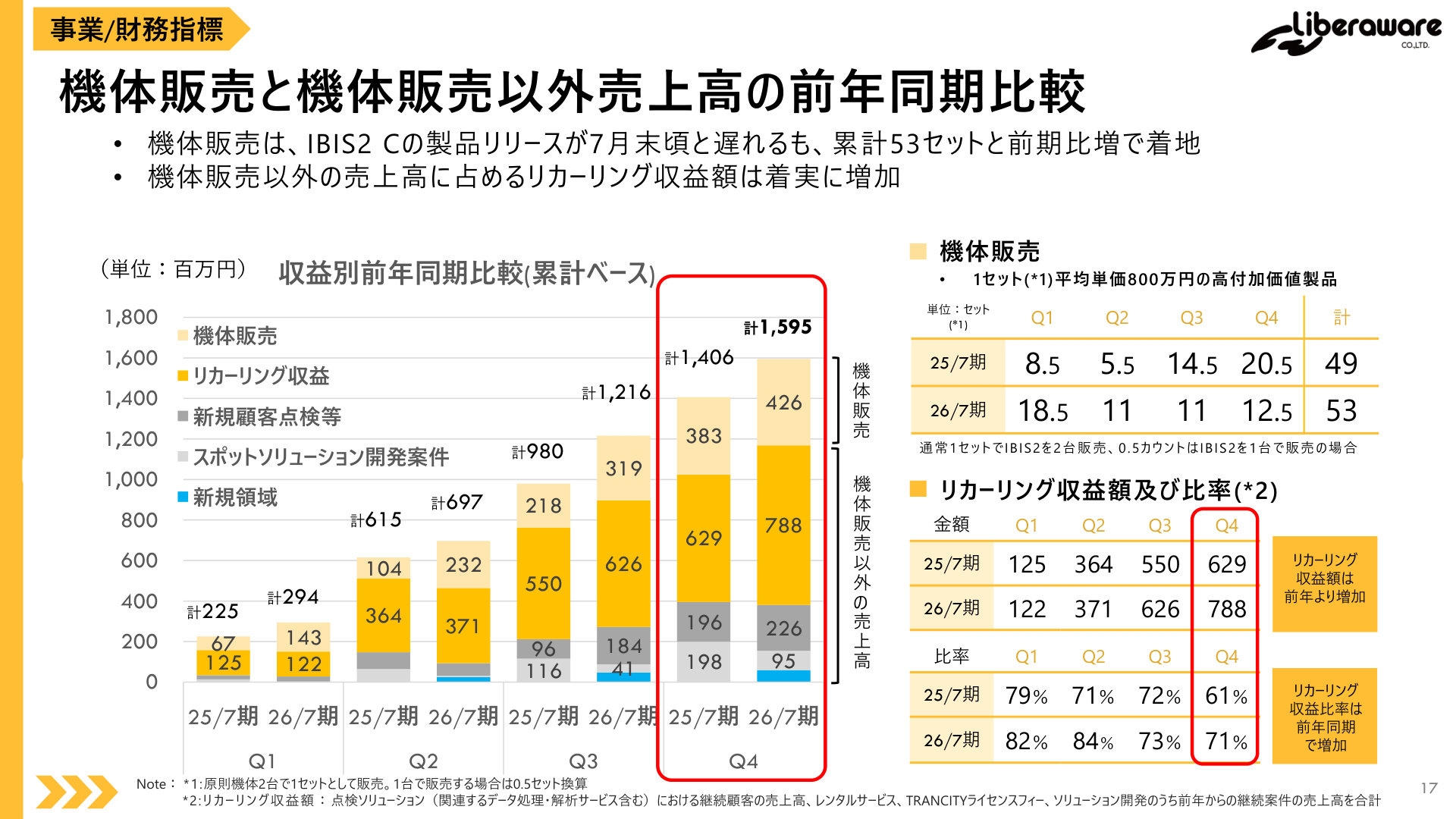
Progress in Hardware Sales and Recurring Revenue
As shown in Slide 17, a qualitative shift in the revenue mix is underway.
- Hardware Sales Performance : Total annual unit sales reached 53 sets (up from 49 in the previous year) . Despite the release of the new "IBIS2 C" model being delayed until late July, the company continues to capture steady demand for its high-value-added products (average unit price of approximately ¥8 million).
- Expansion of Recurring Revenue : Recurring revenue as a percentage of non-hardware sales has grown each quarter, reaching ¥788 million in Q4 alone, accounting for 71% of revenue (compared to ¥629 million and 61% in the same period last year).
- KPI Trends :
- Percentage of revenue from repeat customers (Inspection/Data Processing) : 69% (maintaining a high retention rate).
- Rental sets : 35 sets.
- TRANCITY (3D city model/point cloud platform) accounts : 152 accounts (up from 148 in the previous year).
- Ongoing solution development projects : 7 projects (shifting toward larger-scale engagements).
The total number of client companies has reached 450 , with a track record of doing business with approximately 60% of major corporations (top 10 by revenue) in key industries such as steel, power, gas, construction, roads, petrochemicals, and plant engineering.
3. The "Domestic Drone Platform" Strategy: Capturing National Policy and Economic Security
The small unmanned aerial vehicle (UAV) industry is currently undergoing a major shift toward "de-Sinicization" and "domestic production" due to changes in the security environment and supply chain risks. Small UAVs are a priority area in the government's "17 Strategic Fields," a massive market expected to generate approximately ¥4 trillion in public-private investment and ¥117.7 trillion in economic ripple effects .
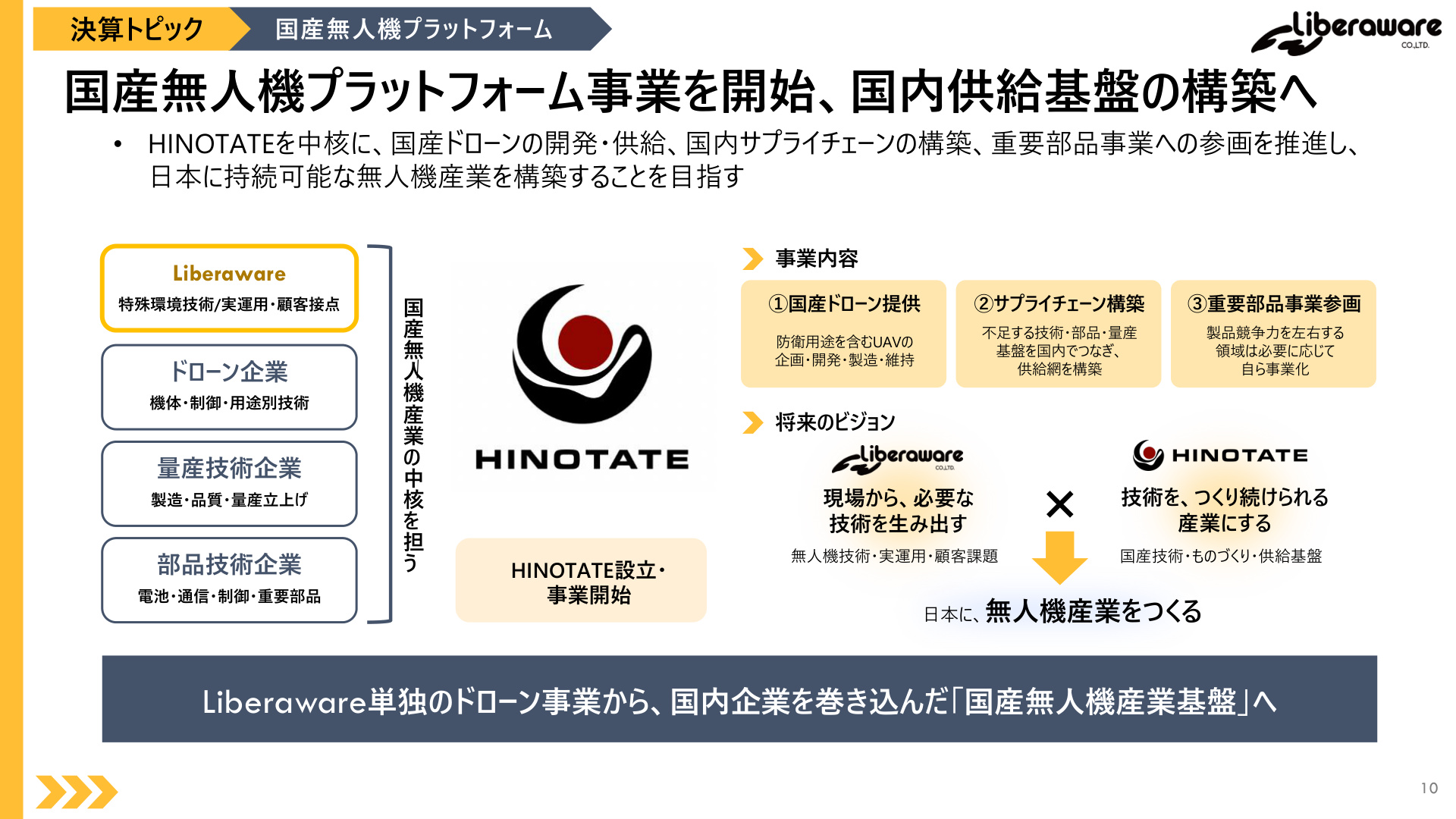
Significance of the Subsidiary "HINOTATE" and Ecosystem Building
The domestic drone platform business, outlined in Slide 10, is the core strategy driving future non-linear growth.
- Role of HINOTATE (Established August 2026) : It functions not only as a drone supplier but as a central organization coordinating drone developers, mass production firms, and component technology companies (batteries, communications, control systems).
- Three Pillars of the Business :
- Domestic Drone Supply : Planning, development, manufacturing, and maintenance of UAVs, including defense applications.
- Supply Chain Construction : Integrating domestic technical capabilities and mass production infrastructure to build a robust supply network.
- Participation in Critical Component Business : Accelerating efforts to secure core components, such as the business alliance (September 2026) with the Korean subsidiary of Canadian-listed "NEO BATTERY MATERIAL."
- Synergy Effects : By fusing Liberaware’s "specialized environment technology, operational expertise, and customer touchpoints" with HINOTATE’s "domestic technology, manufacturing, and supply base," the company aims to establish a sustainable domestic drone industry.
4. Progress and Growth Strategy by Business Segment
① Infrastructure Maintenance and the "No Entry" Sewage Initiative
Legislation is advancing to mandate inspection methods that prevent human entry into dangerous sewer pipes.
- Policy Alignment : The amendment to the Sewerage Act was promulgated on July 23, 2026, with the Ministry of Land, Infrastructure, Transport and Tourism (MLIT) establishing a basic policy for "No Entry" inspections.
- New Aircraft Deployment : Market launch of the "IBIS2 C" , a "No Entry" drone that eliminates the need for human entry. It streamlines the entire workflow from distance and damage measurement to report generation, aiming to establish a de facto standard.
② Disaster Relief and Government Collaboration
- Response to the 2026 Kumamoto Earthquake : Arrived on-site 18 hours after the disaster, collaborating immediately with the Self-Defense Forces, fire departments, and JUIDA-D³ to search for survivors inside collapsed facilities. This demonstrated an evolution in operations from the Noto Peninsula Earthquake (initial response of ~5 days), showcasing strong social implementation capabilities and a nationwide network.
③ New Products and SBIR Progress
- Railway Inspection Drone : Design complete; transitioning to the mass-production prototype development phase for a planned launch in April 2028.
- Autonomous Patrol Camera "Torinosu" : Conducted 4 PoCs with major infrastructure companies. Sales efforts are being strengthened for mass production and revenue contribution in FY2027.
- Infrastructure Data/AI Business : Launched a construction progress management support service using the proprietary "LAPIS" platform and signed a business alliance with ugo, a developer of domestic AI robots.
④ Global Market Expansion
- Asia : Conducted business matching in Thailand via JICA Biz to validate key customers and local partners. Accelerated market formation in South Korea through PoCs.
- Europe : Initiated discussions with overseas nuclear and power operators at trade shows, validating the application of IBIS for inspecting energy infrastructure where human entry is difficult.
5. FY2027 Earnings Forecast and Outlook
The consolidated earnings forecast for the fiscal year ending July 2027 is as follows:
| Metric (¥ millions) | FY2026 Actual | FY2027 Forecast | YoY Change | Growth Rate |
|---|---|---|---|---|
| Net Sales | 1,595 | 2,300 | +705 | +44.2% |
| Gross Profit | 676 | 1,150 | +474 | +70.1% |
| (Gross Margin) | 42.4% | 50.0% | +7.6pt | - |
| Recurring Profit/Loss | ▲807 | ▲1,106 | ▲299 | - |
| (Adjusted Recurring P/L) | ▲603 | ▲698 | ▲95 | - |
Key Points of the Outlook
- Significant Top-Line Growth (+44%) : Building on the foundation established in FY2026, the company expects growth from existing sewage and disaster prevention businesses, alongside contributions from the mass production of the "IBIS2 C" and "Torinosu." Note: Revenue projections for the domestic drone platform business (HINOTATE) are not conservatively included in this forecast , leaving room for potential upside.
- Improvement in Gross Margin to 50% : Profit margins are expected to recover to the 50% level due to an increase in high-margin drone sales and the completion of temporary, low-margin projects.
- Continued Strategic Investment and Financial Health : Capturing the shift from "demonstration" to "full-scale adoption and domestic production," the company will continue aggressive investments, including R&D and HINOTATE-related expenses (¥150 million). With ¥832 million in cash and deposits, an unused credit line of ¥300 million, and ¥270 million in outstanding SBIR settlements, the company maintains the liquidity to support growth investments.
As the drone and infrastructure inspection market moves from the demonstration phase to full-scale adoption, Liberaware is leveraging its technical prowess, alignment with national policy, and platform strategy to drive business expansion.
個別の投資に関する推奨やアドバイスを提供することを意図しておりません。ここで述べられている意見や見解は、あくまでも各記事の個人的見解です。