

![[Manabi Aid Q1 FY2027 Earnings Analysis] 34.3% Revenue Growth and Significant Profitability Improvement; Recurring Revenue Ratio Surges to 85% with Steady Progress Toward Second-Half Profitability](https://news-images.stock-club.net/market_news/images/184A/140120260914535814/slide_eyecatch_en_4c7eef99.webp)
[Manabi Aid Q1 FY2027 Earnings Analysis] 34.3% Revenue Growth and Significant Profitability Improvement; Recurring Revenue Ratio Surges to 85% with Steady Progress Toward Second-Half Profitability

StockClub
公開日時: Sep 14, 2026, 09:52 AM
Sentiment Analysis

Manabi Aid Co., Ltd. (TSE Growth: 184A) reported its financial results for the first quarter of the fiscal year ending April 2027 (May–July 2026), achieving a 34.3% year-on-year increase in revenue to 76 million yen and a 33 million yen improvement in operating profit/loss to a loss of 44 million yen . These results demonstrate significant top-line growth and a substantial narrowing of losses, tracking in line with the company's full-year guidance of 708 million yen in revenue and 105 million yen in operating profit (targeting a return to profitability).
This report provides a comprehensive analysis of the Q1 performance, the transformation of the revenue structure, progress against full-year targets, and the advancement of growth strategies centered on strategic alliances, based on official disclosures.
1. Q1 Earnings Highlights: Revenue Growth and Qualitative Shift in Revenue Structure
A notable achievement in the first quarter was the expansion of revenue, which drove the recurring revenue ratio to 85.0% (+15.8 percentage points from the end of the previous fiscal year) .
◆ Significance and Explanation of the Slide
The slide above highlights key financial indicators and shifts in the business structure for Q1. While the progress rate against the full-year revenue target (708 million yen) stands at 10.7% , the company’s internally calculated full-year revenue accumulation rate has reached 98.0% , confirming that progress is aligned with initial plans.
- Revenue : 76 million yen ( +34.3% YoY)
- Operating Profit/Loss : -44 million yen ( 33 million yen improvement YoY)
- Full-Year Revenue Progress Rate : 10.7% (Full-year accumulation rate: 98.0% )
- Recurring Revenue Ratio : 85.0% ( +15.8pt from previous fiscal year-end, exceeding the full-year target of 83.4%)
This performance is underpinned by the continued adoption of "Manabi Aid Master" by major cram schools, alongside steady accumulation of recurring revenue from system development and maintenance services.
2. Improvement in Profit Structure and Cost Optimization
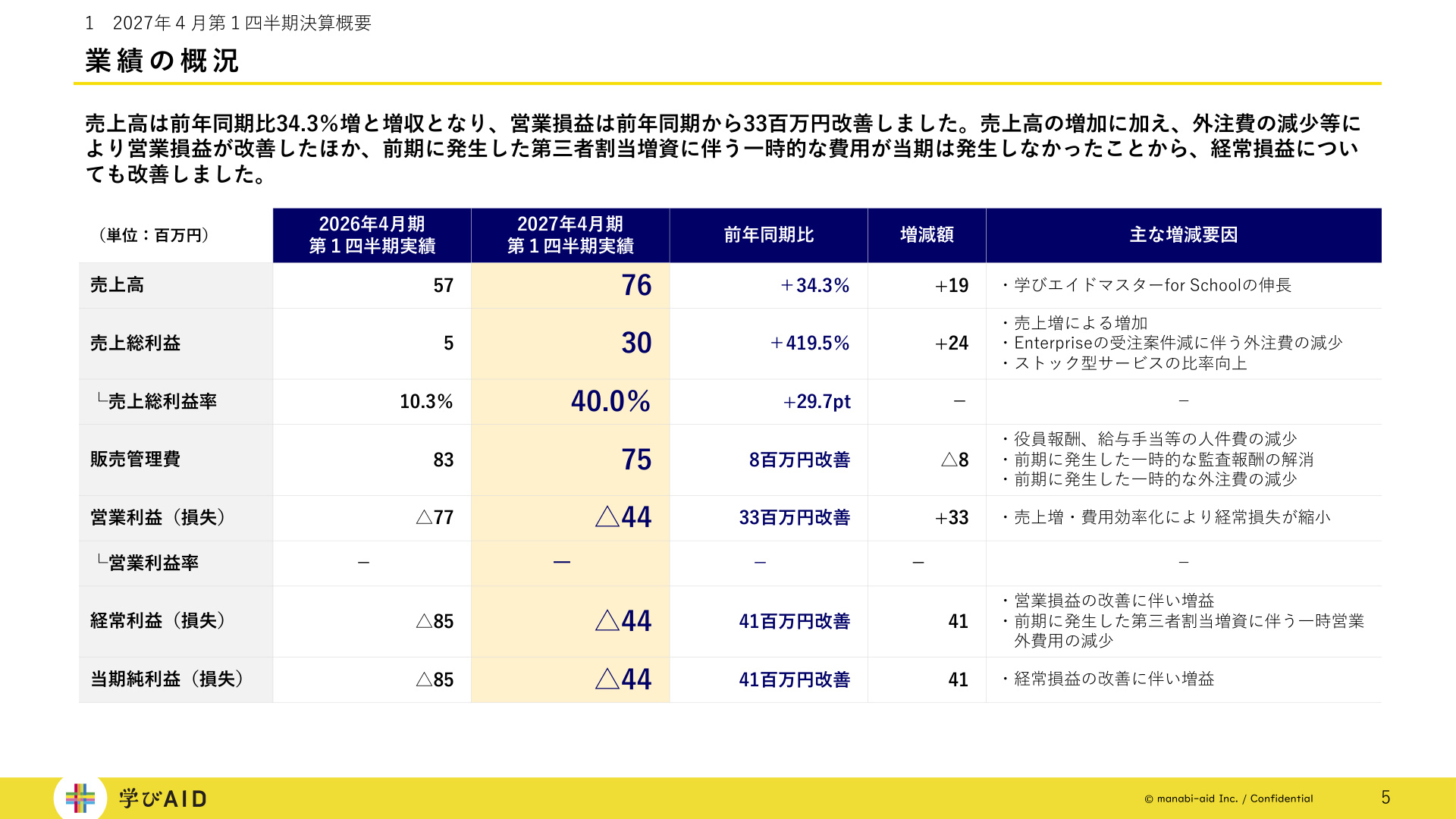
A breakdown of the income statement reveals not only top-line growth but also a dramatic improvement in the gross profit margin (from 10.3% to 40.0%) .
| Item (Millions of JPY) | Q1 FY2026 | Q1 FY2027 | YoY Change | Variance | Primary Factors |
|---|---|---|---|---|---|
| Revenue | 57 | 76 | +34.3% | +19 | Significant growth in "Manabi Aid Master for School" |
| Gross Profit | 5 | 30 | +419.5% | +24 | +29.7pt margin improvement (lower outsourcing costs, higher recurring ratio) |
| SG&A Expenses | 83 | 75 | -9.6% | -8 | Reduced executive/staff compensation, elimination of one-time costs |
| Operating Profit (Loss) | -77 | -44 | Improvement | +33 | Loss reduction via revenue growth and cost efficiency |
| Ordinary Profit (Loss) | -85 | -44 | Improvement | +41 | Elimination of one-time costs from previous year's third-party allotment |
| Quarterly Net Profit (Loss) | -85 | -44 | Improvement | +41 | Linked to improvement in ordinary profit/loss |
Cost of sales was reduced from 51 million yen in the same period last year to 46 million yen , due to a decrease in outsourcing costs following the completion of certain Enterprise projects. SG&A expenses were contained at 75 million yen (down 8 million yen YoY) ; while the company invested in advertising and promotion (from 5 million to 8 million yen) to drive usage, this was offset by the optimization of personnel costs and the absence of one-time expenses related to the previous year's listing and capital increase.
3. Revenue Trends by Service: "for School" Drives Growth
Specific large-scale collaborative projects significantly boosted performance across service segments.
- Manabi Aid Master for School : 49.6 million yen (vs. 16.7 million yen in Q1 FY2026, +32 million yen )
- Driven by expanded adoption at " ITTO Individual Tutoring Academy " (NOVA Holdings group) and new acquisitions of mid-sized regional cram schools.
- Manabi Aid Master : 16 million yen (vs. 19.3 million yen in Q1 FY2026, -3 million yen)
- Impacted by a slight churn in existing schools and sluggish new corporate acquisitions.
- Manabi Aid for Enterprise : 7.8 million yen (vs. 19.2 million yen in Q1 FY2026, -11.4 million yen)
- Despite progress in upselling to existing clients, revenue declined YoY due to the timing of acceptance inspections for commissioned production projects.
- Other (Directly Managed Schools, etc.) : 3.3 million yen (vs. 1.9 million yen in Q1 FY2026, +1.4 million yen)
4. Full-Year Forecast and Expansion Scenario from Q2 Onward
The company maintains its full-year forecast for FY2027 of 708 million yen in revenue and 105 million yen in operating profit . While the Q1 revenue progress rate is 10.7%, the company’s revenue structure is planned to scale rapidly from Q2 onward .

◆ Significance and Explanation of the Slide
The slide above is a critical document visualizing the projected revenue growth from Q1 through Q4 and the drivers supporting it.
The sharp rise in revenue from Q2 is backed by the following clear business developments:
- Full-scale launch of cram school management outsourcing (from Q2) : Commissioned operations began in August, adding stable monthly revenue.
- Contribution from new system development (from Q2) : Development projects, such as school management systems, will begin contributing to earnings.
- Internal deployment and external sales verification of new systems (Q3–Q4) : Following operational testing with alliance partners, the company will begin verifying external sales to the broader education industry.
By fully leveraging the initiatives seeded in Q1, the company aims to achieve quarterly operating profitability and meet its full-year targets .
5. Progress in Growth Strategy and Concrete Results from Collaboration
The company’s five priority strategies (Restoring Trust and Strengthening Governance, Redefining Core Services and Expanding Customer Base, Transforming Revenue Models, Scaling via Alliances, and Enhancing On-site Capabilities) are progressing largely as planned. In particular, the alliance strategy is beginning to yield concrete results by leveraging existing resources.

◆ Significance and Explanation of the Slide
The slide above shows the application results for " Sama-Sta 2026 " (an online course event during summer vacation), realized through collaboration with alliance partners.
- Total number of course applications surged approximately 30-fold year-on-year
- Success factors:
- Expanded target audience from high school students to include junior high school students .
- Added junior high school science and social studies courses to the traditional English and math offerings.
- Planned and executed during a period when cram schools find it easier to propose and sell to parents and students .
By designing products tailored to the sales and instruction cycles of partner schools, rather than simply providing video content, the company is establishing a model that exponentially increases the number of participating students.
6. Manabi Aid’s Business Foundation and Mid-to-Long-Term Competitiveness
The company’s mid-to-long-term strengths are summarized in the following three points:
- Overwhelming Content Assets : A network of over 130 expert instructors and a library of over 100,000 video lessons .
- Individually Optimized Micro-Lectures : 5-minute short-form videos eliminate wasted time on board-writing, reducing study time by 1/3 to 1/2 and maximizing time performance.
- Production and Rights Expertise : Comprehensive in-house systems for curriculum compliance, copyright management, and educational review.
Leveraging these assets, the company is expanding its value proposition from "Manabi Aid Master" for small schools to customized development and operational support for mid-to-large schools, and even full-scale cram school management outsourcing.
7. Summary and Future Outlook
Q1 FY2027 was a quarter where improvements in the profit structure were clearly reflected in the numbers , evidenced by a 34.3% YoY revenue increase, the halving of operating losses, and an increase in the recurring revenue ratio to 85.0%.
Key points to watch moving forward include:
- The earnings contribution from cram school management outsourcing and new system development (the probability of turning profitable in Q2).
- Deepening collaboration with major partners like NOVA Holdings and progress in horizontal expansion to mid-sized regional schools.
- Progress on PoC (Proof of Concept) for the external sale of the school management system currently under development.
As the plan incorporates a sharp acceleration in performance toward the second half, the speed of revenue progress and profit generation from Q2 onward will remain critical indicators.
個別の投資に関する推奨やアドバイスを提供することを意図しておりません。ここで述べられている意見や見解は、あくまでも各記事の個人的見解です。