


NISSO FY2026 Earnings Deep Dive: Revenue Growth Offset by M&A Costs and Goodwill Impairment; Strategic Shift to Large-Scale Renovation Projects and Group Restructuring Set the Stage for a Turnaround

StockClub
公開日時: Sep 14, 2026, 09:51 AM
Sentiment Analysis
1. FY2026 Earnings Summary: Revenue Growth Maintained, but Upfront Investments and Goodwill Impairment Lead to Operating Loss
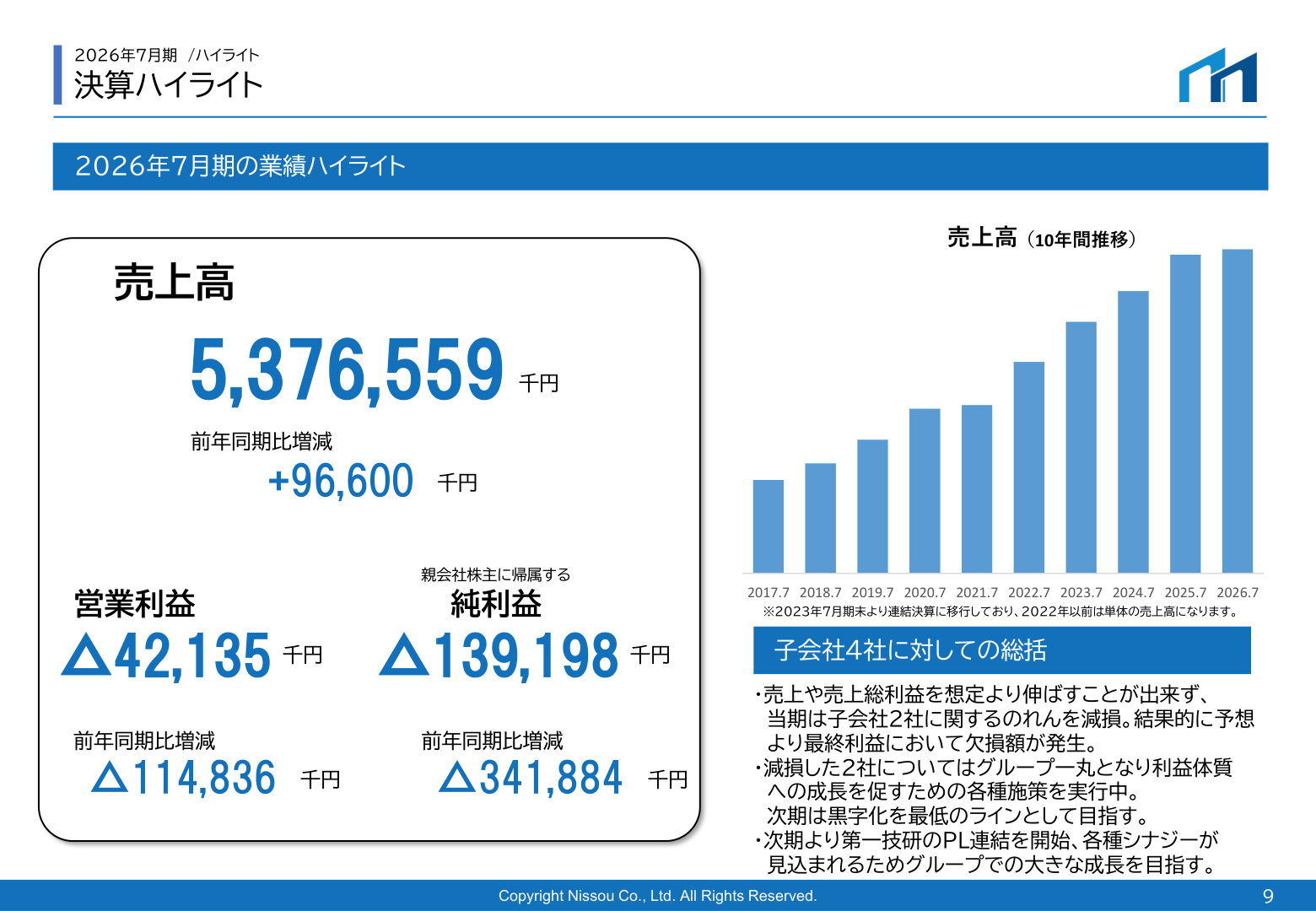
For the fiscal year ended July 2026, NISSO Corporation reported consolidated net sales of 5.376 billion JPY (+1.8% YoY) , maintaining a growth trend. However, the company recorded an operating loss of 42.13 million JPY (compared to an operating profit of 72.70 million JPY in the previous fiscal year) and a net loss attributable to owners of the parent of 139.19 million JPY (compared to a net profit of 202.68 million JPY in the previous year).
Key Highlights and Background
As shown in the highlight slide above, net sales have maintained an upward trajectory over the past decade, reaching a record high this fiscal year. However, profitability saw a significant decline. This downturn and the resulting net loss are primarily attributed to the following three factors:
- Increase in SG&A Expenses due to Upfront Investments : Higher personnel costs associated with an increase in headcount (770 million JPY, up YoY) and aggressive spending on TV commercials and advertising to drive order growth (78.21 million JPY).
- One-time M&A-related Expenses : Acquisition costs for Daiichi Giken Co., Ltd. (32.18 million JPY) , which became a subsidiary in May 2026, were recorded as SG&A expenses in Q4. As the subsidiary's earnings will only be consolidated starting from the next fiscal year (FY2027), this period bore the upfront costs.
- Goodwill Impairment for Two Subsidiaries : Due to two consolidated subsidiaries underperforming against their sales and profit targets, the company took a conservative accounting approach by recording goodwill impairment as an extraordinary loss, further deepening the net loss.
2. Segment Performance Analysis: Renovation Drives Sales, While Real Estate Distribution and Construction Face Profitability Challenges
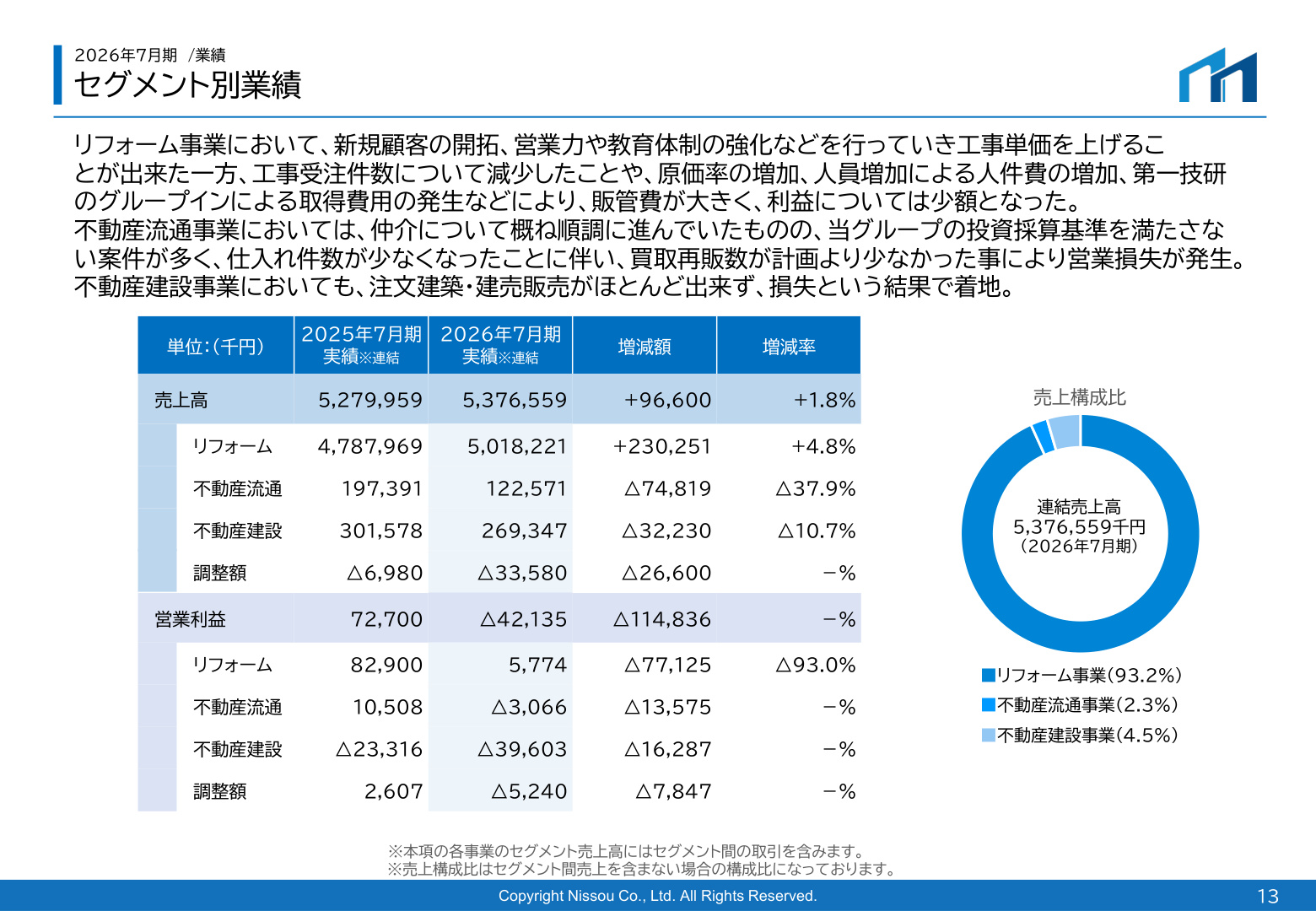
NISSO Group’s business portfolio consists of three segments: the core Renovation business, Real Estate Distribution, and Real Estate Construction. While the Renovation business, which accounts for over 90% of sales, supported revenue growth, profitability challenges emerged across all segments.
Segment Details
-
Renovation Business (93.2% of total sales)
- Net Sales: 5.018 billion JPY (+4.8% YoY)
- Segment Profit: 5.77 million JPY (-93.0% YoY)
- Sales grew due to an increase in new customer acquisition and high-value projects such as renovations. However, segment profit shrank significantly due to rising cost-of-sales ratios, increased fixed costs from personnel expansion, and costs related to the Daiichi Giken acquisition.
-
Real Estate Distribution Business (2.3% of total sales)
- Net Sales: 122.57 million JPY (-37.9% YoY)
- Segment Loss: 3.06 million JPY (vs. 10.50 million JPY profit in the previous year)
- Brokerage operations performed well, with the number of closed deals rising to 17 (+21.4% YoY) and sales reaching 25.95 million JPY (+54.2% YoY). However, as the group strictly selected purchase properties to meet investment profitability criteria, the number of buy-and-resell transactions fell short of the plan (4 units, 96.61 million JPY in sales, -46.5% YoY), resulting in an overall decline in revenue and an operating loss.
-
Real Estate Construction Business (4.5% of total sales)
- Net Sales: 269.34 million JPY (-10.7% YoY)
- Segment Loss: 39.60 million JPY (vs. 23.31 million JPY loss in the previous year)
- Sales of custom-built and spec homes were impacted by market conditions and intensified competition, causing orders to fall short of plans and widening the loss. This necessitated goodwill impairment related to the subsidiary Heisei Housing and others.
3. Key KPI Trends and Structural Changes: Higher Unit Prices and Expanded Customer Base
To better understand the performance trends of the current fiscal year, it is necessary to examine the key performance indicators (KPIs) of each business.
Renovation Business KPI Trends: Trade-off Between Volume and Unit Price
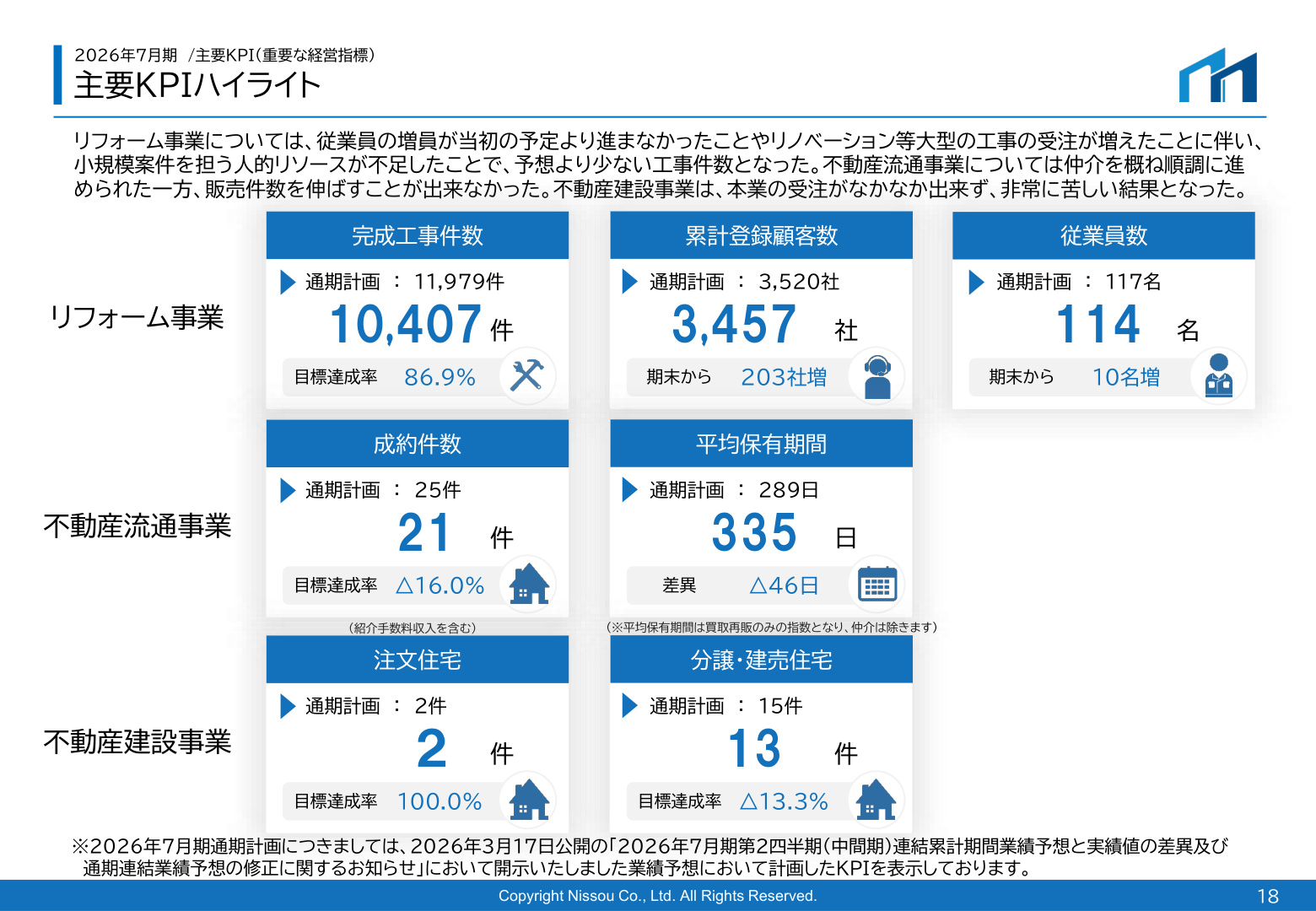
- Completed Projects : Against a full-year target of 11,979, the company achieved 10,407 projects (86.9% achievement rate) . Quarterly trends show Q4 was sluggish at 2,412 projects (-13.7% YoY). This was because human resources were concentrated on large-scale renovation projects, limiting the capacity to handle smaller restoration work .
- Shift in Project Mix : While the traditional core of "restoration work" accounted for 40.0% of sales, "renovation work" rose to 40.9% , shifting the structure to one where renovations represent the largest revenue component. An increase in average order value was confirmed across all project types.
- Cumulative Registered Customers : The base expanded by 203 companies from the end of the previous fiscal year to 3,457 companies , steadily growing through advertising efforts like TV commercials.
- Personnel Structure : The number of group employees increased to 114 at the end of the period (+10 YoY) , with 90.3% of the total workforce assigned to the Renovation business.
Real Estate Distribution and Construction KPI Trends
- Real Estate Distribution : Total closed deals reached 21 (target 25), with an average holding period of 335 days (longer than the planned 289 days) , reflecting the strict selection of properties and longer sales cycles.
- Real Estate Construction : Custom home sales met the target of 2 units, but spec home sales reached only 13 units (target 15). Moving forward, the company is launching a new brand, " 9900000 JPY House ," to capture demand in the low-price segment.
4. Financial Position, Cost Structure, and Cash Flow
- Asset and Capital Soundness : As of the end of July 2026, total assets were 3.371 billion JPY (-86.13 million JPY YoY), and net assets were 1.574 billion JPY (-128.98 million JPY YoY). The equity ratio remains at 46.7% (49.3% at the end of the previous year), maintaining financial health.
- Cash Flow Trends : Operating cash flow resulted in a net outflow of 296.82 million JPY , due to pre-tax losses and tax payments. Investing cash flow also saw an outflow of 244.01 million JPY due to M&A activities, leaving a year-end cash and cash equivalents balance of 1.436 billion JPY .
- Cost Structure Characteristics : The cost-of-sales ratio was 75.7% (75.1% in the previous year), and the SG&A ratio was 25.1% (23.5% in the previous year). Personnel costs (770 million JPY) and other expenses (479 million JPY) account for the majority of SG&A, indicating an upfront investment phase for future organizational expansion.
5. Mid-to-Long-Term Growth Strategy and Outlook
By executing impairment charges this fiscal year, NISSO has cleared accounting risks associated with past acquisitions and is laying the groundwork for a turnaround in the coming periods.
- Synergies from Daiichi Giken : Daiichi Giken, acquired in May 2026, specializes in large-scale repair work for condominiums and buildings in the Tokyo metropolitan area. With the consolidation of its P&L starting next term, the group will enter the growing "condominium longevity and regeneration market," which is expected to contribute to overall sales and profit growth.
- Profitability Improvement of Existing Subsidiaries : For the two subsidiaries that underwent goodwill impairment, the group is strengthening cost reviews and sales collaboration, setting a return to profitability as the minimum target for the next fiscal year.
- Foothold in Overseas Real Estate : Through an MOU with the OSK Group , a listed Malaysian company, NISSO is exploring global revenue opportunities, including sales of new condominiums in Melbourne and involvement in a 70-story mixed-use development project in Kuala Lumpur.
- Internal Controls and Organizational Strength : The company is enhancing compliance and internal controls with an eye toward a future listing on the Prime Market, while promoting technical knowledge transfer from veteran employees and developing next-generation leaders.
While the current fiscal year was a period of temporary adjustment due to aggressive upfront investment and impairment charges, the focus will now shift to the recovery of earnings and renewed growth, driven by higher unit prices in the core Renovation business, the contribution of Daiichi Giken, and progress in overseas strategies.
個別の投資に関する推奨やアドバイスを提供することを意図しておりません。ここで述べられている意見や見解は、あくまでも各記事の個人的見解です。